




Metallogenic Specificity and Prospecting Directions of Sandstone-Type Uranium Deposits in Uranium-Bearing Series in Arid Depositional Background
-
摘要: 最近十多年来,我国砂岩型铀矿勘查的目标层位由早期的灰黑色含铀岩系逐渐转变为红杂色含铀岩系.由于两者形成发育的沉积古气候悬殊,从而造成了含铀岩系还原能力的极大差异,并进而从“基因”上影响了区域层间氧化带的发育规模,直接制约对远景区和找矿靶区的预测.鉴于此,笔者结合多个沉积盆地系列干旱沉积背景含铀岩系的研究,在含铀岩系类型划分的基础上,以温暖潮湿沉积背景含铀岩系作为参照物,系统总结了红杂色含铀岩系的基本特征和铀成矿规律,并提出了关键科学问题和勘查预测建议.研究认为,沉积古气候通过与古环境的耦合直接影响含铀岩系的有机还原介质丰度,并进而制约铀成矿,因此有必要依据深时古气候和古环境将含铀岩系划分为灰黑色和红杂色两种极端类型.研究发现,两种极端类型的含铀岩系具有本质区别,红杂色含铀岩系在制约铀成矿方面具有两个重要特征:一是总体缺少有机还原介质,TOC、S全和FeO含量均较低;二是铀储层砂体的岩石地球化学类型更加复杂多样.由于缺少有机还原介质,铀储层中的无机还原介质充当了铀成矿的重要角色,它们在铀储层中的成因演化和分布规律均有章可循.另外,由沉积相变而形成的铀储层外部还原介质也可以弥补内部还原能力的不足,而且对区域层间氧化带和铀成矿的空间定位起到决定性作用——沉积相变优先控矿.红杂色含铀岩系的后生氧化蚀变看似“微弱”且不易识别,主要表现为条带状、斑点状和灰白色氧化,氧化带是后生氧化与原生氧化的叠加复合,其规模宏大,通常可以延伸至盆地腹地.红杂色含铀岩系隶属新类型含铀岩系,业界亟待探索无机还原介质成矿机理、建立无机还原介质评价的环境参数标准、总结原生与后生氧化作用的识别标志.在铀矿勘查预测中,不仅需要准确定位整装灰色还原地质体、正确识别“弱”氧化带,还要打破常规进入盆地腹地开展预测评价.Abstract: Over the past decades, the target strata for sandstone-type uranium exploration in China have gradually shifted from early grayish-black uranium-bearing series to reddish-variegated uranium-bearing series. Due to the significant differences in the sedimentary paleoclimates in which these two types formed and developed, there is a substantial variation in the reducing capacity of the uranium-bearing series, which in turn fundamentally affects the scale of regional interlayer oxidation zones, directly restricting the prediction of prospective areas and prospecting targets. In light of this, in this paper, based on the study of uranium-bearing series in arid depositional backgrounds across multiple sedimentary basins, and using uranium-bearing series with warm and humid depositional background as a reference, it systematically summarizes the basic characteristics and uranium mineralization patterns of reddish-variegated uranium-bearing series, and proposes key scientific issues and exploration prediction suggestions. The study suggests that sedimentary paleoclimate, through its coupling with the paleoenvironment, directly affects the abundance of organic reducing media in uranium-bearing series, thus restricting uranium mineralization. Therefore, it is necessary to classify uranium-bearing rock series into two extreme types: grayish-black and reddish-variegated, based on sedimentary paleoclimate and paleoenvironment. The two extreme types of uranium-bearing series are fundamentally different. The reddish-variegated uranium-bearing series has two important characteristics that restrict uranium mineralization: firstly, an overall lack of organic reducing media, with low contents of TOC, Stotal, and FeO; secondly, more complex and diverse lithogeochemical types of uranium reservoir sand bodies. Owing to the lack of organic reducing media, inorganic reducing media in uranium reservoirs play a significant role in uranium mineralization, and their genetic evolution and distribution patterns are well-documented. Furthermore, external reducing media formed by sedimentary facies changes can compensate for insufficient internal reducing capacity and play a decisive role in the spatial positioning of regional interlayer oxidation zones and uranium mineralization-sedimentary facies changes preferentially control mineralization. The epigenetic oxidation alteration of the reddish-variegated uranium-bearing series appears "weak", mainly manifested as banded, spotted, and grayish-white oxidation. Being large in scale, the oxidation zones are a superposition of secondary and primary oxidation, and often extend into the hinterland of the basin. The reddish-variegated uranium-bearing series belongs to a new type of uranium-bearing series, and there is an urgent need to explore the ore-controlling mechanism of inorganic reducing media, establish environmental parameter standards for evaluating inorganic reducing media, and summarize the identification marks of primary and epigenetic oxidation. In uranium exploration and prediction, it is not only necessary to accurately locate the integral gray reducing geological body and correctly identify the "weak" oxidation zone, but also to break with convention and enter the hinterland of the basin to carry out prediction and evaluation.
-
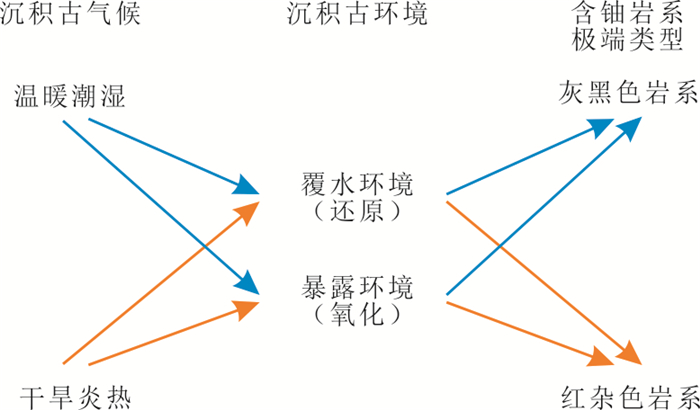
图 1 中国陆相沉积盆地含铀岩系分类及其沉积学关键要素
Fig. 1. Classification of uranium-bearing series and its key sedimentological elements in continental sedimentary basins in China
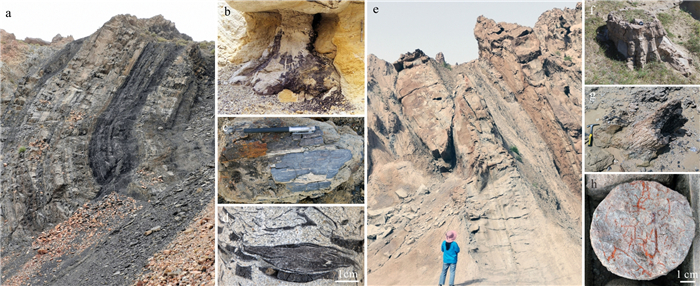
图 2 两类极端类型含铀岩系的宏观区别
a.灰黑色含铀岩系,中侏罗统克孜勒努尔组,富含煤层、有机质,强还原环境,库车库台克里克;b.碳化木植物根化石,中侏罗统直罗组下段下亚段,东胜黄天棉图;c.碳化植物茎秆化石,中侏罗统直罗组下段,东胜神山沟;d.碳质碎屑及其外围的黄铁矿,中侏罗统直罗组下段,磁窑堡‒惠安堡铀矿床;e.红杂色含铀岩系,上新统库车组,缺乏有机质,强氧化环境,拜城巴拉库艾肯(盐水沟);f.钙化木植物根化石,中侏罗统直罗组下段上亚段,东胜神山沟;g.膏化木植物茎秆化石,上新统阿图什组,塔里木盆地玛扎塔格;h.被氧化的铁质植物根化石,下白垩统环河组,ZKW2019-1(198.9 m),特拉敖包铀矿床
Fig. 2. Macroscopic differences between the two extreme types of uranium-bearing series
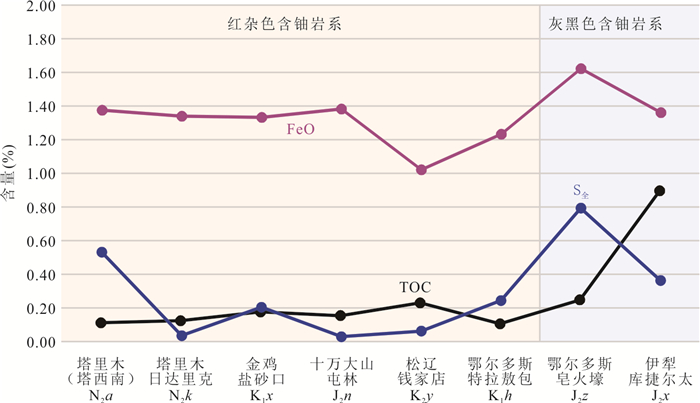
图 3 我国典型砂岩型铀矿床原生灰色还原砂体氧化‒还原环境参数差异对比
Fig. 3. Comparison of oxidation-reduction environmental parameters of primary reduced sand bodies in typical sandstone-type uranium deposits in China
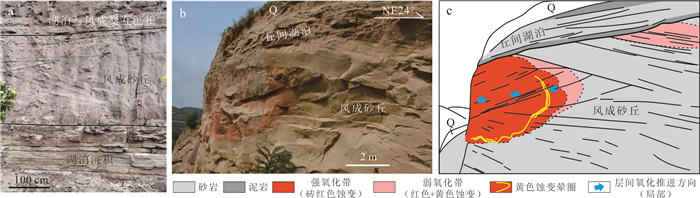
图 4 鄂尔多斯盆地下白垩统原生灰色风成沉积及其后生蚀变典型露头剖面
a. 泾川组风成砂丘与湖泊交互沉积,镇原三岔镇余坪村;b,c. 罗汉洞组风成砂丘内部后生氧化蚀变舌,镇原三岔镇红崖湾
Fig. 4. Typical outcrop profile of Lower Cretaceous primary gray eolian deposits and their epigenetic alteration in the Ordos basin
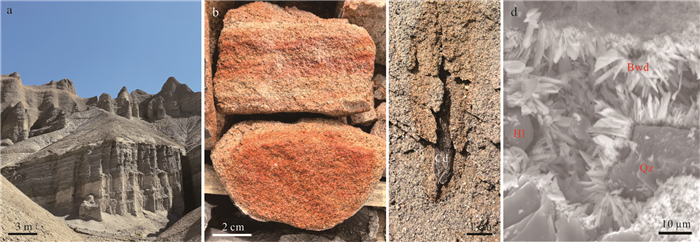
图 5 塔西南坳陷阿图什组原生灰色砂岩、后生氧化蚀变及其铀矿化
a.大规模原生灰色砂砾岩,莎车县霍什拉甫乡露头;b.沿粗碎屑纹层发育后生氧化蚀变作用,墨玉县卡瓦克乡钻孔岩心(ZKM0702);c.沿植物碎屑周边的后生氧化蚀变,墨玉县玛扎塔格山露头;d.由硅钾铀矿和石盐组成的表生铀矿化(γ异常最高达15 000×10-6),墨玉县玛扎塔格山露头砂岩(扫描电镜);Bwd.硅钾铀矿;Hl.石盐;Qz.石英;Cd.碳质碎屑
Fig. 5. Primary gray sandstone, diagenetic oxidation alteration, and uranium mineralization in the Atushi Formation of the southwest depression in Tarim basin
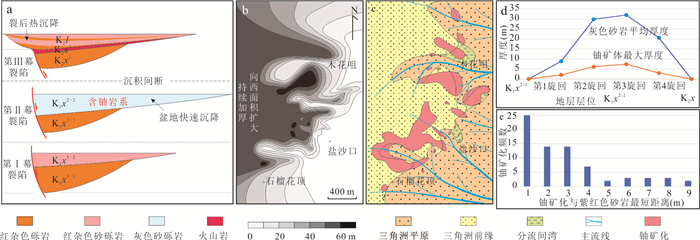
图 6 金鸡盆地新隆组含铀岩系整装灰色砂岩、沉积体系及其与铀成矿关系
a.盆地结构模型,整装灰色砂岩形成于第Ⅱ裂陷幕末期的快速沉降阶段;b.新隆组上段上亚段第3沉积旋回整装灰色砂岩分布规律,显示灰色砂岩向西面积扩大、厚度增加,盐沙口铀矿床;c.新隆组上段上亚段第3沉积旋回沉积体系与铀成矿关系,铀矿化产出于三角洲平原(氧化)与前缘(还原)的相变过渡部位,盐沙口铀矿床;d.灰色砂岩厚度与铀成矿呈正相关;e.统计发现70%铀矿化距氧化砂体边界0~3 m,整装灰色砂岩的边界是找矿的关键标志
Fig. 6. Integral gray sandstone, sedimentary system and their relationships with uranium mineralization in uranium-bearing series of the Xinlong Formation in the Jinji basin
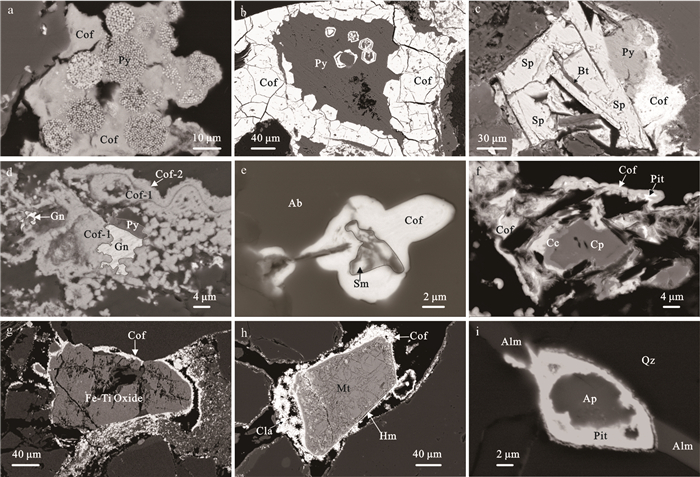
图 7 红杂色含铀岩系铀储层内部无机还原介质与铀成矿关系(扫描电镜)
a.氧化‒还原界面附近的铀石紧密包裹于莓状黄铁矿之外,特拉敖包铀矿床(鄂尔多斯盆地北部);b.铀石具正六边形黄铁矿假晶和环带结构,表现为多期次交代黄铁矿,特拉敖包铀矿床(鄂尔多斯盆地北部);c.铀石形成于闪锌矿和黄铁矿外围,特拉敖包铀矿床(鄂尔多斯盆地北部);d.铀石与方铅矿、黄铁矿紧密伴生,铀石具双层环带生长结构,屯林铀矿床(十万大山盆地);e.铀石包裹粒状砷钴矿,屯林铀矿床(十万大山盆地);f.辉铜矿依附黄铜矿发育,外围分别产出沥青铀矿和铀石,盐沙口铀矿床(金鸡盆地);g.铀石沿铁钛氧化物碎屑颗粒边缘生长,特拉敖包铀矿床(鄂尔多斯盆地北部);h.铀石、硒铅矿与磁铁矿密切相关,铀石沿磁铁矿边缘和裂隙生长,特拉敖包铀矿床(鄂尔多斯盆地北部);i.沥青铀矿围绕磷灰石产出,三湾铀矿床(鄂尔多斯盆地南部). Cof.铀石;Pit.沥青铀矿;Py.黄铁矿;Sp.闪锌矿;Gn.方铅矿;Sm.砷钴矿;Cp.黄铜矿;Cc.辉铜矿;Cla.硒铅矿;Mt.磁铁矿;Fe-Ti Oxide.铁钛氧化物;Ap.磷灰石;Alm.铁铝榴石;Hm.赤铁矿;Bt.黑云母;Qz.石英;Ab.钠长石
Fig. 7. Backscattered electron images showing the relationship between inorganic reducing media and uranium mineralization within the uranium reservoir of the reddish-variegated uranium-bearing series
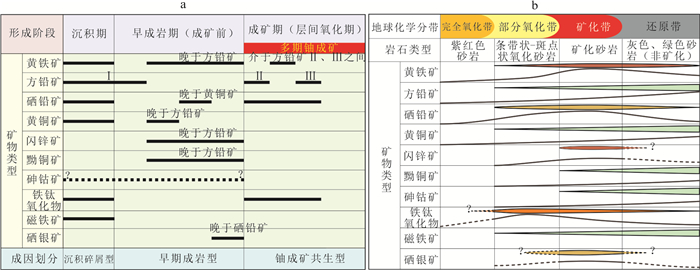
图 8 十万大山盆地屯林铀矿床铀储层内部无机还原介质的成因演化和分布规律(据李金辉,2024修改)
a.无机还原介质的成因分类;b.无机还原介质的地球化学分带
Fig. 8. Genetic evolution and distribution pattern of inorganic reducing media within the uranium reservoir of the Tunlin uranium deposit in the Shiwandashan basin (modified from Li, 2024)
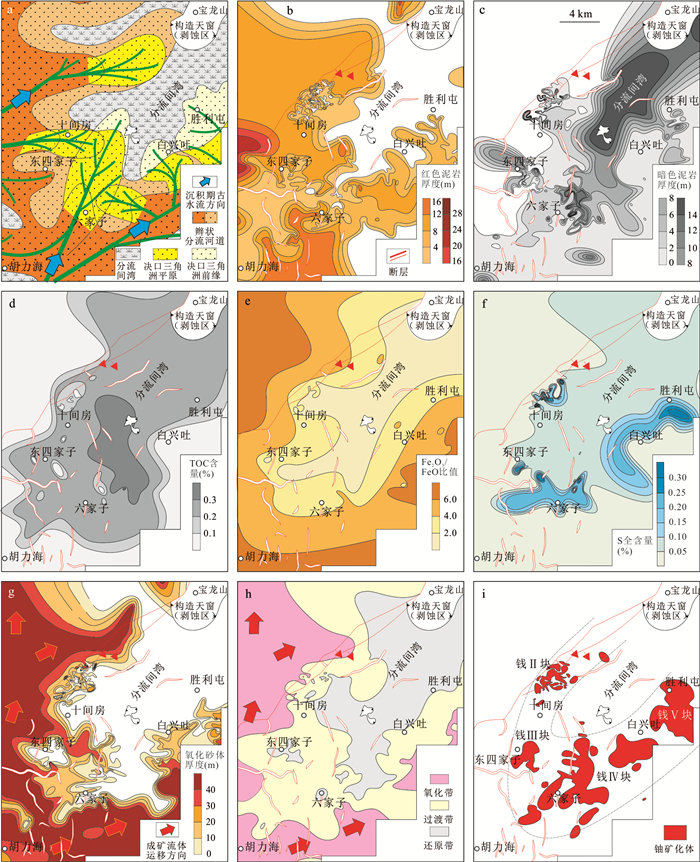
图 9 钱家店铀矿床主要控矿要素的空间配置关系(姚家组湖泊扩展体系域第1小层序)
a. 沉积体系的相变关系,辫状分流河道朝北和北东方向分叉,在东北部相变为分流间湾;b.红色泥岩厚度向分流间湾方向减薄;c.暗色泥岩厚度向分流间湾方向增厚;d. TOC向分流间湾方向增高;e. Fe2O3/FeO向分流间湾方向持续降低;f. S全在沉积相变处突增,可能为分流间湾暗色泥岩衍生的还原流体渗入铀储层砂体导致黄铁矿大量形成;g. 铀储层中氧化砂体的厚度在沉积相变处迅速减薄;h. 铀储层砂体内部层间氧化分带结构;i. 铀矿化体完全沿分流河道与分流间湾的相变带分布
Fig. 9. Spatial configuration relationship of main ore-controlling factors in the Qianjiadian uranium deposit (the first subsequence of the lacustrine expansion system tract in the Yaojia Formation)
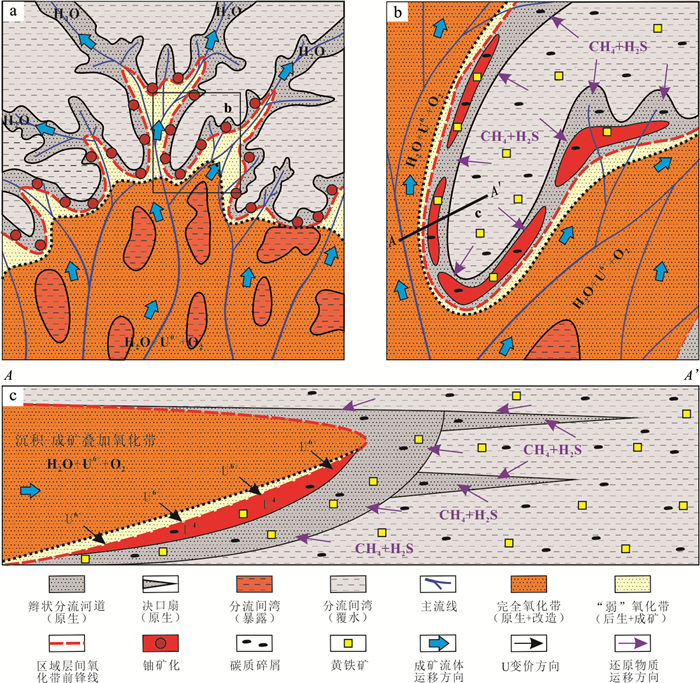
图 10 钱家店铀矿床的干旱红层相控模式
a.辫状河三角洲宏观控矿模型,展示三角洲平原‒前缘地区原生氧化、后生氧化与铀成矿的空间配置关系;b.分流间湾控矿模型细节,展示稳定覆水的分流间湾对区域层间氧化带和铀成矿发育的制约关系;c.相控铀成矿机理剖面模型,展示分流间湾还原物质与铀储层氧化流体的耦合为铀变价富集成矿奠定了良好的环境地质基础
Fig. 10. Sedimentary facies-controlled model in the arid red beds in the Qianjiadian uranium deposit
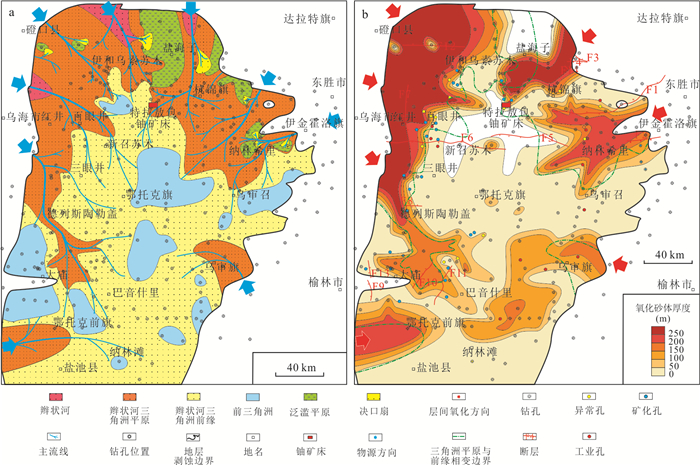
图 11 鄂尔多斯盆地北部沉积相变优先控矿典型实例(特拉敖包铀矿床,环河组上段)
a.含铀岩系沉积体系域重建图,纵向上依次具有由辫状河→辫状河三角洲(平原→前缘)→开阔湖泊(前三角洲)的演化特征;b.铀储层内部氧化砂体厚度与铀矿化叠合图,氧化砂体主要受沉积朵体控制,前锋线位置(大约50 m等厚线)基本与辫状河三角洲平原‒前缘相变边界吻合,铀矿床和铀矿化主要围绕前锋线一带发育
Fig. 11. Typical example of preferential ore control by sedimentary facies change in the northern Ordos basin (the Telaaobao uranium deposit, the upper Huanhe Formation)
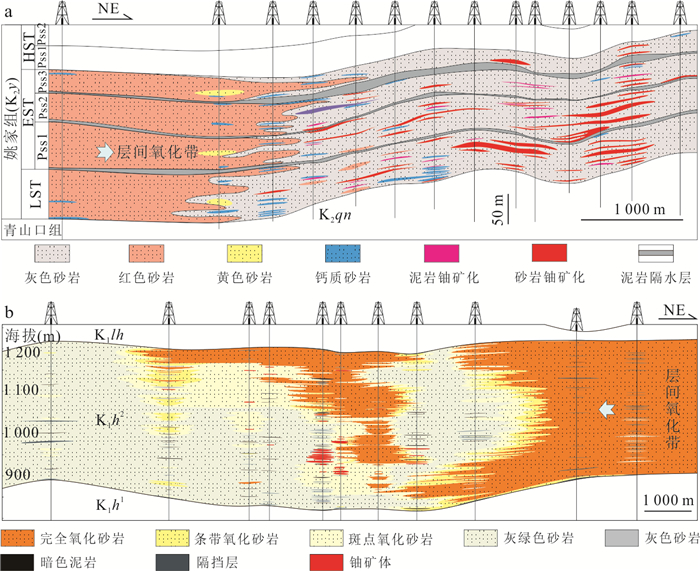
图 12 红杂色含铀岩系铀储层中的铀矿体通常与完全氧化带没有直接接触
铀矿床与完全氧化带之间为条带状、斑点状或灰白色氧化亚带. a.松辽盆地西南部钱家店铀矿床;b.鄂尔多斯盆地北部特拉敖包铀矿床
Fig. 12. Indirect contact relationship between uranium ore bodies and completely oxidized zone with the uranium reservoir of the reddish-variegated uranium-bearing series (between the two is a banded, spotted, or grayish-white faded oxidation subzone)
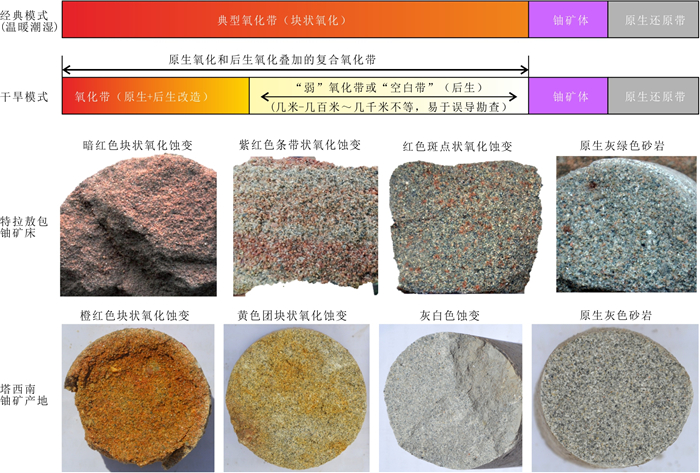
图 13 干旱炎热沉积背景铀储层中层间氧化带发育的普遍规律及典型实例(岩心直径为8 cm)
Fig. 13. Developmental patterns and typical examples of interlayer oxidation zone in uranium reservoirs in arid and hot depositional backgrounds (the core diameter is 8 cm)
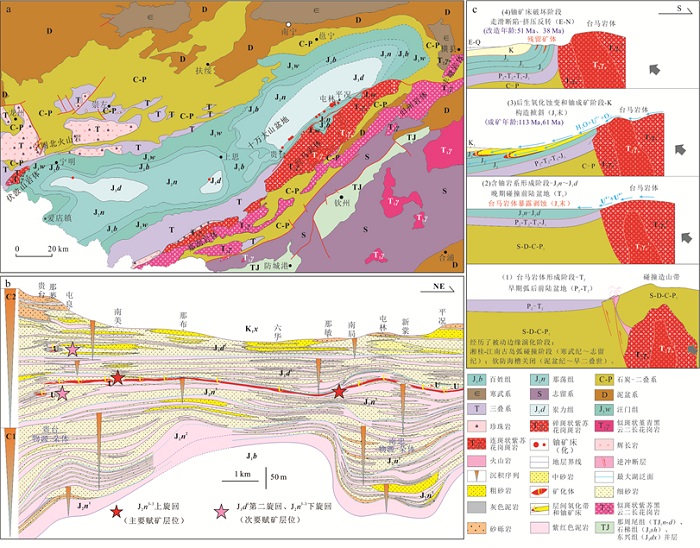
图 14 十万大山盆地屯林铀矿床发育的地质背景与演化过程
a.侏罗系含铀岩系与区域地质背景空间配置关系; b.贵台-平况一带含铀岩系地层格架、沉积充填与铀矿化关系, 剖面线方向总体垂直于古水流; c.铀矿床(化)及其关键控矿要素形成发展演化过程模式
Fig. 14. Geological background and evolution process of the Tunlin uranium deposit in the Shiwandashan basin
表 1 红杂色含铀岩系铀储层砂体岩石地球化学类型复杂多样
Table 1. Complex and diverse lithogeochemical types in reddish-variegated uranium-bearing series
沉积期 成岩‒成矿期 沉积古环境 原生型 后生蚀变作用 后生型 暴露氧化沉积环境 原生氧化色系砂岩 后生氧化蚀变作用 后生氧化色系砂岩 覆水还原沉积环境 原生还原色系砂岩 后生还原蚀变作用 后生还原色系砂岩  下载: 导出CSV
表 2 红杂色含铀岩系典型铀矿床铀储层内部还原介质对比
Table 2. Comparison of inner reducing media within uranium reservoirs of typical uranium deposits in the reddish-variegated uranium-bearing series
沉积盆地 铀矿床 宏观有机还原介质 无机还原介质 金属硫化物 铁、钛氧化物 磷酸盐矿物 碳酸盐矿物 优势矿物 典型矿物 衍生物 鄂尔多斯 特拉敖包 极少量碳质碎屑 黄铁矿、闪锌矿、辉铜矿、方铅矿、黄铜矿、毒砂 硒铅矿 钛铁矿、锐钛矿、金红石、磁铁矿 磷灰石 无 黄铁矿、磁铁矿、钛铁矿 三湾 无 黄铁矿、方铅矿、白铁矿、闪锌矿、辉钼矿、辉锑矿、黄铜矿 无 钛铁矿、锐钛矿、金红石、铁铝榴石、磁铁矿 磷灰石 碳酸盐岩砾石 钛铁矿、黄铁矿 十万大山 屯林 少量碳质碎屑 黄铁矿、方铅矿、黄铜矿、闪锌矿 硒铅矿、黝铜矿、砷钴矿、硒银矿 钛铁矿、磁铁矿 无 无 方铅矿、黄铁矿、钛铁矿 金鸡 371(盐沙口) 少量碳质碎屑 黄铁矿、黄铜矿、斑铜矿、辉铜矿、方铅矿、辉钴矿 硒铅矿、红砷镍矿 钛铁矿、锐钛矿 磷灰石 (铁)白云石 黄铁矿、黄铜矿、辉铜矿 注:资料来源:屈伸,2023;李金辉,2024;钟伟辉,2025.
下载: 导出CSV
-
Bai, W. H., 2025. Genesis of Gray Sand Bodies within the Uranium-Bearing Strata of the Lower Cretaceous Arid Red Beds in the Jinji Basin and Their Geological Significance for Uranium Prospecting (Dissertation). China University of Geosciences, Wuhan (in Chinese with English abstract). Cao, M. Q., Rong, H., Chen, Z. Y., et al., 2021. Quantitative Characterization and Controlling Factors of the Interlayer Oxidation Zone of Qianjiadian Uranium Deposit, Songliao Basin. Earth Science, 46(10): 3453-3466 (in Chinese with English abstract). Chen, Z. B., Zhao, F. M., 2002. Formation Model of In- Situ Leachable Uranium Deposit and Its Prospecting Prospect in China. World Nuclear Geoscience, 19(3): 127-133 (in Chinese). Chen, Z. Y., Chen, D. S., Gu, K. H., et al., 2011. China′s Uranium Deposit Research Evaluation (Volume Ⅲ: Sandstone Type Uranium Deposits). China Nuclear Geology and Beijing Research Institute of Uranium Geology, Beijing (in Chinese). Cheng, L. W., Du, Q. K., Wu, J. S., et al., 2012. The Practice and Enlightenment of "Simultaneous Exploration of Coal and Uranium" in Daying Uranium Mine. China Nuclear Industry, (S1): 1-105 (in Chinese). Cheng, Y. H., Jin, R. S., Miao, P. S., et al., 2025. Two Metallogenic Models of Sedimentary-Hosted Uranium Deposit: Jingchuan and Tale Types. Earth Science, 50(1): 46-57 (in Chinese with English abstract). https://doi.org/10.3799/dqkx.2024.078 Guo, Q. Y., Chen, Z. Y., Han, S. Q., et al., 2008. Application Status and Vistas of Sequence Stratigraphy to the Exploration of Sandstone-Hosted Uranium Deposits. Uranium Geology, 24(1): 5-11, 4 (in Chinese with English abstract). Guo, Q. Y., Li, Z. Y., Yu, J. S., et al., 2010. Meso- Neozoic Structural Evolution in the Western Margin of Ordos Basin with Respect to Uranium Ore Formation. Uranium Geology, 26(3): 137-144 (in Chinese with English abstract). Guo, Q. Y., Liu, H. X., Chen, Z. Y., et al., 2004. An Evaluation System for Uranium Potential in Continental Basins Dominated by Recognizing Favourable Sand Body. World Nuclear Geoscience, 21(2): 69-76, 92 (in Chinese with English abstract). He, F., Li, Z. Y., Liu, X. Y., et al., 2023. Study on the Metallogenic Mechanism of Telaaobao Occurrence in the Lower Cretaceous, Northwestern Ordos Basin. Uranium Geology, 39(6): 859-874 (in Chinese with English abstract). Hu, Y. X., Yang, T., Hu, Y., et al., 2023. Relation of Characteristics of Hydrocarbon Fluid in Sandstone of Luohe Formation in Zhenyuan Area of Oreos Basin to U Mineralization. Contributions to Geology and Mineral Resources Research, 38(3): 277-284 (in Chinese with English abstract). Jiao, Y. Q., Chen, A. P., Wang, M. F., et al., 2005. Genetic Analysis of the Bottom Sandstone of Zhiluo Formation, Northeastern Ordos Basin: Predictive Base of Spatial Orientation of Sandstone-Type Uranium Deposit. Acta Sedimentologica Sinica, 23(3): 371-379 (in Chinese with English abstract). Jiao, Y. Q., Wu, L. Q., Peng, Y. B., et al., 2015a. Sedimentary-Tectonic Setting of the Deposition-Type Uranium Deposits Forming in the Paleo-Asian Tectonic Domain, North China. Earth Science Frontiers, 22(1): 189-205 (in Chinese with English abstract). https://doi.org/10.13745/j.esf.2015.01.016 Jiao, Y. Q., Wu, L. Q., Rong, H., 2015b. Sedimentology of Coal-Bearing Basins. China University of Geosciences Press, Wuhan (in Chinese). Jiao, Y. Q., Wu, L. Q., Rong, H., 2018a. Model of Inner and Outer Reductive Media within Uranium Reservoir Sandstone of Sandstone-Type Uranium Deposits and Its Ore-Controlling Mechanism: Case Studies in Daying and Qianjiadian Uranium Deposits. Earth Science, 43(2): 459-474 (in Chinese with English abstract). Jiao, Y. Q., Wu, L. Q., Rong, H., et al., 2018b. Geological Modeling of Uranium Reservoir: The Geological Foundation of Revealing the Metallogenic Mechanism and Solving "Remaining Uranium". Earth Science, 43(10): 3568-3583 (in Chinese with English abstract). Jiao, Y. Q., Wu, L. Q., Rong, H., et al., 2016. The Relationship between Jurassic Coal Measures and Sandstone-Type Uranium Deposits in the Northeastern Ordos Basin, China. Acta Geologica Sinica (English Edition), 90(6): 2117-2132. https://doi.org/10.1111/1755-6724.13026 Jiao, Y. Q., Wu, L. Q., Rong, H., et al., 2021a. Review of Basin Uranium Resources in China. Earth Science, 46(8): 2675-2696 (in Chinese with English abstract). Jiao, Y. Q., Wu, L. Q., Rong, H., et al., 2021b. Geological Modeling for Uranium Reservoir Heterogeneous: A Sedimentology Basis of Revealing Metallogenic Mechanism and Enhancing Recovery for Sandstone-Type Uranium Deposits in the Zhiluo Formation in Ordos Basin. China University of Geosciences Press, Wuhan (in Chinese). Jiao, Y. Q., Wu, L. Q., Rong, H., et al., 2022. Sedimentation, Diagenesis and Uranium Mineralization: Innovative Discoveries and Cognitive Challenges in Study of Sandstone-Type Uranium Deposits in China. Earth Science, 47(10): 3580-3602 (in Chinese with English abstract). Jiao, Y. Q., Wu, L. Q., Rong, H., et al., 2023. Uranium Enrichment Mechanism and Metallogenic Model of Important Basins in Northern China. Geological Publishing House, Beijing (in Chinese). Jiao, Y. Q., Wu, L. Q., Wang, M. F., et al., 2005. Forecasting the Occurrence of Sandstone-Type Uranium Deposits by Spatial Analysis: An Example from the Northeastern Ordos Basin, China. Mineral Deposit Research: Meeting the Global Challenge. Springer, Berlin, 273-275. https://doi.org/10.1007/3-540-27946-6_71 Jiao, Y. Q., Wu, L. Q., Yang, S. K., et al., 2006. Sedimentology of Uranium Reservior: The Foundation of Sandstone Type Uranium Deposit Exploration and Development. Geological Publishing House, Beijing (in Chinese). Jin, R. S., 2020. Mineralization of Sandstone-Type Uranium Deposits in Ordos Basin. Science Press, Beijing (in Chinese). Jones, D. J., 1953. Gypsum-OöLITE Dunes, Great Salt Lake Desert, Utah. AAPG Bulletin, 37(11): 2530-2538. https://doi.org/10.1306/5ceaddb2-16bb-11d7-8645000102c1865d Lai, C. Y., 2024. Study on Metallogenic Mechanism and Model of Sandstone-Type Uranium Deposit in Jinji Basin, Guangxi. Uranium Geology, 40(3): 480-487 (in Chinese with English abstract). Lei, A. G., Chen, Z. Y., Wei, D., et al., 2020. Resource Assessment of Qian Ⅴ Uranium Deposite in Qianjiadian Uranium Orefield. Journal of Jilin University (Earth Science Edition), 50(6): 1675-1684 (in Chinese with English abstract). Li, J. H., 2024. Study on Inorganic Reducing Medium for Uranium Mineralization in Arid Sedimentary Background: A Case Study of Tunlin Uranium Deposit in Shiwandashan Basin (Dissertation). China University of Geosciences, Wuhan (in Chinese with English abstract). Li, X. Y., 2022. Mineralization Characteristics and Prospecting Target of Sandstone-Type Uranium Deposit in Jinji Basin, Guangxi. World Nuclear Geoscience, 39(2): 199-207 (in Chinese with English abstract). Li, Z. Y., 2019. Sandstone-Hosted Uranium Metallogeny in North Ordos Basin, China. Geological Publishing House, Beijing (in Chinese). Liu, Y., Liu, H., Jiao, Y. Q., et al., 2025. Evolution and Uranium Mineralization of the Northern Ordos Basin Revealed by Detrital Zircons of the Jurassic Strata. Geological Society of America Bulletin, 137(1/2): 575-593. https://doi.org/10.1130/b37488.1 Liu, Y., Zhao, J. H., Jiao, Y. Q., et al., 2023. Constraints of In-Situ S-Isotopic Compositions of Pyrite on the Genesis of the Bayinqinggeli Sandstone-Hosted Uranium Deposit, Ordos Basin, Northern China. Ore Geology Reviews, 161: 105608. https://doi.org/10.1016/j.oregeorev.2023.105608 Miall, A. D., 1996. The Geology of Fluvial Deposits: Sedimentary Facies, Basin Analysis and Petroleum Geology. Springer-Verlag, New York. Miao, P. S., Chen, Y., Cheng, Y. H., et al., 2020. New Deep Exploration Discoveries of Sandstone-Type Uranium Deposits in North China. Geotectonica et Metallogenia, 44(4): 563-575 (in Chinese with English abstract). https://doi.org/10.16539/j.ddgzyckx.2020.04.002 Nie, F. J., Chen, A. P., Peng, Y. B., 2010. Paleochannel Sandstone Type Uranium Deposit in Erlian Basin. Geological Publishing House, Beijing (in Chinese). Ning, J., Li, J. M., Xia, F., et al., 2023. Geological Characteristics and Genesis of Hailijin Uranium Deposit in Southern Songliao Basin. Journal of East China University of Technology (Natural Science), 46(3): 223-232 (in Chinese with English abstract). Peng, H., 2023. Spatio-Temporal Coupling Configuration for Key Elements of Ore-Controlling and "Source-Sink" System Reconstruction of Sandstone-Type Uranium Deposit in Southeastern Margin of Songliao Basin (Dissertation). China University of Geosciences, Wuhan (in Chinese with English abstract). Peng, H., Jiao, Y. Q., Dong, F. S., et al., 2022. Relationships between Uranium Occurrence, Pyrite and Carbonaceous Debris in Fuxin Formation in the Songliao Basin: Evidenced by Mineralogy and Sulfur Isotopes. Ore Geology Reviews, 140: 104580. https://doi.org/10.1016/j.oregeorev.2021.104580 Peng, S., Wang, J. C., Wang, P. H., et al., 2022. Interlayer Oxidation Zone Distribution Pattern and Uranium Mineralization of Qianjiadian Uranium Deposit(Qian Ⅳ) in Songliao Basin. Journal of Guilin University of Technology, 42(3): 549-556 (in Chinese with English abstract). Peng, Y. B., Jiao, Y. Q., Chen, A. P., 2019. Theoretical & Technological Innovation of Uranium Mineralization and Major Prospecting Breakthrough of Mesozoic Uranium-Bearing Basins in Midwestern Inner Mongolia (Dissertation). China University of Geosciences Press, Wuhan (in Chinese). Peng, Y. B., Jiao, Y. Q., Zhang, J. D., et al., 2015. Synsedimentary Mudstone-Hosted Uranium Deposit: A Typical Study of the Super-Large Nuheting Uranium Deposit in Erlian Basin. Geological Publishing House, Beijing (in Chinese). Qu, S., 2023. Characteristics and Genesis of Uranium Mineralization in Conglomerate of Huanhe Formation in the Southwestern Margin of Ordos Basin (Dissertation). China University of Geosciences, Wuhan (in Chinese with English abstract). Quan, J. P., Wu, Z. Q., Mao, N., et al., 2023. Analysis of Geological Characteristics and Control Factors of Uranium Mineralization in the Lower Cretaceous Huanhe Formation in Zhenyuan Area, Southern Ordos Basin. Uranium Geology, 39(6): 950-959 (in Chinese with English abstract). Quan, J. P., Xu, G. Z., Li, W. H., et al., 2006. Study on Ore-Controlling Factors and Metallogenic Model of Shihongtan Sandstone-Type Uranium Deposit. Uranium Geology, 22(1): 10-16 (in Chinese with English abstract). Quan, Z. G., Li, Z. S., 2002. Geological Characteristics and Genesis of the Shihongtan Sandstone-Type Uranium Deposit, Xinjiang. Geological Review, 48(4): 430-436 (in Chinese with English abstract). https://doi.org/10.16509/j.georeview.2002.04.015 Rong, H., 2012. The Effects of the Palaeoclimate of the Late Cretaceous Yaojia Formation on the Uranium Mineralization in the South Songliao Basin (Dissertation). China University of Geosciences, Wuhan (in Chinese with English abstract). Rong, H., Jiao, Y. Q., Wu, L. Q., et al., 2016. Epigenetic Alteration and Its Constraints on Uranium Mineralization from the Qianjiadian Uranium Deposit, Southern Songliao Basin. Earth Science, 41(1): 153-166 (in Chinese with English abstract). Rong, H., Jiao, Y. Q., Wu, L. Q., et al., 2019. Origin of the Carbonaceous Debris and Its Implication for Mineralization within the Qianjiadian Uranium Deposit, Southern Songliao Basin. Ore Geology Reviews, 107: 336-352. https://doi.org/10.1016/j.oregeorev.2019.02.036 Shi, Z. L., 2003. Formation and Reservation of Grey Reduction Sandbody under Arid Environment and Its Significance for Prospecting Sandstone-Type Uranium Deposits. Xinjiang Geology, 21(3): 317-320 (in Chinese with English abstract). Shi, Z. L., 2023. New Century's Uranium Prospecting Practice and Major Breakthrough in Xinjiang. Uranium Geology, 39(4): 481-491 (in Chinese with English abstract). Si, Q. H., Li, J. G., Miao, P. S., et al., 2021. Characteristics and Mechanism of Hydrocarbon Alteration of Faded Sandstone in the Uranium-Bearing Luohe Formation, Pengyang Area, Southwestern Ordos Basin. Ore Geology Reviews, 139: 104500. https://doi.org/10.1016/j.oregeorev.2021.104500 Sun, Y. H., 2023. The Genetic Mechanism of Metal Sulfide and Its Relationship with Uranium Mineralization in the Diantou-Shuanglong Uranium Deposit, Ordos Basin (Dissertation). China University of Geosciences, Wuhan (in Chinese with English abstract). Tao, Z. P., 2020. Architecture of a Sandstone Uranium Reservoir and the Spatial Distribution of Its Internal Carbonaceous Debris: A Case Study of the Zhiluo Formation, Eastern Ordos Basin, Northern China (Dissertation). China University of Geosciences, Wuhan (in Chinese with English abstract). Tao, Z. P., Jiao, Y. Q., Wu, L. Q., et al., 2020. Architecture of a Sandstone Uranium Reservoir and the Spatial Distribution of Its Internal Carbonaceous Debris: A Case Study of the Zhiluo Formation, Eastern Ordos Basin, Northern China. Journal of Asian Earth Sciences, 191: 104219. https://doi.org/10.1016/j.jseaes.2019.104219 Tao, Z. P., Wu, L. Q., Jiao, Y. Q., et al., 2022. Outcrop Modeling of Flow Units and Reductant within a Sandstone Uranium Reservoir in the Zhiluo Formation, Eastern Ordos Basin: Implications for the Uranium Mineralization Mechanism. Geosciences Journal, 26(5): 569-586. https://doi.org/10.1007/s12303-022-0008-z Wang, B. Q., 2002. Important Breakthrough in Exploration of In-Situleachable Sandstone-Type Uranium Deposits at Southern Margin of Ili Basin. Xinjiang Geology, 20(2): 106-109 (in Chinese with English abstract). Wang, L. H., Yan, P. B., Jiao, Y. Q., et al., 2023. Uranium Metallogenic Model of the Lower Cretaceous in the Northern Ordos Basin. Bulletin of Geological Science and Technology, 42(3): 222-233 (in Chinese with English abstract). Wang, Q. H., Liu, K. P., Wu, Z. Q., et al., 2025. Study on Grain Size Characteristics of Uranium Reservoirs in the Huanhe Formation in the Zhenyuan Area, Southern Ordos Basin. Geological Review, 71(S1): 99-100 (in Chinese). https://doi.org/10.16509/j.georeview.2025.s1.037 Wu, L. Q., Jiao, Y. Q., Wang, G. R., et al., 2022. Response of Uranium Mineralization in Kuqa Depression Driven by Basin-Mountain Coupling Mechanism. Earth Science, 47(9): 3174-3191 (in Chinese with English abstract). Wu, L. Q., Wang, S. Y., Jiao, Y. Q., et al., 2026. Genesis of Boltwoodite in the Hinterland Surface of the Taklamakan Desert: Implication for Exploration of Sandstone-Hosted Uranium Deposits. Journal of Geochemical Exploration, 288: 108118. https://doi.org/10.1016/j.gexplo.2026.108118 Wu, Z. Q., Hu, Y. X., Liu, K. P., et al., 2023. Basic Feature of Mineralization Host Rocks and Its Relation to Uranium Metallogenesis in Zhenyuan, Southern Ordos Basin. Uranium Geology, 39(6): 960-969 (in Chinese with English abstract). Xia, Y. L., Lin, J. R., Li, Z. Y., et al., 2003. Perspective and Resource Evaluation and Metallogenic Studies on Sandstone-Type Uranium Deposit in Qianjiadian Depression of Songliao Basin. China Nuclear Science and Technology Report, (3): 105-117 (in Chinese with English abstract). Xiang, Y., 2022. Relationship between Oxidation-Reduction and Uranium Mineralization in Aolian Depositional System (Dissertation). China University of Geosciences, Wuhan (in Chinese with English abstract). Xiang, Y., Jiao, Y. Q., Wu, L. Q., et al., 2022. Markers and Genetic Mechanisms of Primary and Epigenetic Oxidation of an Aeolian Depositional System of the Luohandong Formation, Ordos Basin. Journal of Earth Science, 33(2): 358-372. https://doi.org/10.1007/s12583-020-1109-0 Yue, L., 2021. The Formation Process and Evolution Law of Pyrite in Uranium Reservoir in Zhiluo Formation, Northern Ordos Basin (Dissertation). China University of Geosciences, Wuhan (in Chinese with English abstract). Yue, L., Jiao, Y. Q., Fayek, M., et al., 2021. Micromorphologies and Sulfur Isotopic Compositions of Pyrite in Sandstone-Hosted Uranium Deposits: A Review and Implications for Ore Genesis. Ore Geology Reviews, 139: 104512. https://doi.org/10.1016/j.oregeorev.2021.104512 Yue, L., Jiao, Y. Q., Fayek, M., et al., 2022. Transformation of Fe-Bearing Minerals from Dongsheng Sandstone-Type Uranium Deposit, Ordos Basin, North-Central China: Implications for Ore Genesis. American Mineralogist, 107(7): 1396-1409. https://doi.org/10.2138/am-2021-7888 Yue, L., Jiao, Y. Q., Wu, L. Q., et al., 2020. Evolution and Origins of Pyrite in Sandstone-Type Uranium Deposits, Northern Ordos Basin, North-Central China, Based on Micromorphological and Compositional Analysis. Ore Geology Reviews, 118: 103334. https://doi.org/10.1016/j.oregeorev.2020.103334 Yue, L., Jiao, Y. Q., Wu, L. Q., et al., 2023. In Situ Characterization of Pyrite from Multiple Microenvironments in Middle Jurassic Strata, Northeastern Ordos Basin, China: Evaluation of Synsedimentary/Diagenetic Fluid Evolution. Sedimentary Geology, 452: 106412. https://doi.org/10.1016/j.sedgeo.2023.106412 Yue, L., Jiao, Y. Q., Wu, L. Q., et al., 2024a. Framboidal Pyrite in Dongsheng Sandstone-Hosted Uranium Deposit, Northern Ordos Basin: Implications for Fluid Evolution and Uranium Mineralization. Ore Geology Reviews, 174: 106303. https://doi.org/10.1016/j.oregeorev.2024.106303 Yue, L., Jiao, Y. Q., Wu, L. Q., et al., 2024b. Quantitative Characterization on Multistage Formation of Sedimentary Pyrite Driven by H2S Derived from Biogenic Process in the Northeastern Ordos Basin, China. Sedimentary Geology, 473: 106768. https://doi.org/10.1016/j.sedgeo.2024.106768 Zang, Y. H., Jiang, S., Li, J. M., et al., 2023. Occurrence and Enrichment Mechanism of Uranium in the Hailijin Uranium Deposit, Southern Songliao Basin: Periodically Oxidation-Reduction-Type Mineralization. Geotectonica et Metallogenia, 47(3): 546-569 (in Chinese with English abstract). https://doi.org/10.16539/j.ddgzyckx.2023.01.201 Zhang, B., Cheng, Y. H., Xiao, K. Y., et al., 2025a. Prediction of Sandstone-Type Uranium Deposits Based on Data from Oilfield Drilling and Its Mineralization Regularity: A Case Study of Jingchuan Uranium Deposit, SW Ordos Basin. Applied Sciences, 15(20): 11268. https://doi.org/10.3390/app152011268 Zhang, T., Lei, J. C., Hu, C., et al., 2025b. The Uranium Enrichment Mechanism of Hydrocarbon-Bearing Fluids in Aeolian Sedimentary Background Uranium Reservoirs of the Ordos Basin. Minerals, 15(7): 716. https://doi.org/10.3390/min15070716 Zhang, C. C., 2025. Study on Diagenetic-Minerogenetic Processes and Their Evolution Sequence of Uranium Reservoirs in the Jinji Basin, Guangxi (Dissertation). China University of Geosciences, Wuhan (in Chinese with English abstract). Zhang, F., 2018. Enhancement of Organic Matter Maturation of Carbonaceous Debris Due to Radiogenic Heat from the Sandstone-Type Uranium Deposits, Ordos Basin (Dissertation). China University of Geosciences, Wuhan (in Chinese with English abstract). Zhang, F., Jiao, Y. Q., Wu, L. Q., et al., 2021. Roles of Dispersed Organic Matters in Sandstone-Type Uranium Mineralization: A Review of Geological and Geochemical Processes. Ore Geology Reviews, 139: 104485. https://doi.org/10.1016/j.oregeorev.2021.104485 Zhang, J. D., 2024. Decision-Making Process and Historical Experience Enlightenment of Attacking Sandstone-Type Uranium Deposits in Northern China. Uranium Geology, 40(3): 587-590 (in Chinese). Zhang, L., Wu, Z. Q., Liu, K. P., et al., 2025. Characteristics of Clay Minerals in the Ore-Bearing Sandstones of the Lower Member of Huanhe Formation in Xinzhuang Area of Ordos Basin, China and Their Significance for Uranium Mineralization. Journal of Earth Sciences and Environment, 47(5): 901-911 (in Chinese with English abstract). Zhang, T., Lei, J. C., Hu, C., et al., 2025. Uranium Reservoir Characteristics and Geological Significance in Pengyang-Zhenyuan Area, Ordos Basin. Geological Review, 71(S1): 145-146 (in Chinese with English abstract). Zhao, H. L., Li, J. G., Si, Q. H., et al., 2022. Characteristics of Fluid Inclusions and Fluid Coupling Mineralization of the Pengyang Uranium Deposit, Ordos Basin. Ore Geology Reviews, 148: 105043. https://doi.org/10.1016/j.oregeorev.2022.105043 Zhao, H. L., Li, J. G., Xiao, Z. B., et al., 2021. Determination of Formation Age of the Pengyang Sandstone-Type Uranium Deposit in the Ordos Basin, China: Using In Situ Femtosecond LA-MC-ICP-MS Method. China Geology, 4(1): 1-3. https://doi.org/10.31035/cg2021008 Zheng, D. Y., 2001. To Meet a New Challenge While Stepping into the New Century. Uranium Geology, 17(1): 1-4, 17 (in Chinese with English abstract). Zheng, J. W., 2010. Geological Setting and Exploration Potential of Qianjiadian Uranium Deposit in Kailu Basin. Uranium Geology, 26(4): 193-200, 207 (in Chinese with English abstract). Zhong, W. H., 2025. Research on the Relationship between Reductive Medium in Arid Sedimentary Background Uranium-Bearing Rock Series and Uranium Mineralization: Taking the Telaobaq Uranium Deposit in Ordos Basin as an Example (Dissertation). China University of Geosciences, Wuhan (in Chinese with English abstract). Zhong, W. H., Wu, L. Q., Wang, L. H., et al., 2025. The Distinctiveness of Carbonaceous Debris in Uranium Reservoirs under Arid Sedimentary Backgrounds and Its Implication for Uranium Mineralization: A Case Study of Northern Ordos Basin. Ore Geology Reviews, 179: 106526. https://doi.org/10.1016/j.oregeorev.2025.106526 Zhu, Q., Li, J. G., Wen, S. B., et al., 2021. Alteration, Uranium Occurrence State, and Enrichment Mechanism of the Cretaceous Luohe Formation, Southwestern Ordos Basin, Western China. Ore Geology Reviews, 139: 104486. https://doi.org/10.1016/j.oregeorev.2021.104486 Zhu, Q., Si, Q. H., Li, J. G., et al., 2023. Two Geneses of Gray Sandstone and Their Uranium-Bearing Analysis of Lower Cretaceous Luohe Formation in Southwestern Ordos Basin. Earth Science, 48(11): 3995-4016 (in Chinese with English abstract). https://doi.org/10.3799/dqkx.2022.012 白文浩, 2025. 金鸡盆地下白垩统干旱红层含铀岩系中灰色砂体成因及其找矿地质意义(硕士学位论文). 武汉: 中国地质大学. 曹民强, 荣辉, 陈振岩, 等, 2021. 松辽盆地钱家店铀矿床层间氧化带结构定量表征及制约因素. 地球科学, 46(10): 3453-3466. doi: 10.3799/dqkx.2020.375 陈肇博, 赵凤民, 2002. 可地浸型铀矿床的形成模式和在中国的找矿前景. 国外铀金地质, 19(3): 127-133. 陈祖伊, 陈戴生, 古抗衡, 等, 2011. 中国铀矿床研究评价(第3卷•砂岩型铀矿床). 北京: 中国核工业地质局和核工业北京地质研究院. 程利伟, 杜清坤, 吴建设, 等, 2012. 大营铀矿——"煤铀兼探"的实践与启示. 中国核工业, (S1): 1-105. 程银行, 金若时, 苗培森, 等, 2025. 砂岩型铀矿的两种成矿模式: 泾川式和塔勒式. 地球科学, 50(1): 46-57. doi: 10.3799/dqkx.2024.078 郭庆银, 陈祖伊, 韩淑琴, 等, 2008. 层序地层学在砂岩型铀矿勘查中的应用现状与前景展望. 铀矿地质, 24(1): 5-11, 4. 郭庆银, 李子颖, 于金水, 等, 2010. 鄂尔多斯盆地西缘中新生代构造演化与铀成矿作用. 铀矿地质, 26(3): 137-144. 郭庆银, 刘红旭, 陈祖伊, 等, 2004. 以识别主砂体为主线的陆相盆地产铀远景评价体系. 世界核地质科学, 21(2): 69-76, 92. 贺锋, 李子颖, 刘鑫扬, 等, 2023. 鄂尔多斯盆地西北部特拉敖包矿产地铀成矿机理研究. 铀矿地质, 39(6): 859-874. 胡永兴, 杨涛, 胡妍, 等, 2023. 鄂尔多斯盆地镇原地区洛河组砂岩中烃类流体特征与铀成矿关系探讨. 地质找矿论丛, 38(3): 277-284. 焦养泉, 陈安平, 王敏芳, 等, 2005. 鄂尔多斯盆地东北部直罗组底部砂体成因分析: 砂岩型铀矿床预测的空间定位基础. 沉积学报, 23(3): 371-379. 焦养泉, 吴立群, 彭云彪, 等, 2015a. 中国北方古亚洲构造域中沉积型铀矿形成发育的沉积‒构造背景综合分析. 地学前缘, 22(1): 189-205. 焦养泉, 吴立群, 荣辉, 2015b. 聚煤盆地沉积学. 武汉: 中国地质大学出版社. 焦养泉, 吴立群, 荣辉, 2018a. 砂岩型铀矿的双重还原介质模型及其联合控矿机理: 兼论大营和钱家店铀矿床. 地球科学, 43(2): 459-474. doi: 10.3799/dqkx.2017.512 焦养泉, 吴立群, 荣辉, 等, 2018b. 铀储层地质建模: 揭示成矿机理和应对"剩余铀"的地质基础. 地球科学, 43(10): 3568-3583. doi: 10.3799/dqkx.2018.229 焦养泉, 吴立群, 荣辉, 等, 2021a. 中国盆地铀资源概述. 地球科学, 46(8): 2675-2696. doi: 10.3799/dqkx.2020.304 焦养泉, 吴立群, 荣辉, 等, 2021b. 铀储层非均质性地质建模: 揭示鄂尔多斯盆地直罗组铀成矿机理和提高采收率的沉积学基础. 武汉: 中国地质大学出版社. 焦养泉, 吴立群, 荣辉, 等, 2022. 沉积、成岩与铀成矿: 中国砂岩型铀矿研究的创新发现与认知挑战. 地球科学, 47(10): 3580-3602. doi: 10.3799/dqkx.2022.284 焦养泉, 吴立群, 荣辉, 等, 2023. 中国北方重要盆地铀富集机理与成矿模式. 北京: 地质出版社. 焦养泉, 吴立群, 杨生科, 等, 2006. 铀储层沉积学——砂岩型铀矿勘查与开发的基础. 北京: 地质出版社. 金若时, 陈印, 司庆红, 等, 2020. 鄂尔多斯盆地砂岩型铀矿成矿作用. 北京: 科学出版社. 赖传勇, 2024. 广西金鸡盆地砂岩型铀矿成矿机理和成矿模式研究. 铀矿地质, 40(3): 480-487. 雷安贵, 陈振岩, 魏达, 等, 2020. 钱家店铀矿床钱Ⅴ铀矿床资源预测. 吉林大学学报(地球科学版), 50(6): 1675-1684. 李金辉, 2024. 干旱沉积背景中铀成矿无机还原介质研究——以十万大山盆地屯林铀矿床为例(硕士学位论文). 武汉: 中国地质大学. 李小英, 2022. 广西金鸡盆地砂岩型铀矿化特征与找矿方向. 世界核地质科学, 39(2): 199-207. 李子颖, 2019. 鄂尔多斯盆地北部砂岩铀成矿作用. 北京: 地质出版社. 苗培森, 陈印, 程银行, 等, 2020. 中国北方砂岩型铀矿深部探测新发现及其意义. 大地构造与成矿学, 44(4): 563-575. 聂逢君, 陈安平, 彭云彪, 2010. 二连盆地古河道砂岩型铀矿. 北京: 地质出版社. 宁君, 李继木, 夏菲, 等, 2023. 松辽盆地南部海力锦铀矿床地质特征及成因探讨. 东华理工大学学报(自然科学版), 46(3): 223-232. 彭虎, 2023. 松辽盆地东南缘砂岩型铀矿关键控矿要素时空耦合配置与"源‒汇"系统重建(博士学位论文). 武汉: 中国地质大学. 彭爽, 汪劲草, 王佩华, 等, 2022. 钱家店铀矿床(钱Ⅳ块)层间氧化带分布特征与铀矿化关系. 桂林理工大学学报, 42(3): 549-556. 彭云彪, 焦养泉, 陈安平, 等, 2019. 内蒙古中西部中生代产铀盆地理论技术创新与重大找矿突破. 武汉: 中国地质大学出版社. 彭云彪, 焦养泉, 张金带, 等, 2015. 同沉积泥岩型铀矿床: 二连盆地超大型努和廷铀矿床典型分析. 北京: 地质出版社. 屈伸, 2023. 鄂尔多斯盆地西南缘环河组砾岩铀矿化特征及成因(硕士学位论文). 武汉: 中国地质大学. 权建平, 武正乾, 毛宁, 等, 2023. 鄂尔多斯盆地南部镇原地区铀成矿地质特征与控矿因素分析. 铀矿地质, 39(6): 950-959. 权建平, 徐高中, 李卫红, 等, 2006. 十红滩砂岩型铀矿床成矿控制因素与成矿模式研究. 铀矿地质, 22(1): 10-16. 权志高, 李占双, 2002. 新疆十红滩砂岩型铀矿床基本特征及成因分析. 地质论评, 48(4): 430-436. 荣辉, 2012. 松辽盆地南部姚家组沉积期古气候对铀成矿的影响(博士学位论文). 武汉: 中国地质大学. 荣辉, 焦养泉, 吴立群, 等, 2016. 松辽盆地南部钱家店铀矿床后生蚀变作用及其对铀成矿的约束. 地球科学, 41(1): 153-166. doi: 10.3799/dqkx.2016.012 师志龙, 2003. 干旱条件下灰色还原砂体的形成与保存及其在砂岩型铀矿找矿中的意义. 新疆地质, 21(3): 317-320. 师志龙, 2023. 新世纪以来新疆铀矿找矿实践与重大突破. 铀矿地质, 39(4): 481-491. 孙钰函, 2023. 鄂尔多斯盆地店头‒双龙铀矿床金属硫化物成因机制与铀成矿关系(博士学位论文). 武汉: 中国地质大学. 陶振鹏, 2020. 鄂尔多斯盆地东缘直罗组铀储层砂体内部结构及碳质碎屑空间分布地质建模(博士学位论文). 武汉: 中国地质大学. 王保群, 2002. 伊犁盆地南缘可地浸砂岩型铀矿的重大突破. 新疆地质, 20(2): 106-109. 王龙辉, 剡鹏兵, 焦养泉, 等, 2023. 鄂尔多斯盆地北部下白垩统铀成矿模式. 地质科技通报, 42(3): 222-233. 王奇辉, 刘坤鹏, 武正乾, 等, 2025. 鄂尔多斯盆地南部镇原地区环河组铀储层粒度特征研究. 地质论评, 71(S1): 99-100. 吴立群, 焦养泉, 王国荣, 等, 2022. 盆山耦合机制驱动下的库车坳陷铀成矿作用响应. 地球科学, 47(9): 3174-3191. doi: 10.3799/dqkx.2022.100 武正乾, 胡永兴, 刘坤鹏, 等, 2023. 鄂尔多斯盆地南部镇原地区环河组下段赋矿砂岩基本特征与铀成矿作用. 铀矿地质, 39(6): 960-969. 夏毓亮, 林锦荣, 李子颖, 等, 2003. 松辽盆地钱家店凹陷砂岩型铀矿预测评价和铀成矿规律研究. 中国核科技报告, (3): 105-117. 向尧, 2022. 风成沉积体系中氧化还原作用与铀成矿关系——以鄂尔多斯盆地西南部洛河组和罗汉洞组为例(博士学位论文). 武汉: 中国地质大学. 乐亮, 2021. 鄂尔多斯盆地北部直罗组铀储层中黄铁矿的形成过程与演化规律(博士学位论文). 武汉: 中国地质大学. 臧亚辉, 姜山, 李继木, 等, 2023. 松辽盆地南部海力锦铀矿床铀矿物赋存状态及富集机理——试论"潮汐式"成矿作用过程. 大地构造与成矿学, 47(3): 546-569. 张成成, 2025. 广西金鸡盆地铀储层成岩‒成矿作用及其演化序列研究(硕士学位论文). 武汉: 中国地质大学. 张帆, 2018. 鄂尔多斯盆地砂岩型铀矿衰变生热对炭质碎屑成熟度的催化影响(博士学位论文). 武汉: 中国地质大学. 张金带, 2024. 主攻北方砂岩型铀矿的决策过程和历史经验启示. 铀矿地质, 40(3): 587-590. 张良, 武正乾, 刘坤鹏, 等, 2025. 鄂尔多斯盆地新庄地区环河组下段含矿砂岩黏土矿物特征及其铀成矿意义. 地球科学与环境学报, 47(5): 901-911. 张涛, 雷晶超, 胡琮, 等, 2025. 鄂尔多斯盆地彭阳‒镇原地区铀储层特征及地质意义. 地质论评, 71(S1): 145-146. 郑大瑜, 2001. 跨入新世纪 迎接新挑战. 铀矿地质, 17(1): 1-4, 17. 郑纪伟, 2010. 开鲁盆地钱家店铀矿床成矿地质条件及勘探潜力分析. 铀矿地质, 26(4): 193-200, 207. 钟伟辉, 2025. 干旱沉积背景含铀岩系还原介质与铀成矿关系研究——以鄂尔多斯盆地特拉敖包铀矿产地为例(博士学位论文). 武汉: 中国地质大学. 朱强, 司庆红, 李建国, 等, 2023. 鄂尔多斯盆地西南部下白垩统洛河组灰色砂岩的两种成因及其含铀性. 地球科学, 48(11): 3995-4016. doi: 10.3799/dqkx.2022.012 -

 点击查看大图
计量
- 文章访问数: 1801
- HTML全文浏览量: 11
- PDF下载量: 69
- 被引次数: 0
