




Occurrence Forms of Antimony in Geothermal Waters of Different Genesis and Its Controlling Factors and Indicative Significance
-
摘要: 为理解不同类型地热水中总锑及锑形态的分布特征、主控因素及其指示意义,选择云南腾冲热海、龙陵邦腊掌和广东诸地热区,系统对比了存在壳内岩浆囊且接受岩浆流体输入、存在壳内岩浆囊但未接受岩浆流体输入、不存在壳内岩浆囊3类地热系统中地热水的总锑和各锑形态含量并分析了其主控因素.结果表明:总锑含量与地热水成因密切相关;而硫化物的富集及偏高的pH是硫代锑酸盐形成的关键条件.总体来看,地热水中锑形态分布受控于其地球化学环境,对地热系统成因有一定指示意义:未形成硫代锑酸盐的地热水几乎不可能接受岩浆流体直接输入,但无论有无岩浆流体输入,地热水中均可能因富集硫化物而形成硫代锑酸盐.Abstract: To understand the distribution characteristics, controlling factors and significance of total antimony and antimony species in different types of geothermal water, geothermal areas in Tengchong Rehai and Longling Banglazhang in Yunnan, as well as various geothermal areas in Guangdong, were selected. this study systematically compared the concentration of total antimony and antimony species, along with their controlling factors, across three distinct geothermal system scenarios: those with intra-crustal magma chamber receiving magmatic fluid input; those with intra-crustal magma chamber but without magmatic fluid input; and those without intra-crustal magma chamber. The results indicate that total antimony content is related to the genesis of geothermal water; meanwhile, enrichment of sulfide coupled with elevated pH constitutes a critical prerequisite for formation of thioantimonate. Overall, the distribution of antimony species in geothermal water is controlled by the geochemical environment of the geothermal system and provides some indication of the genesis of geothermal systems: for geothermal waters lacking thioantimonate, direct magmatic fluid input can be ruled out, however, both magmatically influenced and unaffected geothermal waters may yield thioantimonate in sulfide-rich environment.
-
Key words:
- antimony /
- thioantimonate /
- geothermal water /
- environmental geology
-
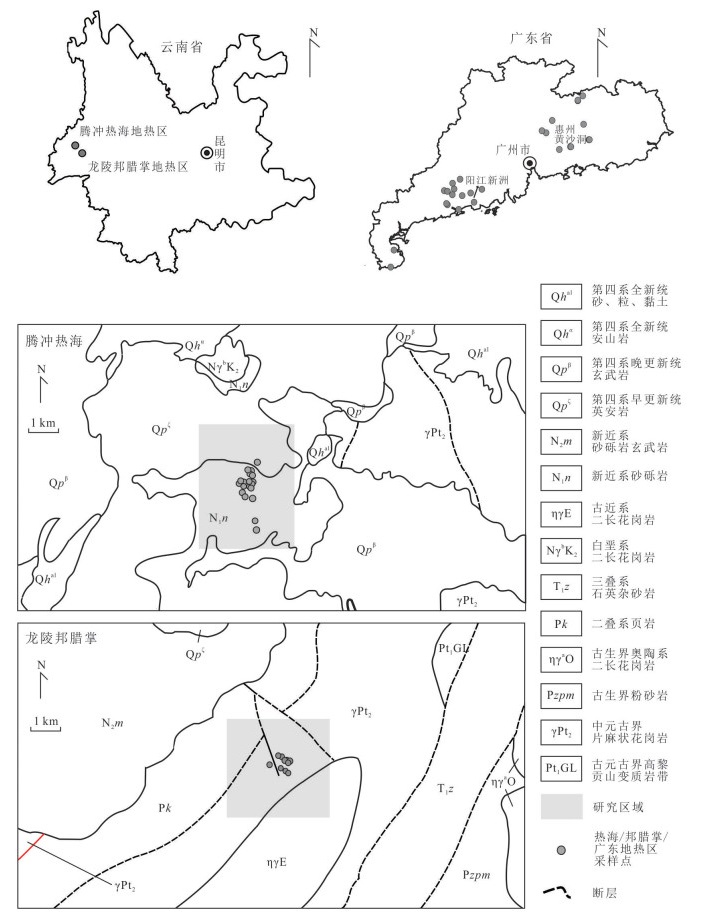
图 1 研究区地质图与采样点分布
Fig. 1. Geological map of the study area and distribution of sampling points
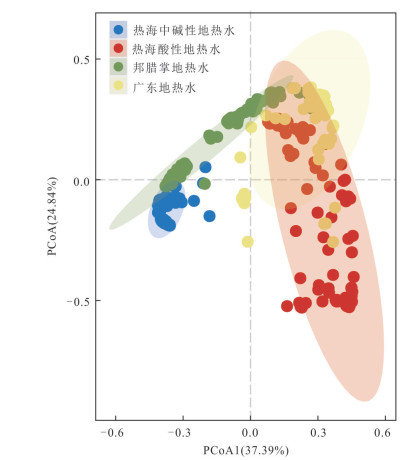
图 2 热海酸性/中碱性地热水、邦腊掌地热水与广东地热水的PCoA图(椭圆代表 95%置信区间)
Fig. 2. Principal coordinates analysis (PCoA) plot of acidic/moderately alkaline geothermal waters from Rehai versus those from Banglazhang and Guangdong (ellipses denote 95% confidence intervals)
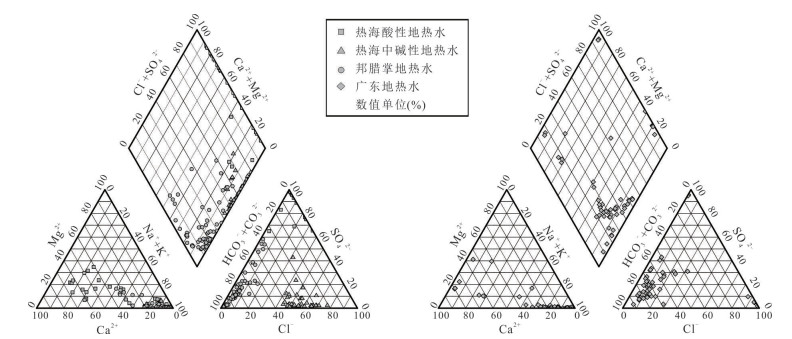
图 3 热海酸性/中碱性地热水、邦腊掌地热水与广东地热水的piper三线图
Fig. 3. Piper diagrams of acidic/moderately alkaline geothermal waters from Rehai versus those from Banglazhang and Guangdong
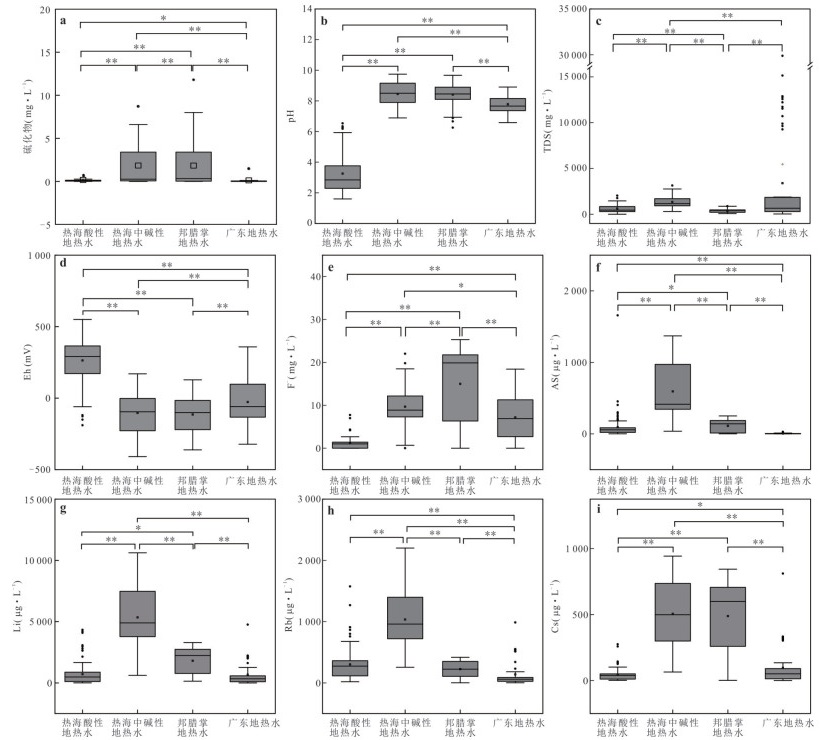
图 4 热海酸性/中碱性地热水、邦腊掌地热水和广东地热水部分水化学特征及特征组分箱线图
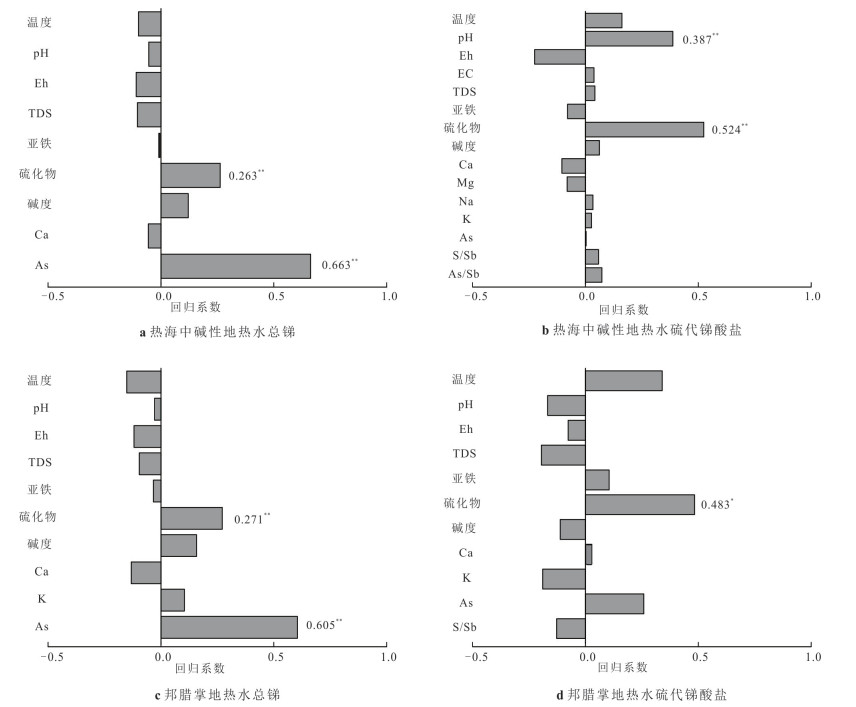
**表示在0.01级别相关性显著;*表示在0.05级别相关性显著
Fig. 4. Box plots of selected water chemistry characteristics and key constituents for acidic/moderately alkaline geothermal waters from Rehai versus those from Banglazhang and Guangdong
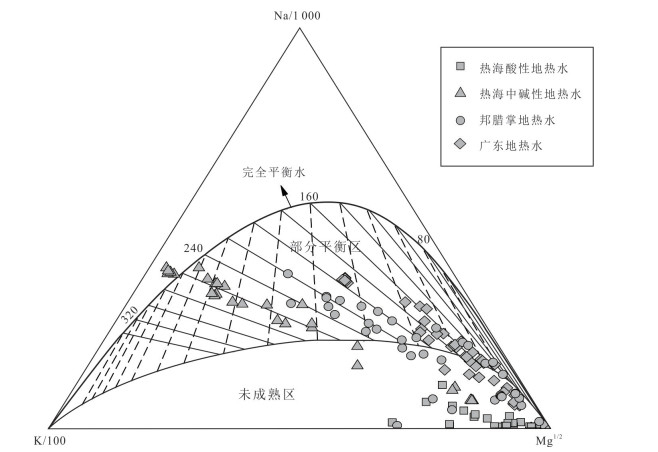
图 5 热海酸性/中碱性地热水、邦腊掌地热水和广东地热水的Na-K-Mg三角图
Fig. 5. Na-K-Mg triangular diagram of acidic/moderately alkaline geothermal waters from Rehai versus those from Banglazhang and Guangdong
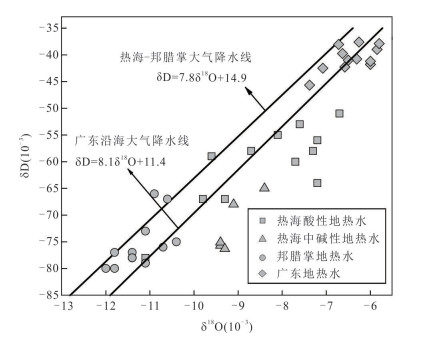
图 6 热海酸性/中碱性地热水、邦腊掌地热水与广东地热水的δD和δ18O关系
Fig. 6. Relationship between δD and δ18O of acidic/moderately alkaline geothermal waters from Rehai versus those from Banglazhang and Guangdong
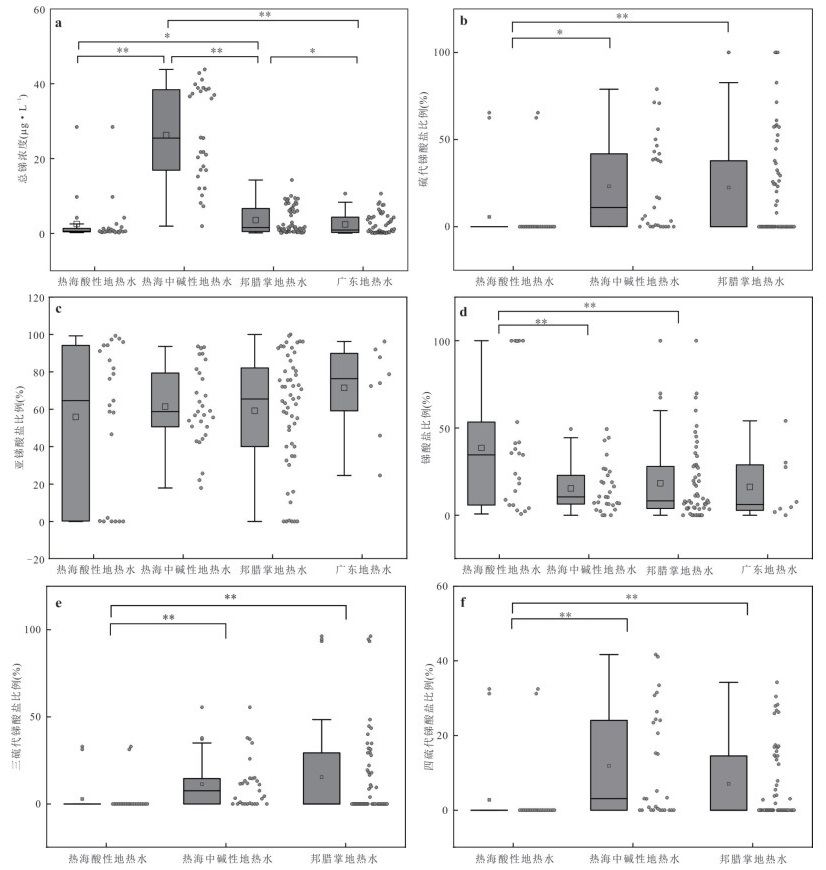
图 7 热海酸性/中碱性地热水、邦腊掌地热水和广东地热水的总锑含量及锑形态箱线图
Fig. 7. Box plots of total antimony concentration/antimony species for acidic and moderately alkaline geothermal waters from Rehai versus those from Banglazhang and Guangdong
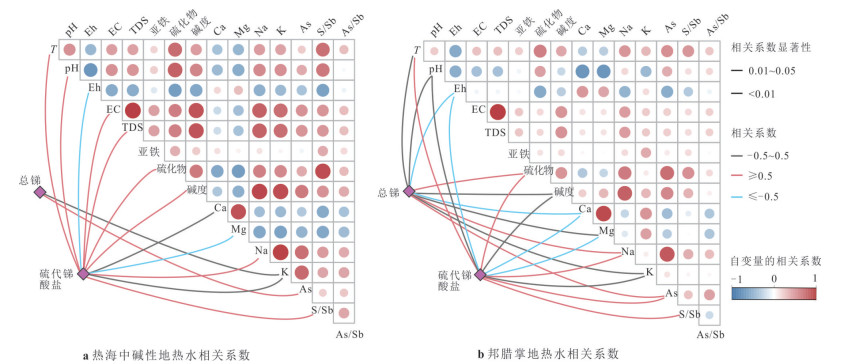
图 8 热海中碱性地热水与邦腊掌地热水中总锑和硫代锑酸盐比例与各水化学特征的相关系数
Fig. 8. Correlation coefficients between antimony, thioantimonate proportions and hydrochemical characteristics in alkaline geothermal waters from Rehai and geothermal waters from Banglazhang
-
Aksoy, N., Şimşek, C., Gunduz, O., 2009. Groundwater Contamination Mechanism in a Geothermal Field: A Case Study of Balcova, Turkey. Journal of Contaminant Hydrology, 103(1-2): 13-28. https://doi.org/10.1016/j.jconhyd.2008.08.006 Bai, D. H., Liao, Z. J., Zhao, G. Z., et al., 1994. Inferring the Magma Heat Source of Tengchong Rehai Geothermal Field from MT Detection Results. Chinese Science Bulletin, 39(4): 344-347 (in Chinese). doi: 10.1360/csb1994-39-4-344 Cavallo, D., Iavicoli, I., Setini, A., et al., 2002. Genotoxic Risk and Oxidative DNA Damage in Workers Exposed to Antimony Trioxide. Environmental and Molecular Mutagenesis, 40(3): 184-189. https://doi.org/10.1002/em.10102 Chen, L. Z., Ma, T., Du, Y., et al., 2016. Hydrochemical and Isotopic (2H, 18O and 37Cl) Constraints on Evolution of Geothermal Water in Coastal Plain of Southwestern Guangdong Province, China. Journal of Volcanology and Geothermal Research, 318: 45-54. https://doi.org/10.1016/j.jvolgeores.2016.03.003 Feng, R. W., Wei, C. Y., Tu, S. X., et al., 2013. The Uptake and Detoxification of Antimony by Plants: A Review. Environmental and Experimental Botany, 96: 28-34. https://doi.org/10.1016/j.envexpbot.2013.08.006 Filella, M., Belzile, N., Chen, Y. W., 2002. Antimony in the Environment: A Review Focused on Natural Waters I. Occurrence. Earth-Science Reviews, 57(1-2): 125-176. https://doi.org/10.1016/S0012-8252(01)00070-8 Giggenbach, W. F., 1988. Geothermal Solute Equilibria. Derivation of Na-K-Mg-Ca Geoindicators. Geochimica et Cosmochimica Acta, 52(12): 2749-2765. https://doi.org/10.1016/0016-7037(88)90143-3 Guo, Q. H., 2020. Magma-Heated Geothermal Systems and Hydrogeochemical Evidence of Their Occurrence. Acta Geologica Sinica, 94(12): 3544-3554 (in Chinese with English abstract). Guo, Q. H., Liu, M. L., Li, J. X., et al., 2014. Acid Hot Springs Discharged from the Rehai Hydrothermal System of the Tengchong Volcanic Area (China): Formed via Magmatic Fluid Absorption or Geothermal Steam Heating? Bulletin of Volcanology, 76(10): 868. https://doi.org/10.1007/s00445-014-0868-9 Guo, Q. H., Liu, M. L., Li, J. X., 2017. Thioarsenic Species in the High-Temperature Hot Springs from the Rehai Geothermal Field(Tengchong) and Their Geochemical Geneses. Earth Science, 42(2): 286-297 (in Chinese with English abstract). Guo, Q. H., Liu, M. L., Li, J. X., et al., 2017. Fluid Geochemical Constraints on the Heat Source and Reservoir Temperature of the Banglazhang Hydrothermal System, Yunnan-Tibet Geothermal Province, China. Journal of Geochemical Exploration, 172: 109-119. https://doi.org/10.1016/j.gexplo.2016.10.012 Guo, Q. H., Planer-Friedrich, B., Luo, L., et al., 2020. Speciation of Antimony in Representative Sulfidic Hot Springs in the YST Geothermal Province (China) and Its Immobilization by Spring Sediments. Environmental Pollution, 266: 115221. https://doi.org/10.1016/j.envpol.2020.115221 Guo, Q. H., Qian, J. B., Li, Y., et al., 2025. The Antimonite-Thioantimonates-Antimonate Pathway: Insights from Sulfidic Hot Springs and Microbial Culture Experiments for a Novel Mechanism of Abiotic Antimonite Oxidation. Geochimica et Cosmochimica Acta, 406: 164-174. https://doi.org/10.1016/j.gca.2025.01.007 Guo, Q. H., Wang, Y. X., 2012. Geochemistry of Hot Springs in the Tengchong Hydrothermal Areas, Southwestern China. Journal of Volcanology and Geothermal Research, 215: 61-73. https://doi.org/10.1016/j.jvolgeores.2011.12.003 Herath, I., Vithanage, M., Bundschuh, J., 2017. Antimony as a Global Dilemma: Geochemistry, Mobility, Fate and Transport. Environmental Pollution, 223: 545-559. https://doi.org/10.1016/j.envpol.2017.01.057 Johnston, S. G., Bennett, W. W., Doriean, N., et al., 2020. Antimony and Arsenic Speciation, Redox-Cycling and Contrasting Mobility in a Mining-Impacted River System. Science of the Total Environment, 710: 136354. https://doi.org/10.1016/j.scitotenv.2019.136354 Li, X., Guo, Q. H., Zhao, Q., 2024. Dissolution of Stibnite and Morphological Distribution of Antimony in Its Products under Different Aqueous Conditions. Earth Science, 49(11): 4022-4034 (in Chinese with English abstract). Liu, L., Wang, G. L., Li, Y. L., et al., 2024. Hydrogeochemistry of Geothermal Water in Huangshadong and Adjacent Areas of Guangdong Province: Implications for Water-Rock Interaction. Geothermics, 122: 103084. https://doi.org/10.1016/j.geothermics.2024.103084 Okkenhaug, G., Grasshorn Gebhardt, K. A., Amstaetter, K., et al., 2016. Antimony (Sb) and Lead (Pb) in Contaminated Shooting Range Soils: Sb and Pb Mobility and Immobilization by Iron Based Sorbents, a Field Study. Journal of Hazardous Materials, 307: 336-343. https://doi.org/10.1016/j.jhazmat.2016.01.005 Pierart, A., Shahid, M., Séjalon-Delmas, N., et al., 2015. Antimony Bioavailability: Knowledge and Research Perspectives for Sustainable Agricultures. Journal of Hazardous Materials, 289: 219-234. https://doi.org/10.1016/j.jhazmat.2015.02.011 Planer-Friedrich, B., Scheinost, A. C., 2011. Formation and Structural Characterization of Thioantimony Species and Their Natural Occurrence in Geothermal Waters. Environmental Science Technology, 45(16): 6855-6863. https://doi.org/10.1021/es201003k Planer-Friedrich, B., Wilson, N., 2012. The Stability of Tetrathioantimonate in the Presence of Oxygen, Light, High Temperature and Arsenic. Chemical Geology, 322: 1-10. https://doi.org/10.1016/j.chemgeo.2012.06.010 Qin, S. L., Zeng, Z. J., Zhou, X. C., et al., 2025. Study on the Hot Spring Hydrogeochmistry and Their Anomalous Characteristics of Short-Term and Impending Earthquake Precursors at Yingjiang. Earthquake, 45(2): 193-210 (in Chinese with English abstract). Reimann, C., Matschullat, J., Birke, M., et al., 2010. Antimony in the Environment: Lessons from Geochemical Mapping. Applied Geochemistry, 25(2): 175-198. https://doi.org/10.1016/j.apgeochem.2009.11.011 Shangguan, Z. G., Bai, C. H., Sun, M. L., 2000. Mantle-Derived Magmatic Gas Releasing Features at the Rehai Area, Tengchong County, Yunnan Province, China. Science in China: Earth Sciences, 43(2): 132-140. https://doi.org/10.1007/bf02878142 Smichowski, P., 2008. Antimony in the Environment as a Global Pollutant: A Review on Analytical Methodologies for Its Determination in Atmospheric Aerosols. Talanta, 75(1): 2-14. https://doi.org/10.1016/j.talanta.2007.11.005 Song, H. Y., Guo, Q. H., 2023. The Morphological Distribution and Geochemical Genesis of Antimony in Typical High-Temperature Hot Springs. Earth Science, 48(3): 946-957 (in Chinese with English abstract). Ullrich, M. K., Pope, J. G., Seward, T. M., et al., 2013. Sulfur Redox Chemistry Governs Diurnal Antimony and Arsenic Cycles at Champagne Pool, Waiotapu, New Zealand. Journal of Volcanology and Geothermal Research, 262: 164-177. https://doi.org/10.1016/j.jvolgeores.2013.07.007 Wehmeier, S., Feldmann, J., 2005. Investigation into Antimony Mobility in Sewage Sludge Fermentation. Journal of Environmental Monitoring, 7(12): 1194. https://doi.org/10.1039/b509538g Willis, S. S., Haque, S. E., Johannesson, K. H., 2011. Arsenic and Antimony in Groundwater Flow Systems: A Comparative Study. Aquatic Geochemistry, 17(6): 775-807. https://doi.org/10.1007/s10498-011-9131-6 Wilson, N., Webster-Brown, J., 2009. The Fate of Antimony in a Major Lowland River System, the Waikato River, New Zealand. Applied Geochemistry, 24(12): 2283-2292. https://doi.org/10.1016/j.apgeochem.2009.09.016 Wu, G. P., 2023. Characteristics and Genesis of Uplift Geothermal System in Guangdong Province. Yunnan Geology, 42(4): 442–450 (in Chinese with English abstract). Wu, Y. T., Ye, H. E., Guo, Z., 2019. A Brief Analysis of the Distribution Characteristics and Genesis of Geothermal Resources in Guangdong Province. Earth, (4): 99-101 (in Chinese). Yan, K. T., Guo, Q. H., Luo, L., 2022. Methylation and Thiolation of Arsenic in Tengchong Hot Springs. Earth Science, 47(2): 622–632 (in Chinese with English abstract). Yin, Z. P., Ye, L., Jing, C. Y., 2022. Thiolated Methylantimonials: A New Organoantimony Group Identified in Mouse and Human Urines. Environmental Science Technology Letters, 9(9): 792-797. https://doi.org/10.1021/acs.estlett.2c00308 Yuan, J. F., 2013. Hydrogeochemistry of the Geothermal Systems in Coastal Areas of Guangdong Province, South China(Dissertation). China University of Geosciences, Wuhan (in Chinese with English abstract). Zhao, C. P., Ran, H., Chen, K. H., 2006. Present-Day Magma Chambers in Tengchong Volcano Area Inferred from Relative Geothermal Gradient. Acta Petrologica Sinica, 22(6): 1517-1528(in Chinese with English abstract). Zheng, H. R., Luo, J., 2024. Progress in Research on the Exploration and Evaluation of Deep Geothermal Resources in the Fujian-Guangdong-Hainan Region, China. Energy Geoscience, 5(2): 100232. https://doi.org/10.1016/j.engeos.2023.100232 白登海, 廖志杰, 赵国泽, 等, 1994. 从MT探测结果推论腾冲热海热田的岩浆热源. 科学通报, 39(4): 344-347. 郭清海, 2020. 岩浆热源型地热系统及其水文地球化学判据. 地质学报, 94(12): 3544-3554. 郭清海, 刘明亮, 李洁祥, 2017. 腾冲热海地热田高温热泉中的硫代砷化物及其地球化学成因. 地球科学, 42(2): 286-297. doi: 10.3799/dqkx.2017.021 李鑫, 郭清海, 赵倩, 2024. 不同水环境条件下辉锑矿的溶解及其产物中锑的形态分布. 地球科学, 49(11): 4022-4034. doi: 10.3799/dqkx.2023.172 秦双龙, 曾召君, 周晓成, 等, 2025. 云南盈江-龙陵断裂带温泉水文地球化学与地震短临前兆异常特征研究. 地震, 45(2): 193-210. 宋泓禹, 郭清海, 2023. 典型高温热泉中锑的形态分布及其地球化学成因. 地球科学, 48(3): 946-957. doi: 10.3799/dqkx.2022.310 吴广翩, 2023. 广东隆起山地型地热系统特征及成因. 云南地质, 42(4): 442-450. 吴玉婷, 叶洪恩, 郭志, 2019. 浅析广东省地热资源分布特征及成因. 地球, (4): 99-101. 严克涛, 郭清海, 罗黎, 2022. 腾冲热泉中砷的甲基化和巯基化过程. 地球科学, 47(2): 622-632. doi: 10.3799/dqkx.2021.105 袁建飞, 2013. 广东沿海地热系统水文地球化学研究(博士学位论文). 武汉: 中国地质大学. 赵慈平, 冉华, 陈坤华, 2006. 由相对地热梯度推断的腾冲火山区现存岩浆囊. 岩石学报, 22(6): 1517-1528. -

 下载:
下载:
 点击查看大图
计量
- 文章访问数: 25
- HTML全文浏览量: 13
- PDF下载量: 4
- 被引次数: 0
