




Progress and Application of Centrifuge Analogue Modelling in Tectonic Deformation
-
摘要: 超重力物理模拟技术是重现具有多层流变结构的地壳-岩石圈尺度构造变形过程的有效方法,在研究深部流变结构及其对上地壳脆性变形的影响中发挥了重要作用,广泛应用于底辟构造、褶皱冲断带、大陆伸展构造、岩浆-裂谷相互作用和走滑拉分盆地研究中.本文回顾了超重力构造物理模拟技术发展历史,论述了超重力构造物理模拟实验原理、仪器设备、实验材料以及监测与分析技术的最新进展,对比了超重力与常规构造物理模拟实验的差异,分析了超重力构造物理模拟技术在伸展、挤压、走滑、盐/岩浆构造等不同构造背景研究的实例,并展望了超重力构造物理模拟技术在油气勘探与深地研究中的应用前景,探讨了未来发展方向.Abstract: Centrifuge analogue modelling is an effective method to reproduce the tectonic deformation process of the crust-lithosphere scale with a multi-layer rheological structure. Due to its important role in investigating deep rheological architectures and their influence on brittle deformation in the upper crust, it has been widely applied to studies of diapirism, fold-and-thrust belts, continental extension, magma-rift interactions, and strike-slip pull-apart basins. In this study, the development history of centrifuge analogue tectonic modeling is summarized, and the modelling principles, apparatus, materials, and recent advances in monitoring and analysis techniques are discussed in detail. Differences between centrifuge and normal gravity analogue modeling experiments are systematically compared. Representative applications of centrifuge analogue modeling under different tectonic settings are analyzed, including extensional, compressional, strike-slip, and salt/magmatic tectonic regimes. Finally, it presents the application prospects of centrifuge analogue modelling in hydrocarbon exploration and deep-earth system research and discuss the future development direction of this technology.
-
Key words:
- tectonic analogue modelling /
- centrifuge /
- rheological structure /
- petroleum exploration /
- deep Earth /
- tectonics /
- petroleum geology
-
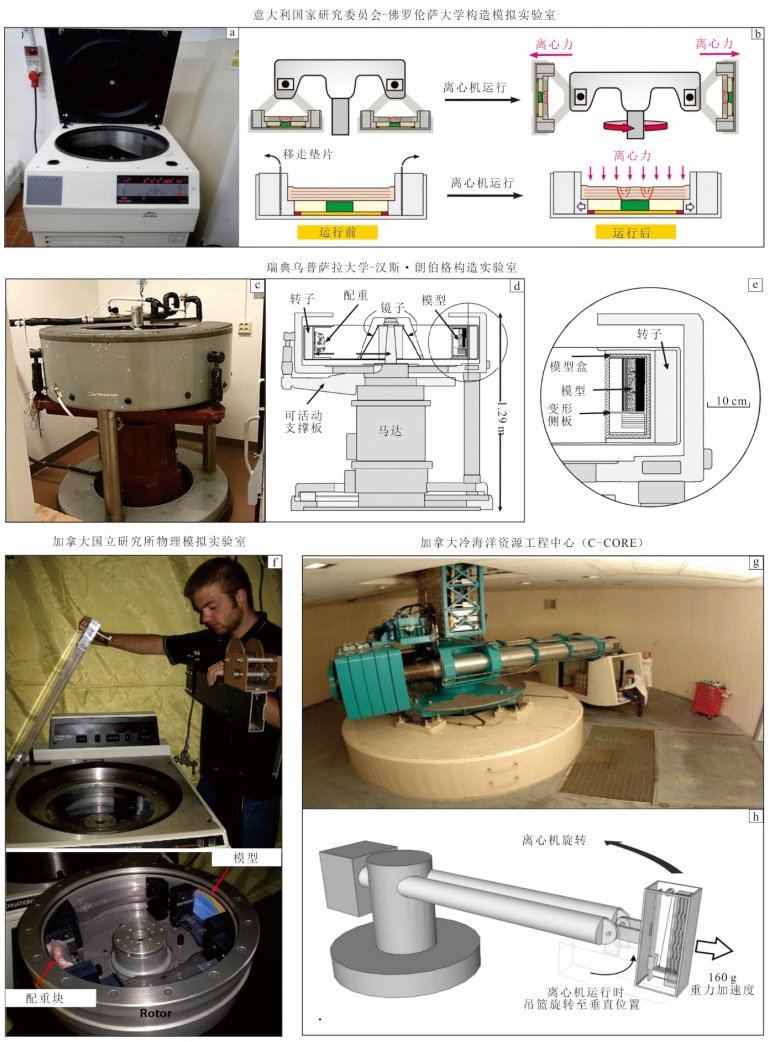
图 1 全球不同实验室开展超重力物理模拟实验使用的离心机设备
a.意大利国家研究委员会‒佛罗伦萨大学构造模拟实验配置的离心机;b. 运行示意(Milazzo et al.,2021;Zou et al.,2024);c~e.瑞典乌普萨拉大学汉斯·朗伯格构造实验室的离心机及模型设置(Harris and Koyi,2003);f.加拿大魁北克大学国立科学研究所使用的离心机及内部结构(Godin et al.,2011);g~h.加拿大冷海洋资源研究中心(C-CORE)的大型土工离心机(Noble and Dixon,2011)
Fig. 1. Centrifuges used for analogue modelling in different laboratories worldwide
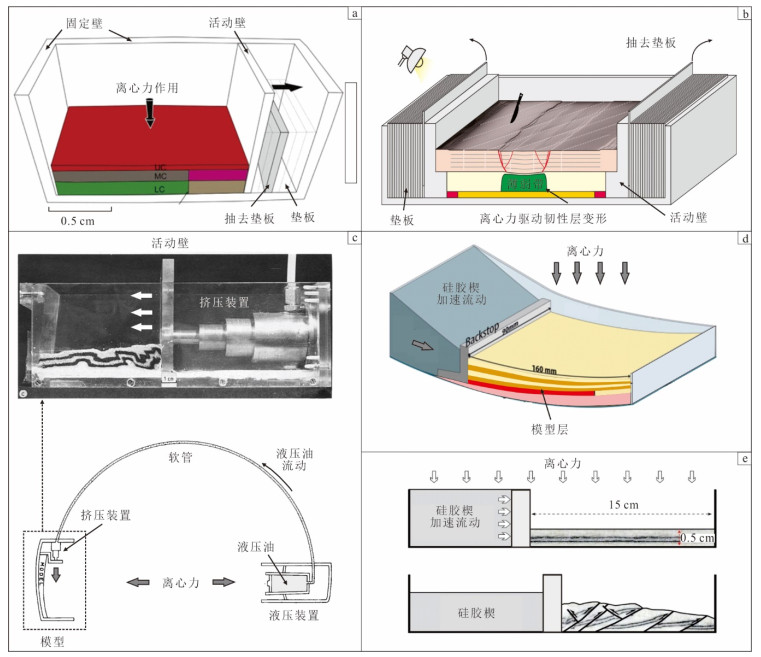
图 2 超重力模型的驱动方式
a.抽去单侧垫板(Nikkilä et al.,2015);b.抽去双侧垫板(Zou et al.,2024),通过离心力驱动韧性层流动变形来实现伸展应力的施加;c.通过离心机内置液压装置施加挤压应力(Mulugeta,1988b);d~e.通过离心力加速侧边硅胶楔流动来施加挤压应力(Milazzo et al.,2021;Santolaria et al.,2022)
Fig. 2. Driving mechanisms of centrifuge models
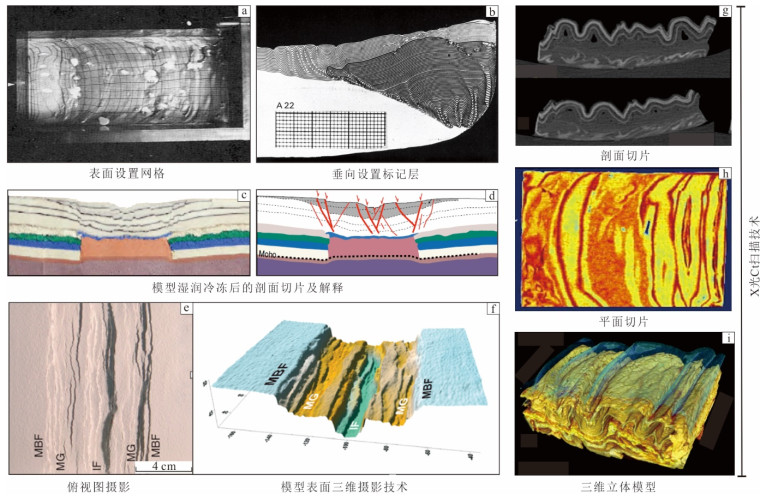
图 3 超重力模型的监测技术的发展
a.在模型表面设置网格分析应变(Koyi,1988);b.垂向设置标记层分析几何变形(Dixon and Summers,1985);c.湿润冷冻模型后的剖面切片;d. 剖面解释(Corti et al.,2013a);e. 模型的俯视图摄影;f. 表面三维摄影(Agostini et al.,2009);基于CT扫描技术的模型剖面切片(g)、平面切片(h)、三维立体建模(i)(Harris et al.,2012b)
Fig. 3. Development of monitoring techniques in centrifuge modelling
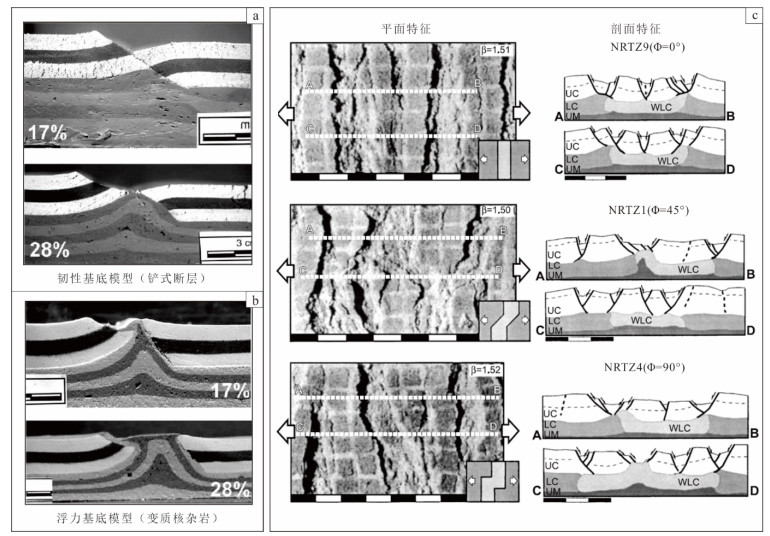
图 4 早期较典型的伸展构造超重力模拟实验
a.铲式断层;b.变质核杂岩形成演化过程(Koyi and Skelton,2001);c.不同类型转换带的裂谷盆地模拟实验结果,在平面断裂特征、岩石圈剖面结构上均有明显差异(Corti,2004),其中UC为上地壳,LC为下地壳,LM为岩石圈地幔,WLC为薄弱下地壳,Φ为转换带处薄弱下地壳的走向
Fig. 4. Representative early centrifuge modelling of continental extension
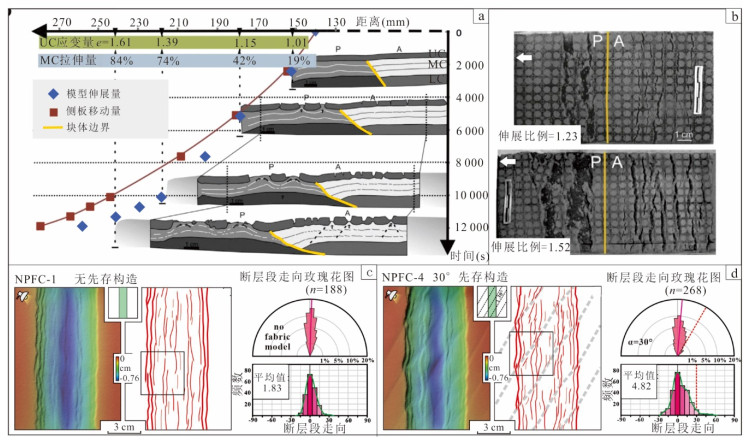
图 5 伸展构造超重力模拟实验及定量化分析
a~b.碰撞后造山带伸展过程的超重力实验(Nikkilä et al.,2015);a.展示了活动壁、模型伸展量与模型剖面的演化过程,上地壳(UC)的拉伸量以应变量表示,塑性中地壳(MC)的对应拉伸量以百分比表示,随时间推移,块体边界发生伸展、旋转并形成铲状形态,中地壳(MC)内发育穹窿构造和构造剥露;b.俯视图照片显示上地壳(浅灰色区域)的破裂特征,以及折返剥露的中地壳(深灰色区域)的平面展布范围.c~d.上地壳先存构造影响裂谷断层的超重力物理模拟实验结果(Zou et al.,2024),两个模型的俯视图、断层解释、断层段走向的玫瑰花图与直方图具有显著差异
Fig. 5. Centrifuge models and quantitative analysis of continental extension
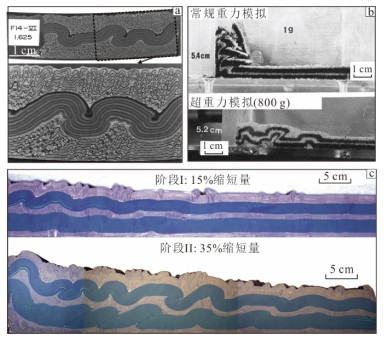
图 6 挤压构造超重力模拟的探索性实验
a.弱‒强‒弱地层序列模型的剖面变形及放大图片,弱地层中具有更多且规模更小的褶皱(Dixon and Tirrul,1991);b.常规重力模拟与超重力模拟的对比,超重力模拟更加强调重力的作用(Mulugeta,1988b);c.应用大型土工离心机进行的大尺寸褶皱模拟结果(Noble and Dixon,2011)
Fig. 6. Exploratory centrifuge modelling of compressional tectonics
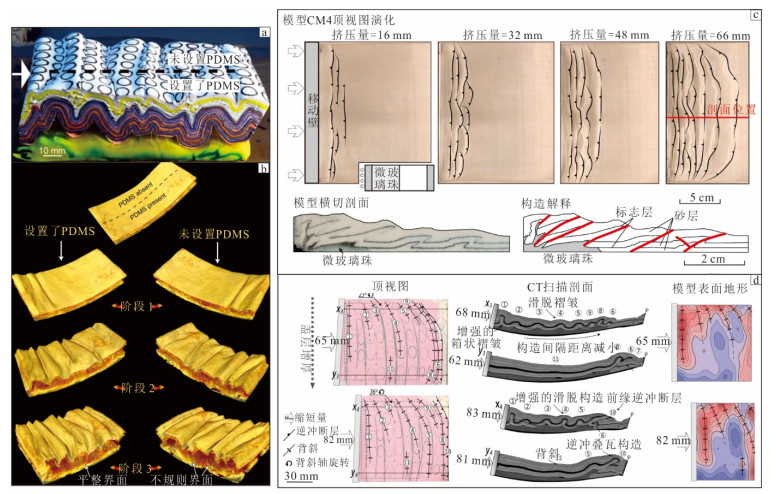
图 7 代表性的挤压构造超重力模拟实验
a.基底‒盖层界面软弱层存在与否对褶皱构造几何样式的影响的超重力模型及;b.CT扫描三维建模结果(Yakymchuk and Godin,2012);c.基底滑脱层‒逆冲推覆构造的超重力模型,基底滑脱层之上更容易发育叠瓦状构造(Milazzo et al.,2021);d.楔状盖层逆冲推覆带超重力实验的顶视图、CT扫描剖面及模型表面地形,薄盖层区域易形成数量更多且更紧闭的褶皱,而厚盖层区域主要在逆冲前缘形成叠瓦状构造(Santolaria et al.,2022)
Fig. 7. Representative centrifuge models of compressional tectonics
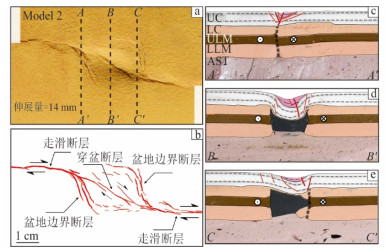
图 8 岩石圈尺度拉分盆地的超重力物理模拟实验
据Corti and Dooley(2015).a.模型的顶视图;b.模型的顶视图解释;c,d,e.模型岩石圈不同剖面切片,其中UC为上地壳,LC为下地壳,ULM为岩石圈地幔上部,LLC为岩石圈地幔下部,AST为软流圈
Fig. 8. Centrifuge modelling of lithosphere-scale strike-slip pull-apart basins
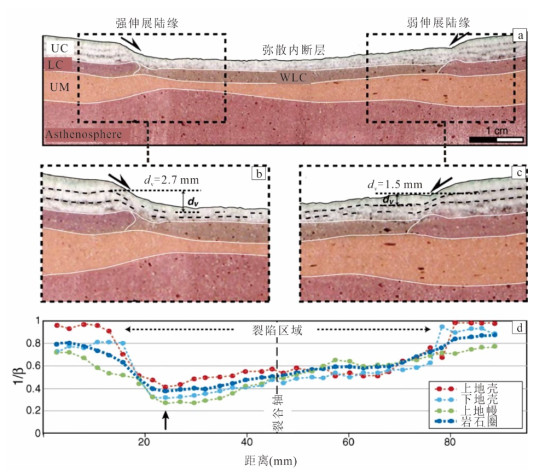
图 9 不对称陆缘形成的超重力物理模拟实验
据Corti and Manetti(2006)a.不对称陆缘模型的横切剖面,其中UC为上地壳,LC为下地壳,UM为岩石圈地幔;b.强伸展陆缘区域的放大图,dv为陆架与洋底标志层的垂向距离;c.弱伸展陆缘;d.地壳、地幔及岩石圈的减薄系数1/β与距离的投图,1/β即各圈层初始厚度与最终厚度的比值.1/β数值越小,表明岩石圈减薄程度越高,反之则减薄程度越低
Fig. 9. Centrifuge modelling of asymmetric continental margins
表 1 主要超重力构造物理模拟实验室设备及应用对比
Table 1. Comparison of major centrifuge facilities and their applications in tectonic analogue modelling
实验室 设备类型与参数 技术特点 主要研究对象 参考文献 瑞典乌普萨拉大学HRTL 大功率离心机(约3 000~5 000 rpm) 最早的构造离心机应用,高转速强重力场;支持多层流变结构 裂谷、岩浆-构造耦合、拆离断层、俯冲启动 Harris and Koyi(2003) 意大利佛罗伦萨TOOLab 悬挂吊篮式离心机(PM980R) 可使用离散砂状材料;高分辨率表面监测 裂谷、逆冲楔、拉分盆地 Corti (2012); Zou et al. (2024) 加拿大INRS实验室 高加速度离心机(~1 000 g)+ CT扫描 内部结构三维/四维成像;可视化演化过程 褶皱-逆冲带、滑脱层控制构造 Godin et al.(2011) 中国浙江大学 大型超重力离心平台(ZJU-400) 机载相机、三维扫描和PIV分析;多期复杂动力加载 青藏高原通道流等 Chen et al.(2026)  下载: 导出CSV
表 2 常规重力构造物理模拟与超重力构造物理模拟实验对比
Table 2. Comparison of centrifuge and normal gravity tectonic analogue modelling experiments
对比方面 常规重力场构造物理模拟 超重力场构造物理模拟 实验原理 正常重力场,g*值为1 超重力场,g*值可达1 000 实验装置 砂箱装置 离心机装置 模型尺寸 模型尺寸更大,构造变形现象更丰富 模型尺寸较小,受限于离心机尺寸 模型材料 使用较弱韧性材料,难以构建复杂流变结构 可以使用强度更大的韧性材料,易于塑造特定的流变结构,岩石圈流变结构建模更容易 边界条件 定量的边界条件控制 更真实的应力‒流变耦合,边界干扰敏感 变形驱动力施加 通过电机等进行驱动,能够实现对速度、方向的精准控制,可以考虑多因素、多期次的影响 通过材料加速流动来实现,难以精准控制变形速度等参数,较难实现多期变形模拟 实验时间 实验的准备和持续时间较长(数天至一周) 实验的准备和持续时间较短(分钟‒天) 实验效果 实验结果与实际地质环境可能存在较大偏差 离心力均匀作用于模型,与地质原型更接近 实验监测 可以详细监测,实现全过程延时摄影,应用粒子图像测速(PIV)或数字图像相关(DIC)技术 可应用的监测方式有限,难以进行延时摄影,在应用DIC、PIV等技术上存在挑战
下载: 导出CSV
表 3 超重力构造物理模拟在不同构造类型中的应用
Table 3. Applications of centrifuge modelling in different tectonic settings
构造环境 常规物理模拟局限性 超重力模拟进展 方法优势 伸展构造 底板拖拽等边界效应影响实验效果 裂谷分段、断层迁移、先存构造控制机制明确 岩石圈尺度、多层流变结构 挤压构造 重力作用弱、流变耦合不足 滑脱层控制、褶皱‒逆冲断层演化、通道流机制 强化重力驱动、结构演化真实 走滑构造 三维结构模拟困难 拉分盆地结构及深浅耦合初步刻画 岩石圈尺度三维模拟潜力 岩浆/盐构造 流动过程难以真实再现 岩浆侵位、盐底辟与构造耦合机制 高效模拟高流动性物质 板块构造问题 难以约束深部动力学 裂解、俯冲启动、陆缘不对称机制 深部动力过程可视化
下载: 导出CSV
-
Abdelmalak, M. M., Bulois, C., Mourgues, R., et al., 2016. Description of New Dry Granular Materials of Variable Cohesion and Friction Coefficient: Implications for Laboratory Modeling of the Brittle Crust. Tectonophysics, 684: 39-51. https://doi.org/10.1016/j.tecto.2016.03.003 Agostini, A., Bonini, M., Corti, G., et al., 2011. Fault Architecture in the Main Ethiopian Rift and Comparison with Experimental Models: Implications for Rift Evolution and Nubia-Somalia Kinematics. Earth and Planetary Science Letters, 301(3/4): 479-492. https://doi.org/10.1016/j.epsl.2010.11.024 Agostini, A., Corti, G., Zeoli, A., et al., 2009. Evolution, Pattern, and Partitioning of Deformation during Oblique Continental Rifting: Inferences from Lithospheric‐Scale Centrifuge Models. Geochemistry, Geophysics, Geosystems, 10(11): 2009GC002676. https://doi.org/10.1029/2009GC002676 Ballard, S., Pollack, H. N., 1987. Diversion of Heat by Archean Cratons: A Model for Southern Africa. Earth and Planetary Science Letters, 85(1/2/3): 253-264. https://doi.org/10.1016/0012-821X(87)90036-7 Bonini, L., Fracassi, U., Bertone, N., et al., 2023. How do Inherited Dip-Slip Faults Affect the Development of New Extensional Faults Insights from Wet Clay Analog Models. Journal of Structural Geology, 169: 104836. https://doi.org/10.1016/j.jsg.2023.104836 Bonini, M., Sokoutis, D., Mulugeta, G., et al., 2001. Dynamics of Magma Emplacement in Centrifuge Models of Continental Extension with Implications for Flank Volcanism. Tectonics, 20(6): 1053-1065. https://doi.org/10.1029/2001tc900017 Boutelier, D., Schrank, C., Regenauer-Lieb, K., 2019.2-D Finite Displacements and Strain from Particle Imaging Velocimetry (PIV) Analysis of Tectonic Analogue Models with TecPIV. Solid Earth, 10(4): 1123-1139. https://doi.org/10.5194/se-10-1123-2019 Brun, J. P., 2002. Deformation of the Continental Lithosphere: Insights from Brittle-Ductile Models. Geological Society, London, Special Publications, 200(1): 355-370. https://doi.org/10.1144/gsl.sp.2001.200.01.20 Brun, J. P., Merle, O., 1985. Strain Patterns in Models of Spreading-Gliding Nappes. Tectonics, 4(7): 705-719. https://doi.org/10.1029/tc004i007p00705 Bucky, P., 1931. Use of Models for the Study of Mining Problems. The American Institute of Mining, Metallurgical, and Petroleum Engineers, Pennsylvania. Chen, X., Zhuang, D. Y., Zhan, L. T., et al., 2026. Study on the Role of Weak Lower Crust in Cenozoic Tectonic Deformation of Qinghai-Tibet Plateau by an Integrated Centrifugal Analog Modeling and Numerical Simulation Approach. Journal of Earth Science, 37(1): 137-154. https://doi.org/10.1007/s12583-025-0284-4 Chen, Y. M., 2020. Centrifugal Hypergravity Experiment: A Revolutionary Means to Explore the Evolution of Multiphase Media. Journal of Zhejiang University (Engineering Science), 54(4): 631-632 (in Chinese with English abstract). Corti, G., 2004. Centrifuge Modelling of the Influence of Crustal Fabrics on the Development of Transfer Zones: Insights into the Mechanics of Continental Rifting Architecture. Tectonophysics, 384(1-4): 191-208. https://doi.org/10.1016/j.tecto.2004.03.014 Corti, G., 2008. Control of Rift Obliquity on the Evolution and Segmentation of the Main Ethiopian Rift. Nature Geoscience, 1(4): 258-262. https://doi.org/10.1038/ngeo160 Corti, G., 2012. Evolution and Characteristics of Continental Rifting: Analog Modeling-Inspired View and Comparison with Examples from the East African Rift System. Tectonophysics, 522: 1-33. https://doi.org/10.1016/j.tecto.2011.06.010 Corti, G., Bonini, M., Conticelli, S., et al., 2003a. Analogue Modelling of Continental Extension: A Review Focused on the Relations between the Patterns of Deformation and the Presence of Magma. Earth-Science Reviews, 63(3-4): 169-247. https://doi.org/10.1016/S0012-8252(03)00035-7 Corti, G., Van Wijk, J., Bonini, M., et al., 2003b. Transition from Continental Break-up to Punctiform Seafloor Spreading: How Fast, Symmetric and Magmatic. Geophysical Research Letters, 30(12): 1-4. https://doi.org/10.1029/2003gl017374 Corti, G., Bonini, M., Innocenti, F., et al., 2001. Centrifuge Models Simulating Magma Emplacement during Oblique Rifting. Journal of Geodynamics, 31(5): 557-576. https://doi.org/10.1016/S0264-3707(01)00032-1 Corti, G., Calignano, E., Petit, C., et al., 2011. Controls of Lithospheric Structure and Plate Kinematics on Rift Architecture and Evolution: An Experimental Modeling of the Baikal Rift. Tectonics, 30(3): 2011TC002871. https://doi.org/10.1029/2011tc002871 Corti, G., Dooley, T. P., 2015. Lithospheric-Scale Centrifuge Models of Pull-apart Basins. Tectonophysics, 664: 154-163. https://doi.org/10.1016/j.tecto.2015.09.004 Corti, G., Iandelli, I., Cerca, M., 2013a. Experimental Modeling of Rifting at Craton Margins. Geosphere, 9(1): 138-154 doi: 10.1130/GES00863.1 Corti, G., Philippon, M., Sani, F., et al., 2013b. Re-Orientation of the Extension Direction and Pure Extensional Faulting at Oblique Rift Margins: Comparison between the Main Ethiopian Rift and Laboratory Experiments. Terra Nova, 25(5): 396-404. https://doi.org/10.1111/ter.12049 Corti, G., Ranalli, G., Agostini, A., et al., 2013c. Inward Migration of Faulting during Continental Rifting: Effects of Pre-Existing Lithospheric Structure and Extension Rate. Tectonophysics, 594: 137-148. https://doi.org/10.1016/j.tecto.2013.03.028 Corti, G., Manetti, P., 2006. Asymmetric Rifts Due to Asymmetric Mohos: An Experimental Approach. Earth and Planetary Science Letters, 245(1/2): 315-329. https://doi.org/10.1016/j.epsl.2006.02.004 Del Ventisette, C., Bonini, M., Agostini, A., et al., 2019. Using Different Grain-Size Granular Mixtures (Quartz and K-Feldspar Sand) in Analogue Extensional Models. Journal of Structural Geology, 129: 103888. https://doi.org/10.1016/j.jsg.2019.103888 Dietl, C., Koyi, H., 2011. Sheets within Diapirs-Results of a Centrifuge Experiment. Journal of Structural Geology, 33(1): 32-37. https://doi.org/10.1016/j.jsg.2010.10.010 Dixon, J. M., Simpson, D. G., 1987. Centrifuge Modelling of Laccolith Intrusion. Journal of Structural Geology, 9(1): 87-103. https://doi.org/10.1016/0191-8141(87)90046-0 Dixon, J. M., Summers, J. M., 1983. Patterns of Total and Incremental Strain in Subsiding Troughs: Experimental Centrifuged. Models of Inter-Diapir Synclines. Canadian Journal of Earth Sciences, 20(12): 1843-1861. https://doi.org/10.1139/e83-175 Dixon, J. M., Summers, J. M., 1985. Recent Developments in Centrifuge Modelling of Tectonic Processes: Equipment, Model Construction Techniques and Rheology of Model Materials. Journal of Structural Geology, 7(1): 83-102. https://doi.org/10.1016/0191-8141(85)90117-8 Dixon, J. M., Tirrul, R., 1991. Centrifuge Modelling of Fold-Thrust Structures in a Tripartite Stratigraphic Succession. Journal of Structural Geology, 13(1): 3-20. https://doi.org/10.1016/0191-8141(91)90097-3 Donnadieu, F., Kelfoun, K., van Wyk de Vries, B., et al., 2003. Digital Photogrammetry as a Tool in Analogue Modelling: Applications to Volcano Instability. Journal of Volcanology and Geothermal Research, 123(1-2): 161-180. https://doi.org/10.1016/S0377-0273(03)00034-9 Ghosh, S. K., Ramberg, H., 1968. Buckling Experiments on Intersecting Fold Patterns. Tectonophysics, 5(2): 89-105. https://doi.org/10.1016/0040-1951(68)90083-8 Godin, L., Yakymchuk, C., Harris, L. B., 2011. Himalayan Hinterland-Verging Superstructure Folds Related to Foreland-Directed Infrastructure Ductile Flow: Insights from Centrifuge Analogue Modelling. Journal of Structural Geology, 33(3): 329-342. https://doi.org/10.1016/j.jsg.2010.09.005 Harris, L. B., Godin, L., Yakymchuk, C., 2012a. Regional Shortening Followed by Channel Flow Induced Collapse: A New Mechanism for "Dome and Keel" Geometries in Neoarchaean Granite-Greenstone Terrains. Precambrian Research, 212: 139-154. https://doi.org/10.1016/j.precamres.2012.04.022 Harris, L. B., Yakymchuk, C., Godin, L., 2012b. Implications of Centrifuge Simulations of Channel Flow for Opening out or Destruction of Folds. Tectonophysics, 526: 67-87. https://doi.org/10.1016/j.tecto.2011.05.002 Harris, L. B., Koyi, H. A., 2003. Centrifuge Modelling of Folding in High-Grade Rocks during Rifting. Journal of Structural Geology, 25(2): 291-305. https://doi.org/10.1016/S0191-8141(02)00018-4 Hubbert, M. K., 1937. Theory of Scale Models as Applied to the Study of Geologic Structures. Geological Society of America Bulletin, 48(10): 1459-1520. https://doi.org/10.1130/gsab-48-1459 Jackson, M. P. A., Talbot, C. J., 1986. External Shapes, Strain Rates, and Dynamics of Salt Structures. Geological Society of America Bulletin, 97(3): 305. https://doi.org/10.1130/0016-7606(1986)97305:essrad>2.0.co;2 doi: 10.1130/0016-7606(1986)97305:essrad>2.0.co;2 Jackson, M. P. A., Talbot, C. J., 1989. Anatomy of Mushroom-Shaped Diapirs. Journal of Structural Geology, 11(1-2): 211-230. https://doi.org/10.1016/0191-8141(89)90044-8 Jia, D., Yang, S. F., Yin, H. W., et al., 2023. Physical Modelling Experiments of Fold-Thrust Belts: A Review Based on Previous and New Experimental Models. Acta Geologica Sinica, 97(9): 2896-2913 (in Chinese with English abstract). Koyi, H., 1988. Experimental Modeling of Role of Gravity and Lateral Shortening in Zagros Mountain Belt. AAPG Bulletin, 72(11): 1381-1394. https://doi.org/10.1306/703c99ab-1707-11d7-8645000102c1865d Koyi, H., 1991. Gravity Overturns, Extension, and Basement Fault Activation. Journal of Petroleum Geology, 14(S1): 117-142. https://doi.org/10.1111/j.1747-5457.1991.tb00358.x Koyi, H., 1997. Analogue Modelling: From a Qualitative to a Quantitative Technique—A Historical Outline. Journal of Petroleum Geology, 20(2): 223-238. https://doi.org/10.1111/j.1747-5457.1997.tb00774.x Koyi, H., Petersen, K., 1993. Influence of Basement Faults on the Development of Salt Structures in the Danish Basin. Marine and Petroleum Geology, 10(2): 82-94. https://doi.org/10.1016/0264-8172(93)90015-K Koyi, H. A., Skelton, A., 2001. Centrifuge Modelling of the Evolution of Low-Angle Detachment Faults from High-Angle Normal Faults. Journal of Structural Geology, 23(8): 1179-1185. https://doi.org/10.1016/S0191-8141(00)00185-1 Liu, S. M., Dixon, J. M., 1991. Centrifuge Modelling of Thrust Faulting: Structural Variation along Strike in Fold-Thrust Belts. Tectonophysics, 188(1/2): 39-62. https://doi.org/10.1016/0040-1951(91)90313-H Mart, Y., Aharonov, E., Mulugeta, G., et al., 2005. Analogue Modelling of the Initiation of Subduction. Geophysical Journal International, 160(3): 1081-1091. https://doi.org/10.1111/j.1365-246x.2005.02544.x Michon, L., Sokoutis, D., 2005. Interaction between Structural Inheritance and Extension Direction during Graben and Depocentre Formation: An Experimental Approach. Tectonophysics, 409(1/2/3/4): 125-146. https://doi.org/10.1016/j.tecto.2005.08.020 Milazzo, F., Cavozzi, C., Corti, G., et al., 2021. Centrifuge Modelling of Thrust Systems in the Brittle Crust: Role of Frictional Décollement Geometry. Journal of Structural Geology, 153: 104450. https://doi.org/10.1016/j.jsg.2021.104450 Mulugeta, G., 1988a. Modelling the Geometry of Coulomb Thrust Wedges. Journal of Structural Geology, 10(8): 847-859. https://doi.org/10.1016/0191-8141(88)90099-5 Mulugeta, G., 1988b. Squeeze Box in a Centrifuge. Tectonophysics, 148(3-4): 323-335. https://doi.org/10.1016/0040-1951(88)90139-4 Nestola, Y., Storti, F., Cavozzi, C., 2015. Strain Rate-Dependent Lithosphere Rifting and Necking Architectures in Analog Experiments. Journal of Geophysical Research: Solid Earth, 120(1): 584-594. https://doi.org/10.1002/2014jb011623 Nikkilä, K., Korja, A., Koyi, H., et al., 2015. Analog Modeling of One-Way Gravitational Spreading of Hot Orogen: A Case Study from the Svecofennian Orogen, Fennoscandian Shield. Precambrian Research, 268: 135-152. https://doi.org/10.1016/j.precamres.2015.07.011 Noble, T. E., Dixon, J. M., 2011. Structural Evolution of Fold-Thrust Structures in Analog Models Deformed in a Large Geotechnical Centrifuge. Journal of Structural Geology, 33(2): 62-77. https://doi.org/10.1016/j.jsg.2010.12.007 Philippon, M., Corti, G., 2016. Obliquity along Plate Boundaries. Tectonophysics, 693: 171-182. https://doi.org/10.1016/j.tecto.2016.05.033 Philippon, M., Willingshofer, E., Sokoutis, D., et al., 2015. Slip Re-Orientation in Oblique Rifts. Geology, 43(2): 147-150. https://doi.org/10.1130/g36208.1 Ramberg, H., 1970. Folding of Laterally Compressed Multilayers in the Field of Gravity, I. Physics of the Earth and Planetary Interiors, 2(4): 203-232. https://doi.org/10.1016/0031-9201(70)90010-5 Ramberg, H., 1971. Folding of Laterally Compressed Multilayers in the Field of Gravity, Ⅱ Numerical Examples. Physics of the Earth and Planetary Interiors, 4(2): 83-120. https://doi.org/10.1016/0031-9201(71)90006-9 Ramberg, H., 1981. The Role of Gravity in Orogenic Belts. Geological Society, London, Special Publications, 9(1): 125-140. https://doi.org/10.1144/gsl.sp.1981.009.01.11 Ramberg, H., 2010. Model Experimentation of the Effect of Gravity on Tectonic Processes. Geophysical Journal of the Royal Astronomical Society, 14(1/2/3/4): 307-329. https://doi.org/10.1111/j.1365-246x.1967.tb06247.x Ritter, M. C., Leever, K., Rosenau, M., et al., 2016. Scaling the Sandbox—Mechanical (Dis) Similarities of Granular Materials and Brittle Rock. Journal of Geophysical Research: Solid Earth, 121(9): 6863-6879. https://doi.org/10.1002/2016jb012915 Santolaria, P., Harris, L. B., Casas, A. M., et al., 2022. Influence of Décollement-Cover Thickness Variations in Fold-and-Thrust Belts: Insights from Centrifuge Analog Modeling. Journal of Structural Geology, 163: 104704. https://doi.org/10.1016/j.jsg.2022.104704 Schlagenhauf, A., Manighetti, I., Malavieille, J., et al., 2008. Incremental Growth of Normal Faults: Insights from a Laser-Equipped Analog Experiment. Earth and Planetary Science Letters, 273(3/4): 299-311. https://doi.org/10.1016/j.epsl.2008.06.042 Sokoutis, D., Corti, G., Bonini, M., et al., 2007. Modelling the Extension of Heterogeneous Hot Lithosphere. Tectonophysics, 444(1-4): 63-79. https://doi.org/10.1016/j.tecto.2007.08.012 Talbot, C. J., 1977. Inclined and Asymmetric Upward-Moving Gravity Structures. Tectonophysics, 42(2/3/4): 159-181. https://doi.org/10.1016/0040-1951(77)90166-4 Tentler, T., 2003. Analogue Modeling of Overlapping Spreading Centers: Insights into Their Propagation and Coalescence. Tectonophysics, 376(1/2): 99-115. https://doi.org/10.1016/j.tecto.2003.08.011 Tentler, T., Temperley, S., 2003. Segment Linkage during Evolution of Intracontinental Rift Systems: Insights from Analogue Modelling. Geological Society, London, Special Publications, 212(1): 181-196. https://doi.org/10.1144/gsl.sp.2003.212.01.12 Wu, Z. Y., Yang, X. L., Yin, H. W., et al., 2023. Characteristics and Influencing Factors of Salt Structure Evolution in Awate Transfer Zone, Western Kuqa Depression. Earth Science, 48(4): 1271-1287 (in Chinese with English abstract). Xu, Y. G., Chen, J., 2025. China's Deep Earth Science Development Strategy 2035. Science Press, Beijing (in Chinese). Xu, Z. P., Yang, G. X., Luo, H. Y., et al., 2024. The Influence Lithologic Differences at Different Depths on the Segmentation between the Eastern and the Western Zones of Kuqa Depression. Earth Science, 49(8): 3029-3042 (in Chinese with English abstract). Yakymchuk, C., Godin, L., 2012. Coupled Role of Deformation and Metamorphism in the Construction of Inverted Metamorphic Sequences: An Example from Far-Northwest Nepal. Journal of Metamorphic Geology, 30(5): 513-535. https://doi.org/10.1111/j.1525-1314.2012.00979.x Yang, S. F., Jia, C. Z., Chen, H. L., et al., 2022. Core Theories of Sedimentary Basin Structure and the Related Key Research Techniques: Frontiers and Development Directions. Earth Science Frontiers, 29(6): 10-23 (in Chinese with English abstract). Zhou, W. W., Dong, Y. P., Xiao, A. C., et al., 2023. Effect of Strike-Slip Activity of Basement Faults on Hydrocarbon Accumulation in Dongying Sag. Earth Science, 48(7): 2718-2732 (in Chinese with English abstract). Zou, Y. Y., 2024. The Influence of Preexisting Structures on the Cenozoic Tectonic Evolution of Western Branch of the East African Rift Basin: Insights from Analog Modeling (Dissertation). China University of Geosciences, Wuhan (in Chinese with English abstract). Zou, Y. Y., Maestrelli, D., Corti, G., et al., 2024. Influence of Inherited Brittle Fabrics on Continental Rifting: Insights from Centrifuge Experimental Modeling and Application to the East African Rift System. Tectonics, 43: e2023TC007947. https://doi.org/10.1029/2023tc007947 Zwaan, F., Corti, G., Keir, D., et al., 2020. Analogue Modelling of Marginal Flexure in Afar, East Africa: Implications for Passive Margin Formation. Tectonophysics, 796: 228595. https://doi.org/10.1016/j.tecto.2020.228595 Zwaan, F., Schreurs, G., 2023. Analog Models of Lithospheric-Scale Rifting Monitored in an X-Ray CT Scanner. Tectonics, 42(3): e2022TC007291. https://doi.org/10.1029/2022tc007291 陈云敏, 2020. 离心超重力实验: 探索多相介质演变的革命性手段. 浙江大学学报(工学版), 54(4): 631-632. 贾东, 杨树锋, 尹宏伟, 等, 2023. 褶皱冲断带物理模拟实验研究进展. 地质学报, 97(9): 2896-2913. 吴珍云, 杨秀磊, 尹宏伟, 等, 2023. 库车坳陷西段阿瓦特构造转换带盐构造演化特征及影响因素. 地球科学, 48(4): 1271-1287. 徐义刚, 陈骏, 2025. 中国深地科学2035发展战略. 北京: 科学出版社. 徐振平, 杨庚兄, 罗浩渝, 等, 2024. 不同深度岩性差异对库车坳陷构造分段特征的影响. 地球科学, 49(8): 3029-3042. doi: 10.3799/dqkx.2022.391 杨树锋, 贾承造, 陈汉林, 等, 2022. 沉积盆地构造核心理论和关键技术方法: 前沿与发展方向. 地学前缘, 29(6): 10-23. 周维维, 董有浦, 肖安成, 等, 2023. 东营凹陷基底断裂走滑活动对油气成藏的影响. 地球科学, 48(7): 2718-2732. doi: 10.3799/dqkx.2022.398 邹耀遥, 2024. 先存构造对东非裂谷盆地西支新生代构造演化的影响(博士学位论文). 武汉: 中国地质大学. -

 点击查看大图
计量
- 文章访问数: 100
- HTML全文浏览量: 16
- PDF下载量: 13
- 被引次数: 0
