




An Intelligent Inferring Method of Deep Formation Drillability Based on Drillability Knowledge Graph
-
摘要: 地层可钻性作为衡量钻进过程中地层被钻难易程度的关键指标,是合理选择钻进方法和优化钻进操作参数的重要依据. 针对深部地质钻进过程中可钻性信息获取成本高昂、许多岩石没有对应的地层可钻性范围标准等问题,提出一种基于可钻性知识图谱的深部在钻地层可钻性智能推断方法. 该方法首先构建包含岩石关键特征的可钻性知识图谱,设计基于岩石相似性度量的可钻性推理算法,将地矿行业标准中的67种地层可钻性级别推广至已知的292种岩石. 其次,通过钻孔地层岩性动态分析与可钻性智能推断,实时分析地层岩性分布,推断在钻地层可钻性级别. 最后,通过微钻实验和压入硬度实验验证所提方法的有效性. 该方法为深部地质钻进过程智能控制奠定了重要基础.Abstract: The formation drillability, as a key indicator for measuring the ease or difficulty of drilling the formation during the drilling process, serves as an important basis for rationally selecting drilling methods and optimizing drilling operational parameters. Addressing the issues of high cost in acquiring drillability information during deep geological drilling and the lack of corresponding formation drillability range standards for many rocks, this paper proposes an intelligent inference method for deep drilling formation drillability based on a drillability knowledge graph. Firstly, a drillability knowledge graph incorporating the key characteristics of rocks is constructed, and a drillability reasoning algorithm based on rock similarity measurement is designed. This approach extends the 67 rock drillability levels specified in the geomining industry standards to 292 known types of rocks. Secondly, through dynamic analysis of borehole formation lithology and intelligent inference of drillability, the distribution of formation lithology is analyzed in real-time, and the drillability level of the formation being drilled is inferred. Finally, the effectiveness of the proposed method is verified through micro-drilling experiments and indentation hardness tests. This method lays an important foundation for the intelligent control of the deep geological drilling process.
-
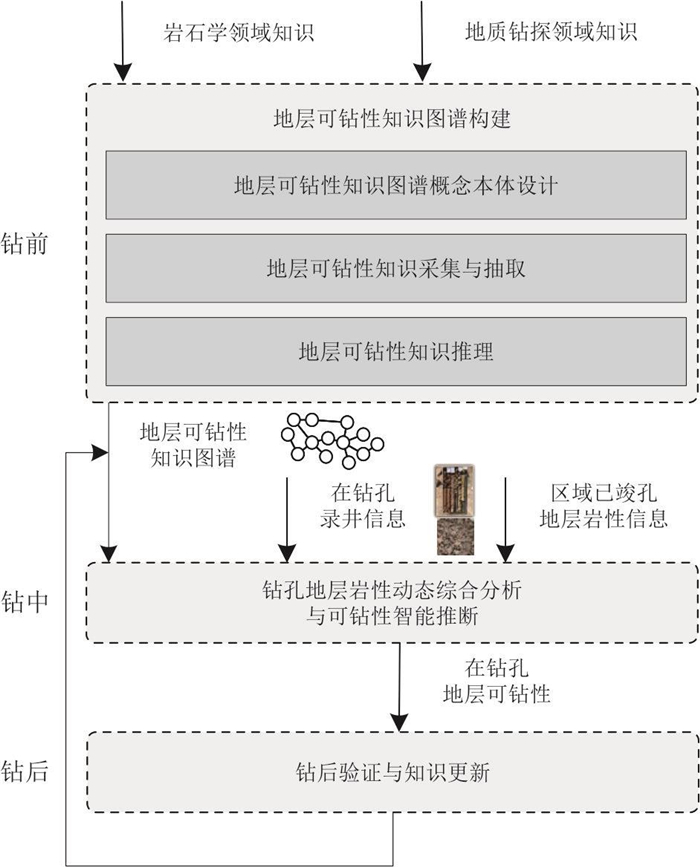
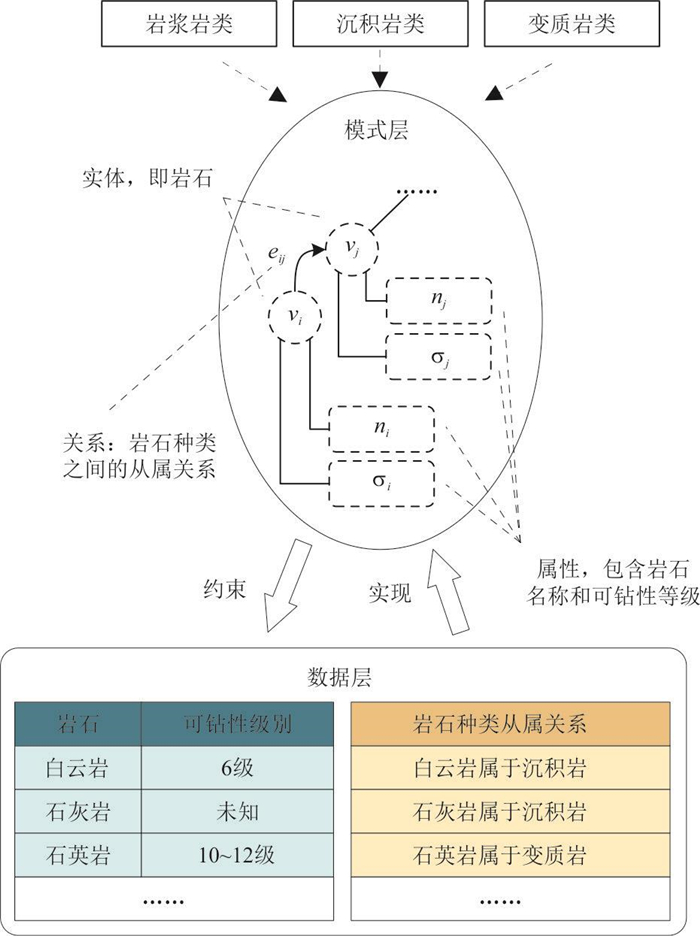
图 1 基于可钻性知识图谱的在钻地层可钻性智能推断框架
Fig. 1. An intelligent framework of drillability inferring method of in-drilling formation based on drillability knowledge graph
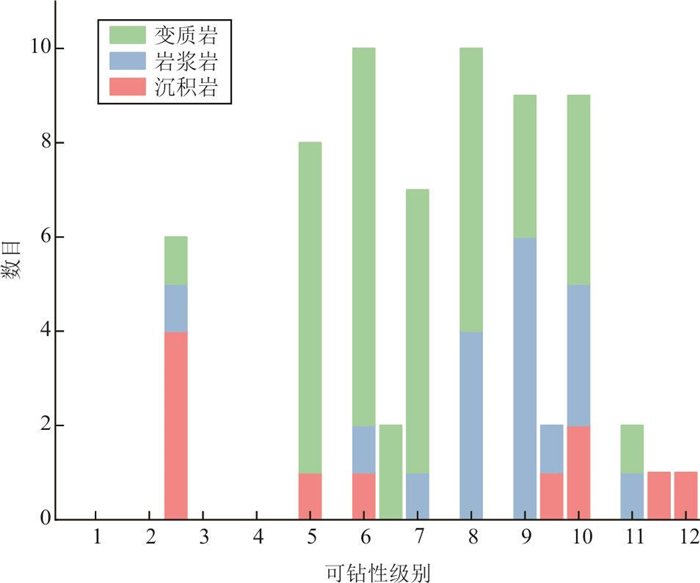
图 3 已知岩石的可钻性级别分布图
图中可钻性级别为其地层可钻性范围平均值
Fig. 3. A distribution chart of the drillability grades of known rocks
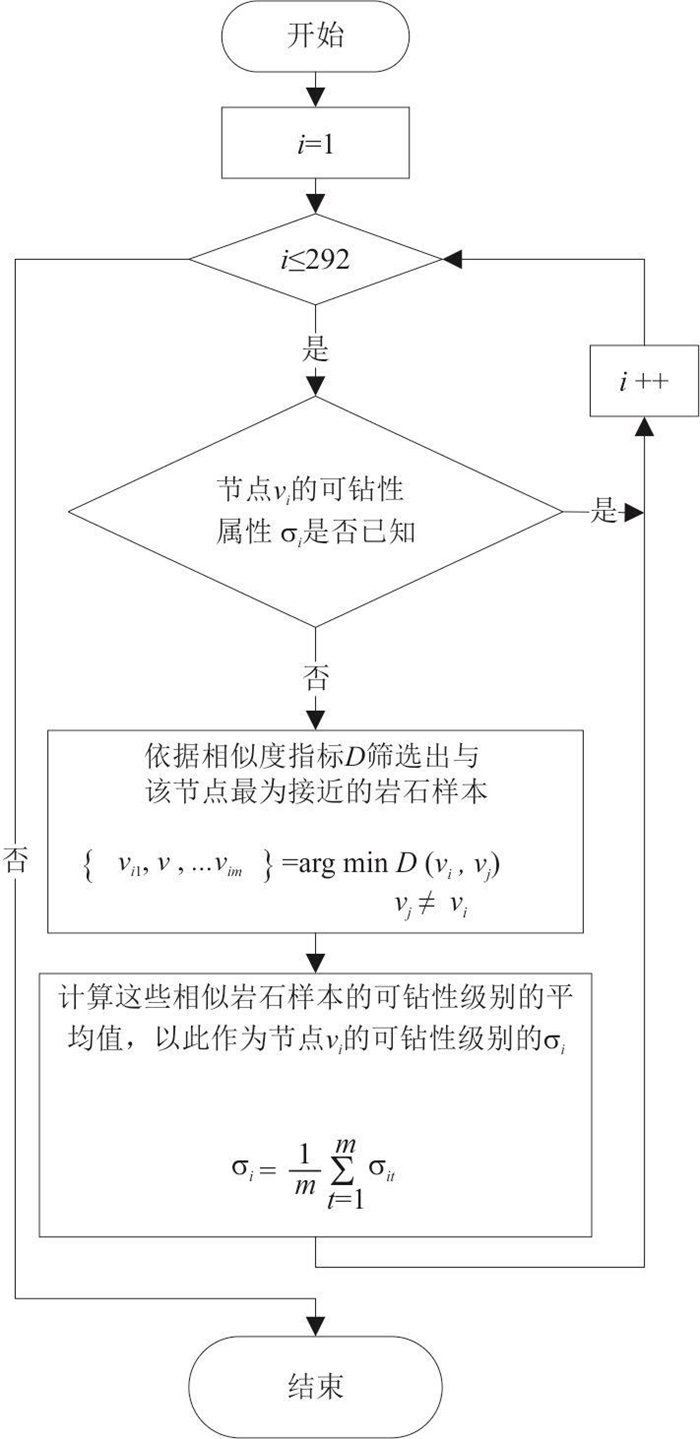
图 4 基于岩石相似度度量的可钻性推理算法流程图
Fig. 4. Flowchart of the drillability inference algorithm based on rock similarity measurement
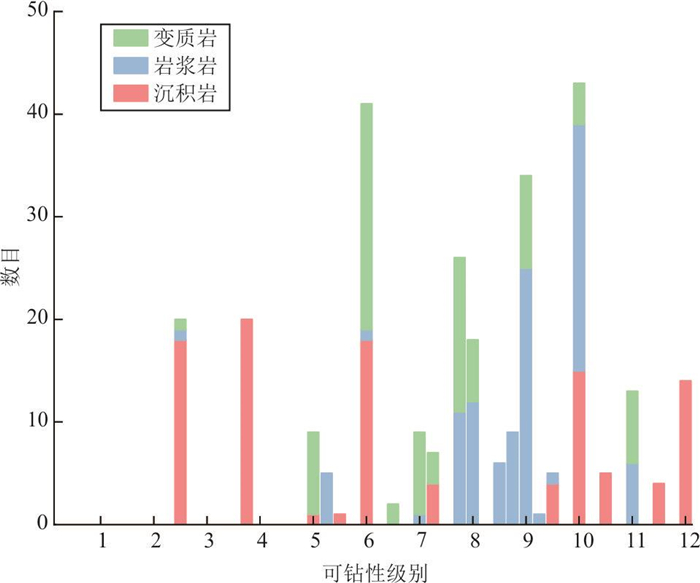
图 6 推算后所有岩石的可钻性级别分布图
同图 3说明
Fig. 6. A distribution chart of the drillability grades of all rocks after calculation
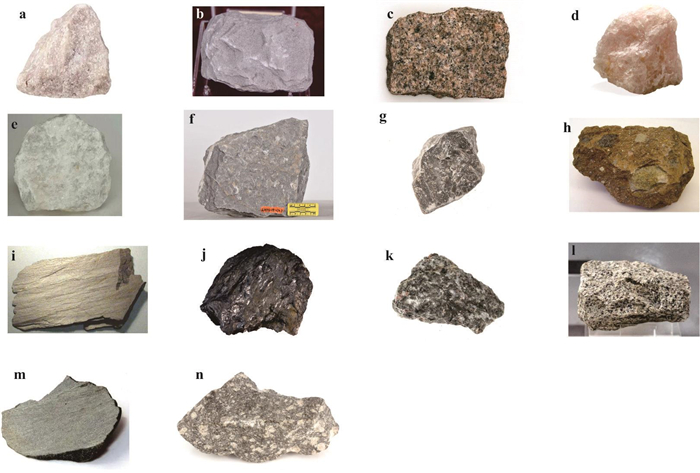
图 9 岩石样本图
a.白云岩dolomite;b. 中粒砂岩medium sandstone;c. 花岗岩moorstone;d. 石英岩quartzite;e.大理岩marble;f. 泥质页岩muddy shale;g. 石灰岩limestone;h. 角砾岩breccia;i. 千枚岩phyllite;j.片岩schist;k.麻粒岩granulite;l.霞石正长岩nepheline syenite;m.辉长岩gabbro;n. 火山角砾岩volcanic breccia
Fig. 9. Rock sample image
表 1 DZ/T 0227-2010地质岩心钻探规程中给出的地层可钻性分级表(自然资源部, 2010)
Table 1. DZ/T 0227-2010 The rock drillability classification table provided in the geological core drilling regulations(Ministry of Natural Resources, 2010)
地层可钻性级别 代表岩石举例 钻进时效(m/h) 1~4 粉砂质泥岩、碳质页岩、粉砂岩、中粒砂岩、透闪岩、煌斑岩 / 5 硅化粉砂岩、碳质硅页岩、滑石透闪岩、橄榄大理岩、白色大理岩、石英闪长玢岩、黑色片岩、透辉石大理岩、大理岩 2.90~3.60 6 角闪斜长片麻岩、白云斜长片麻岩、石英白云石大理岩、黑云母大理岩、白云岩、蚀变角闪闪长岩、角闪变粒岩、角闪岩、黑云母石英片岩、角岩、透辉石榴石矽卡岩、黑云白云母大理岩 2.30~3.10 7 白云斜长片麻岩、石英白云石大理岩、透辉石化闪长玢岩、混合岩化浅粒岩、黑云角闪斜长岩、透辉石岩、白云母大理岩、蚀变石英闪长玢岩、黑云角石英片岩 1.90~2.60 8 花岗岩、矽卡岩化闪长玢岩、石榴石矽卡岩、石英闪长斑岩、黑云母斜长角闪岩、伟晶岩、黑云母花岗岩、斜长角闪岩、石英角闪岩、混合片麻岩、凝灰岩、闪长岩、混合岩化浅粒岩 1.50~2.10 9 混合岩化浅粒岩、花岗岩、斜长角闪岩、混合闪长岩、斜长闪长岩、钾长伟晶岩、橄榄岩、混合岩、闪长玢岩、石英闪长玢岩、似斑状花岗岩、斑状花岗闪长岩 1.10~1.70 10 硅化大理岩、矽卡岩、混合斜长片麻岩、钠长斑岩、钾长伟晶岩、斜长角闪岩、安山质熔岩、混合岩化角闪岩、斜长岩、花岗岩、石英岩、硅质凝灰砂砾岩、英安质角砾熔岩 0.80~1.20 11 凝灰岩、熔凝灰岩、石英岩、英安岩 0.50~0.95 12 石英岩、硅质岩、熔凝灰岩 < 0.60  下载: 导出CSV
表 2 地层可钻性知识抽取结果
Table 2. The extracted knowledge regarding the drillability of rocks
岩石类型 岩浆岩 沉积岩 变质岩 总数 103 104 85 其中已知可钻性的岩石数量 18 11 38
下载: 导出CSV
表 3 9种常见岩石的可钻性智能推断结果与实验标定结果对比
Table 3. A comparison between the inferred results and experimental calibration outcomes for the drillability of nine common rock types
岩石类别 实验标定的可钻性级别 可钻性级别推断值 参考岩石 A 白云岩 6.82 6.00 白云岩 中粒砂岩 3.87 [1.00, 4.00] 中粒砂岩 花岗岩 8.22 [8.00, 10.00] 花岗岩 石英岩 12.00 [10.00, 12.00] 石英岩 大理岩 5.81 5.00 大理岩 B 泥质页岩 3.00 [3.00, 4.50] 碳质页岩、碳质硅页岩 石灰岩 5.17 6.00 白云岩 角砾岩 6.00 [6.50, 8.00] 粉砂岩、硅质岩 千枚岩 6.50 [6.80, 7.30] 大理岩、石英岩、黑色片岩、黑云角石英片岩、黑云母石英片岩、角闪斜长片麻岩、白云斜长片麻岩、斜长角闪岩、角闪岩、混合岩 片岩 7.00 6.00 黑云角石英片岩、黑云母石英片岩、黑色片岩 麻粒岩 7.00 [6.83, 7.67] 角闪斜长片麻岩、白云斜长片麻岩、斜长角闪岩、角闪岩、石英岩、大理岩 霞石正长岩 8.00 [7.40, 8.10] 闪长岩、斜长闪长岩、闪长玢岩、石英闪长玢岩、石英闪长斑岩、蚀变角闪闪长岩、钠长斑岩、安山质熔岩、煌斑岩、伟晶岩 辉长岩 9.00 10.00 斜长岩 火山角砾岩 10.00 [8.00, 11.00 ] 凝灰岩
下载: 导出CSV
-
Deng, H. J., Xiao, Y. F., Zheng, R. C., 2017. Concise Textbook of Petrology (4th Edition). Geological Publishing House, Beijing (in Chinese). Fu, M. C., 2020. Study on DC Index Correction. Mud Logging Engineering, 31(3): 8-13(in Chinese with English abstract). Feng, J. X., Yuan, S. Y., Luo, C. M., et al., 2025. Research and Application of Intelligent Evaluation Method for Formation Drillability Based on Multi-Source Data Fusion. Petroleum Science Bulletin, 10(5): 892-907(in Chinese with English abstract). Gan, C., Li, A., Cao, W. H., et al., 2016. Intelligent Nadaboost-ELM Modeling Method for Formation Drillability Using Well Logging Data. Journal of Advanced Computational Intelligence and Intelligent Informatics, 20(7): 1103-1111. https://doi.org/10.20965/jaciii.2016.p1103 Gan, C., Cao, W. H., Wu, M., et al., 2017. An Online Modeling Method for Formation Drillability Based on OS-Nadaboost-ELM Algorithm in Deep Drilling Process. IFAC-PapersOnLine, 50(1): 12886-12891. https://doi.org/10.1016/j.ifacol.2017.08.1941 Gan, C., Cao, W. H., Liu, K. Z., et al., 2020. Spatial Estimation for 3D Formation Drillability Field: A New Modeling Framework. Journal of Natural Gas Science and Engineering, 84(12): 103628. https://doi.org/10.1016/j.jngse.2020.103628 Gan, C., Cao, W. H., Liu, K. Z., et al., 2021. A New Spatial Modeling Method for 3D Formation Drillability Field Using Fuzzy C-Means Clustering and Random Forest. Journal of Petroleum Science and Engineering, 200(10): 108371. https://doi.org/10.1016/j.petrol.2021.108371 Gan, C., Wang, X., Wang, L. Z., et al., 2023. Dynamic Prediction Method of Drilling Rate in Deep Geological Drilling Based on Regional Multi-Well Data Optimization and Model Pre-Training. Drilling Engineering, 50(4): 1-8(in Chinese with English abstract). Li, W. Y., 2022. Prediction of Rock Drillability of Gypsum Interlayer Based on Fractal Theory and Modified Drilling Rate Equation. West-China Exploration Engineering, 34(2): 52-54(in Chinese). Li, Y. B., Li, Z. H., Hu, P. J., et al., 2023. Evaluation and Application of Rock Drill-Resistant Characteristics Based on Mineral Composition. Drilling & Production Technology, 46(6): 177-183(in Chinese with English abstract). Li, F. Q., Su, Q. Y., Liu, S. P., et al., 2024. Study and Application of Drillability of Red Bed Rock Strata in Changsha Basin. Drilling Engineering, 51(1): 51-57(in Chinese with English abstract). Liu, X., 2025. Launch of the National Science and Technology Major Project for Deep Earth Exploration "Ultra-Deep Scientific Drilling Technology and Equipment (over 10, 000 meters)". China Natural Resources News(in Chinese). Ma, H., Wang, Y. J., Wei, M. A., et al., 2008. A New Method for Predicting Formation Drillability Grade. Acta Petrolei Sinica, (5): 761-765(in Chinese with English abstract). Ma, H., Wang, Y. J., Hu, R., et al., 2010. Prediction of Formation Drillability Grade Based on Relevance Vector Machine. Journal of China University of Petroleum (Natural Science Edition), 34(2): 67-70(in Chinese with English abstract). Ministry of Natural Resources., 2010. DZ/T 0227-2010, Specifications for Geological Core Drilling. National Technical Committee for Standardization of Natural Resources and Territorial Spatial Planning(in Chinese). National Energy Administration., 2016. SY/T 5426-2016, Methods for Determination and Classification of Rock Drillability. Petroleum Drilling Engineering Professional Standardization Committee(in Chinese). Qin, Y., Yang, H., Cui, L., et al., 2026. Developing a Data-Knowledge Synergy-Driven Methodology for Co-Associated Minerals Knowledge Graph Construction. Earth Science, 51(2): 674-689(in Chinese with English abstract). Wang, D., He, Y. X., 2014. Geological Drilling Handbook. Central South University Press, Changsha (in Chinese). Wu, R. Z., Li, H., Mei, H. B., et al., 2025. A Landslide Monitoring and Early Warning System with Retrieval-Augmented Generation Enhanced by Knowledge Graph. Earth Science, 50(10): 4125-4136. (in Chinese with English abstract). Xiao, Y. Z., Zheng, S., Shi, J. C., et al., 2023. Knowledge Graph-Based Manufacturing Process Planning: A State-of-the-Art Review. Journal of Manufacturing Systems, 70(2): 417-435. https://doi.org/10.1016/j.jmsy.2023.08.006 Zhang, Y. X., Gao, X. Y., 2011. Study on Rock Drillability Based on Logging Data. Information System Engineering, (9): 97-98(in Chinese). 邓红江, 肖渊甫, 郑荣才, 2017. 岩石学简明教程第4版. 北京: 地质出版社. 冯建祥, 袁三一, 骆春妹, 等, 2025. 多源数据融合的地层可钻性智能评估方法研究及应用. 石油科学通报, 10(5): 892-907. 付明川, 2020. dc指数校正研究. 录井工程, 31(3): 8-13. 甘超, 汪祥, 王鲁朝, 等, 2023. 基于区域多井数据优选与模型预训练的深部地质钻探过程钻速动态预测方法. 钻探工程, 50(4): 1-8. 国家能源局, 2016. SY/T 5426-2016, 岩石可钻性测定及分级方法. 石油钻井工程专业标准化委员会. 李嵬岩, 2022. 分形理论及修正钻速方程预测石膏夹层岩石可钻性. 西部探矿工程, 34(2): 52-54. 李玉波, 李忠慧, 胡棚杰, 等, 2023. 基于矿物组分的岩石抗钻特性评价及应用. 钻采工艺, 46(6): 177-183. 李奋强, 粟琼玉, 刘素平, 等, 2024. 长沙盆地红层岩石地层可钻性研究及应用. 钻探工程, 51(1): 51-57. 刘烜, 2025. 深地国家科技重大专项"超万米科学钻探技术与装备"项目启动. 中国自然资源报. 马海, 王延江, 魏茂安, 等, 2008. 地层可钻性级值预测新方法. 石油学报, (5): 761-765. 马海, 王延江, 胡睿, 等, 2010. 基于相关向量机的地层可钻性级值预测. 中国石油大学学报(自然科学版), 34(2): 67-70. 秦颖, 杨慧, 崔柳, 等, 2026. 数据-知识协同驱动的共伴生矿产知识图谱构建方法. 地球科学, 51(2): 674-689. doi: 10.3799/dqkx.2025.268 王达, 何远信, 2014. 地质钻探手册. 长沙: 中南大学出版社. 吴润泽, 李浩, 梅红波, 等, 2025. 基于知识图谱检索增强生成的滑坡监测预警系统. 地球科学, 50(10): 4125-4136. doi: 10.3799/dqkx.2025.127 张亚旭, 高小燕, 2011. 基于测井资料的岩石可钻性研究. 信息系统工程, (9): 97-98. 自然资源部, 2010. DZ/T 0227-2010, 地质岩心钻探规程. 全国自然资源与国土空间规划标准化技术委员会. -

 点击查看大图
计量
- 文章访问数: 126
- HTML全文浏览量: 29
- PDF下载量: 22
- 被引次数: 0
