




Paleogene Structural Characteristics and Exploration Significance of Baiyun Sag in Pearl River Mouth Basin
-
摘要: 白云凹陷是我国深水油气勘探的前沿阵地,受地震资料深层反射信号弱、局部浅层气屏蔽、海沟影响等,古近纪深层结构和构造认识不清,影响了油气勘探进程.基于此,开展了全凹陷连片地震资料PSDM重处理,新资料基本消除了浅层气和海沟的影响,同时深层成像明显改善,可识别的低频同相轴明显增加.根据新的地震资料,开展了深层关键界面特征、构造层、结构分区及地壳破裂过程的综合分析.研究表明:珠江组沉积期以前,从下到上发育了四种类型共六个区域不整合界面;古近系从下到上可划分为五套构造层;按照断层发育方式及基底隆升位置的差异,白云凹陷可以分为三个构造区;按不整合面时空演化特征,划分了七个构造幕(均衡伸展幕,下地壳伸展幕、岩石圈伸展幕,不同方向伸展的三幕地幔剥露幕及最终形成边缘海的漂移幕).类比开平凹陷的油气成藏条件,推测白云凹陷下地壳伸展期发育的文四段为主力烃源岩,具有重要勘探前景.研究合理解释了白云凹陷复杂构造的成因,为古近纪构造演化、沉积体系迁移演化提供了全新构造框架,也为南海北部陆缘盆地其他凹陷构造对比研究提供了新思路,对深水油气勘探具有重要意义.Abstract: The Baiyun sag is the forefront of deep-water oil and gas exploration in China. Due to the weak deep reflection signal of seismic data, local shallow gas shielding and trench influence, the deep architecture and structure of Paleogene are not clearly understood, which affects the process of oil and gas exploration. Based on this, the PSDM reprocessing of the unified seismic data in the whole sag was carried out. The new data basically eliminated the influence of shallow gas and trenches, as a result, the deep imaging was significantly improved, and the identifiable low-frequency events increased clearly. Based on the new seismic data, a comprehensive analysis of the deep key interface characteristics, tectonic layers, structural zoning and crustal rupture process was carried out. The study shows that there are four types of six regional unconformity interfaces developed from bottom to top before the sedimentary period of Zhujiang Formation. The Paleogene can be divided into five sets of structural layers from bottom to top. According to the difference of fault development mode and basement uplift position, Baiyun sag can be divided into three structural areas. According to the temporal and spatial evolution characteristics of the unconformity surface, seven tectonic episodes are divided (balanced extension episode, lower crust extension episode, lithosphere extension episode, three episodes of mantle exhumation in different directions and the drift episode that eventually forms the marginal sea). By analogy with the oil and gas accumulation conditions in Kaiping sag, it is speculated that the fourth member of Wenchang Formation developed in the lower crust extension period of Baiyun sag is the main source rock, which has important exploration prospects. The study reasonably explains the genesis of complex structures in Baiyun sag, provides a new structural framework for Paleogene tectonic evolution and sedimentary system migration and evolution, and also provides a new idea for the comparative study of other sags in the northern continental margin basin of the South China Sea, which is of great significance for deep-water oil and gas exploration.
-
Key words:
- structure /
- unconformity /
- structural evolution /
- Baiyun sag /
- Paleogene /
- Pearl River Mouth basin /
- petroleum geology
-
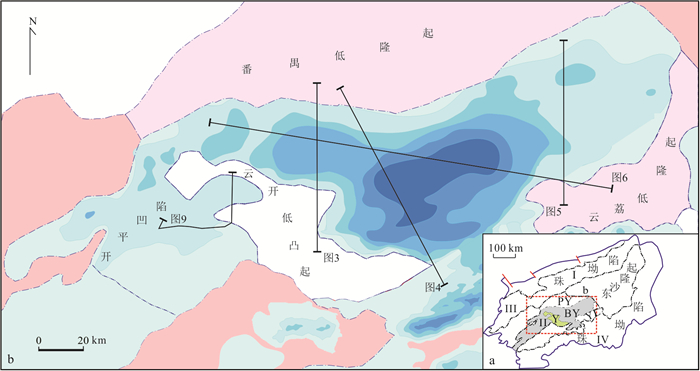
图 1 珠江口盆地构造单元划分及研究区位置
a.珠江口盆地位置;b.白云凹陷构造单元;字母说明:Ⅱ.珠Ⅱ坳陷;Ⅲ.珠Ⅲ坳陷;BY.白云凹陷;PY.番禺低隆起;Y.云开低凸起;YL.云荔低隆起
Fig. 1. The tectonic units of the Pearl River Mouth basin showing the location of the study area
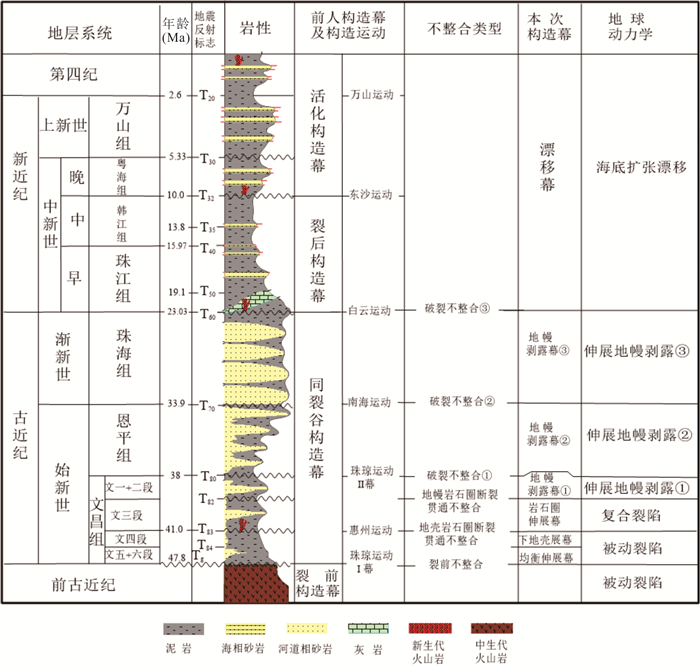
图 2 白云凹陷地层及构造属性综合柱状图
Fig. 2. Comprehensive histogram of structural attributes in Baiyun sag
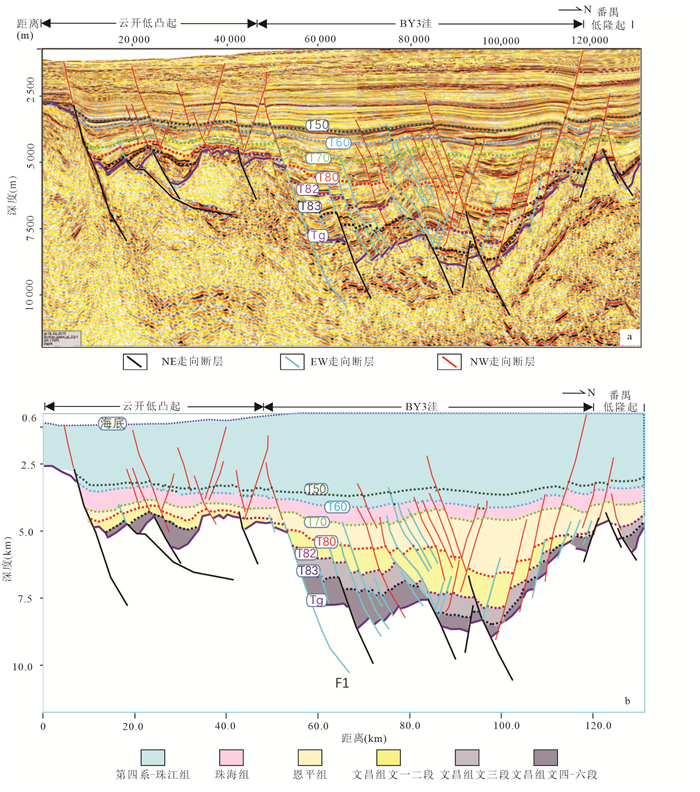
图 3 白云凹陷西洼典型结构剖面(SN向,剖面位置见图 1b,下同)
a.原始地震剖面;b.地质剖面
Fig. 3. Typical architecture section of Baiyun West sag
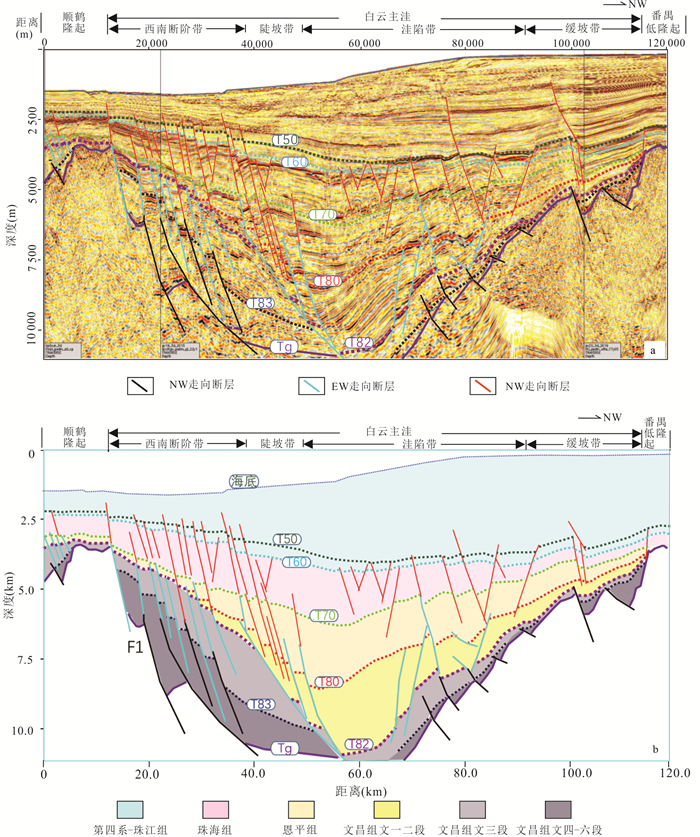
图 4 白云凹陷主洼典型结构剖面(NW-SE向)
a.原始地震剖面;b.地质剖面
Fig. 4. Typical architecture section of Baiyun Main sag
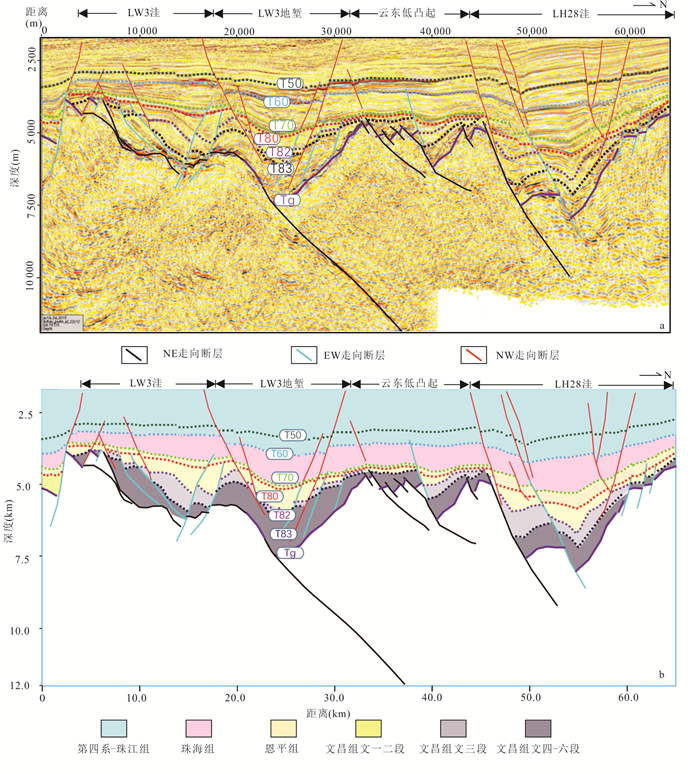
图 5 白云凹陷东洼典型结构剖面(SN向)
a.原始地震剖面;b. 地质剖面
Fig. 5. Typical architecture section of Baiyun East sag
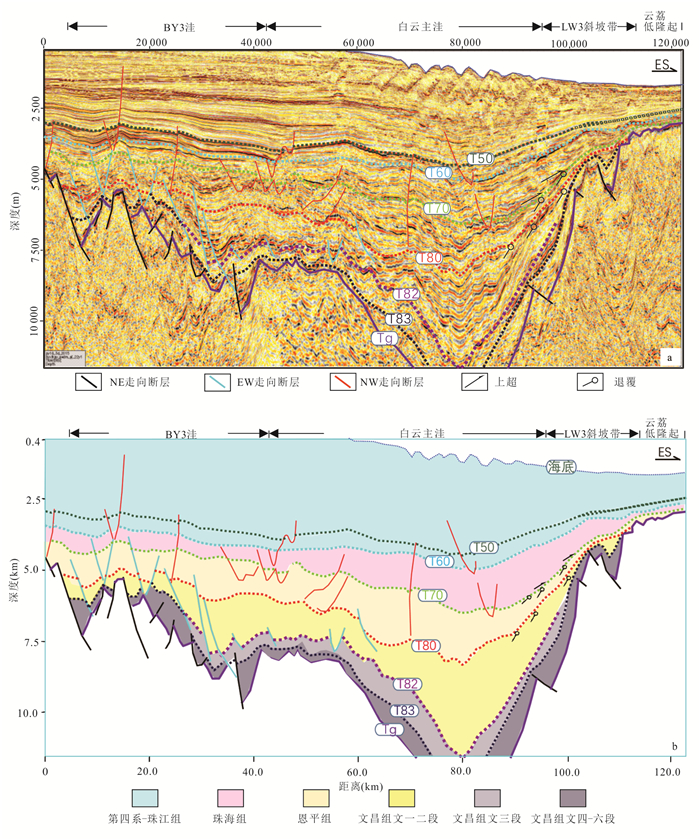
图 6 白云凹陷东洼典型结构剖面(EW向)
a.原始地震剖面;b.地质剖面
Fig. 6. Typical architecture section of Baiyun East sag
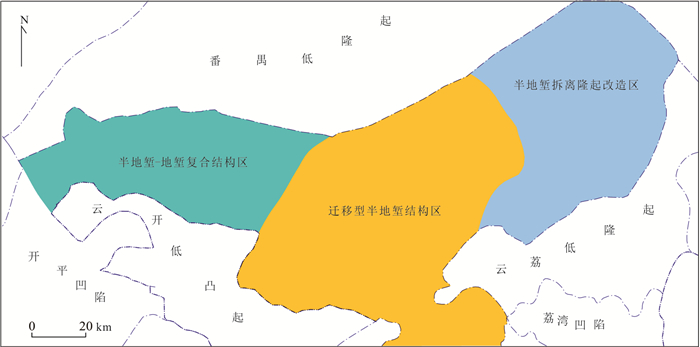
图 7 白云凹陷古近系结构平面分区
Fig. 7. Plane classification map of Paleogene architecture in Baiyun sag
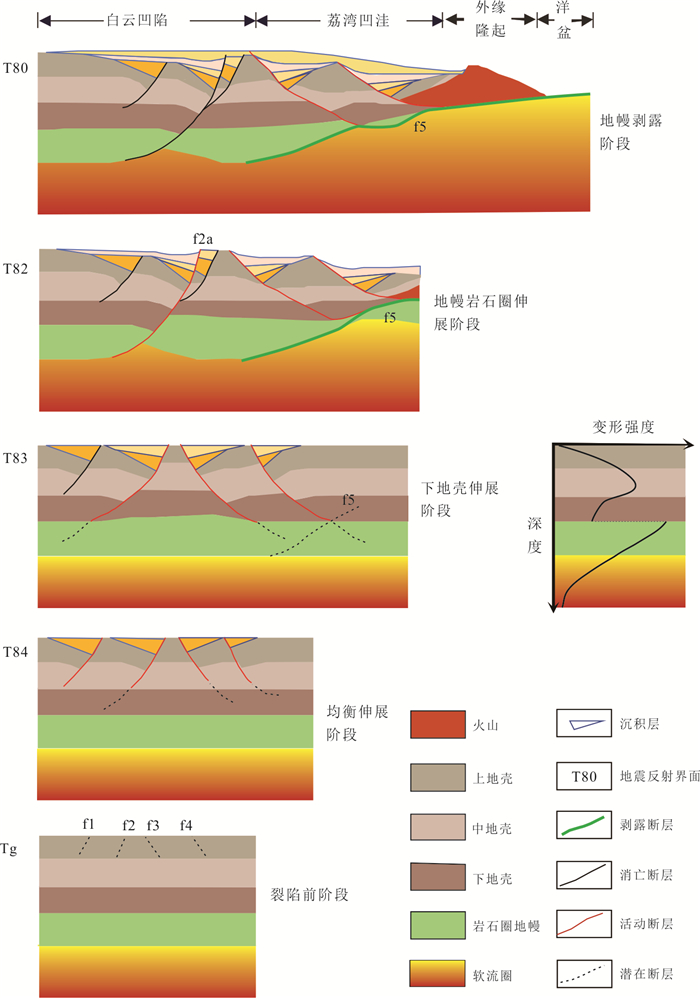
图 8 白云凹陷断裂活动与不整合面耦合演化模式
Fig. 8. The coupling evolution model diagram of fault activity and unconformity surface in Baiyun sag
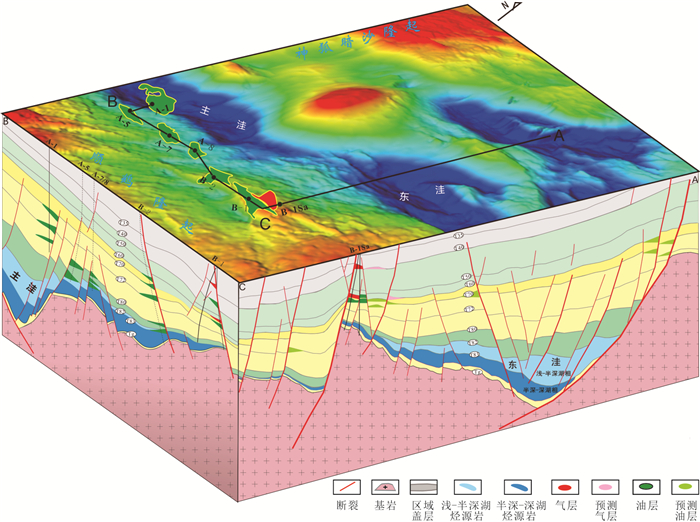
图 9 开平凹陷油气成藏模式(剖面位置见图 1)(据徐长贵等,2024)
Fig. 9. Oil and gas accumulation model diagram in Kaiping sag(Xu et al., 2024)
-
Dong, D. D., Wang, D. W., Zhang, G. C., et al., 2009. Cenozoic Tectonic and Sedimentary Evolution of Deepwater Area, Pearl River Mouth Basin. Journal of China University of Petroleum (Edition of Natural Science), 33(5): 17-22, 29 (in Chinese with English abstract). Gao, Y. D., Wang, X. D., Xu, L. Y., et al., 2025. Natural Gas Exploration History and Main Controlling Factors for Formation of Large and Medium Gas Fields in Baiyun Sag. China Offshore Oil and Gas, 37(3): 1-15 (in Chinese with English abstract). Ji, M., Zhang, G. C., Zhao, Z. G., et al., 2014. The Tectonic Evolution of Liwan Sag in the Deep-Water Area of the South China Sea and It Soil Geological Significance. Geological Bulletin of China, 33(5): 723-732 (in Chinese with English abstract). Li, M. B., Jin, X. L., Li, J. B., et al., 2005. Miocene Deposition and Palaeo-Slope Evolvement of the Middle Part of Northern Continental Slope in the South China Sea. Acta Oceanologica Sinica, 27(3): 73-79 (in Chinese with English abstract). Li, P. L., 1993. Cenozoic Tectonic Movement in the Pearl River Mouth Basin. China Offshore Oil and Gas, 5(6): 11-17 (in Chinese with English abstract). Li, P. L., Wang, W. P., He, Y. C., et al., 1989. The Tectonic Characters and Evolution of the Pearl River Mouth Basin. China Offshore Oil and Gas, 1(1): 11-18, 63-64 (in Chinese with English abstract). Lian, S. Y., He, M., Pang, X., et al., 2007. Research on Eocene Structure of Baiyun Sag in Deep-Water Area of Pearl River Mouth Basin. Acta Petrolei Sinica, 28(3): 13-16 (in Chinese with English abstract). Liao, J., Zhou, D., Zhao, Z. X., et al., 2011. Numerical Modeling of the Tectonic Evolution of Extensional Basin: Take Baiyun Sag of Northern South China Sea for Example. Geological Bulletin of China, 30(1): 71-81 (in Chinese with English abstract). Ma, B. S., 2020. The Cenozoic Structural Characteristics and Tectonic Evolution of the Pearl River Mouth Basin, Northern South China Sea (Dissertation). China University of Petroleum (Beijing), Beijing (in Chinese with English abstract). Pang, X., Zheng, J. Y., Ren, J. Y., et al., 2022. Structural Evolution and Magmatism of Fault Depression in Baiyun Sag, Northern Margin of South China Sea. Earth Science, 47(7): 2303-2316 (in Chinese with English abstract). https://doi.org/10.3799/dqkx.2022.064 Qiu, Y., Ju, D., Huang, W. K., et al., 2024. Re-Determination of the Initiation Time of the Seafloor Spreading of the Central Basin, South China Sea. Journal of Tropical Oceanography, 43(2): 154-165 (in Chinese with English abstract). Ren, J. Y., Lei, C., 2011. Tectonic Stratigraphic Framework of Yinggehai-Qiongdongnan Basins and Its Implication for Tectonic Province Division in South China Sea. Chinese Journal of Geophysics, 54(12): 3303-3314 (in Chinese with English abstract). Ren, J. Y., Pang, X., Yu, P., et al., 2018. Characteristics and Formation Mechanism of Deepwater and Ultra-Deepwater Basins in the Northern Continental Margin of the South China Sea. Chinese Journal of Geophysics, 61(12): 4901-4920 (in Chinese with English abstract). Shu, L. F., Zhang, L. L., Lei, S. L., et al., 2022. Evolution Characteristics and Controlling Factors of Shelf Break Zone in South Subsag of Baiyun Sag in Northern South China Sea. Oil Geophysical Prospecting, 57(3): 686-696, 495-496 (in Chinese with English abstract). Sun, Z., Pang, X., Zhong, Z. H., et al., 2005. Dynamics of Tertiary Tectonic Evolution of the Baiyun Sag in the Pearl River Mouth Basin. Earth Science Frontiers, 12(4): 489-498 (in Chinese with English abstract). Sutra, E., Manatschal, G., Mohn, G., et al., 2013. Quantification and Restoration of Extensional Deformation along the Western Iberia and Newfoundland Rifted Margins. Geochemistry, Geophysics, Geosystems, 14(8): 2575-2597. https://doi.org/10.1002/ggge.20135 Wang, F. G., Zhang, X. T., Mei, L. F., et al., 2023. Characteristics of Paleogene Compression-Extension Deformation and Exploration Significance in the Baiyun East Area, Pearl River Mouth Basin. Bulletin of Geological Science and Technology, 42(1): 246-252 (in Chinese with English abstract). Wu, P. K., 1998. Multistage Rifting and Petroleum Systems in the Northpart of South China Sea. Acta Petrolei Sinica, 19(3): 11-15 (in Chinese with English abstract). Xie, Y. H., 2024. New Insights and Future Research Focuses on Oil and Gas Exploration in the Continental Margin Deepwater Area of the Northern South China Sea. Natural Gas Industry, 44(1): 13-25, 201 (in Chinese with English abstract). Xu, C. G., Gao, Y. D., Liu, J., et al., 2024. Discovery of "Detachment-Core Complex Type" Basins Offshore the Northern South China Sea and Their Oil and Gas Geological Conditions: A Case Study of the Kaiping Sag in the Northern South China Sea. Earth Science Frontiers, 31(6): 381-404 (in Chinese with English abstract). Yang, H. C., Chen, Y., Ji, M., et al., 2017. Structural Evolution Difference and the Significance for Oil and Gas Exploration in the Deep Water Area of the Pearl River Mouth Basin. China Petroleum Exploration, 22(6): 59-68 (in Chinese with English abstract). Zhao, H. C., Zhu, X. M., Ge, J. W., et al., 2018. Forming Mechanism and Types Characteristics of Ocean-Continent Transition and Its Performance in Northern South China Sea. Geological Science and Technology Information, 37(4): 51-60 (in Chinese with English abstract). Zheng, J. Y., Gao, Y. D., Zhang, X. T., et al., 2022. Tectonic Evolution Cycles and Cenozoic Sedimentary Environment Changes in Pearl River Mouth Basin. Earth Science, 47(7): 2374-2390 (in Chinese with English abstract). Zheng, M., Jia, C. Z., Li, J. Z., et al., 2010. Oil and Gas-Rich Features in the Passive Margin Deep-Water Exploration Areas Worldwide and Comparison with the South China Sea Passive Continental Margin Deep-Water. Geological Science and Technology Information, 29(6): 45-54 (in Chinese with English abstract). 董冬冬, 王大伟, 张功成, 等, 2009. 珠江口盆地深水区新生代构造沉积演化. 中国石油大学学报(自然科学版), 33(5): 17-22, 29. 高阳东, 汪旭东, 徐乐意, 等, 2025. 白云凹陷天然气勘探历程与大中型气田形成主控因素. 中国海上油气, 37(3): 1-15. 纪沫, 张功成, 赵志刚, 等, 2014. 南海北部深水区荔湾凹陷构造演化及其石油地质意义. 地质通报, 33(5): 723-732. 黎明碧, 金翔龙, 李家彪, 等, 2005. 南海中北部中新世陆坡凹陷沉积充填与古陆坡形态演变. 海洋学报, 27(3): 73-79. 李平鲁, 1993. 珠江口盆地新生代构造运动. 中国海上油气, 7(6): 11-17. 李平鲁, 王维平, 贺亚纯, 等, 1989. 珠江口盆地构造特征及演化. 中国海上油气, 1(1): 11-18, 63-64. 连世勇, 何敏, 庞雄, 等, 2007. 珠江口盆地深水区白云凹陷始新世洼陷结构研究. 石油学报, 28(3): 13-16. 廖杰, 周蒂, 赵中贤, 等, 2011. 伸展盆地构造演化的数值模拟——以南海北部白云凹陷为例. 地质通报, 30(1): 71-81. 马兵山, 2020. 南海北部珠江口盆地新生代构造特征及其演化. 北京: 中国石油大学(北京). 庞雄, 郑金云, 任建业, 等, 2022. 南海北部陆缘超伸展区白云凹陷断陷结构演化与岩浆作用. 地球科学, 47(7): 2303-2316. doi: 10.3799/dqkx.2022.064 邱燕, 鞠东, 黄文凯, 等, 2024. 南海中央海盆海底初始扩张时间的重新认定. 热带海洋学报, 43(2): 154-165. 任建业, 雷超, 2011. 莺歌海‒琼东南盆地构造‒地层格架及南海动力变形分区. 地球物理学报, 54(12): 3303-3314. 任建业, 庞雄, 于鹏, 等, 2018. 南海北部陆缘深水‒超深水盆地成因机制分析. 地球物理学报, 61(12): 4901-4920. 舒梁锋, 张丽丽, 雷胜兰, 等, 2022. 南海北部白云南洼陆架坡折带演化特征及其控制因素. 石油地球物理勘探, 57(3): 686-696, 495-496. 孙珍, 庞雄, 钟志洪, 等, 2005. 珠江口盆地白云凹陷新生代构造演化动力学. 地学前缘, 12(4): 489-498. 王福国, 张向涛, 梅廉夫, 等, 2023. 珠江口盆地白云东区古近纪挤压‒伸展变形模式及勘探意义. 地质科技通报, 42(1): 246-252. 吴培康, 1998. 南海北部多幕裂陷作用与含油气系统. 石油学报, 19(3): 11-15. 谢玉洪, 2024. 南海北部陆缘盆地深水区油气勘探新认识及攻关方向. 天然气工业, 44(1): 13-25, 201. 徐长贵, 高阳东, 刘军, 等, 2024. 南海陆缘"拆离‒核杂岩型" 盆地发现与油气地质条件: 以南海北部开平凹陷为例. 地学前缘, 31(6): 381-404. 杨海长, 陈莹, 纪沫, 等, 2017. 珠江口盆地深水区构造演化差异性与油气勘探意义. 中国石油勘探, 22(6): 59-68. 赵宏超, 朱筱敏, 葛家旺, 等, 2018. 洋陆转换带类型特征和形成机理及其在南海北部的表现特征. 地质科技情报, 37(4): 51-60. 郑金云, 高阳东, 张向涛, 等, 2022. 珠江口盆地构造演化旋回及其新生代沉积环境变迁. 地球科学, 47(7): 2374-2390. doi: 10.3799/dqkx.2021.258 郑民, 贾承造, 李建忠, 等, 2010. 全球被动陆缘深水勘探领域富油气特征及与我国南海被动陆缘深水区对比. 地质科技情报, 29(6): 45-54. -

 下载:
下载:
 点击查看大图
计量
- 文章访问数: 19
- HTML全文浏览量: 8
- PDF下载量: 4
- 被引次数: 0
