




Pore-Scale Biofilm Evolution and Its Control on Dissolved Oxygen Distribution
-
摘要:
缺氧微区是多孔介质中重要的氧化还原反应热点区域,但对于其形成与演化机制并不完全清楚.基于自主构建的孔隙网络尺度微流控实验平台,结合微生物膜与溶解氧(dissolved oxygen,DO)原位可视化监测技术,系统研究了营养供给浓度与水动力条件对微生物膜生长及DO时空分布演化的影响机制,并在孔隙尺度下直接观测与解析了缺氧微区的形成与演化过程.微生物膜生长与营养供给浓度并非正相关.仅12.5 mg/L葡萄糖供给浓度搭配0.125水力梯度能使DO空间分布始终呈现“全局富氧-局部缺氧”的格局,从而维持持续性缺氧微区,其余场景仅能形成短暂性缺氧微区.营养供给浓度与水动力条件的协同作用,通过调控DO供给与消耗的动态平衡,主导了持续性缺氧微区的形成与演化.
Abstract:Anoxic microzone is an important redox reaction hotspot in porous media, however, the mechanism of its formation and evolution is not completely clear. Based on the self-built pore network-scale microfluidic experimental platform, combined with the in-situ visualization monitoring technology of biofilm and dissolved oxygen (DO), the effects of nutrient supply concentration and hydrodynamic conditions on the growth of microbial biofilm and the temporal and spatial distribution evolution of DO were systematically studied. The formation and evolution of anoxic microzones were directly observed and analyzed at the pore scale. Microbial membrane growth was not positively correlated with nutrient supply concentration. Only 12.5 mg/L glucose supply concentration combined with 0.125 hydraulic gradient can make the spatial distribution of DO always show the pattern of ' global oxic-local anoxic', so as to maintain the persistent anoxic microzone, and the other scenarios can only form temporary anoxic microzone. The synergistic effect of nutrient supply concentration and hydrodynamic conditions dominates the formation and evolution of persistent anoxic microzones by regulating the dynamic balance of DO supply and consumption.
-
Key words:
- biofilm /
- anoxic microzone /
- pore scale /
- microfluidics /
- dissolved oxygen /
- redox environment /
- environmental geology
-
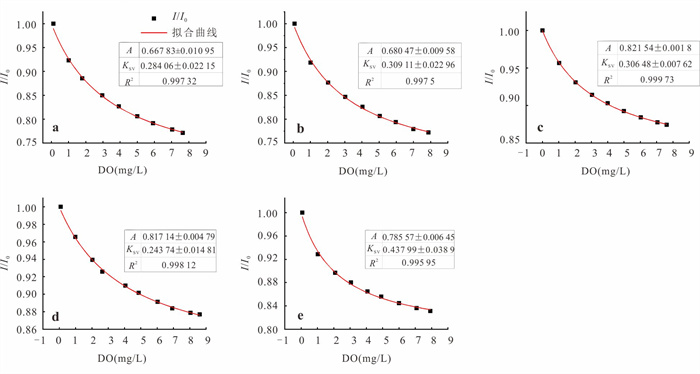
图 2 平面光极DO传感器拟合曲线
a~e依次对应N-1~N-5
Fig. 2. Fitting curves of DO calibration based on planar optode sensor
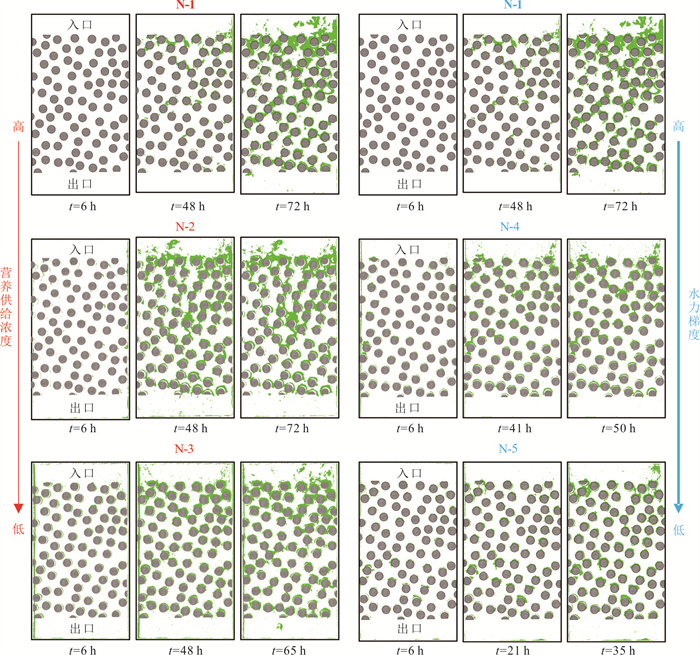
图 3 微生物膜时空分布
灰色为介质颗粒,绿色部分为微生物膜
Fig. 3. Spatial and temporal distribution of microbial membrane
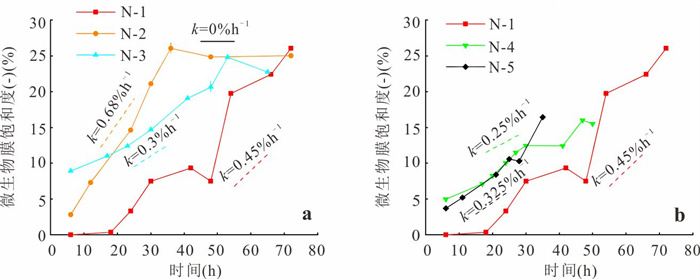
图 4 微生物膜饱和度随时间的变化
a.不同营养供给浓度;b.不同水力梯度
Fig. 4. The change of microbial membrane saturation with time
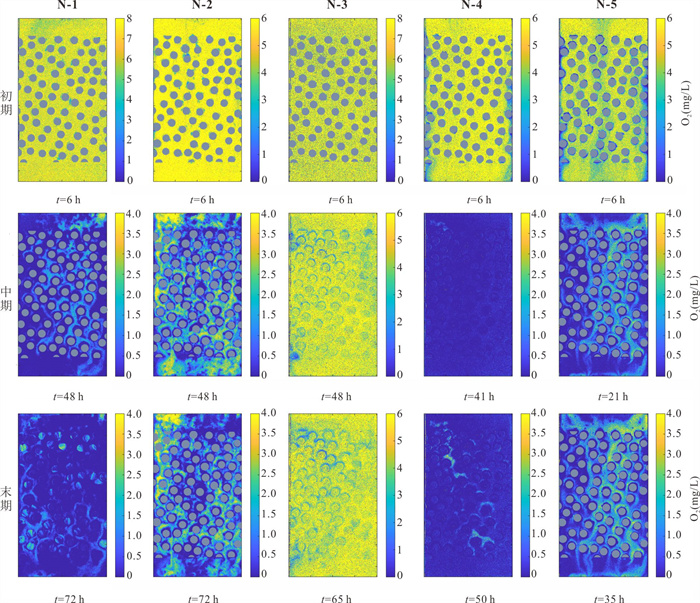
图 5 不同营养供给浓度、水力梯度条件下含水介质DO空间分布
Fig. 5. The spatial distribution of DO in aquifer medium under different nutrient supply concentrations and different hydraulic gradients
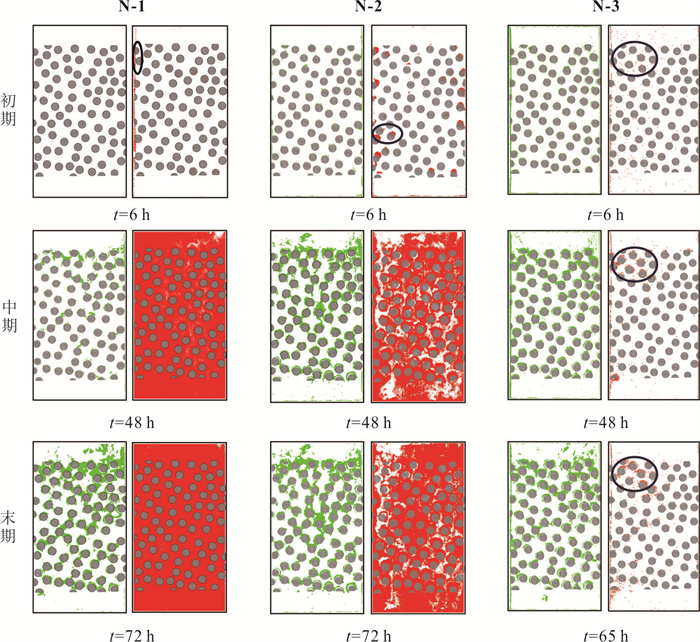
图 7 不同营养供给浓度条件下含水介质中微生物膜及缺氧区时空分布
绿色部分为微生物膜,红色部分为缺氧区
Fig. 7. The spatial and temporal distribution of microbial membrane and anoxic zone in aqueous medium under different nutrient supply concentrations
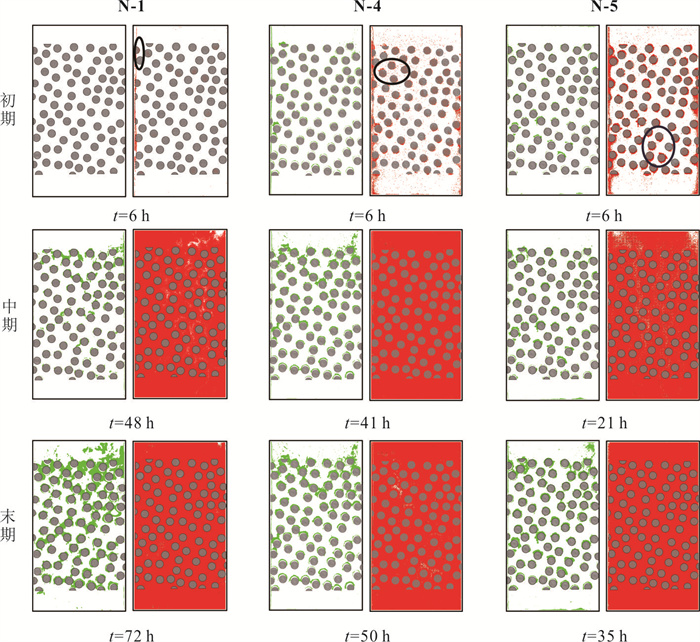
图 8 不同水力梯度条件下含水介质中微生物膜及缺氧区时空分布
绿色部分为微生物膜,红色部分为缺氧区
Fig. 8. Spatial and temporal distribution of microbial membrane and anoxic zone in aqueous media under different hydraulic gradient conditions
表 1 各实验方案营养物质含量、DO浓度及水力梯度参数设置
Table 1. Nutrient content, DO concentration and hydraulic gradient parameter setting of each experimental scheme
方案编号 葡萄糖(mg/L) NaNO3(mg/L) KH2PO4(mg/L) CaCl2(mg/L) H3BO3(mg/L) MgSO4×7H2O(mg/L) MnSO4×H2O(mg/L) DO(mg/L) Δh N-1 125 34.27 2.1 1.5 0.5 0.374 0.626 7~9 0.125 00 N-2 50 13.71 2.1 1.5 0.5 0.374 0.626 7~9 0.125 00 N-3 12.5 3.43 2.1 1.5 0.5 0.374 0.626 7~9 0.125 00 N-4 125 34.27 2.1 1.5 0.5 0.374 0.626 7~9 0.062 50 N-5 125 34.27 2.1 1.5 0.5 0.374 0.626 7~9 0.031 25  下载: 导出CSV
-
Baveye, P., Vandevivere, P., Hoyle, B. L., et al., 1998. Environmental Impact and Mechanisms of the Biological Clogging of Saturated Soils and Aquifer Materials. Critical Reviews in Environmental Science and Technology, 28(2): 123-191. https://doi.org/10.1080/10643389891254197 Boano, F., Demaria, A., Revelli, R., et al., 2010. Biogeochemical Zonation Due to Intrameander Hyporheic Flow. Water Resources Research, 46(2): W02511. https://doi.org/10.1029/2008WR007583 Briggs, M. A., Day-Lewis, F. D., Zarnetske, J. P., et al., 2015. A Physical Explanation for the Development of Redox Microzones in Hyporheic Flow. Geophysical Research Letters, 42(11): 4402-4410. https://doi.org/10.1002/2015GL064200 Briggs, M. A., Day-Lewis, F. D., Dehkordy, F. M. P., et al., 2018. Direct Observations of Hydrologic Exchange Occurring with Less-Mobile Porosity and the Development of Anoxic Microzones in Sandy Lakebed Sediments. Water Resources Research, 54(7): 4714-4729. https://doi.org/10.1029/2018WR022823 Carrel, M., Morales, V. L., Dentz, M., et al., 2018. Pore-Scale Hydrodynamics in a Progressively Bioclogged Three-Dimensional Porous Medium: 3-D Particle Tracking Experiments and Stochastic Transport Modeling. Water Resources Research, 54(3): 2183-2198. https://doi.org/10.1002/2017WR021726 Chowdhury, R. S., Zarnetske, J. P., Phanikumar, M. S., et al., 2020. Formation Criteria for Hyporheic Anoxic Microzones: Assessing Interactions of Hydraulics, Nutrients, and Biofilms. Water Resources Research, 56(3): e2019WR025971. https://doi.org/10.1029/2019WR025971 Deng, W., Cardenas, M. B., Kirk, M. F., et al., 2013. Effect of Permeable Biofilm on Micro- and Macro-Scale Flow and Transport in Bioclogged Pores. Environmental Science Technology, 47(19): 11092-11098. https://doi.org/10.1021/es402596v De Falco, N., Boano, F., Bogler, A., et al., 2018. Influence of Stream-Subsurface Exchange Flux and Bacterial Biofilms on Oxygen Consumption under Nutrient-Rich Conditions. Journal of Geophysical Research: Biogeosciences, 123(7): 2021-2034. https://doi.org/10.1029/2017JG004372 Ding, W. J., Lu, F. Y., Zhao, B., et al., 2024. Kinetics of Nitrification and Denitrification in Hyporheic Zone Sediment with Periodical Supply of Nitrogen. Earth Science, 49(10): 3712-3722(in Chinese with English abstract). Febria, C. M., Beddoes, P., et al., 2012. Bacterial Community Dynamics in the Hyporheic Zone of an Intermittent Stream. The ISME Journal, 6(5): 1078-1088. https://doi.org/10.1038/ismej.2011.173 Harvey, J. W., Böhlke, J. K., Voytek, M. A., et al., 2013. Hyporheic Zone Denitrification: Controls on Effective Reaction Depth and Contribution to Whole-Stream Mass Balance. Water Resources Research, 49(10): 6298-6316. https://doi.org/10.1002/wrcr.20492 Hampton, T. B., Zarnetske, J. P., Briggs, M. A., et al., 2020. Experimental Shifts of Hydrologic Residence Time in a Sandy Urban Stream Sediment-Water Interface Alter Nitrate Removal and Nitrous Oxide Fluxes. Biogeochemistry, 149(2): 195-219. https://doi.org/10.1007/s10533-020-00674-7 Huang, J. P., Zhang, H. R., Bian, X. Z., et al., 2025. COD Concentration Influence on Membrane Fouling and Microbial Communities in A/O-MBR and A/A-MBR Systems. Environmental Technology, 46(22): 4532-4544. https://doi.org/10.1080/09593330.2025.2507391 Huang, Y. Y., Shen, J. H., Zhu, Z. C., et al., 2025. Microbial Indicator of Iron Cycling in Riverwater-Groundwater Interaction Zone—FMN Reductase Gene. Earth Science, 50(4): 1575-1584 (in Chinese with English abstract). Klimant, I., Meyer, V., Kühl, M., 1995. Fiber-Optic Oxygen Microsensors, a New Tool in Aquatic Biology. Limnology and Oceanography, 40(6): 1159-1165. https://doi.org/10.4319/lo.1995.40.6.1159 Kone, T., Golfier, F., Orgogozo, L., et al., 2014. Impact of Biofilm-Induced Heterogeneities on Solute Transport in Porous Media. Water Resources Research, 50(11): 9103-9119. https://doi.org/10.1002/2013WR015213 Karimifard, S., Li, X., Elowsky, C., et al., 2021. Modeling the Impact of Evolving Biofilms on Flow in Porous Media Inside a Microfluidic Channel. Water Research, 188: 116536. https://doi.org/10.1016/j.watres.2020.116536 Ke, D. F., Li, R., Liu, C. X., 2021. The Feedback Interaction between Biomass Accumulation and Heterogeneous Flow in Porous Media: Effect of Shear Stresses. Journal of Hydrology, 597: 126083. https://doi.org/10.1016/j.jhydrol.2021.126083 Kurz, D. L., Secchi, E., Stocker, R., et al., 2022. A Microfluidic Platform to Study Bioclogging in Porous Media. Journal of Visualized Experiments, (188): e64689. https://doi.org/10.3791/64689 Larsen, M., Borisov, S. M., Grunwald, B., et al., 2011. A Simple and Inexpensive High Resolution Color Ratiometric Planar Optode Imaging Approach: Application to Oxygen and pH Sensing. Limnology and Oceanography: Methods, 9(9): 348-360. https://doi.org/10.4319/lom.2011.9.348 Larson, C. A., Passy, S. I., 2013. Rates of Species Accumulation and Taxonomic Diversification during Phototrophic Biofilm Development are Controlled by Both Nutrient Supply and Current Velocity. Applied and Environmental Microbiology, 79(6): 2054-2060. https://doi.org/10.1128/AEM.03788-12 Morales, V. L., Parlange, J. Y., Steenhuis, T. S., 2010. Are Preferential Flow Paths Perpetuated by Microbial Activity in the Soil Matrix? A Review. Journal of Hydrology, 393(1-2): 29-36. https://doi.org/10.1016/j.jhydrol.2009.12.048 Merl, T., Koren, K., 2020. Visualizing NH3 Emission and the Local O2 and pH Microenvironment of Soil upon Manure Application Using Optical Sensors. Environment International, 144: 106080. https://doi.org/10.1016/j.envint.2020.106080 Ramezanian, S., Ta, H. X., Muhunthan, B., et al., 2018. Role of Ionic Strength in the Retention and Initial Attachment of Pseudomonas Putidato Quartz Sand. Biointerphases, 13(4): 041005. https://doi.org/10.1116/1.5027735 Ran, H. Y., Ye, X., Zhu, X. Y., et al., 2021. Principle of Planar Optode and Its Application in Investigating Microscale Soil Heterogeneity. Soils, 53(5): 916-928(in Chinese with English abstract). Sawyer, A. H., 2015. Enhanced Removal of Groundwater-Borne Nitrate in Heterogeneous Aquatic Sediments. Geophysical Research Letters, 42(2): 403-410. https://doi.org/10.1002/2014GL062234 Scheidweiler, D., Bordoloi, A. D., Jiao, W. Q., et al., 2024. Spatial Structure, Chemotaxis and Quorum Sensing Shape Bacterial Biomass Accumulation in Complex Porous Media. Nature Communications, 15: 191. https://doi.org/10.1038/s41467-023-44267-y Wang, H. Y., 2013. Experiment and Numerical Simulation for Bioclogging in Aquifer Media during Artificial Recharge (Dissertation). Ocean University of China, Qingdao(in Chinese with English abstract). Winstanley, H. F., Chapwanya, M., Fowler, A. C., et al., 2015. A 2D Channel-Clogging Biofilm Model. Journal of Mathematical Biology, 71(3): 647-668. https://doi.org/10.1007/s00285-014-0833-4 Weng, S. C., 2020. Study on the Process and Mechanism of Biological Clogging in Porous Media Based on Two-Dimensional Pore Structure (Dissertation). Zhejiang University, Hangzhou(in Chinese with English abstract). Xu, J. W., He, Q., Li, H., et al., 2018. Modeling of Methane Formation in Gravity Sewer System: The Impact of Microorganism and Hydraulic Condition. AMB Express, 8: 34. https://doi.org/10.1186/s13568-018-0559-6 Xian, Y., Jin, M. G., Zhan, H. B., et al., 2019. Reactive Transport of Nutrients and Bioclogging during Dynamic Disconnection Process of Stream and Groundwater. Water Resources Research, 55(5): 3882-3903. https://doi.org/10.1029/2019WR024826 Xian, Y., Jin, M. G., Zhan, H. B., 2020. Buffer Effect on Identifying Transient Streambed Hydraulic Conductivity with Inversion of Flood Wave Responses. Journal of Hydrology, 580: 124261. https://doi.org/10.1016/j.jhydrol.2019.124261 Xian, Y., Jin, M. G., Zhan, H. B., et al., 2022. Permeable Biofilms can Support Persistent Hyporheic Anoxic Microzones. Geophysical Research Letters, 49(14): e2021GL096948. https://doi.org/10.1029/2021GL096948 Zarnetske, J. P., Haggerty, R., Wondzell, S. M., et al., 2012. Coupled Transport and Reaction Kinetics Control the Nitrate Source-Sink Function of Hyporheic Zones. Water Resources Research, 48(11): W11508. https://doi.org/10.1029/2012WR011894 Zhang, Y. H., Ye, S. J., Wu, J. C., et al., 2012. A Study of Distribution of Biofilm in Porous Media and Its Effect on Permeability. Acta Scientiae Circumstantiae, 32(5): 1072-1080 (in Chinese with English abstract). 丁吾举, 陆菲雨, 赵博, 等, 2024. 氮周期供给时潜流带沉积物硝化、反硝化动力学. 地球科学, 49(10): 3712-3722. 黄莹芸, 沈俊豪, 朱子超, 等, 2025. 河水—地下水交互带铁循环的微生物指示物-FMN还原酶基因. 地球科学, 50(4): 1575-1584. 冉洪芋, 叶馨, 朱晓艳, 等, 2021. 平面光极基本原理及其在土壤微观异质性研究中的应用. 土壤, 53(5): 916-928. 王宏宇, 2013. 含水介质生物堵塞的回灌试验和数值分析(硕士学位论文). 青岛: 中国海洋大学. 翁时超, 2020. 基于二维孔隙结构的多孔介质生物堵塞过程及机理研究(硕士学位论文). 杭州: 浙江大学. 章艳红, 叶淑君, 吴吉春, 等, 2012. 孔隙介质中生物膜空间分布及其对渗透性影响研究. 环境科学学报, 32(5): 1072-1080. -

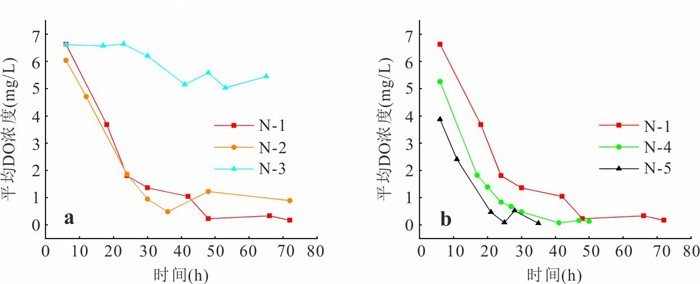
 点击查看大图
计量
- 文章访问数: 59
- HTML全文浏览量: 13
- PDF下载量: 6
- 被引次数: 0
