




Hierarchical Stacked Autoencoders for Real-Time Lithology Identification While Drilling
-
摘要: 岩性识别在油气勘探中起着至关重要的作用. 钻井数据能够提供经济高效的实时岩性表征,但其应用常受到岩性信号微弱、特征强耦合以及复杂非线性关系的限制. 为克服这些局限,提出了一种基于层次化堆叠自动编码器的钻井实时岩性识别方法. 该方法构建了由原始钻井参数、短时能量中间特征和最大信息系数驱动的正则化机制组成的分层特征学习框架,以增强钻井数据中弱岩性信息的表达能力,引导模型优先学习与岩性相关性较强的特征. 在四个钻井数据集上的实验验证表明,所提出的方法整体性能优于7种基准方法,在A井上实现了95.1%的准确率和93.6%的F1分数,在B井上实现了92.1%的准确率和86.0%的F1分数. 此外,该模型在跨井预测中表现出良好的泛化能力,对C井和D井的预测准确率分别达到94.2%和95.4%,为实时岩性识别提供了一种稳健的解决方案.Abstract: Lithology identification plays a crucial role in oil and gas exploration. Although drilling data can provides costeffective and realtime lithology characterization, its effectiveness is often constrained by weak lithological signals, strong feature coupling, and complex nonlinear relationships. To overcome these limitations, this study presents a hierarchical stacked autoencoderbased method for real-time lithology identification while drilling. The proposed method constructs a hierarchical feature learning framework composed of raw drilling parameters, shorttime energy intermediate features, and a maximal information coefficientdriven regularization mechanism. This framework enhances the representation of weak lithological information in drilling data and guides the model to preferentially learn features with stronger correlations to lithology. Experimental validation on four drilling datasets demonstrates that the proposed method outperforms seven benchmark methods overall. The proposed model achieved 95.1% accuracy with an F1 score of 93.6% on Well A and 92.1% accuracy with an F1 score of 86.0% on Well B. Moreover, the model exhibited good generalization capability in crosswell prediction, yielding accuracies of 94.2% for Well C and 95.4% for Well D, offering a robust solution for realtime lithology identification.
-
Key words:
- lithology identification /
- drilling data /
- deep learning /
- shorttime energy
-
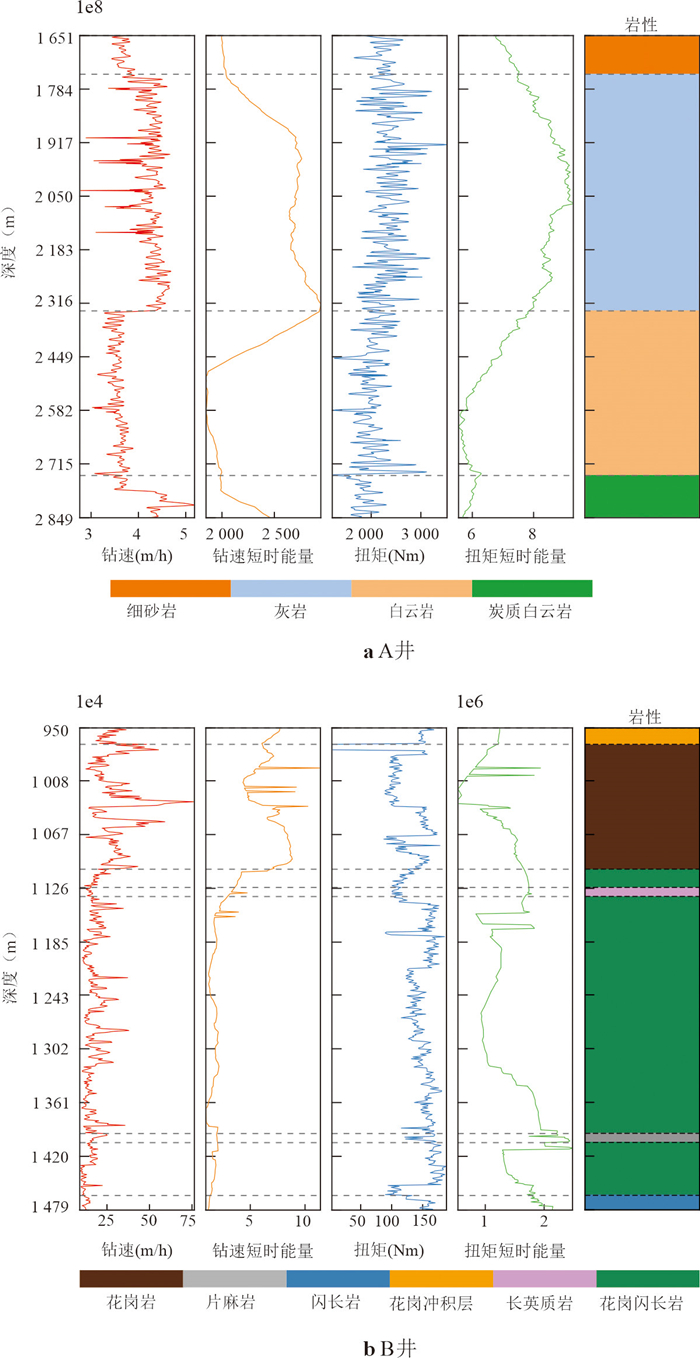
图 2 短时能量与地层岩性相关性
Fig. 2. Correlation between short-time energy and formation lithology
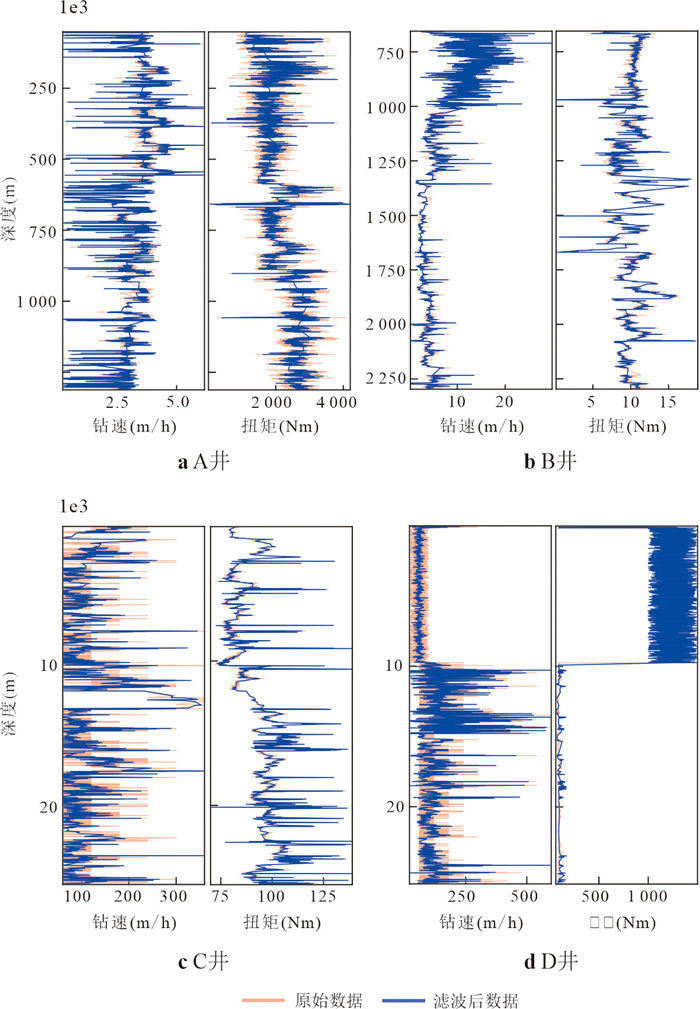
图 4 小波滤波去噪前后对比曲线
Fig. 4. Comparison curves before and after wavelet filtering denoising
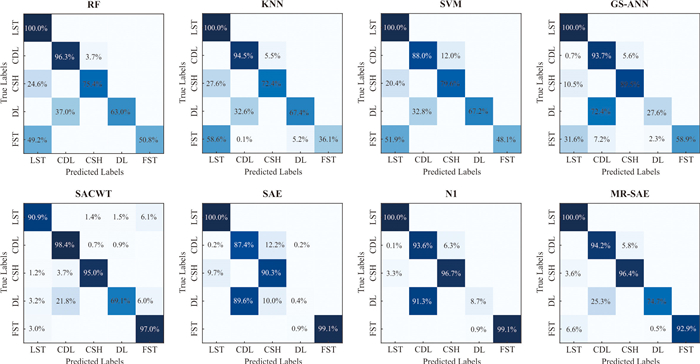
图 9 不同模型在A井上的混淆矩阵
LST. 灰岩;CDL. 炭质白云岩;CSH. 炭质页岩;DL. 白云岩;FST. 细砂岩
Fig. 9. Confusion matrices of different models on Well A
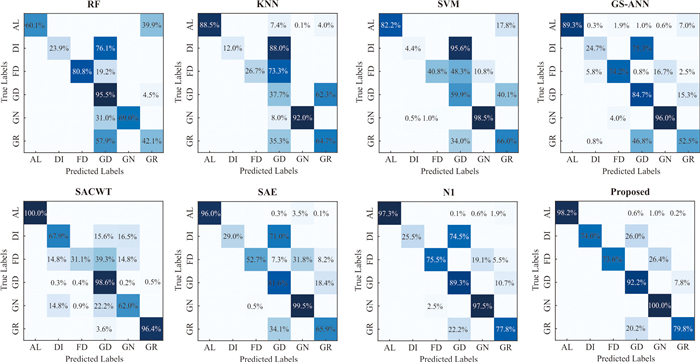
图 10 不同模型在B井上的混淆矩阵
GR. 花岗岩;GN. 片麻岩;DI. 闪长岩;GD. 花岗闪长岩;FD. 长英质岩脉;AL. 花岗岩冲积层
Fig. 10. Confusion matrices of different models on Well B
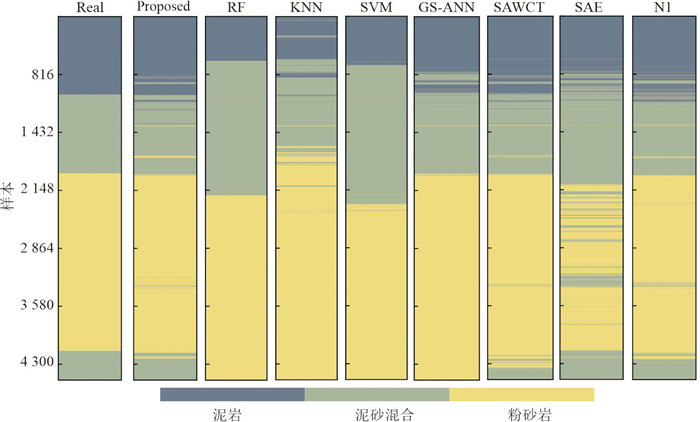
图 11 D井岩性识别结果可视化
模型基于C井数据构建
Fig. 11. Visualization of lithology identification results for Well D
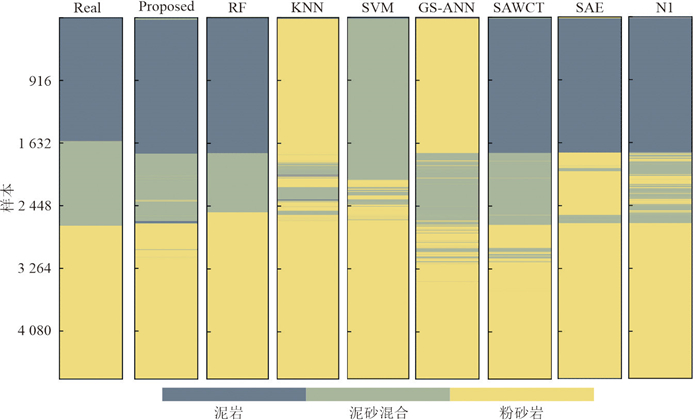
图 12 C井岩性识别结果可视化
模型基于D井数据构建
Fig. 12. Visualization of lithology identification results for Well C
表 1 用于建模分析的部分数据集
Table 1. Datasets used for analysis
深度(m) 钻速(m/h) 扭矩(Nm) 转速(rpm) A井 Min 41.07 0.13 26.20 19.60 Max 1 049.60 218.80 5 033.99 99.16 Mean 548.56 3.39 2 184.77 49.76 Std. 296.81 3.01 559.31 7.71 B井 Min 655.30 0.22 13.24 1.69 Max 2 296.94 29.79 1 887.23 107.31 Mean 1 454.87 6.23 997.64 47.79 Std. 500.36 4.52 188.66 14.06 C井 Min 0.00 20.00 64.00 20.00 Max 25.50 635.00 1 499.00 799.00 Mean 11.51 103.82 528.06 496.99 Std. 8.02 78.99 564.12 174.19 D井 Min 0.00 60.00 60.00 98.00 Max 25.51 660.00 177.00 701.00 Mean 14.13 102.96 93.67 628.93 Std. 7.12 59.10 12.67 41.61  下载: 导出CSV
算法1:基于MIC的短时能量滑动窗口优化 (1)输入: 钻井数据$ \mathrm{X}=\left\{{x}_{1}, \dots, {x}_{n}\right\} $,岩性标签$ \mathrm{Y}=\left\{{y}_{1}, \dots, {y}_{n}\right\} $,候选窗口$ W=\left\{{w}_{1}, ..., {w}_{K}\right\} $. (2)输出: 最优滑动窗口$ {w}^{*} $ (3)For每一个候选窗口$ W $ do (4)计算短时能量序列: (5)$ {E}_{w}\left[i\right]=\sum\limits_{j=\max(1, i-w+1)}^{i}\;{x}_{j}^{2}, \forall i\in [1, n] $ (6)通过MIC评估相关性: (7)$ {\rho }_{w}=\mathrm{M}\mathrm{I}\mathrm{C}({E}_{w}, Y) $ (8)End for (9)选择相关性最大的窗口: $ w^*=\arg \max\limits_{w \in W}\left\{\rho_w\right\}$ (10)Return $ {w}^{*} $
下载: 导出CSV
表 2 MR-SAE算法超参数调优
Table 2. MR-SAE algorithm hyperparameter tuning
超参数 取值范围 最优参数 堆叠层数 2, 3, 4 2 预训练学习率 [0.000 1, 0.1] 0.004 预训练迭代次数 [10, 80] 16 微调阶段学习率 [0.001, 0.1] 0.005 微调迭代次数 [100, 1 000] 380 正则化系数α [0.01, 1] 0.6
下载: 导出CSV
表 3 A井与B井不同岩性识别模型性能对比
Table 3. Performance comparison of different models for lithology identification on Well A and Well B
指标 RF KNN SVM GS-ANN SACWT SAE N1 Proposed 井A 准确率 0.865 0.849 0.845 0.854 0.932 0.858 0.919 0.951 精确率 0.923 0.895 0.900 0.713 0.911 0.886 0.932 0.960 召回率 0.768 0.734 0.729 0.681 0.901 0.778 0.878 0.923 F1分数 0.811 0.770 0.771 0.700 0.888 0.794 0.895 0.936 马修斯系数 0.826 0.794 0.801 0.830 0.910 0.791 0.861 0.937 井B 准确率 0.790 0.650 0.728 0.821 0.941 0.754 0.864 0.921 精确率 0.834 0.722 0.612 0.823 0.785 0.696 0.821 0.895 召回率 0.664 0.555 0.610 0.706 0.774 0.614 0.737 0.863 F1分数 0.668 0.523 0.549 0.707 0.757 0.651 0.733 0.860 马修斯系数 0.646 0.400 0.511 0.698 0.859 0.760 0.806 0.865
下载: 导出CSV
表 4 跨井模型验证性能对比
Table 4. Performance comparison of cross-well model validation
指标 RF KNN SVM GS-ANN SACWT SAE N1 Proposed 训练: C井
测试: D井准确率 0.768 0.768 0.757 0.878 0.919 0.836 0.930 0.954 精确率 0.798 0.810 0.802 0.898 0.925 0.871 0.928 0.952 召回率 0.704 0.726 0.728 0.849 0.911 0.843 0.919 0.948 F1分数 0.728 0.746 0.747 0.868 0.917 0.839 0.924 0.950 马修斯系数 0.895 0.317 0.426 0.352 0.891 0.668 0.840 0.915 训练: D井
测试: C井准确率 0.929 0.514 0.576 0.583 0.935 0.794 0.892 0.942 精确率 0.943 0.642 0.711 0.785 0.925 0.872 0.912 0.942 召回率 0.899 0.458 0.546 0.577 0.924 0.708 0.848 0.922 F1分数 0.911 0.397 0.447 0.501 0.924 0.672 0.859 0.929 马修斯系数 0.771 0.741 0.758 0.824 0.889 0.765 0.888 0.938
下载: 导出CSV
-
Akiba, T., Sano, S., Yanase, T., et al., 2019. Optuna: A Next-Generation Hyperparameter Optimization Framework. Proceedings of the 25th ACM SIGKDD International Conference on Knowledge Discovery & Data Mining. Anchorage AK USA: ACM, 2623-2631. https://doi.org/10.1145/3292500.3330701 Chen, J., Gui, Z., Rui, Y. C., et al., 2025. A Dual Attention-Based Deep Learning Model for Lithology Identification while Drilling. Journal of Rock Mechanics and Geotechnical Engineering, 18(2): 1177-1192. https://doi.org/10.1016/j.jrmge.2025.03.051 Chen, J. M., Fan, S. S., Yang, C. H., et al., 2022a. Stacked Maximal Quality-Driven Autoencoder: Deep Feature Representation for Soft Analyzer and Its Application on Industrial Processes. Information Sciences, 596: 280-303. https://doi.org/10.1016/j.ins.2022.02.049 Chen, X., Cao, W. H., Gan, C., et al., 2022b. A Hybrid Partial Least Squares Regression-Based Real Time Pore Pressure Estimation Method for Complex Geological Drilling Process. Journal of Petroleum Science and Engineering, 210: 109771. https://doi.org/10.1016/j.petrol.2021.109771 Du, S., Huang, C., Ma, X., et al., 2024. A Review of Data-Driven Intelligent Monitoring for Geological Drilling Processes. Processes, 12(11): 2478. https://doi.org/10.3390/pr12112478 Gan, C., Cao, W. H., Liu, K. Z., et al., 2022. A Novel Dynamic Model for the Online Prediction of Rate of Penetration and Its Industrial Application to a Drilling Process. Journal of Process Control, 109: 83-92. https://doi.org/10.1016/j.jprocont.2021.12.002 Geekiyanage, S. C. H., Tunkiel, A., Sui, D., 2021. Drilling Data Quality Improvement and Information Extraction with Case Studies. Journal of Petroleum Exploration and Production Technology, 11(2): 819-837. https://doi.org/10.1007/s13202-020-01024-x Gwynn, M., Allis, R., Hardwick, C., et al., 2018. Rock Properties of FORGE Well 58-32, Milford, Utah. GRC Transactions, 42 Lazarová, E., Kruľáková, M., Krúpa, V., et al., 2022. Regime and Rock Identification in Disintegration by Drilling Based on Vibration Signal Differentiation. International Journal of Rock Mechanics and Mining Sciences, 149: 104984. https://doi.org/10.1016/j.ijrmms.2021.104984 Li, Q. F., Peng, C., Fu, J. H., et al., 2023. A Comprehensive Machine Learning Model for Lithology Identification While Drilling. Geoenergy Science and Engineering, 231: 212333. https://doi.org/10.1016/j.geoen.2023.212333 Li, Z. R., Wu, Y. P., Kang, Y., et al., 2021. Feature-Depth Smoothness Based Semi-Supervised Weighted Extreme Learning Machine for Lithology Identification. Journal of Natural Gas Science and Engineering, 96: 104306. https://doi.org/10.1016/j.jngse.2021.104306 Liang, H. B., Chen, H. F., Guo, J. H., et al., 2022. Research on Lithology Identification Method Based on Mechanical Specific Energy Principle and Machine Learning Theory. Expert Systems with Applications, 189: 116142. https://doi.org/10.1016/j.eswa.2021.116142 Liu, Y. L., Bai, Y., Cui, B., et al., 2025. A Survey on Automated Feature Engineering for Machine Learning. Computer Applications and Software, 42(1): 1-10, 40(in Chinese with English abstract). Mahmoud, A. A., Elkatatny, S., Al-AbdulJabbar, A., 2021. Application of Machine Learning Models for Real-Time Prediction of the Formation Lithology and Tops from the Drilling Parameters. Journal of Petroleum Science and Engineering, 203: 108574. https://doi.org/10.1016/j.petrol.2021.108574 Ou, C., Zhu, H. Q., Shardt, Y. A. W., et al., 2022. Quality-Driven Regularization for Deep Learning Networks and Its Application to Industrial Soft Sensors. IEEE Transactions on Neural Networks and Learning Systems, 36(3): 3943-3953. https://doi.org/10.1109/TNNLS.2022.3144162 Wang, C., Xue, Q. L., He, Y. M., et al., 2023. Lithological Identification Based on High-Frequency Vibration Signal Analysis. Measurement, 221: 113534. https://doi.org/10.1016/j.measurement.2023.113534 Wang, J., Cao, J. X., 2023. A Lithology Identification Approach Using Well Logs Data and Convolutional Long Short-Term Memory Networks. IEEE Geoscience and Remote Sensing Letters, 20: 7506405. https://doi.org/10.1109/LGRS.2023.3322677 Wang, M., Yang, J. L., Wang, X., et al., 2023. Identification of Shale Lithofacies by Well Logs Based on Random Forest Algorithm. Earth Science, 48(1): 130-142(in Chinese with English abstract). Wang, R. P., Chen, Y., Wang, D., et al., 2024. Vehicle Interior Abnormal Noise Recognition Based on Muti-Feature Extraction and Svm Optimized by Gray Wolf Optimization. Computer Applications and Software, 41(3): 41-48(in Chinese with English abstract). Wu, H. L., Lai, Q., Feng, Z., et al., 2025. Progress on Key Technologies for Logging Evaluation of Deep and Ultra-Deep Carbonate Reservoirs. Earth Science, 50(7): 2844-2860(in Chinese with English abstract). Xu, Z. H., Shi, H., Lin, P., et al., 2021. Integrated Lithology Identification Based on Images and Elemental Data from Rocks. Journal of Petroleum Science and Engineering, 205: 108853. https://doi.org/10.1016/j.petrol.2021.108853 Yan, T., Xu, R., Sun, S. H., et al., 2024. A Real-Time Intelligent Lithology Identification Method Based on a Dynamic Felling Strategy Weighted Random Forest Algorithm. Petroleum Science, 21(2): 1135-1148. https://doi.org/10.1016/j.petsci.2023.09.011 You, M. L., Hong, Z. K., Tan, F., et al., 2024. Stratigraphic Identification Using Real-Time Drilling Data. Journal of Rock Mechanics and Geotechnical Engineering, 16(9): 3452-3464. https://doi.org/10.1016/j.jrmge.2024.02.012 Yue, Z. W., Yue, X. L., Wang, X., et al., 2022. Experimental Study on Identification of Layered Rock Mass Interface along the Borehole while Drilling. Bulletin of Engineering Geology and the Environment, 81(9): 353. https://doi.org/10.1007/s10064-022-02861-2 Zhang, J. F., Liu, Y., Ma, Y. H., et al., 2025. Real-Time Lithology Identification from Drilling Data with Self & Cross Attention Model and Wavelet Transform. Geoenergy Science and Engineering, 244: 213427. https://doi.org/10.1016/j.geoen.2024.213427 刘玉琳, 白杨, 崔斌, 等, 2025. 面向机器学习的自动化特征工程研究综述. 计算机应用与软件, 42(1): 1-10, 40. 王民, 杨金路, 王鑫, 等, 2023. 基于随机森林算法的泥页岩岩相测井识别. 地球科学, 48(1): 130-142. doi: 10.3799/dqkx.2022.181 王若平, 陈严, 王东, 等, 2024. 基于多特征提取与灰狼算法优化SVM的车内异响识别方法. 计算机应用与软件, 41(3): 41-48. 武宏亮, 赖强, 冯周, 等, 2025. 深层-超深层碳酸盐岩储层测井评价关键技术进展. 地球科学, 50(7): 2844-2860. doi: 10.3799/dqkx.2025.116 -

 点击查看大图
计量
- 文章访问数: 58
- HTML全文浏览量: 28
- PDF下载量: 5
- 被引次数: 0
