




Frequency Domain Feature Matching and Adaptive Modeling for Rate of Penetration Prediction Based on Real-Time Data Streams
-
摘要: 针对深部复杂地层钻速预测中数据流非平稳及工况漂移难题,提出基于频域感知与自适应反馈的动态建模方法. 该方法利用滑动窗口与快速傅里叶变换提取实时数据流频域特征,通过余弦相似度量化主井与邻井工况匹配度. 创新构建基于$ {R}^{2} $反馈的动态阈值机制,实时调节判别标准:工况相似时复用历史模型,突变时采用主井累积+邻井深度匹配混合数据重训随机森林模型. 10口井实钻数据验证表明,该方法全井段预测平均$ {R}^{2} $达0.96,均方误差0.001 5;相较于固定阈值策略(复用率为0%),动态机制将模型复用率显著提升至18%. 进一步通过3口独立新井盲测验证模型泛化能力,平均$ {R}^{2} $达到0.91. 该研究有效解决了时域信号量化困难与模型适应性差的矛盾,在保证高精度的同时显著降低了计算开销,为复杂非平稳钻井工况下的实时钻速预测及智能钻井辅助决策提供了新的技术方案.Abstract: To address the challenges of non-stationary data streams and working condition drift in Rate of Penetration (ROP) prediction for deep complex formations, a dynamic modeling method based on frequency domain perception and adaptive feedback is proposed. The method utilizes sliding windows and Fast Fourier Transform (FFT) to extract frequency domain features from real-time data streams, quantifying the matching degree of working conditions between the main well and neighboring wells via cosine similarity. An innovative dynamic threshold mechanism based on $ {R}^{2} $ feedback is constructed to adjust discrimination standards in real time: historical models are reused when conditions are similar, while the Random Forest model is retrained using hybrid data (main well accumulation plus neighbor well depth matching) during abrupt changes. Validation with real drilling data from 10 wells demonstrates that the method achieves an average $ {R}^{2} $ of 0.96 across the entire well section, with a Mean Squared Error (MSE) of 0.001 5. Compared to the fixed threshold strategy (with a reuse rate of 0%), the dynamic mechanism significantly increases the model reuse rate to 18%.Furthermore, the generalization capability of the proposed method was validated through blind tests on three previously unseen wells, achieving an average R2 of 0.91. This study effectively resolves the contradiction between the difficulty of quantifying time-domain signals and poor model adaptability. It significantly reduces computational overhead while ensuring high accuracy.The proposed method provides a new technical framework for real-time rate of penetration prediction and intelligent drilling decision support under complex non-stationary drilling conditions.
-
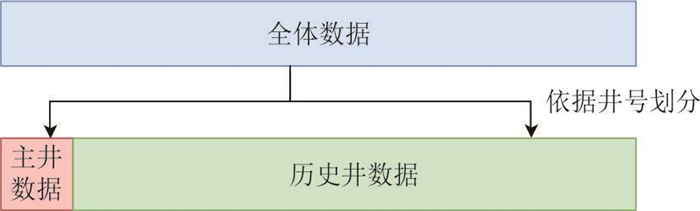
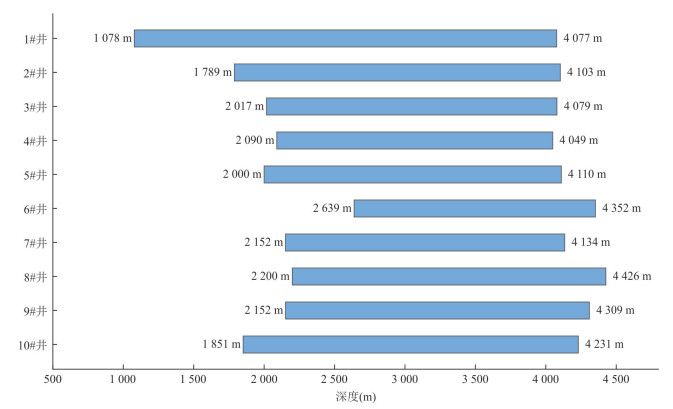
图 4 分井示意图
Fig. 4. Schematic diagram of dataset partitioning for main and auxiliary wells
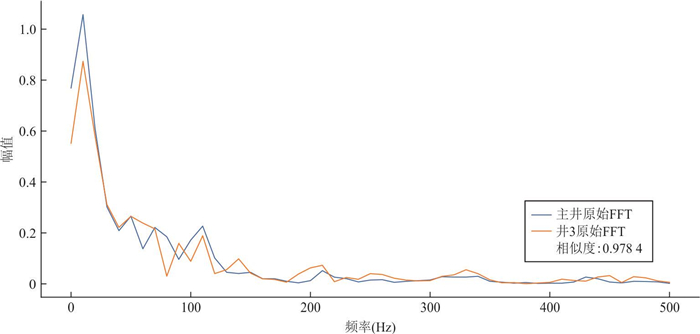
图 7 频谱对比图
Fig. 7. Comparison of spectrum features between main well and historical well
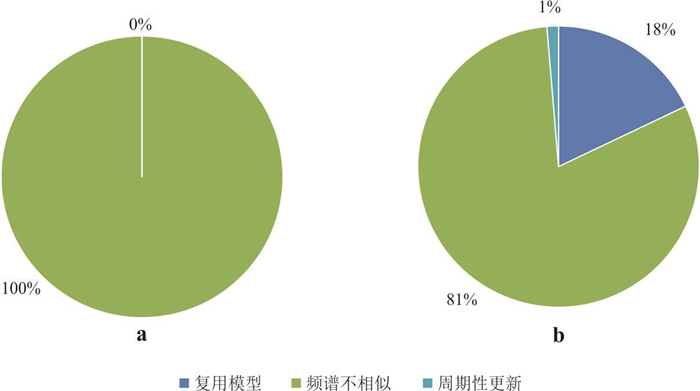
图 10 不同阈值模型来源
a. 静态阈值模型来源;b. 动态阈值模型来源
Fig. 10. Distribution of model sources under different thresholds
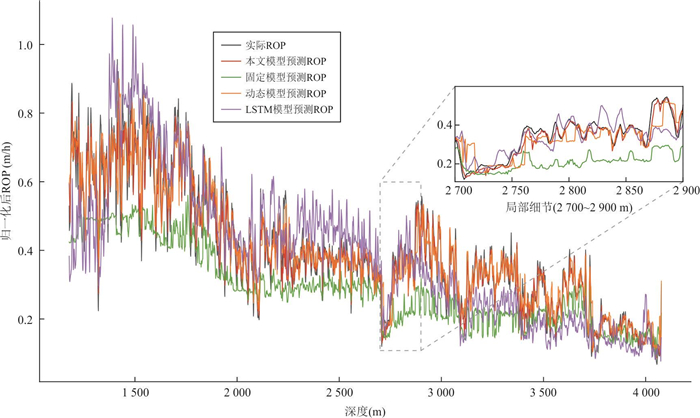
图 13 4个模型预测ROP与实际ROP
Fig. 13. Comparison between actual ROP and ROP predicted by four models
表 1 参数对照表
Table 1. Parameter Comparison Table
中文全名 中文单位 英文单位 操作参数 钻井直径 英寸 in 钻速 米每小时 m/h 钻压 吨 t 大钩载荷 吨 t 发动机转速 转每分钟 r/min 扭矩 千磅力·英尺 klbf·ft 立管压力 磅每平方英寸 psi 泵量 升每分钟 L/min 钻头实际工作时间 小时 h 泵的总工作时间 小时 h 泥浆参数 泥浆进口比重 克每立方厘米 g/cm3 泥浆出口比重 克每立方厘米 g/cm3 钻井液入口温度 摄氏度 degC 钻井液出口温度 摄氏度 degC 屈服值 帕 Pa 泥浆密度 克每立方厘米 g/cm3 马氏漏斗粘度 秒 s 塑性粘度 毫帕·秒 mPa·s 3转读数 6转读数 10 s静切力 帕 Pa 10 min静切力 帕 Pa 滤矢量 毫升每三十分钟 mL/30 min 泥饼厚度 毫米 mm 酸碱度 流性系数 稠度系数 帕·秒的n次方 Pa·sn 氯离子含量 毫克每升 mg/L 钙离子含量 毫克每升 mg/L 膨润土含量 千克每立方米 kg/m3 固相含量 百分比 % 含沙量 百分比 % 地质条件 地震速度 米每秒 m/s 孔隙压力 克每立方厘米 g/cm3 破裂压力 克每立方厘米 g/cm3 上覆压力 克每立方厘米 g/cm3 岩性 岩性编号 钻头参数 喷嘴个数 个 等效直径 毫米 mm 内排磨损 外排磨损 提速钻具 液力提速马达 水里脉冲 钻头齿形  下载: 导出CSV
表 2 相似度阈值实验对照结果
Table 2. Experimental comparison results of similarity thresholds
阈值机制 R2 复用率 计算开销 计算耗时 固定阈值($ T=0.85 $) 0.74 0% 高计算开销 2.1 h 动态自适应 0.96 18% 低计算开销 1.6 h
下载: 导出CSV
表 3 各对比实验结果
Table 3. Comparison of experimental results among different models
模型 R2 MAE MSE 固定模型 0.371 5 0.112 8 0.019 4 仅主井动态模型 0.879 6 0.040 6 0.003 7 LSTM模型 0.509 5 0.089 5 0.013 5 本文模型 0.965 1 0.025 8 0.001 5
下载: 导出CSV
表 4 局部复杂突变井段(2 700~2 900 m)性能对比
Table 4. Performance comparison in the local complex transition section (2 700~2 900 m)
模型 局部R2 局部MAE 局部MSE 固定模型 < 0 0.213 4 0.052 1 仅主井动态模型 0.651 2 0.078 2 0.012 5 LSTM模型 0.284 5 0.145 6 0.038 4 本文模型 0.892 4 0.038 5 0.004 2
下载: 导出CSV
表 5 盲测井实验结果
Table 5. Experimental results of the blind test
盲测目标井井号 $ {R}^{2} $ 8 0.921 3 9 0.933 6 10 0.875 1
下载: 导出CSV
-
Chen, H. D., Jin, Y., Zhang, W. D., et al., 2022. Deep Neural Network Prediction of Mechanical Drilling Speed. Energies, 15(9): 3037. https://doi.org/10.3390/en15093037 Ehsan, B., Ebrahim, D. B., 2022. Computational Prediction of the Drilling Rate of Penetration (ROP): A Comparison of Various Machine Learning Approaches and Traditional Models. Journal of Petroleum Science and Engineering, 210. https://doi.org/10.1016/J.PETROL.2021.110033. Encinas, M. A., Tunkiel, A. T., Sui, D., 2022. Downhole Data Correction for Data-Driven Rate of Penetration Prediction Modeling. Journal of Petroleum Science and Engineering, 210: 109904. https://doi.org/10.1016/j.petrol.2021.109904 Hegde, C., Daigle, H., Millwater, H., et al., 2017. Analysis of Rate of Penetration (ROP) Prediction in Drilling Using Physics-Based and Data-Driven Models. Journal of Petroleum Science and Engineering, 159: 295-306. https://doi.org/10.1016/j.petrol.2017.09.020 Huang, X. L., Liu, D. T., Song, J. M., et al., 2021. Real-Time ROP Optimization Technology Based on Big Data and Artificial Intelligence. Oil Drilling & Production Technology, 43(4): 442-448(in Chinese with English abstract). Li, B. Z., Yang, M. H., Xu, K., et al., 2024. Prediction Method for ROP Based on Attention Mechanism of Convolutional Neural Network. Science Technology and Engineering, 24(21): 8910-8916(in Chinese with English abstract). Li, P., Yu, C., Wang, J. L., et al., 2024. Intelligent Prediction of Pore Pressure Using Real-Time Drilling Parameters. China Petroleum Machinery, 52(5): 1-8(in Chinese with English abstract). Mehmood, E., Anees, T., 2020. Challenges and Solutions for Processing Real-Time Big Data Stream: a Systematic Literature Review. IEEE Access, 8: 119123-119143. https://doi.org/10.1109/ACCESS.2020.3005268 Tu, B. R., Bai, K., Zhan, C., et al., 2024. Real-Time Prediction of ROP Based on GRU-Informer. Scientific Reports, 14: 2133. https://doi.org/10.1038/s41598-024-52261-7 Zhang, H. J., Zhang, G. F., Wang, G. N., et al., 2022. Classification and Prediction Method for ROP Based on Genetic Algorithm Optimization Random Forest Model. Science Technology and Engineering, 22(35): 15572-15578(in Chinese with English abstract). Zhang, R., Zhu, Z. P., Li, D. Y., et al., 2024. Interpretable Real-Time Prediction of Drilling Parameters Based on Improved Sequential Network. China Petroleum Machinery, 52(4): 1-10(in Chinese with English abstract). Zhang, Y., Zhou, B. F., Guo, W. X., et al., 2026. Spike Waveform Recognition for Strong-Motion Records Based on Light GBM-SVM Stacking Algorithm. Earth Science, 51(1): 185-198(in Chinese with English abstract). Zhou, C. C., Jiang, J., Li, Q., et al., 2022. Research on Drilling Rate Prediction Model Based on Fusion Feature Selection Algorithm. Drilling Engineering, 49(4): 31-40(in Chinese with English abstract). Zhu, J. B., Liu, H. Y., Luan, S. C., et al., 2025. Prediction of On-Site Peak Ground Motion Based on Machine Learning and Transfer Learning. Earth Science, 50(5): 1842-1860(in Chinese with English abstract). 黄小龙, 刘东涛, 宋吉明, 等, 2021. 基于大数据及人工智能的钻速实时优化技术. 石油钻采工艺, 43(4): 442-448. 李博志, 杨明合, 许楷, 等, 2024. 基于注意力机制的卷积神经网络机械钻速预测方法. 科学技术与工程, 24(21): 8910-8916. 李萍, 于琛, 王建龙, 等, 2024. 基于实时钻进参数的孔隙压力智能预测技术. 石油机械, 52(5): 1-8. 张海军, 张高峰, 王国娜, 等, 2022. 基于遗传算法优化随机森林模型的机械钻速分类预测方法. 科学技术与工程, 22(35): 15572-15578. 张瑞, 祝兆鹏, 李大钰, 等, 2024. 基于改进时序网络的钻进参数可解释实时预测. 石油机械, 52(4): 1-10. 张越, 周宝峰, 郭文轩, 等, 2026. 基于LightGBM-SVM堆叠算法的强震动记录尖刺波形识别. 地球科学, 51(1): 185-198. doi: 10.3799/dqkx.2025.233 周长春, 姜杰, 李谦, 等, 2022. 基于融合特征选择算法的钻速预测模型研究. 钻探工程, 49(4): 31-40. 朱景宝, 刘赫奕, 栾世成, 等, 2025. 基于机器学习和迁移学习的现地地震动峰值预测. 地球科学, 50(5): 1842-1860. -

 点击查看大图
计量
- 文章访问数: 44
- HTML全文浏览量: 29
- PDF下载量: 4
- 被引次数: 0
