




Pore-Water Occurrence Characteristics in High-Rank Coal Based on NMR and Its Water-Blocking on Coalbed Methane Production
-
摘要: 沁水盆地南部高阶煤层气开发存在显著的井间产能差异,水锁效应是制约煤层气解吸与高效产出的关键微观因素.为揭示高阶煤储层孔隙赋水分布规律、水锁效应程度及其对煤层气排采的控制作用,以樊庄区块南部(A区块)、沁南东区块(C区块)为研究对象,对应采集寺河煤矿(SH,无烟煤)、古城煤矿(GC,贫煤)3号煤样,开展低场核磁共振(NMR)孔隙流体测试和甲烷高压等温吸附实验,结合研究区煤层气井长期排采数据,系统分析煤孔隙的赋水特征与水相赋存状态差异,阐明煤孔隙赋水-水锁效应-煤层气解吸排采的响应机制.SH煤样以小孔(10~100 nm)赋水为主(55.97%),微孔(<10 nm)赋水为40.87%;GC煤样微孔赋水占比高达81.72%,小孔赋水仅14.51%.经1.61 MPa离心后,SH煤样吸附水占比73.89%,显著低于GC煤样的97.94%,表明C区块微孔发育、吸附水滞留量大,毛管束缚力强,水锁效应伤害风险远高于A区块.在储层压力条件下,A区块煤样甲烷平均解吸速率达5.27 m3·t-1·MPa-1,远高于C区块的1.45 m3·t-1·MPa-1,解吸驱动力更强、流体运移阻力更小.排采数据验证显示,单相排水阶段C区块排水周期更长、降压解吸难度更大;两相流上产阶段压降漏斗扩展受限、产能提升缓慢;A区块单井累计产气量和峰值日产气能力均显著优于C区块.分析了高阶煤微观孔隙赋水特征对宏观排采效果的影响,明确微孔吸附水富集诱发高程度水锁、抑制气水高效运移是区块产能差异化的关键,可为高阶煤储层产能评价、水锁伤害防控及排采参数优化提供理论支撑.Abstract: Significant productivity differences exist among high-rank coalbed methane (CBM) wells in the southern Qinshui Basin, and the water-blocking effect is a key microscopic factor limiting CBM desorption and efficient production. To reveal the pore-water occurrence law, water-blocking effect, and the control on CBM production in high-rank coal, the southern Fanzhuang Block (Block A) and eastern Qinnan Block (Block C) were selected, and the No.3 coal samples were collected from Sihe Coal Mine (SH, anthracite) and Gucheng Coal Mine (GC, lean coal). Low-field nuclear magnetic resonance (NMR) pore-fluid test and high-pressure methane isothermal adsorption experiment were conducted. Combined with long-term production data from CBM wells, the differences in pore-water occurrence and water-phase distribution in coal pores were systematically analyzed, and the coupling response mechanism of pore-water occurrence, water-blocking effect, and CBM desorption-production was clarified. SH coal is dominated by water in transition pores (10-100 nm) with a proportion of 55.97%, while micropores (<10 nm) account for 40.87%. In contrast, GC coal has a micropore water proportion of 81.72% and a transition pore proportion of 14.51%. After centrifugation at 1.61 MPa, the adsorbed water proportion of SH coal is 73.89%, significantly lower than 97.94% of GC coal, indicating that Block C has well-developed micropores, a high volume of adsorbed water, and strong capillary binding forces, making the risk of damage from water-blocking effect significantly higher than that in Block A. Under reservoir pressure, the average methane desorption rate of Block A reaches 5.27 m3·t-1·MPa-1, far exceeding 1.45 m3·t-1·MPa-1 of Block C, demonstrating stronger desorption driving force and lower fluid migration resistance. Production data confirm that Block C exhibits a longer single-phase water drainage period, greater difficulty in pressure reduction and desorption, limited pressure-drop funnel expansion during the two-phase flow stage, and slow productivity improvement. Both the cumulative gas production and the peak daily gas production capacity in Block A are significantly higher than those in Block C. This paper analyzes the effect of the microscopic pore-water occurrence on macroscopic CBM production performance of high-rank coal. It is clarified that enriched adsorbed water in micropores induces high-intensity water blocking and restricts efficient gas-water migration, which is the core cause of block productivity differentiation. The results provide theoretical support for productivity evaluation, water-blocking damage prevention, and production parameter optimization of high-rank coal reservoirs.
-
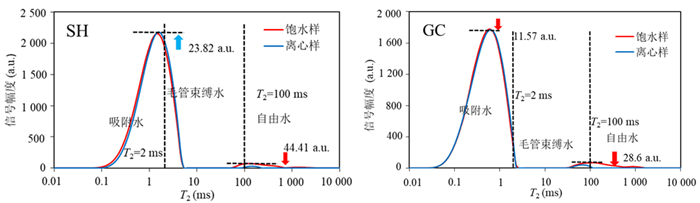
图 2 饱水样与离心样(1.61 MPa)T2谱图
Fig. 2. T2 spectra of water-saturated and centrifuged (1.61 MPa) coal samples
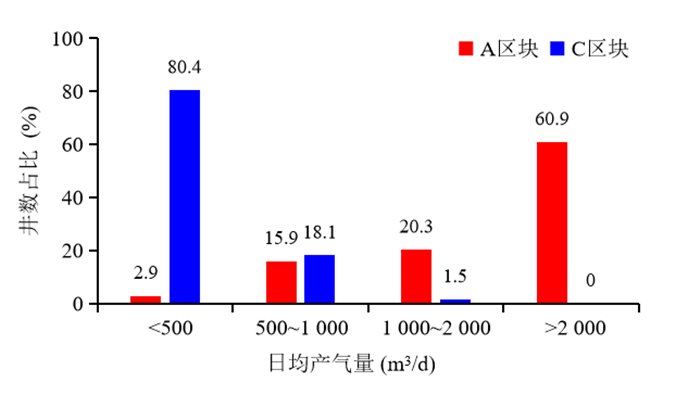
图 7 A、C区块日均产气量对比
Fig. 7. Comparison of average daily gas production between A and C blocks
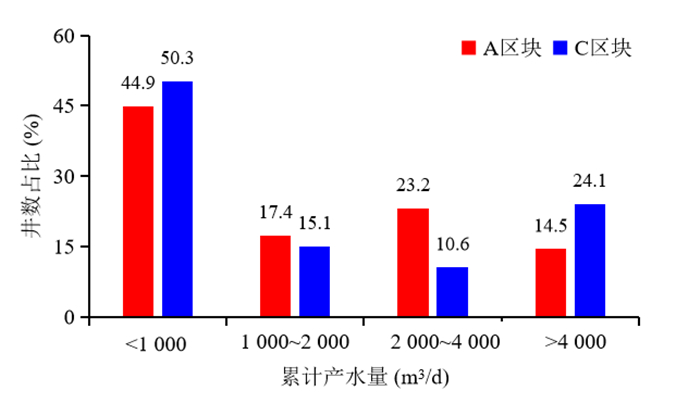
图 8 A、C区块累计产水量对比
Fig. 8. Comparison of cumulative water production between A and C blocks
表 1 煤样基本性质
Table 1. Basic properties of the coal samples
样品
编号Ro, max
(%)煤阶 工业分析(%) 煤岩有机显微组分(%) Mad Ad Vdaf 镜质组 惰质组 SH 3.24 无烟煤 2.79 9.21 8.92 92.5 7.5 GC 2.22 贫煤 1.44 7.31 10.51 83.9 16.1  下载: 导出CSV
表 2 孔隙水赋存特征
Table 2. Pore-water occurrence characteristics of the coal samples
样品号 核磁孔隙度
(%)原始干质量
(g)饱和水质量
(g)单位质量吸附的水体积
(mL/g)不同孔径范围内赋存的水体积占比(%) 0~10 nm 10~100 nm 100~1 000 nm >1 000 nm SH 6.86 31.996 33.578 0.049 4 40.87 55.97 0.71 2.45 GC 4.76 34.534 35.703 0.033 8 81.72 14.51 1.5 2.27
下载: 导出CSV
表 3 不同离心力下煤样含水饱和度
Table 3. Water saturation of the coal samples under different centrifugal pressures
样品 含水饱和度(%) 0.46 MPa 0.69 MPa 0.92 MPa 1.15 MPa 1.38 MPa 1.61 MPa 1.84 MPa SH 96.21 94.94 94.06 93.24 92.35 91.85 91.84 GC 97.55 92.56 91.62 90.59 89.91 89.39 89.39 注:含水饱和度=(离心后质量‒干重)/(饱和水质量‒干重)×100%.
下载: 导出CSV
表 4 煤样孔隙中水的相态分布
Table 4. Phase distribution of pore waters
样品 离心压力
(MPa)不同相态水占比(%) 吸附水 毛管束缚水 自由水 <2 ms 2~100 ms >100 ms SH 0 69.13 28.42 2.45 1.61 73.89 25.68 0.43 GC 0 95.15 2.58 2.27 1.61 97.94 2.05 0.01
下载: 导出CSV
表 5 储层压力对应解吸阶段
Table 5. Desorption stages under reservoir pressures
区块 煤样 储层压力
(MPa)平均储层压力
(MPa)平均储层压力下解吸速率
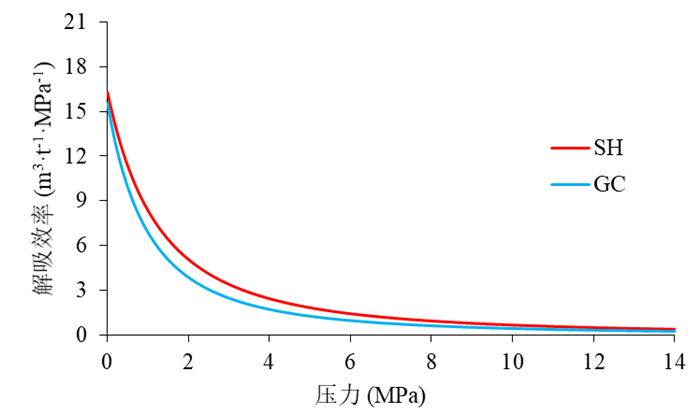
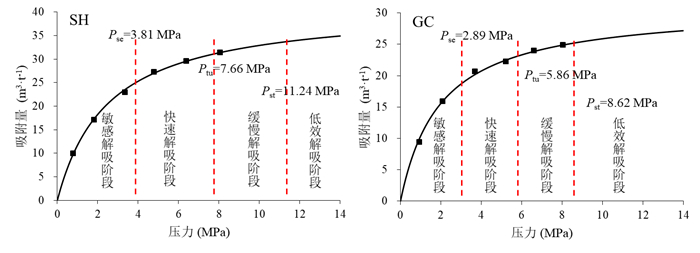
(m3·t-1·MPa-1)解吸阶段 A SH 0.9~3.44 1.92 5.27 敏感解吸 C GC 3.79~6.43 4.53 1.45 快速解吸、缓慢解吸
下载: 导出CSV
表 6 单相排水阶段排采特征参数
Table 6. Production-performance parameters during the single-phase water-production stage
区块 W1(m3) R1(%) 日均产水量(m3/d) 解吸时间(d) A 0.7~1 648.8(171.6) 0.01~27.76(7.87) 0.57~9.75(2.8) 1~229(45.5) C 31~10 436(584.1) 4.1~69.46(32.91) 0.24~28.36(3.26) 24~659(145.3) 注:括号内为平均值,下同.
下载: 导出CSV
表 7 单相排水阶段井底流压特征参数
Table 7. Bottom-hole flowing-pressure parameters during the single-phase water-production stage
区块 储层压力(MPa) 临界解吸压力(MPa) 临储比(%) 压降速率(kPa/d) A 0.9~3.44(1.92) 0.99~2.51(1.72) 40.48~100(85.13) 0~131.4(7.68) C 3.79~6.43(4.53) 0.25~3.23(2.12) 0~80.48(43.96) 3.3~147.7(18.8)
下载: 导出CSV
表 8 两相流初期上产阶段排采特征参数
Table 8. Production parameters during initial two-phase flow stage
区块 最高日产气量(m3) W2(m3) R2(%) 日均产水量(m3/d) 上产时间(d) A 985~21 456(5 795) 75.3~62 720.4(2 300.7) 7.59~95.21(44.42) 0.18~50.1(3.02) 69~2 132(560.7) C 305~4 743(1 051) 68.1~29 705.3(1 108.7) 6.78~72.97(31.28) 0.13~44.87(1.52) 122~1 765(626.3)
下载: 导出CSV
表 9 A区块和C区块典型井排采参数
Table 9. Production-performance parameters of representative wells in A and C blocks
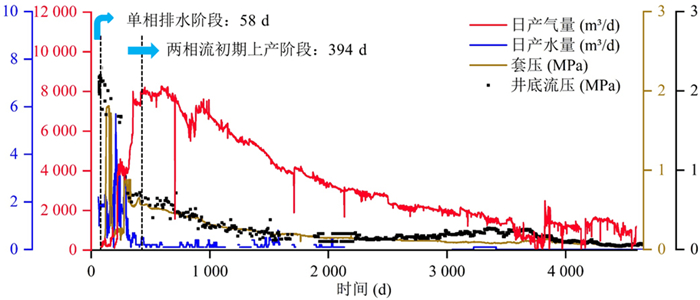
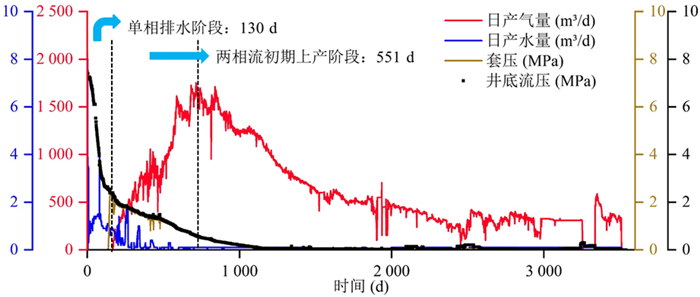
井号 单相排水阶段 两相流初期上产阶段 总累产水(m3) 最高日产气(m3) 解吸天数(d) W1(m3) R1(%) 日均产水(m3/d) 上产天数(d) W2(m3) R2(%) 日均产水(m3/d) A-14 58 104.1 13.7 1.8 394 437.7 57.6 1.1 759.9 8 270 C-170 130 163.9 30.2 1.3 551 159 29.3 0.3 542.6 1 831
下载: 导出CSV
-
Chen, S. D., Tang, D. Z., Tao, S., et al., 2018. Characteristics of In-Situ Stress Distribution and Its Significance on the Coalbed Methane (CBM) Development in Fanzhuang-Zhengzhuang Block, Southern Qinshui Basin, China. Journal of Petroleum Science and Engineering, 161: 108-120. https://doi.org/10.1016/j.petrol.2017.11.042. Chen, W. W., 2024. Study on Gas-Water Occurrence Law of Coal Reservoirs in Southern Qinshui Basin and Response of Coalbed Methane Production Characteristics (Dissertation). China University of Geosciences, Wuhan (in Chinese with English abstract). Chen, W. W., Yang, Y. H., Wang, S. W., et al., 2016. Study on Water Occurrence Features and Migration Rules in High Rank Coalbed Methane Reservoir. Coal Science and Technology, 44(S1): 154-159 (in Chinese with English abstract). Chen, Z. H., Wang, Y. B., Song, Y., et al., 2008. Comparison of Adsorption/Desorption Properties of CBM in Different-Rank Coals. Natural Gas Industry, 28(3): 30-32 (in Chinese with English abstract). Dong, J. X., 2022. Study on Spontaneous Imbibition Characteristics and Temporal and Spatial Distribution Law of Water in Remolded Coal without Gas (Dissertation). Henan Polytechnic University, Jiaozuo (in Chinese with English abstract). Hou, W., Xu, F. Y., Zhang, L., et al., 2022. Influence of Coal Lithotypes on Adsorption/Desorption Characteristics in Coal Reservoirs and Its Practical Significance: A Case Study in Baode Block. Coal Geology & Exploration, 50(3): 110-118 (in Chinese with English abstract). Langmuir, I., 1917. The Constitution and Fundamental Properties of Solids and Liquids. Journal of the Franklin Institute, 183(1): 102-105. https://doi.org/10.1016/S0016-0032(17)90938-X Li, X. F., Shi, J. T., Du, X. Y., et al., 2012. Transport Mechanism of Desorbed Gas in Coalbed Methane Reservoirs. Petroleum Exploration and Development, 39(2): 203-213 (in Chinese with English abstract). Lu, Y., Li, H., Lu, J. X., et al., 2020. Clean Up Water Blocking Damage in Coalbed Methane Reservoirs by Microwave Heating: Laboratory Studies. Process Safety and Environmental Protection, 138: 292-299. https://doi.org/10.1016/j.psep.2020.04.007. Meng, Y. J., Tang, D. Z., Xu, H., et al., 2014. Division of Coalbed Methane Desorption Stages and Its Significance. Petroleum Exploration and Development, 41(5): 612-617 (in Chinese with English abstract). Ni, G. H., Li, Z., Xie, H. C., 2018. Experimental Research on the Methods to Remove Water Blocking Effect Based on Nuclear Magnetic Resonance Testing. Journal of China Coal Society, 43(8): 2280-2287 (in Chinese with English abstract). Su, X. B., Wang, Q., Song, J. X., et al., 2017. Experimental Study of Water Blocking Damage on Coal. Journal of Petroleum Science and Engineering, 156: 654-661. https://doi.org/10.1016/j.petrol.2017.06.048 Sun, X. X., Yao, Y. B., Chen, J. Y., et al., 2015. Determination of Coal Wettability by Using Low-Field Nuclear Magnetic Resonance. Geoscience, 29(1): 190-197 (in Chinese with English abstract). Wang, Z. W., Liu, S. M., Qin, Y., 2021. Coal Wettability in Coalbed Methane Production: A Critical Review. Fuel, 303: 121-277. https://doi.org/10.1016/j.fuel.2021.121277 Wu, J., Wang, P., Huang, K., et al., 2026. Research on the Evaluation of Deep Coal Seam Water Lock Damage and Optimization of Water Lock Release Agents Based on Low Field Nuclear Magnetic Resonance Technology. Progress in Geophysics, 41(2): 719-731 (in Chinese with English abstract). Xu, K., Cui, B., 2015. Application of Isothermal Adsorption Curves in Coalbed Methane Production—A Case Study in Zhijin Block. Reservoir Evaluation and Development, 5(6): 73-75, 80 (in Chinese with English abstract). Yan, X., Fang, J. L., Mou, C., et al., 2026. Advances and Prospects of Design Optimization Technologies for Differential Development with Three-Dimensional Well Patterns for Deep Coalbed Methane Reservoirs: A Case Study of the No. 8 Coal Seam in the Ordos Basin. Coal Geology & Exploration, 54(6): 179-197 (in Chinese with English abstract). Yang, Z. B., Lu, B. J., Zhou, G. X., et al., 2025. Geological Particularities and Desorption-Production Patterns of Deep Coalbed Methane. Acta Petrolei Sinica, 46(8): 1464-1476 (in Chinese with English abstract). Yao, Y. B., Liu, D. M., 2012. Comparison of Low-Field NMR and Mercury Intrusion Porosimetry in Characterizing Pore Size Distributions of Coals. Fuel, 95: 152-158. https://doi.org/10.1016/j.fuel.2011.12.039. Yao, Y. B., Liu, D. M., 2013. Advanced Quantitative Characterization and Comprehensive Evaluation Model of Coalbed Methane Reservoirs. Geological Publishing House, Beijing (in Chinese). Yao, Y. B., Liu, D. M., 2016. Petrophysics and Fluid Properties Characterizations of Coalbed Methane Reservoir by Using NMR Relaxation Time Analysis. Coal Science and Technology, 44(6): 14-22 (in Chinese with English abstract). Yao, Y. B., Ma, R. Y., Sun, X. X., 2025. Mechanism of Enhanced Coalbed Methane Desorption Regulated by Fracturing Fluid Imbibition in Deep Coal Seams. Petroleum Exploration and Development, 52(6): 1388-1400 (in Chinese with English abstract). Ye, J. P., 2025. China's CBM Exploration and Production and Associated Technological Advancements: A Review and Reflections. Coal Geology & Exploration, 53(1): 114-127 (in Chinese with English abstract). Zhang, J. F., Li, G. X., Jia, C. Z., et al., 2026. Coal-Rock Gas Accumulation Mechanisms, Resource Potential, and Its Strategic Significance for China's Natural Gas Industry. World Petroleum Industry, 33(1): 130-141 (in Chinese with English abstract). Zhang, S. C., Tian, T., Yang, Y. C., et al., 2026. Influence of Coal Reservoir Sensitivity on CBM Well Drainage and Production in Binchang Block. Unconventional Oil & Gas, 13(4): 84-91 (in Chinese with English abstract). Zheng, S. J., 2021. Quantitative Analysis Method of Coal Reservoir Characteristics Based on Low-Field Nuclear Magnetic Resonance (Dissertation). China University of Geosciences, Beijing (in Chinese with English abstract). Zhu, Q. Z., Yang, Y. H., Zuo, Y. Q., et al., 2018. CBM Development in China: Challenges and Solutions. Natural Gas Industry, 38(4): 96-100 (in Chinese with English abstract). Zhu, Q. Z., Zuo, Y. Q., Yang, Y. H., 2015. How to Solve the Technical Problems in the CBM Development: A Case Study of a CMB Gas Reservoir in the Southern Qinshui Basin. Natural Gas Industry, 35(2): 106-109 (in Chinese with English abstract). Zou, C. N., Yu, R. Z., Sun, Q. P., et al., 2026. Insights into CBM and Coal-Rock Gas Development Performance, Key Technology and Prospects from Thousands Well Data Analysis. Journal of China University of Petroleum (Edition of Natural Science), 50(3): 94-108 (in Chinese with English abstract). 陈文文, 2024. 沁水盆地南部煤储层气水赋存规律及煤层气生产特征响应研究(博士学位论文). 武汉: 中国地质大学. 陈文文, 杨延辉, 王生维, 等, 2016. 高煤阶煤层气藏内水赋存特征与运移规律研究. 煤炭科学技术, 44(S1): 154-159. 陈振宏, 王一兵, 宋岩, 等, 2008. 不同煤阶煤层气吸附、解吸特征差异对比. 天然气工业, 28(3): 30-32. 董家昕, 2022. 不含瓦斯重塑煤自发渗吸特征及水分时空分布规律研究(博士学位论文). 焦作: 河南理工大学. 侯伟, 徐凤银, 张雷, 等, 2022. 煤岩类型对煤储层吸附/解吸特征影响及实践意义: 以保德区块为例. 煤田地质与勘探, 50(3): 110-118. 李相方, 石军太, 杜希瑶, 等, 2012. 煤层气藏开发降压解吸气运移机理. 石油勘探与开发, 39(2): 203-213. 孟艳军, 汤达祯, 许浩, 等, 2014. 煤层气解吸阶段划分方法及其意义. 石油勘探与开发, 41(5): 612-617. 倪冠华, 李钊, 解宏超, 2018. 基于核磁共振测试的煤层水锁效应解除方法. 煤炭学报, 43(8): 2280-2287. 孙晓晓, 姚艳斌, 陈基瑜, 等, 2015. 基于低场核磁共振的煤润湿性分析. 现代地质, 29(1): 190-197. 吴见, 王鹏, 黄凯, 等, 2026. 基于低场核磁共振技术的深煤层水锁伤害评价及解水锁剂优选研究. 地球物理学进展, 41(2): 719-731. 许科, 崔彬, 2015. 等温吸附曲线在煤层气排采中的应用——以织金区块为例. 油气藏评价与开发, 5(6): 73-75, 80. 闫霞, 方建龙, 牟春, 等, 2026. 深部煤层气藏差异化立体开发优化设计技术进展与展望——以鄂尔多斯盆地为例. 煤田地质与勘探, 54(6): 179-197. 杨兆彪, 卢本举, 周国晓, 等, 2025. 深部煤层气地质特殊性与释放产出规律. 石油学报, 46(8): 1464-1476. 姚艳斌, 刘大锰, 2013. 煤储层精细定量表征与综合评价模型. 北京: 地质出版社. 姚艳斌, 刘大锰, 2016. 基于核磁共振弛豫谱的煤储层岩石物理与流体表征. 煤炭科学技术, 44(6): 14-22. 姚艳斌, 马如英, 孙晓晓, 2025. 深部煤层压裂液渗吸调控煤层气解吸增效机制. 石油勘探与开发, 52(6): 1388-1400. 叶建平, 2025. 中国煤层气勘探开发及其科技进步历程回顾与思考. 煤田地质与勘探, 53(1): 114-127. 张君峰, 李国欣, 贾承造, 等, 2026. 煤岩气成藏机理、资源潜力及其对中国天然气产业的战略意义. 世界石油工业, 33(1): 130-141. 张世春, 田涛, 杨云成, 等, 2026. 彬长区块煤储层敏感性对煤层气井排采的影响. 非常规油气, 13(4): 84-91. 郑司建, 2021. 基于低场核磁共振的煤储层特性定量分析方法(博士学位论文). 北京: 中国地质大学. 朱庆忠, 杨延辉, 左银卿, 等, 2018. 中国煤层气开发存在的问题及破解思路. 天然气工业, 38(4): 96-100. 朱庆忠, 左银卿, 杨延辉, 2015. 如何破解我国煤层气开发的技术难题——以沁水盆地南部煤层气藏为例. 天然气工业, 35(2): 106-109. 邹才能, 于荣泽, 孙钦平, 等, 2026. 万口井数据透视煤层气和煤岩气开发特征、关键技术及前景. 中国石油大学学报(自然科学版), 50(3): 94-108. -

 点击查看大图
计量
- 文章访问数: 59
- HTML全文浏览量: 27
- PDF下载量: 16
- 被引次数: 0
