




Water Occurrence Differences between Primary Adsorbed Water and Artificial Fracturing-Invaded Water in Coal Reservoirs and Their Control Mechanisms on Water-Blocking Damage
-
摘要: 煤层气开发过程中,煤中孔隙水赋存状态是诱发水锁伤害、制约煤层气高效产出的核心因素.目前研究多关注人工压裂液侵入造成的水锁伤害,而对储层原始湿度环境下形成的原生吸附水及其锁水效应认识不足.为厘清原始储层地质条件与人工压裂条件下煤中水赋存的微观差异,揭示差异化水锁伤害机理,以沁水盆地东峰煤矿3#煤层煤样为研究对象,分别开展平衡水吸附实验(模拟原始储层湿度环境)与加压饱水实验(模拟压裂液侵入环境),利用低场核磁共振(LF-NMR)技术表征两种条件下煤岩孔隙水赋存分布特征,结合梯度离心实验定量评价孔隙水可动性,系统对比两种条件下水的赋存差异及其对水锁伤害的控制机制.实验结果表明,平衡水吸附条件下,煤储层中水主要赋存于微孔与过渡孔,环境湿度越高,吸附平衡后水分赋存的孔隙孔径越大、含水率越高;加压饱水条件下,煤储层中水以过渡孔赋存为主,饱水压力增大可拓宽水分赋存孔径,同时改造煤岩孔隙结构、提升孔隙连通性.相较于加压饱水煤样,平衡水吸附煤样整体含水率更低,但水分以水蒸气形式渗入煤中,可赋存于微米级微小孔隙及孤立孔隙,孔隙水可动性显著更弱、排水难度更大.研究证实,低湿度储层原生吸附水引发的水锁伤害显著高于高压压裂液侵入造成的水锁伤害,弥补了当前研究重人工注水伤害、轻原生湿度水锁伤害的认知短板.研究成果可为煤储层水锁伤害精准评价、高效解锁工艺优化提供微观理论支撑.Abstract: Water occurrence in coal pores is a key factor inducing water-blocking damage and restricting efficient coalbed methane (CBM) production. Current studies mainly focus on the damage caused by artificial fracturing fluid invasion, while the primary adsorbed water formed under the original reservoir humidity environment and its water-blocking effect remain insufficiently understood. Coal samples from the No.3 coal seam of Dongfeng Coal Mine in the Qinshui Basin were selected for this study. Controlled experiments of equilibrium water vapor adsorption (simulating the original reservoir humidity) and pressurized water saturation (simulating fracturing fluid invasion) were carried out. Low-field nuclear magnetic resonance (LF-NMR) was used to characterize the distribution of pore water under the two occurrence conditions, and gradient centrifugation experiments were employed to quantitatively evaluate water mobility. The differences in water occurrence and their control mechanisms on water-blocking damage were systematically compared. The results show that under equilibrium water vapor adsorption, water mainly occurs in micropores and transition pores; higher environmental humidity leads to larger occupied pore sizes and higher water contents at adsorption equilibrium. Under pressurized water saturation, water predominantly occupies transition pores; increasing saturation pressure broadens the range of water-occupied pore sizes, while transforming pore structure and enhancing pore connectivity. Compared with pressurized water-saturated samples, equilibrium water-adsorbed samples have a lower overall water content. However, water vapor can penetrate into micro- and nano-scale pores and even isolated pores, resulting in significantly weaker water mobility and greater difficulty in drainage. The water-blocking damage caused by primary adsorbed water in low-humidity reservoirs is far higher than that caused by high-pressure fracturing fluid invasion. This finding remedies the cognitive deficiency of overemphasizing artificial water injection damage while neglecting primary humidity-related water-blocking. The results can provide microscopic theoretical support for accurate evaluation of water-blocking damage and the optimization of efficient damage removal technologies for coal reservoirs.
-
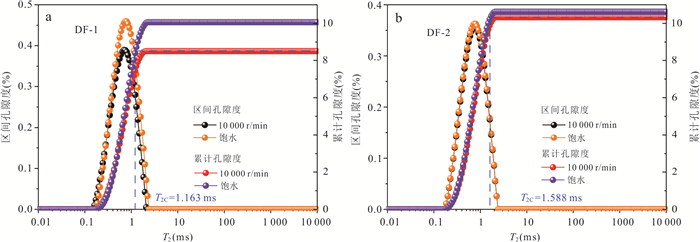
图 1 DF-1(a)、DF-2(b)煤样饱水样与离心样核磁共振T2谱分布以及离心法T2截止值
Fig. 1. NMR T2 spectra of coal samples DF-1 (a) and DF-2 (b) under water-saturated and centrifuged conditions, and the T2 cutoff values determined by centrifugation
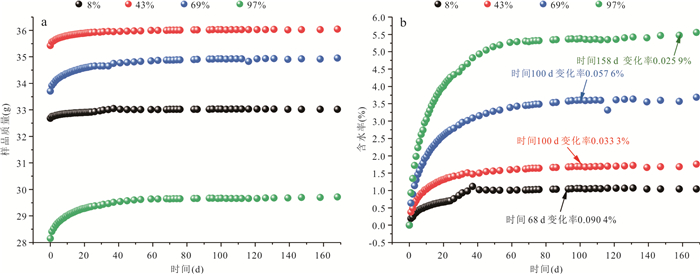
图 2 煤样平衡水吸附特征
a.吸水质量随时间变化;b.吸水率(质量百分比)随时间变化
Fig. 2. Equilibrium water vapor adsorption characteristics of coal samples
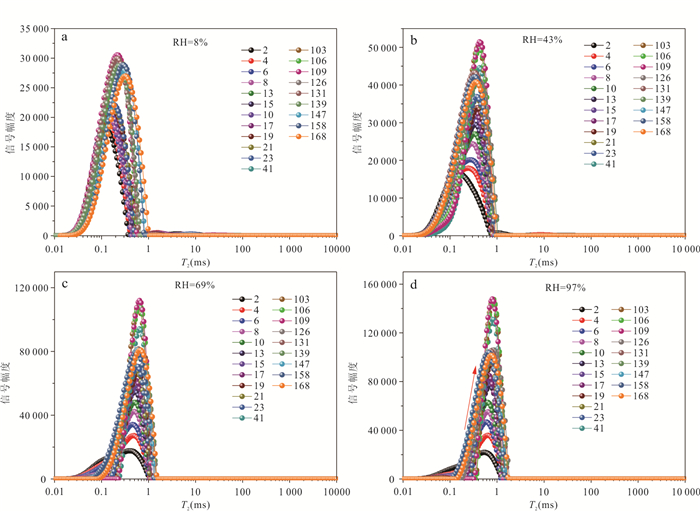
图 3 煤样在相对湿度条件8%(a)、43%(b)、69%(c)与97%(d)下平衡水吸附核磁共振T2谱分布
Fig. 3. NMR T2 spectra of coal samples during equilibrium water vapor adsorption at relative humidities of (a) 8%, (b) 43%, (c) 69%, and (d) 97%
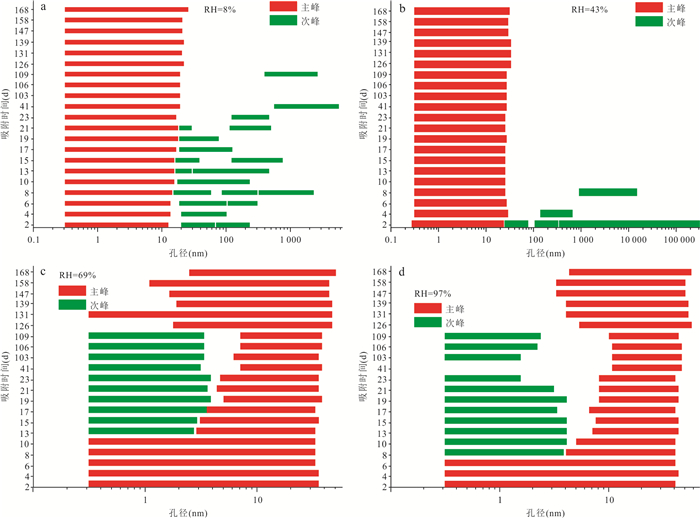
图 4 煤样在相对湿度条件8%(a)、43%(b)、69%(c)与97%(d)下平衡水吸附条件下水赋存孔隙分布演化特征
Fig. 4. Evolution of pore-size distributions for water occurrence in coal samples during equilibrium water vapor adsorption at relative humidities of (a) 8%, (b) 43%, (c) 69%, and (d) 97%
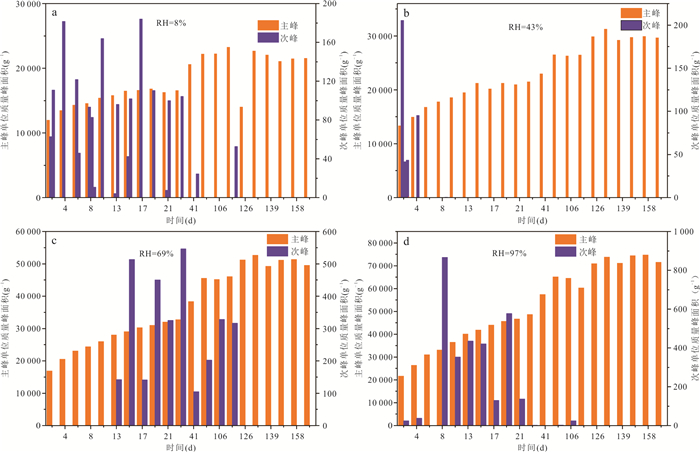
图 5 煤样在相对湿度条件8%(a)、43%(b)、69%(c)与97%(d)下平衡水吸附的核磁共振T2谱峰信号幅度变化
Fig. 5. Variation in NMR T2 peak signal amplitude of coal samples during equilibrium water vapor adsorption at relative humidities of (a) 8%, (b) 43%, (c) 69%, and (d) 97%
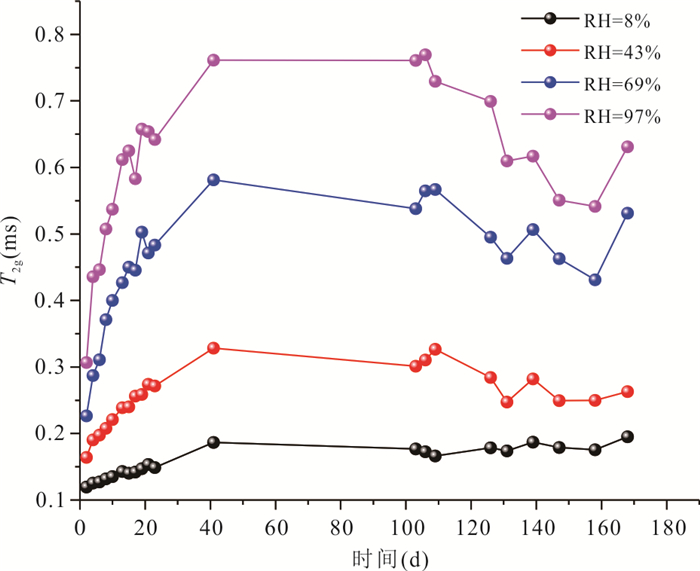
图 6 煤样平衡水吸附条件下核磁共振T2g演化特征
Fig. 6. Evolution of NMR T2g of coal samples during equilibrium water vapor adsorption at different relative humidities
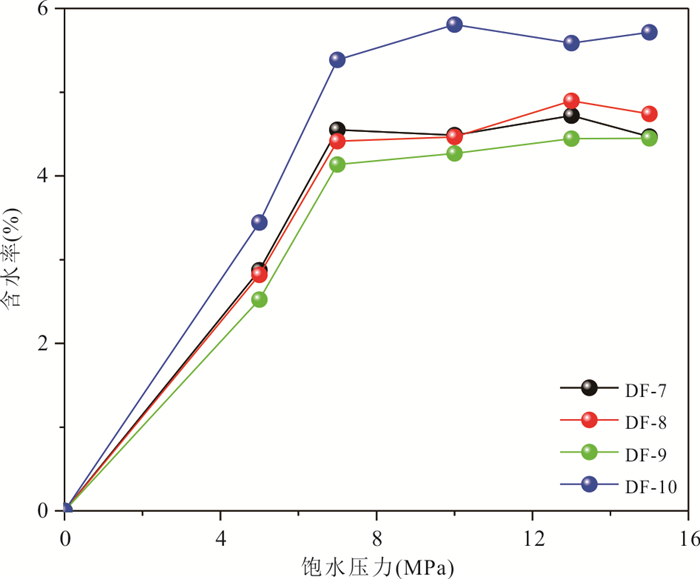
图 7 加压饱水条件下煤样饱水含水率特征
Fig. 7. Variation in water content of coal samples under pressurized water saturation
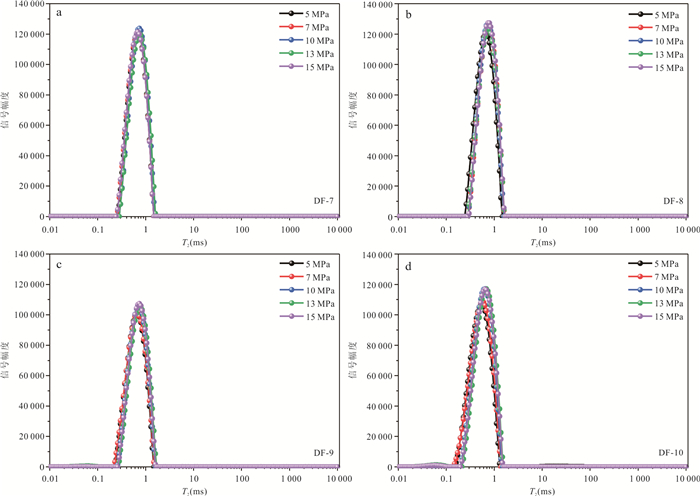
图 8 不同饱水压力条件下煤样DF-7(a)、DF-8(b)、DF-9(c)与DF-10(d)核磁共振T2谱分布
Fig. 8. NMR T2 spectra of coal samples (a) DF-7, (b) DF-8, (c) DF-9, and (d) DF-10 at different water-saturation pressures
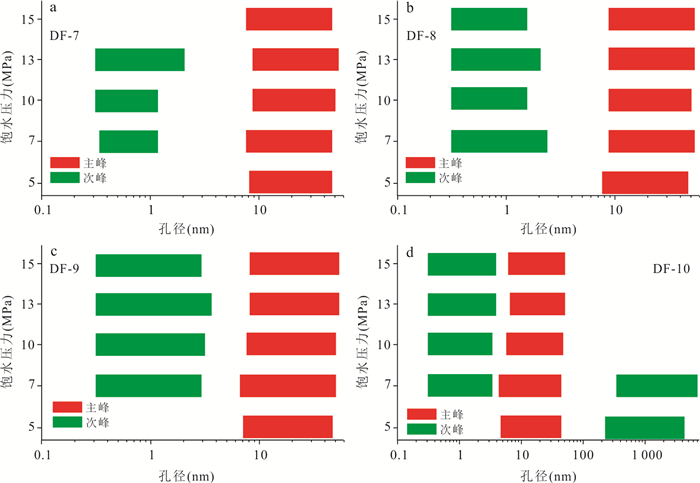
图 9 不同饱水压力条件下煤样DF-7(a)、DF-8(b)、DF-9(c)与DF-10(d)水赋存孔隙分布演化特征
Fig. 9. Evolution of pore-size distributions for water occurrence in coal samples (a) DF-7, (b) DF-8, (c) DF-9, and (d) DF-10 at different water-saturation pressures
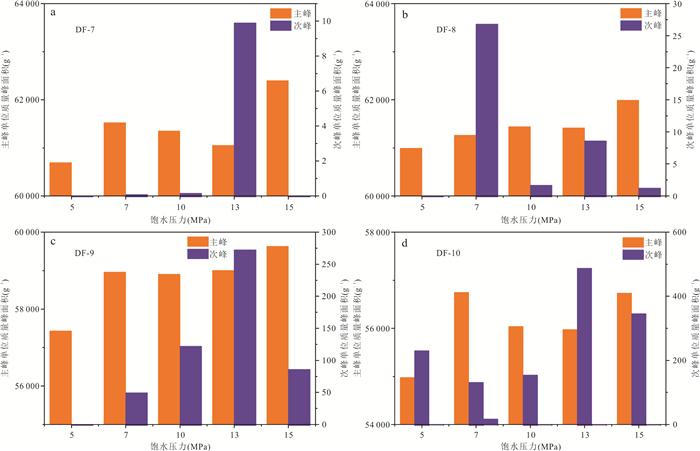
图 10 不同饱水压力条件下煤样DF-7(a)、DF-8(b)、DF-9(c)与DF-10(d)核磁共振T2谱谱峰信号幅度变化
Fig. 10. Variation in NMR T2 peak signal amplitude of coal samples (a) DF-7, (b) DF-8, (c) DF-9, and (d) DF-10 at different water-saturation pressures
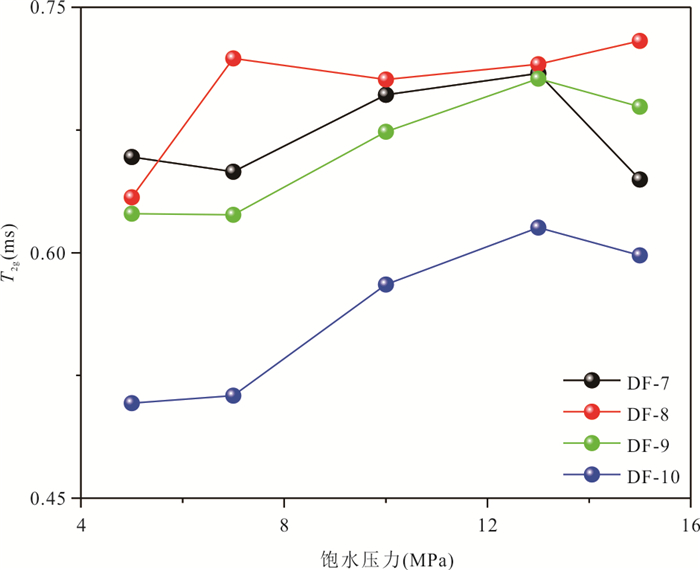
图 11 不同饱水压力条件下煤样核磁共振T2g演化特征
Fig. 11. Evolution of NMR T2g of coal samples at different water-saturation pressures
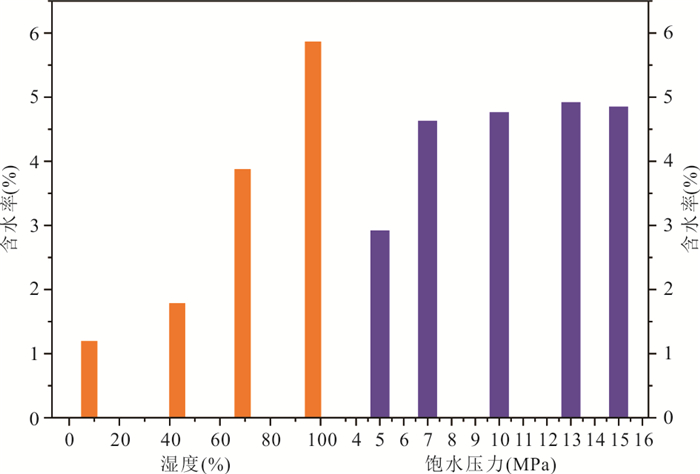
图 12 平衡水吸附与加压饱水煤样含水率对比
Fig. 12. Comparison of water content between equilibrium water-adsorbed and pressurized water-saturated coal
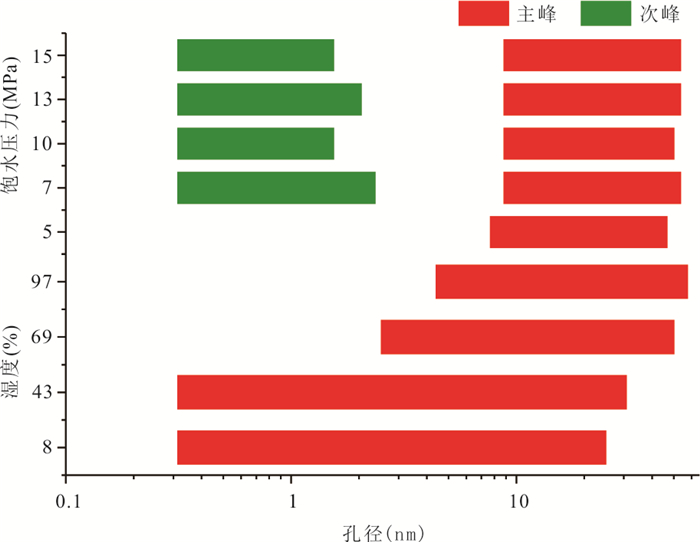
图 13 平衡水吸附与加压饱水煤样水赋存孔径范围对比
Fig. 13. Comparison of pore-size ranges for water occurrence between equilibrium water-adsorbed and pressurized water-saturated coal samples
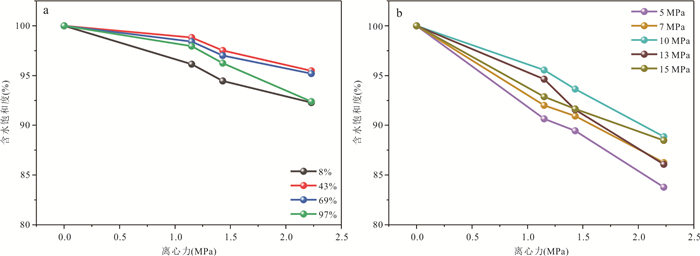
图 14 不同离心力条件下的平衡水吸附煤样(a)与加压饱水煤样(b)含水饱和度
Fig. 14. Water saturation of (a) equilibrium water-adsorbed and (b) pressurized water-saturated coal samples under different centrifugal conditions
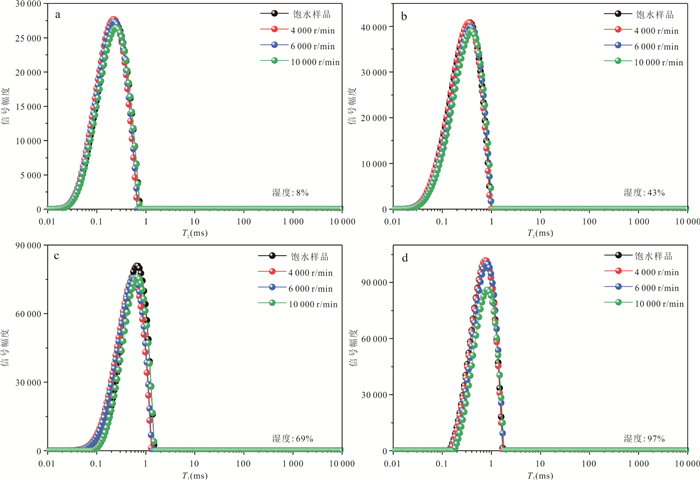
图 15 不同离心力条件下的平衡水吸附煤样核磁共振T2谱分布
Fig. 15. NMR T2 spectra of equilibrium water-adsorbed coal samples under different centrifugal conditions
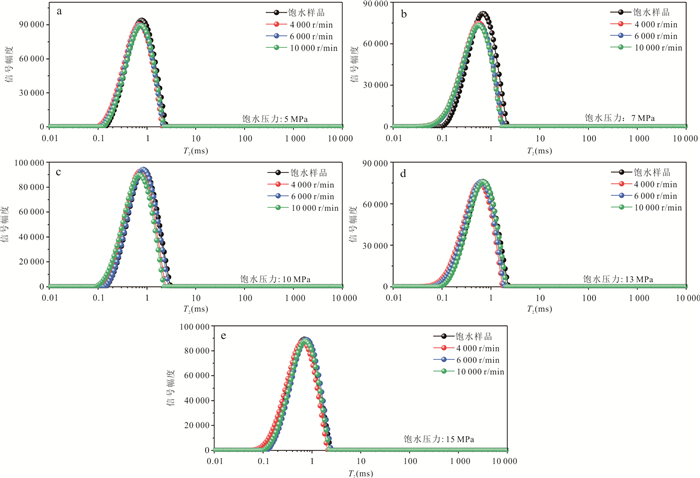
图 16 不同离心力条件下的加压饱水煤样核磁共振T2谱分布
Fig. 16. NMR T2 spectra of pressurized water-saturated coal samples under different centrifugal conditions
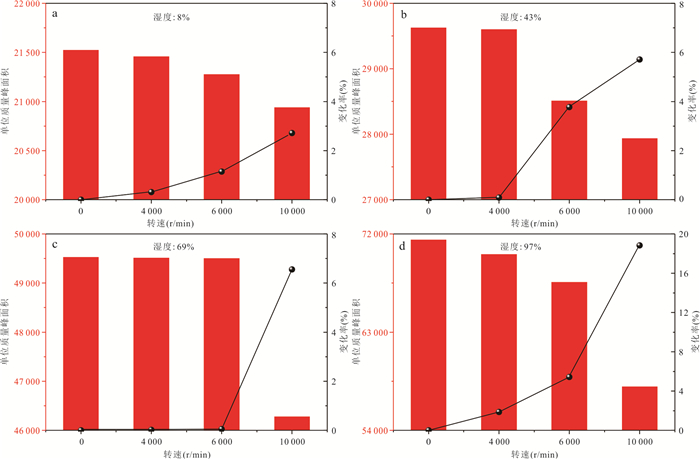
图 17 不同离心力条件下的水吸附煤样核磁共振T2谱弛豫峰面积及其变化率
Fig. 17. NMR T2 peak areas and their rates of change for equilibrium water-adsorbed coal samples under different centrifugal conditions
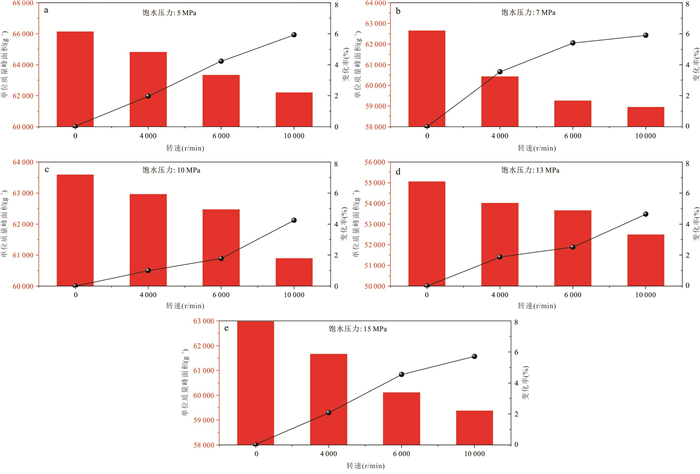
图 18 不同离心力条件下的加压饱水煤样核磁共振T2谱峰面积及其变化率
Fig. 18. NMR T2 peak areas and their rates of change for pressurized water-saturated coal samples under different centrifugal conditions
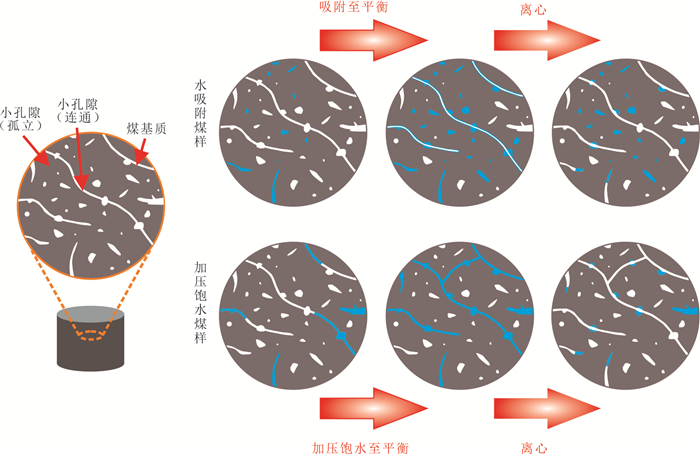
图 19 水吸附煤样与加压饱水煤样水可动性差异机理
Fig. 19. Schematic mechanism of the difference in water mobility between equilibrium water-adsorbed and pressurized water-saturated coal samples
表 1 东峰煤样煤岩煤质特征
Table 1. Coal-quality and petrographic characteristics of the Dongfeng coal sample
样品 工业分析 显微组分 反射率 Mad(%) Ad(%) Ⅴdaf(%) 镜质组(%) 惰质组(%) 黏土类(%) 氧化类(%) 碳酸类(%) 硫化类(%) Ro, max(%) DF 0.69 14.92 10.60 65.82 22.56 9.32 0.69 1.20 0.41 3.12  下载: 导出CSV
-
Chen, X. J., Cheng, Y. P., 2014. Experiment Study on Water Injection Affected to Desorption of Coal Adsorption Gas. Coal Science and Technology, 42(6): 96-99 (in Chinese with English abstract). Huo, C., Guo, H. X., Wang, L., et al., 2025. Research Progress of Deep Coalbed Methane Exploration and Development in China under the Dual Carbon Background. Science Technology and Engineering, 25(14): 5705-5720 (in Chinese with English abstract). Li, J., Zhang, J. J., Huang, K. B., et al., 2022. Dynamic Variation on Water Micro-Occurrence in Low-Rank Coals by a Low-Field Nuclear Magnetic Resonance Experiment: A Case Study of the No. 7 Coal Seam in Kongzhuang Coal Mine. Energy & Fuels, 36(16): 9066-9079. https://doi.org/10.1021/acs.energyfuels.2c01583 Li, Y. J., Zhai, C., Sun, Y., et al., 2023. Characterizing Water Vapor Adsorption on Coal by Nuclear Magnetic Resonance: Influence of Coal Pore Structure and Surface Properties. Energy, 282: 128-420. https://doi.org/10.1016/j.energy.2023.128420. Lin, C. B., 2019. Experimental Research on Coal Seam Pulsating Water Injection in Infiltration and Gas Desorption. Coal Engineering, 51(10): 108-112 (in Chinese with English abstract). Liu, Q., Huang, J. B., Ni, G. H., et al., 2020. Water Blocking Effect of Coal Seam Based on Low Field Nuclear Magnetic Resonance. Journal of China Coal Society, 45(3): 1108-1115 (in Chinese with English abstract). Liu, W., Wang, G., Han, D. Y., et al., 2021. Accurate Characterization of Coal Pore and Fissure Structure Based on CT 3D Reconstruction and NMR. Journal of Natural Gas Science and Engineering, 96: 104-242. https://doi.org/10.1016/j.jngse.2021.104242 Mao, G. T., Lai, F. P., Mukatts, A., 2018. Study on the Influencing Factors of Water Blocking Damage of Coalbed Methane Reservoir in Zhaozhuang Mine, Qinshui Basin, Natural Gas Geoscience, 29(11): 1647-1655 (in Chinese with English abstract). Meng, M. M., Ge, H. K., Ji, W. M., et al., 2015. Monitor the Process of Shale Spontaneous Imbibition in Co-Current and Counter-Current Displacing Gas by Using Low Field Nuclear Magnetic Resonance Method. Journal of Natural Gas Science and Engineering, 27: 336-345. https://doi.org/10.1016/j.jngse.2015.08.069 Ni, G. H., Li, Z., Xie, H. C., 2018. Experimental Research on the Methods to Remove Water Blocking Effect Based on Nuclear Magnetic Resonance Testing. Journal of China Coal Society, 43(8): 2280-2287 (in Chinese with English abstract). Shan, G. X., Cheng, P., Xiao, X. M., et al., 2022. Water-Bearing Characteristics in Overmature Shales from Coal Measure Strata Based on Equilibrium Water Vapor Adsorption and Its Geological Significances. Natural Gas Geoscience, 33(4): 666-676 (in Chinese with English abstract). Yang, H., Cheng, W. M., Liu, Z., et al., 2020. Fractal Characteristics of Effective Seepage Channel Structure of Water Infusion Coal Based on NMR Experiment. Rock and Soil Mechanics, 41(4): 1279-1286 (in Chinese with English abstract). Yang, Z. M., Zhang, Y. P., Li, H. B., et al., 2017. Application Basis of Nuclear Magnetic Resonance Technology in the Unconventional Reservoirs. Earth Science, 42(8): 1333-1339 (in Chinese with English abstract). Yao, Y. B., Liu, D. M., Che, Y., et al., 2010. Petrophysical Characterization of Coals by Low-Field Nuclear Magnetic Resonance (NMR). Fuel, 89(7): 1371-1380. https://doi.org/10.1016/j.fuel.2009.11.005 Zhang, G. H., Liang, B., Bi, Y. W., 2012. Impact of Water Lock on Gas Desorption of Coal with Gas. Journal of China Coal Society, 37(2): 253-258 (in Chinese with English abstract). Zhang, J. J., Wei, C. T., Ju, W., et al., 2020. Microscopic Distribution and Dynamic Variation of Water under Stress in Middle and High Rank Coal Samples. Journal of Natural Gas Science and Engineering, 79: 103-369. https://doi.org/10.1016/j.jngse.2020.103369 Zhang, S. Y., Sang, S. X., 2008. Influence Mechanism of Liquid Water on Methane Absorption of Coals with Different Ranks. Acta Geologica Sinica, 82(10): 1350-1354 (in Chinese with English abstract). Zheng, M., Li, J. Z., Wu, X. Z., et al., 2019. Potential of Oil and Natural Gas Resources of Main Hydrocarbon-Bearing Basins and Key Exploration Fields in China. Earth Science, 44(3): 833-847 (in Chinese with English abstract). 陈向军, 程远平, 2014. 注水对煤层吸附瓦斯解吸影响的试验研究. 煤炭科学技术, 42(6): 96-99. 霍超, 郭海晓, 王蕾, 等, 2025. 双碳背景下中国深部煤层气勘探开发研究进展. 科学技术与工程, 25(14): 5705-5720. 林传兵, 2019. 煤层脉动注水渗透与瓦斯解吸实验研究. 煤炭工程, 51(10): 108-112. 刘谦, 黄建滨, 倪冠华, 等, 2020. 不同煤级煤液相侵入效应低场核磁共振实验研究. 煤炭学报, 45(3): 1108-1115. 毛港涛, 赖枫鹏, 木卡旦斯·阿克木江, 等, 2018. 沁水盆地赵庄井田煤层气储层水锁伤害影响因素. 天然气地球科学, 29(11): 1647-1655. 倪冠华, 李钊, 解宏超, 2018. 基于核磁共振测试的煤层水锁效应解除方法. 煤炭学报, 43(8): 2280-2287. 单国鑫, 程鹏, 肖贤明, 等, 2022. 过成熟煤系页岩平衡水吸附特征及其地质意义. 天然气地球科学, 33(4): 666-676. 杨赫, 程卫民, 刘震, 等, 2020. 注水煤体有效渗流通道结构分形特征核磁共振试验研究. 岩土力学, 41(4): 1279-1286. 杨正明, 张亚蒲, 李海波, 等, 2017. 核磁共振技术在非常规油气藏的应用基础. 地球科学, 42(8): 1333-1339. doi: 10.3799/dqkx.2017.506 张国华, 梁冰, 毕业武, 2012. 水锁对含瓦斯煤体的瓦斯解吸的影响. 煤炭学报, 37(2): 253-258. 张时音, 桑树勋, 2008. 液态水影响不同煤级煤吸附甲烷的差异及其机理. 地质学报, 82(10): 1350-1354. 郑民, 李建忠, 吴晓智, 等, 2019. 我国主要含油气盆地油气资源潜力及未来重点勘探领域. 地球科学, 44(3): 833-847. doi: 10.3799/dqkx.2019.957 -

 点击查看大图
计量
- 文章访问数: 82
- HTML全文浏览量: 35
- PDF下载量: 12
- 被引次数: 0
