




A Chinese Seismic Instrument Intensity Prediction Model Based on Multimodal Deep Learning
-
摘要: 中国地震仪器烈度预测对我国地震预警和减灾至关重要,但传统方法存在精度不足、多源数据融合不充分等问题.本研究旨在构建一种多模态深度学习模型,探索在中国地区对于地震仪器烈度预测的可行性,提升地震预警中仪器烈度预测的准确性和鲁棒性.建立多模态中国仪器烈度预测网络(MCIINet),采用中国地震台网记录的地震事件对MCIINet进行训练和测试.实验表明:在测试数据集上,P波触发后3 s,和基线模型相比,MCIINet对于仪器烈度预测的MAE和RMSE分别降低了9.03%和8.67%、R2和准确率分别提升了9.10%和2.51%.MCIINet通过多模态深度特征融合有效提升了仪器烈度预测精度,验证了多模态深度学习对于我国地震仪器烈度预测的可行性,可为地震预警中仪器烈度预测提供技术支撑.Abstract: The Chinese seismic instrument intensity prediction is crucial for earthquake early warning (EEW) and hazard mitigation in China, but traditional methods suffer from issues such as insufficient accuracy and insufficient fusion of multi-source data. This study aims to construct a multimodal deep learning model, explore its feasibility for predicting seismic instrument intensity in China, and improve the accuracy and robustness of instrument intensity prediction for EEW. A Multimodal Chinese Instrument Intensity prediction Network (MCIINet) is proposed, which is trained and tested by the seismic events recorded by China Earthquake Networks Center. Experiments have shown that on the test dataset, compared to the baseline model at 3 s after P-wave triggering, MCIINet reduced MAE and RMSE of instrument intensity prediction by 9.03% and 8.67%, respectively, and improved R2 and accuracy by 9.10% and 2.51%, respectively. MCIINet has effectively improved the accuracy of intensity prediction through multimodal deep feature fusion, verifying the feasibility of multimodal deep learning for seismic instrument intensity prediction in China, and providing technical support for instrument intensity prediction in EEW.
-
Key words:
- seismic instrument intensity /
- earthquake early warning /
- multimodal /
- deep learning /
- P wave /
- seismology
-
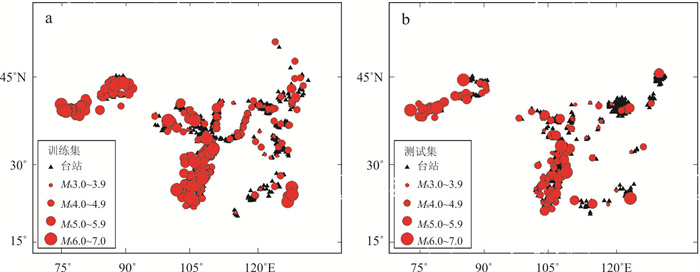
图 1 (a) 训练数据集和(b)测试数据集的震中和台站分布
Fig. 1. Distribution of epicenters and stations in the training dataset (a) and in the testing dataset (b)
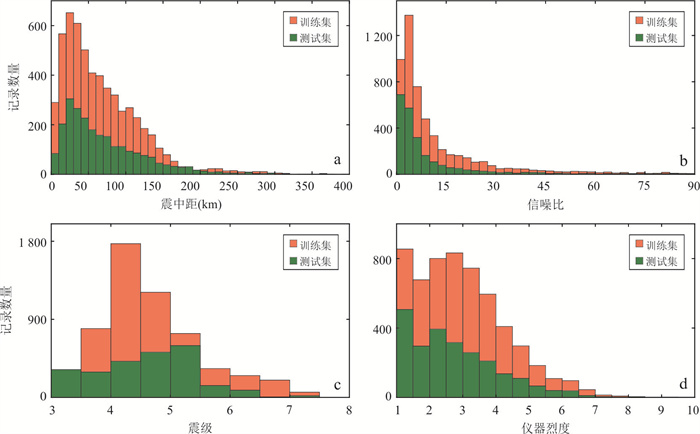
图 2 训练数据集和测试数据集的(a)震中距、(b)信噪比、(c)震级和(d)仪器烈度的分布
Fig. 2. Distribution of (a) epicentral distance, (b) signal-to-noise ratio, (c) magnitude, and (d) instrument intensity for the training and testing datasets
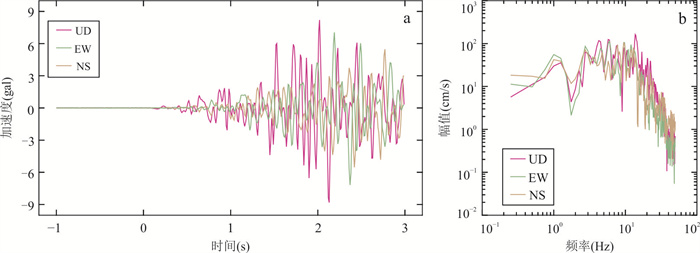
图 3 (a) 时域数据和(b)频谱数据的样例
Fig. 3. Examples of (a) time-domain data and (b) spectrum data
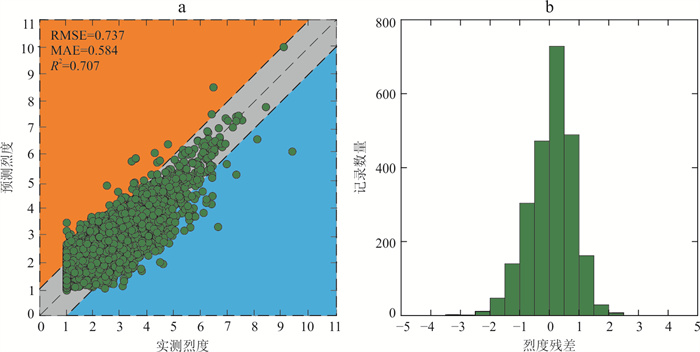
图 5 (a) MCIINet在测试集上的预测烈度与观测烈度的关系以及(b)烈度残差的分布
Fig. 5. (a) Relationship between predicted intensity and observed intensity of MCIINet on the testing dataset, and (b) distribution of intensity residuals
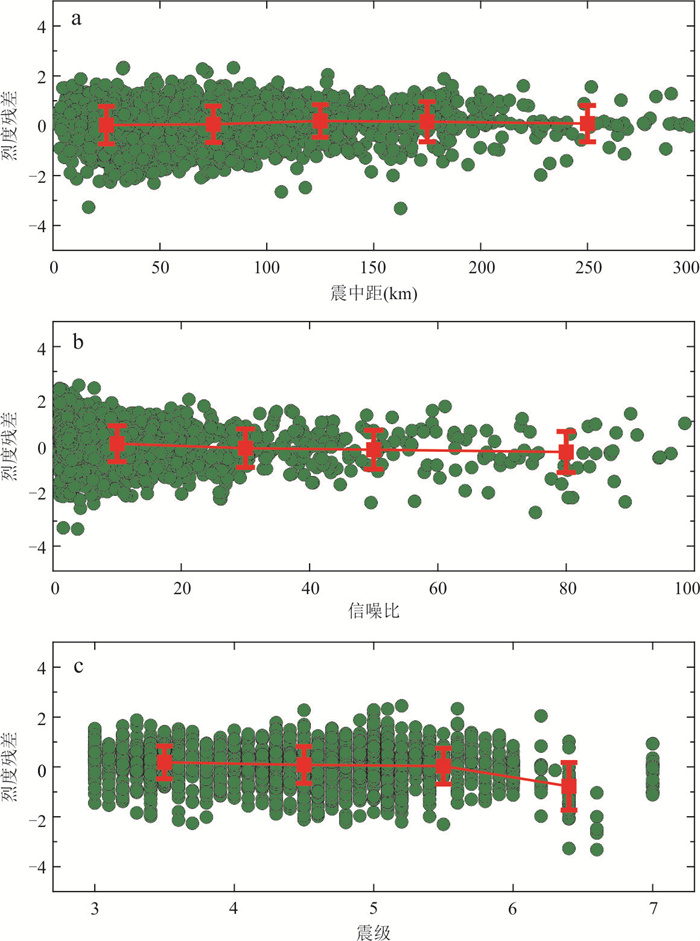
图 6 MCIINet在测试集上的烈度残差与(a)震中距、(b)信噪比和(c)震级的关系
Fig. 6. The relationship between the residual intensity of MCIINet on the testing dataset and (a) epicentral distance, (b) signal-to-noise ratio, and (c) magnitude
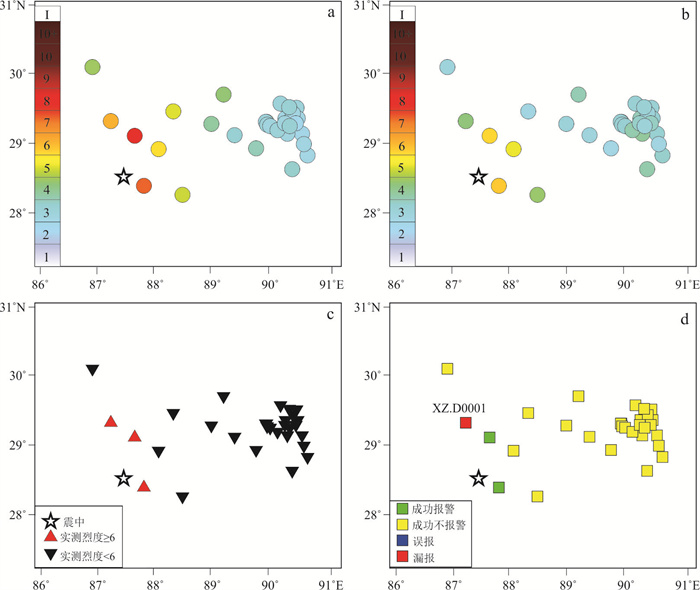
图 7 (a) 定日地震的实际仪器烈度分布;(b) MCIINet预测的仪器烈度;(c)定日地震的实测烈度≥6和实测烈度 < 6的分布;(d)基于MCIINet预测烈度的警报性能
Fig. 7. (a) Actual instrument intensity distribution of Dingri earthquake; (b) the instrument intensity predicted by MCIINet; (c) the distribution of actual instrument intensity ≥6 and actual instrument intensity < 6 for Dingri earthquake; (d) alarm performance based on MCIINet for predicting intensity
表 1 MCIINet和基线模型在测试集上的性能比较
Table 1. Performance comparison between MCIINet and baseline models on the testing dataset
方法 MAE RMSE R2 准确率 基线模型 Pd方法 0.817
(‒28.52%)1.038
(‒28.99%)0.419
(+68.74%)67.34% CONIP模型 0.671
(‒12.97%)0.883
(‒16.53%)0.578
(+22.32%)78.76% LSTM模型 0.642
(‒9.03%)0.807
(‒8.67%)0.648
(+9.10%)80.81% XGBoost模型 0.672
(‒13.09%)0.845
(‒12.78%)0.614
(+15.15)77.50% MCIINet 0.584 0.737 0.707 83.32%  下载: 导出CSV
表 2 MCIINet和基线模型在不同震中距范围上的烈度预测性能
Table 2. Intensity prediction performances of MCIINet and baseline models for different epicentral distance ranges
方法 震中距≤100 km 震中距 > 100 km MAE RMSE MAE RMSE 基线模型 Pd方法 0.794 0
(‒25.23%)0.994 7
(‒25.27%)0.888 3
(‒37.45%)1.158 9
(‒37.79%)CONIP模型 0.688 1
(‒13.72%)0.917 6
(‒18.90%)0.622 9
(‒10.80%)0.772 7
(‒6.70%)LSTM模型 0.654 2
(‒9.25%)0.824 7
(‒9.87%)0.606 6
(‒8.41%)0.751 2
(‒4.03%)XGBoost模型 0.674 8
(‒12.02%)0.848 0
(‒12.35%)0.664 7
(‒16.41%)0.839 4
(‒14.12%)MCIINet 0.593 7 0.743 3 0.555 6 0.720 9
下载: 导出CSV
表 3 MCIINet和基线模型在不同信噪比范围上的烈度预测性能
Table 3. Intensity prediction performances of MCIINet and baseline models for different signal-to-noise ratio ranges
方法 信噪比≤10 信噪比 > 10 MAE RMSE MAE RMSE 基线模型 Pd方法 0.821 2
(‒30.92%)0.979 6
(‒27.13%)0.807 0
(‒21.95%)0.975 9
(‒20.81%)CONIP模型 0.617 7
(‒8.16%)0.773 5
(‒7.72%)0.817 6
(‒22.96%)1.104 6
(‒30.04%)LSTM模型 0.613 0
(‒7.46%)0.761 8
(‒6.30%)0.721 7
(‒12.72%)0.901 5
(‒14.28%)XGBoost模型 0.647 8
(‒12.43%)0.801 3
(‒10.92%)0.738 2
(‒14.67%)0.911 8
(‒15.24%)MCIINet 0.567 3 0.713 8 0.629 9 0.772 8
下载: 导出CSV
表 4 MCIINet和基线模型在不同震级范围上的烈度预测性能
Table 4. Intensity prediction performances of MCIINet and baseline models for different magnitude ranges
方法 震级≤6 震级 > 6 MAE RMSE MAE RMSE 基线模型 Pd方法 0.807 8
(‒29.22%)1.000 9
(‒28.97%)1.124 8
(‒12.38%)1.252 7
(‒23.61%)CONIP模型 0.646 7
(‒11.58%)0.839 9
(‒15.36%)1.484 6
(‒33.61%)1.320 4
(‒27.53%)LSTM模型 0.624 7
(‒8.47%)0.774 2
(‒8.18%)1.214 1
(‒18.82%)1.115 3
(‒14.20%)XGBoost模型 0.654 7
(‒12.66%)0.809 0
(‒12.13%)1.241 4
(‒20.61%)1.175 3
(‒18.58%)MCIINet 0.571 8 0.710 9 0.985 6 0.956 9
下载: 导出CSV
表 5 MCIINet消融实验的结果
Table 5. Results of MCIINet ablation experiment
MCIINet的组成部分 MAE RMSE R2 时域编码器 0.684 0.898 0.564 频谱编码器 0.676 0.889 0.573 文本编码器 0.678 0.857 0.603 时域编码器+频谱编码器 0.620 0.790 0.663 时域编码器+文本编码器 0.599 0.755 0.692 频谱编码器+文本编码器 0.633 0.801 0.653 时域编码器+频谱编码器+文本编码器 0.584 0.737 0.707
下载: 导出CSV
表 6 文本信息消融实验的结果
Table 6. Results of text information ablation experiment
文本信息 MAE RMSE R2 移除峰值位移Pd 0.610 0.759 0.689 移除峰值速度Pv 0.589 0.740 0.705 移除峰值加速度Pa 0.586 0.741 0.704 移除阿里亚斯烈度IA 0.589 0.737 0.707 移除位移平方积分ID2 0.599 0.752 0.695 移除速度平方积分IV2 0.627 0.773 0.677 移除加速度平方积分IA2 0.603 0.754 0.693 移除竖向加速度之和SVA 0.612 0.772 0.678 移除竖向位移之和SVD 0.598 0.747 0.698 移除竖向速度之和SVV 0.601 0.750 0.696 移除累积绝对速度CAV 0.586 0.740 0.705 移除累积能量变化率PIV 0.591 0.746 0.699 未移除任何文本信息 0.584 0.737 0.707
下载: 导出CSV
表 7 全局注意力机制对MCIINet性能的影响
Table 7. The impact of global attention mechanism on the performance of MCIINet
全局注意力机制 MAE RMSE R2 无 0.591 0.742 0.703 有 0.584 0.737 0.707
下载: 导出CSV
表 8 基于仪器烈度的警报定义
Table 8. Definition of alarms based on the instrument intensity
警报 实测烈度 < 6度 实测烈度≥6度 成功不报警 预测烈度 < 7 - 误报 预测烈度≥7 - 成功报警 - 预测烈度≥5 漏报 - 预测烈度 < 5
下载: 导出CSV
表 9 台站XZ.D0001信息
Table 9. Station XZ.D0001 information
台站名称 震中距 信噪比 P波时间窗 3 s 4 s 5 s XZ.D0001 91.27 km 1.47 漏报 漏报 成功报警
下载: 导出CSV
-
Ahn, J. K., Park, E., Kim, B., et al., 2023. Stable Operation Process of Earthquake Early Warning System Based on Machine Learning: Trial Test and Management Perspective. Frontiers in Earth Science, 11: 1157742. https://doi.org/10.3389/feart.2023.1157742 Allen, R. M., Melgar, D., 2019. Earthquake Early Warning: Advances, Scientific Challenges, and Societal Needs. Annual Review of Earth and Planetary Sciences, 47: 361-388. https://doi.org/10.1146/annurev-earth-053018-060457 Arias, A., 1970. A Measure of Earthquake Intensity. In: Hansen, R. J., ed., Seismic Design for Nuclear Power Plants. MIT Press, Cambridge, 438-483. Brondi, P., Picozzi, M., Emolo, A., et al., 2015. Predicting the Macroseismic Intensity from Early Radiated P Wave Energy for On-Site Earthquake Early Warning in Italy. Journal of Geophysical Research: Solid Earth, 120(10): 7174-7189. https://doi.org/10.1002/2015jb012367 Behrad, F., Abadeh, M. S., 2022. An Overview of Deep Learning Methods for Multimodal Medical Data Mining. Expert Systems with Applications, 200: 117006. https://doi.org/10.1016/j.eswa.2022.117006 Caruso, A., Colombelli, S., Elia, L., et al., 2017. An On-Site Alert Level Early Warning System for Italy. Journal of Geophysical Research: Solid Earth, 122(3): 2106-2118. https://doi.org/10.1002/2016JB013403 Chen, K., Han, T., Gong, J., et al., 2023b. Fengwu: Pushing the Skillful Global Medium-Range Weather Forecast beyond 10 Days Lead. arXiv: 2304.02948. https://doi.org/10.48550/arXiv.2304.02948 Chen, W. K., Rao, G., Kang, D. J., et al., 2023a. Early Report of the Source Characteristics, Ground Motions, and Casualty Estimates of the 2023 Mw 7.8 and 7.5 Turkey Earthquakes. Journal of Earth Science, 34(2): 297-303. https://doi.org/10.1007/s12583-023-1316-6 Chen, W. K., Wang, D., Si, H. J., et al., 2022. Rapid Estimation of Seismic Intensities Using a New Algorithm That Incorporates Array Technologies and Ground- Motion Prediction Equations (GMPEs). Bulletin of the Seismological Society of America, 112(3): 1647-1661. https://doi.org/10.1785/0120210207 Erdik, M., Fahjan, Y., Ozel, O., et al., 2003. Istanbul Earthquake Rapid Response and the Early Warning System. Bulletin of Earthquake Engineering, 1(1): 157-163. https://doi.org/10.1023/A:1024813612271 Festa, G., Zollo, A., Lancieri, M., 2008. Earthquake Magnitude Estimation from Early Radiated Energy. Geophysical Research Letters, 35(22): 2008GL035576. https://doi.org/10.1029/2008GL035576 Guzhov, A., Raue, F., Hees, J., et al., 2022. Audioclip: Extending Clip to Image, Text and Audio. In: ICASSP 2022-2022 IEEE International Conference on Acoustics, Speech and Signal Processing (ICASSP). IEEE, Singapore, 976-980. https://doi.org/10.1109/icassp43922.2022.9747631 Hsu, T. Y., Huang, S. K., Chang, Y. W., et al., 2013. Rapid On-Site Peak Ground Acceleration Estimation Based on Support Vector Regression and P-Wave Features in Taiwan. Soil Dynamics and Earthquake Engineering, 49: 210-217. https://doi.org/10.1016/j.soildyn.2013.03.001 Hoshiba, M., Kamigaichi, O., Saito, M., et al., 2008. Earthquake Early Warning Starts Nationwide in Japan. Eos, Transactions American Geophysical Union, 89(8): 73-74. https://doi.org/10.1029/2008EO080001 Hu, J. J., Ding, Y. T., Zhang, H., et al., 2023. A Real-Time Seismic Intensity Prediction Model Based on Long Short-Term Memory Neural Network. Earth Science, 48(5): 1853-1864 (in Chinese with English abstract). Jabeen, S., Li, X., Amin, M. S., et al., 2023. A Review on Methods and Applications in Multimodal Deep Learning. ACM Transactions on Multimedia Computing, Communications, and Applications, 19(2s): 1-41. https://doi.org/10.1145/3545572 Jiang, C., Lyu, Z. Y., Fang, L. H., 2024. Earthquake Detection Model Trained on Velocity and Acceleration Records and Its Application in Xinfengjiang Reservoir. Earth Science, 49(2): 469-479 (in Chinese with English abstract). Jiang, M. Y., Chen, D. Y., Chin, T. L., 2025. Ground- Shaking Intensity Prediction for Onsite Earthquake Early Warning Using Deep Learning. Seismological Research Letters, 96(1): 526-537. https://doi.org/10.1785/0220230263 Jin, X., Zhang, H. C., Li, J., et al., 2013. Preliminary Study on Instrumental Seismic Intensity Standard. Progress in Geophysics, 28(5): 2336-2351 (in Chinese with English abstract). Jozinović, D., Lomax, A., Štajduhar, I., et al., 2020. Rapid Prediction of Earthquake Ground Shaking Intensity Using Raw Waveform Data and a Convolutional Neural Network. Geophysical Journal International, 222(2): 1379-1389. https://doi.org/10.1093/gji/ggaa233 Kubo, H., Kunugi, T., Suzuki, W., et al., 2020. Hybrid Predictor for Ground-Motion Intensity with Machine Learning and Conventional Ground Motion Prediction Equation. Scientific Reports, 10: 11871. https://doi.org/10.1038/s41598-020-68630-x Li, S. L., 2014. Preliminary Study of Seismic Instruments Intensity Calculation Method (Dissertation). Institute of Engineering Mechanics, China Earthquake Administration, Harbin (in Chinese with English abstract). Li, S. L., Chen, Y. L., Yu, W. H., et al., 2023. Prediction Models for Instrumental Seismic Intensity Based on Artificial Neural Network. China Earthquake Engineering Journal, 45(1): 181-190 (in Chinese with English abstract). Li, S. Y., Wang, B. R., Lu, J. Q., et al., 2024a. Prediction of Instrumental Intensity for a Single Station Using a LSTM Neural Network. Chinese Journal of Geophysics, 67(2): 587-599 (in Chinese with English abstract). Li, S. Y., Chen, X., Lu, J. Q., et al., 2024b. Real-Time Discrimination Model for Local Earthquake Intensity Threshold Based on XGBoost. Earth Science, 49(2): 379-390 (in Chinese with English abstract). Li, S. Y., Jin, X., Ma, Q., et al., 2004. Study on Earthquake Early Warning System and Intellegent Emergency Controling System. World Information on Earthquake Engineering, 20(4): 21-26 (in Chinese with English abstract). Li, Z. F., 2022. A Generic Model of Global Earthquake Rupture Characteristics Revealed by Machine Learning. Geophysical Research Letters, 49(8): e2021GL096464. https://doi.org/10.1029/2021GL096464 Lyu, S., Fang, L. H., Ren, H. Y., et al., 2024. Overview of the Earthquake Monitoring Status in the United States. China Earthquake Engineering Journal, 46(2): 431-448 (in Chinese with English abstract). Ma, Q., 2008. Study and Application on Earthquake Early Warning (Dissertation). Institute of Engineering Mechanics, China Earthquake Administration, Harbin (in Chinese with English abstract). Ma, Q., Jin, X., Li, S. Y., et al., 2013. Automatic P-Arrival Detection for Earthquake Early Warning. Chinese Journal of Geophysics, 56(7): 2313-2321 (in Chinese with English abstract). Ma, Q., Li, S. L., Li, S. Y., et al., 2014. On the Correlation of Ground Motion Parameters with Seismic Intensity. Earthquake Engineering and Engineering Dynamics, 34(4): 83-92 (in Chinese with English abstract). McGuire, J. J., Ulberg, C. W., Lux, A. I., et al., 2025. ShakeAlert® Version 3: Expected Performance in Large Earthquakes. Bulletin of the Seismological Society of America, 115(2): 533-561. https://doi.org/10.1785/0120240189 Murphy, S., Nielsen, S., 2009. Estimating Earthquake Magnitude with Early Arrivals: A Test Using Dynamic and Kinematic Models. Bulletin of the Seismological Society of America, 99(1): 1-23. https://doi.org/10.1785/0120070246 Mousavi, S. M., Stogaitis, M., Gadh, T., et al., 2025. Gemini and Physical World: Large Language Models can Estimate the Intensity of Earthquake Shaking from Multimodal Social Media Posts. Geophysical Journal International, 240(2): 1281-1294. https://doi.org/10.1093/gji/ggae436 Mousavi, S. M., Beroza, G. C., 2023. Machine Learning in Earthquake Seismology. Annual Review of Earth and Planetary Sciences, 51: 105-129. https://doi.org/10.1146/annurev-earth-071822-100323 Nakamura, Y., 2003. A New Concept for the Earthquake Vulnerability Estimation and Its Application to the Early Warning System. In: Zschau, J., Küppers, A. N., eds., Early Warning Systems for Natural Disaster Reduction. Springer, Berlin, 693-699. https://doi.org/10.1007/978-3-642-55903-7_92 Otake, R., Kurima, J., Goto, H., et al., 2020. Deep Learning Model for Spatial Interpolation of Real-Time Seismic Intensity. Seismological Research Letters, 91(6): 3433-3443. https://doi.org/10.1785/0220200006 Peng, C. Y., Yang, J. S., Zheng, Y., et al., 2017. New τc Regression Relationship Derived from all P Wave Time Windows for Rapid Magnitude Estimation. Geophysical Research Letters, 44(4): 1724-1731. https://doi.org/10.1002/2016GL071672 Peng, C. Y., Ma, Q., Jiang, P., et al., 2020. Performance of a Hybrid Demonstration Earthquake Early Warning System in the Sichuan-Yunnan Border Region. Seismological Research Letters, 91(2A): 835-846. https://doi.org/10.1785/0220190101 Rastgoo, M. N., Nakisa, B., Maire, F., et al., 2019. Automatic Driver Stress Level Classification Using Multimodal Deep Learning. Expert Systems with Applications, 138: 112793. https://doi.org/10.1016/j.eswa.2019.07.010 Reed, J. W., Kassawara, R. P., 1990. A Criterion for Determining Exceedance of the Operating Basis Earthquake. Nuclear Engineering and Design, 123(2-3): 387-396. https://doi.org/10.1016/0029-5493(90)90259-Z Song, J. D., Zhu, J. B., Li, S. Y., 2023. MEANet: Magnitude Estimation via Physics-Based Features Time Series, an Attention Mechanism, and Neural Networks. Geophysics, 88(1): V33-V43. https://doi.org/10.1190/geo2022-0196.1 Song, J. D., 2013. Research on Seismic Ground Motion Indices for Operation Control and Single Station Earthquake Early Warning Applied for High-Speed Railway (Dissertation). Institute of Engineering Mechanics, China Earthquake Administration, Harbin (in Chinese with English abstract). Song, J. D., Yu, C., Li, S. Y., 2021. Continuous Prediction of Onsite PGV for Earthquake Early Warning Based on Least Squares Support Vector Machine. Chinese Journal of Geophysics, 64(2): 555-568 (in Chinese with English abstract). Stahlschmidt, S. R., Ulfenborg, B., Synnergren, J., 2022. Multimodal Deep Learning for Biomedical Data Fusion: A Review. Briefings in Bioinformatics, 23(2): bbab569. https://doi.org/10.1093/bib/bbab569 Wald, D. J., Quitoriano, V., Heaton, T. H., et al., 1999a. Relationships between Peak Ground Acceleration, Peak Ground Velocity, and Modified Mercalli Intensity in California. Earthquake Spectra, 15(3): 557-564. https://doi.org/10.1193/1.1586058 Wald, D. J., Quitoriano, V., Heaton, T. H., et al., 1999b. TriNet "ShakeMaps": Rapid Generation of Peak Ground Motion and Intensity Maps for Earthquakes in Southern California. Earthquake Spectra, 15(3): 537-555. https://doi.org/10.1193/1.1586057 Wald, D. J., Worden, C. B., Thompson, E. M., et al., 2022. ShakeMap Operations, Policies, and Procedures. Earthquake Spectra, 38(1): 756-777. https://doi.org/10.1177/87552930211030298 Wang, D., Sun, K., 2022. How the Big Data Seismology and AI Refine Rapid Determination of Source Parameters of Large Earthquakes?. Earth Science, 47(10): 3915-3917 (in Chinese with English abstract). Wang, Z. J., Zhao, B. M., 2018. Method of Accurate-Fast Magnitude Estimation for Earthquake Early Warning—Trial and Application for the 2008 Wenchuan Earthquake. Soil Dynamics and Earthquake Engineering, 109: 227-234. https://doi.org/10.1016/j.soildyn.2018.03.006 Wu, J. J., Chen, W. K., Jia, Y. J., et al., 2025. Rapid Seismic Intensity and Disaster Assessment Based on Dense Seismic Array: A Case of the 2025 Rikaze MS6.8 Earthquake in Xizang. Earth Science, 50(5): 1770-1781 (in Chinese with English abstract). Wu, Y. M., Kanamori, H., 2005. Rapid Assessment of Damage Potential of Earthquakes in Taiwan from the Beginning of P Waves. Bulletin of the Seismological Society of America, 95(3): 1181-1185. https://doi.org/10.1785/0120040193 Wu, Y. M., Mittal, H., Chen, D. Y., et al., 2021. Earthquake Early Warning Systems in Taiwan: Current Status. Journal of the Geological Society of India, 97: 1525-1532. https://doi.org/10.1007/s12594-021-1909-6 Yang, T., Wang, S. G., Fang, L. H., et al., 2025. Analysis of Earthquake Sequence and Seismogenic Structure of the 2025 MS6.8 Dingri Earthquake in Tibetan Plateau. Earth Science, 50(5): 1721-1732 (in Chinese with English abstract). Yu, Z. Y., Chu, R. S., Sheng, M. H., 2018. Pick Onset Time of P and S Phase by Deep Neural Network. Chinese Journal of Geophysics, 61(12): 4873-4886 (in Chinese with English abstract). Zhang, H. C., Melgar, D., Sahakian, V., et al., 2022. Learning Source, Path and Site Effects: CNN-Based On-Site Intensity Prediction for Earthquake Early Warning. Geophysical Journal International, 231(3): 2186-2204. https://doi.org/10.1093/gji/ggac325 Zhang, H. C., 2013. Study of Key Technologies in Earthquake Early Warning System (Dissertation). Institute of Engineering Mechanics, China Earthquake Administration, Harbin (in Chinese with English abstract). Zhao, M., Tang, L., Chen, S., et al., 2021. Machine Learning Based Automatic Foreshock Catalog Building for the 2019 MS6.0 Changning, Sichuan Earthquake. Chinese Journal of Geophysics, 64(1): 54-66 (in Chinese with English abstract). Zheng, Z., Lin, B. H., Jin, X., et al., 2024. Predicting Instrumental Seismic Intensity Using Deep Learning and Physical Features. Chinese Journal of Geophysics, 67(7): 2712-2728 (in Chinese with English abstract). Zhu, J. B., Li, S. Y., Song, J. D., 2022. Magnitude Estimation for Earthquake Early Warning with Multiple Parameter Inputs and a Support Vector Machine. Seismological Research Letters, 93(1): 126-136. https://doi.org/10.1785/0220210144 Zhu, J. B., Li, S. Y., Wei, Y. X., et al., 2023. On-Site Instrumental Seismic Intensity Prediction for China via Recurrent Neural Network and Transfer Learning. Journal of Asian Earth Sciences, 248: 105610. https://doi.org/10.1016/j.jseaes.2023.105610 Zollo, A., Amoroso, O., Lancieri, M., et al., 2010. A Threshold-Based Earthquake Early Warning Using Dense Accelerometer Networks. Geophysical Journal International, 183(2): 963-974. https://doi.org/10.1111/j.1365-246X.2010.04765.x 胡进军, 丁祎天, 张辉, 等, 2023. 基于长短期记忆神经网络的实时地震烈度预测模型. 地球科学, 48(5): 1853-1864. doi: 10.3799/dqkx.2022.338 蒋策, 吕作勇, 房立华, 2024. 融合处理速度和加速度记录的地震检测模型及其在新丰江水库的应用. 地球科学, 49(2): 469-479. doi: 10.3799/dqkx.2023.186 金星, 张红才, 李军, 等, 2013. 地震仪器烈度标准初步研究. 地球物理学进展, 28(5): 2336-2351. 李水龙, 2014. 地震仪器烈度计算方法初步研究(硕士学位论文). 哈尔滨: 中国地震局工程力学研究所. 李水龙, 陈以伦, 于伟恒, 等, 2023. 基于人工神经网络的仪器地震烈度预测模型研究. 地震工程学报, 45(1): 181-190. 李山有, 王博睿, 卢建旗, 等, 2024a. 基于LSTM网络的单台仪器地震烈度预测模型. 地球物理学报, 67(2): 587-599. 李山有, 陈欣, 卢建旗, 等, 2024b. 基于XGBoost的现地地震烈度阈值实时判别模型. 地球科学, 49(2): 379-390. 李山有, 金星, 马强, 等, 2004. 地震预警系统与智能应急控制系统研究. 世界地震工程, 20(4): 21-26. 吕帅, 房立华, 任华育, 等, 2024. 美国地震监测现状综述. 地震工程学报, 46(2): 431-448 马强, 2008. 地震预警技术研究及应用(博士学位论文). 哈尔滨: 中国地震局工程力学研究所. 马强, 金星, 李山有, 等, 2013. 用于地震预警的P波震相到时自动拾取. 地球物理学报, 56(7): 2313-2321. 马强, 李水龙, 李山有, 等, 2014. 不同地震动参数与地震烈度的相关性分析. 地震工程与工程振动, 34(4): 83-92. 宋晋东, 2013. 高速铁路运行控制用地震动参数及单台地震预警技术研究(博士学位论文). 哈尔滨: 中国地震局工程力学研究所. 宋晋东, 余聪, 李山有, 2021. 地震预警现地PGV连续预测的最小二乘支持向量机模型. 地球物理学报, 64(2): 555-568. 王墩, 孙琨, 2022. 地震大数据和AI如何改进全球大震参数快速测定?. 地球科学, 47(10): 3915-3917. doi: 10.3799/dqkx.2022.863 吴佳杰, 陈文凯, 贾艺娇, 等, 2025. 基于密集台阵的地震烈度及灾情快速评估: 以2025年西藏日喀则MS6.8地震为例. 地球科学, 50(5): 1770-1781. doi: 10.3799/dqkx.2025.035 杨婷, 王世广, 房立华, 等, 2025.2025年1月7日西藏定日MS6.8地震余震序列特征与发震构造. 地球科学, 50(5): 1721-1732. doi: 10.3799/dqkx.2025.033 于子叶, 储日升, 盛敏汉, 2018. 深度神经网络拾取地震P和S波到时. 地球物理学报, 61(12): 4873-4886. 张红才, 2013. 地震预警系统关键技术研究(博士学位论文). 哈尔滨: 中国地震局工程力学研究所. 赵明, 唐淋, 陈石, 等, 2021. 基于深度学习到时拾取自动构建长宁地震前震目录. 地球物理学报, 64(1): 54-66. 郑周, 林彬华, 金星, 等, 2024. 利用深度学习与物理特征预测仪器地震烈度. 地球物理学报, 67(7): 2712-2728. -

 点击查看大图
计量
- 文章访问数: 246
- HTML全文浏览量: 8
- PDF下载量: 9
- 被引次数: 0
