




A Phase Picking Model Integrating Short-Time Fourier Transform and Multi-Scale Attention
-
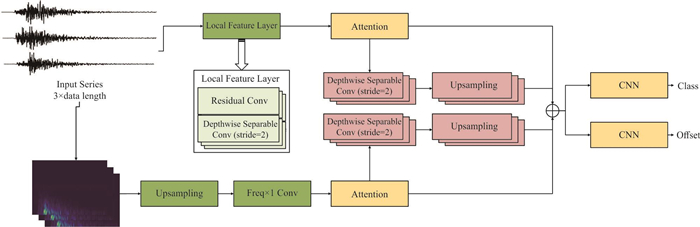
摘要: 地震震相拾取的准确性直接影响震源定位和震级估计的精度,然而传统方法对复杂地震信号的特征捕捉能力有限.提出了一种融合多尺度注意力机制和短时傅里叶变换的双分支模型(SEN),该模型通过两个分支分别捕获信号的时间特征和时频特征,并结合注意力机制实现多尺度的特征增强.实验结果表明,在100 ms的误差范围内P波震相拾取的识别精度和召回率分别达到了95.69%和88.97%,S波震相拾取的识别精度和召回率分别达到了87.98%和77.25%.P波的到时误差均值和标准差分别达到了18.76 ms和27.13 ms,S波的到时误差均值和标准差分别达到了25.97 ms和36.14 ms.同时模型的参数量仅有0.35 M,计算开销为71.38 M.与同类模型相比,SEN模型不仅在性能上取得显著提升,同时在参数量和计算开销上具有一定优势,为地震监测的实时应用提供了有力的技术支持.Abstract: Seismic phase picking is a critical task in earthquake monitoring, as its accuracy directly impacts the precision of hypocenter localization and magnitude estimation. However, traditional methods are often limited in their ability to capture the characteristics of complex seismic signals. This study proposes a dual-branch deep learning model that integrates a multi-scale attention mechanism and short-time Fourier transform (STFT). The model extracts temporal features through a time-domain branch and captures time-frequency representations via a frequency-domain branch, while leveraging the attention mechanism to enhance multi-scale features. Experimental results show that within a 100 ms error threshold, the proposed model achieves a P-wave picking precision and recall of 95.69% and 88.97%, and an S-wave precision and recall of 87.98% and 77.25%, respectively. The mean and standard deviation of arrival time error for the P-wave are 18.76 ms and 27.13 ms, while for the S-wave they are 25.97 ms and 36.14 ms. Moreover, the model contains only 0.35 M parameters and incurs a computational cost of 71.38 M FLOPs. Compared with existing models, the SEN model not only achieves competitive performance but also demonstrates advantages in model size and computational efficiency, offering great potential for real-time seismic monitoring applications.
-
Key words:
- seismic phase picking /
- deep learning /
- convolutional neural network /
- attention mechanism /
- time series /
- seismology
-
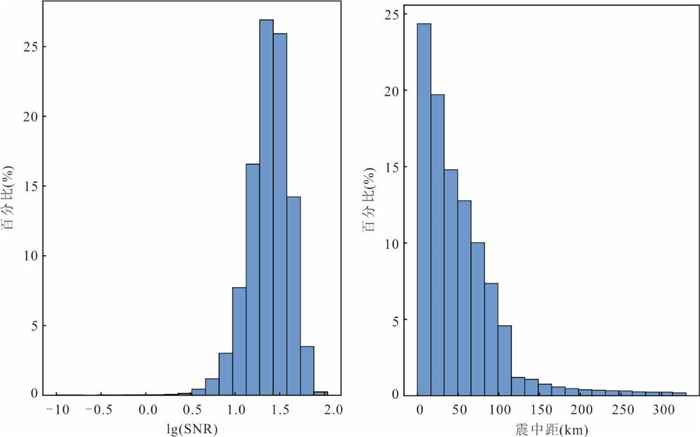
图 3 数据集信噪比及震中距分布
Fig. 3. Distribution of lg(SNR) and epicentral distance of the dataset
表 1 模型各项指标
Table 1. Performance of the models
模型 Precision Recall P波 S波 P波 S波 SEN 0.956 9 0.879 8 0.889 7 0.772 5 LPPNL 0.943 4 0.881 5 0.863 2 0.720 8 EQT 0.935 0 0.873 4 0.854 1 0.702 7 PhaseNet 0.823 0 0.878 2 0.764 0 0.703 0  下载: 导出CSV
表 2 到时误差均值以及标准差
Table 2. Mean and standard deviation of arrival time errors
模型 Mean(ms) Std(ms) P波 S波 P波 S波 SEN 18.76 26.13 27.13 36.14 LPPNL 18.81 25.97 27.71 35.18 EQT 23.90 30.62 32.76 40.11 PhaseNet 18.51 26.63 28.41 36.81
下载: 导出CSV
表 3 模型参数量与计算量对比
Table 3. Parameters and FLOPs
模型 参数量 FLOPs SEN 0.35 M 71.38 M LPPNL 0.66 M 111.98 M EQT 2.59 M 87.91 M PhaseNet 0.17 M 17.06 M
下载: 导出CSV
表 4 模型运行效率对比
Table 4. Model runtime efficiency
模型 训练耗时(s) 推理耗时(s) SEN 3 972.91 4.48 LPPNL 4 646.87 4.89 EQT 11 008.08 26.73 PhaseNet 2 154.90 3.70
下载: 导出CSV
表 5 消融实验模型评价
Table 5. Evaluation of ablation study models
模型配置 Precision Recall P波 S波 P波 S波 基本模型 0.948 1 0.845 1 0.841 8 0.681 2 仅加入注意力 0.953 2 0.879 3 0.868 9 0.732 6 仅加入STFT 0.963 6 0.882 1 0.870 1 0.717 0 完整模型 0.957 9 0.879 8 0.889 7 0.772 5
下载: 导出CSV
表 6 消融实验模型到时误差
Table 6. Arrival time errors of ablation study models
模型配置 Mean(ms) Std(ms) P波 S波 P波 S波 基本模型 20.67 27.77 29.04 36.36 仅加入注意力 19.53 27.53 28.83 36.03 仅加入STFT 16.09 27.39 23.53 36.24 完整模型 18.76 26.13 27.13 36.14
下载: 导出CSV
-
Allen, J. B., 1977. Short Term Spectral Analysis, Synthesis, and Modification by Discrete Fourier Transform. IEEE Transactions on Acoustics, Speech, and Signal Processing, 25(3): 235-238. https://doi.org/10.1109/TASSP.1977.1162950 Bergen, K. J., Johnson, P. A., de Hoop, M. V., et al., 2019. Machine Learning for Data-Driven Discovery in Solid Earth Geoscience. Science, 363(6433): eaau0323. https://doi.org/10.1126/science.aau0323 Chai, C. P., Maceira, M., Santos-Villalobos, H. J., et al., 2020. Using a Deep Neural Network and Transfer Learning to Bridge Scales for Seismic Phase Picking. Geophysical Research Letters, 47(16): e2020GL088651. https://doi.org/10.1029/2020GL088651 Chen, G. Y., Yang, W., Tan, Y. Y., et al., 2023. Automatic Phase Detection and Arrival Picking for Microseismic Events in Hydraulic Fracturing Based on Machine Learning and Array Correlation. Chinese Journal of Geophysics, 66(4): 1558-1574 (in Chinese with English abstract). Chen, Y. K., Zhang, G. Y., Bai, M., et al., 2019. Automatic Waveform Classification and Arrival Picking Based on Convolutional Neural Network. Earth and Space Science, 6(7): 1244-1261. https://doi.org/10.1029/2018EA000466 He, B., Zhou, Y. Y., Lü, Y. Q., 2024. Seismic First Break Picking Algorithm Combining U-Net and FPN. Journal of Geomatics, 49(1): 82-87 (in Chinese with English abstract). Hu, J. J., Ding, Y. T., Zhang, H., et al., 2023. A Real-Time Seismic Intensity Prediction Model Based on Long Short-Term Memory Neural Network. Earth Science, 48(5): 1853-1864 (in Chinese with English abstract). Jiang, C., Fang, L. H., Fan, L. P., et al., 2021. Comparison of the Earthquake Detection Abilities of PhaseNet and EQTransformer with the Yangbi and Maduo Earthquakes. Earthquake Science, 34(5): 425-435. https://doi.org/10.29382/eqs-2021-0038 Jiang, C., Lü, Z. Y., Fang, L. H., 2024. Earthquake Detection Model Trained on Velocity and Acceleration Records and Its Application in Xinfengjiang Reservoir. Earth Science, 49(2): 469-479 (in Chinese with English abstract). Lan, B., Zhao, S. G., Zeng, H., et al., 2024. Seismic Phase Picking Using a Cross-Attention Network on NVIDIA Jetson Xavier NX. IEEE Access, 12: 145511-145521. https://doi.org/10.1109/ACCESS.2024.3471848 LeCun, Y., Bengio, Y., Hinton, G., 2015. Deep Learning. Nature, 521(7553): 436-444. https://doi.org/10.1038/nature14539 Li, B. R., Fan, L. P., Jiang, C., et al., 2023. CSESnet: A Deep Learning P-Wave Detection Model Based on UNet++ Designed for China Seismic Experimental Site. Frontiers in Earth Science, 10: 1032839. https://doi.org/10.3389/feart.2022.1032839 Li, H. Y., Li, J. H., Li, X. G., et al., 2024. Seismic Picking Attention Module. IEEE Transactions on Geoscience and Remote Sensing, 62: 5930816. https://doi.org/10.1109/TGRS.2024.3476329 Li, W., Chakraborty, M., Fenner, D., et al., 2022. EPick: Attention-Based Multi-Scale UNet for Earthquake Detection and Seismic Phase Picking. Frontiers in Earth Science, 10: 953007. https://doi.org/10.3389/feart.2022.953007 Liao, W. Y., Lee, E. J., Mu, D. W., et al., 2021. ARRU Phase Picker: Attention Recurrent-Residual U-Net for Picking Seismic P- and S- Phase Arrivals. Seismological Research Letters, 92(4): 2410-2428. https://doi.org/10.1785/0220200382 Lin, T. Y., Goyal, P., Girshick, R., et al., 2017. Focal Loss for Dense Object Detection. IEEE Transactions on Pattern Analysis and Machine Intelligence, 42(2): 318-327. https://doi.org/10.1109/ICCV.2017.324 Mousavi, S. M., Beroza, G. C., 2022. Deep-Learning Seismology. Science, 377(6607): eabm4470. https://doi.org/10.1126/science.abm4470 Mousavi, S. M., Ellsworth, W. L., Zhu, W. Q., et al., 2020. Earthquake Transformer—An Attentive Deep-Learning Model for Simultaneous Earthquake Detection and Phase Picking. Nature Communications, 11: 3952. https://doi.org/10.1038/s41467-020-17591-w Mousavi, S. M., Sheng, Y. X., Zhu, W. Q., et al., 2019. STanford EArthquake Dataset (STEAD): A Global Data Set of Seismic Signals for AI. IEEE Access, 7: 179464-179476. https://doi.org/10.1109/ACCESS.2019.2947848 Ouyang, D. L., He, S., Zhang, G. Z., et al., 2023. Efficient Multi-Scale Attention Module with Cross-Spatial Learning. In: 2023 IEEE International Conference on Acoustics, Speech and Signal Processing (ICASSP). IEEE, Rhodes Island, 1-5. https://doi.org/10.1109/icassp49357.2023.10096516 Ross, Z. E., Meier, M. A., Hauksson, E., et al., 2018. Generalized Seismic Phase Detection with Deep Learning. Bulletin of the Seismological Society of America, 108(5A): 2894-2901. https://doi.org/10.1785/0120180080 Saad, O. M., Chen, Y. K., 2022. CapsPhase: Capsule Neural Network for Seismic Phase Classification and Picking. IEEE Transactions on Geoscience and Remote Sensing, 60: 5904311. https://doi.org/10.1109/TGRS.2021.3089929 Vaswani, A., Shazeer, N., Parmar, N., et al., 2017. Attention is all You Need. arXiv: 1706.03762. https://doi.org/10.48550/arXiv.1706.03762 Wang, J., Xiao, Z. W., Liu, C., et al., 2019. Deep Learning for Picking Seismic Arrival Times. Journal of Geophysical Research: Solid Earth, 124(7): 6612-6624. https://doi.org/10.1029/2019JB017536 Xiao, Z. W., Wang, J., Liu, C., et al., 2021. Siamese Earthquake Transformer: A Pair-Input Deep-Learning Model for Earthquake Detection and Phase Picking on a Seismic Array. Journal of Geophysical Research: Solid Earth, 126(5): e2020JB021444. https://doi.org/10.1029/2020JB021444 Ye, H. Y., Chen, J. D., Gong, S. J., et al., 2024. ATFNet: Adaptive Time-Frequency Ensembled Network for Long-Term Time Series Forecasting. arXiv: 2404.05192. https://doi.org/10.48550/arXiv.2404.05192 Yu, Z. Y., Wang, W. T., 2022. LPPN: A Lightweight Network for Fast Phase Picking. Seismological Research Letters, 93(5): 2834-2846. https://doi.org/10.1785/0220210309 Yu, Z. Y., Wang, W. T., Chen, Y. N., 2023. Benchmark on the Accuracy and Efficiency of Several Neural Network Based Phase Pickers Using Datasets from China Seismic Network. Earthquake Science, 36(2): 113-131. https://doi.org/10.1016/j.eqs.2022.10.001 Zhang, J., Li, Z. F., Zhang, J., 2023. Simultaneous Seismic Phase Picking and Polarity Determination with an Attention-Based Neural Network. Seismological Research Letters, 94(2A): 813-828. https://doi.org/10.1785/0220220247 Zhou, T., Ma, Z. Q., Wen, Q. S., et al., 2022. FEDformer: Frequency Enhanced Decomposed Transformer for Long-Term Series Forecasting. In: International Conference on Machine Learning. PMLR, New York. Zhou, Y. J., Yue, H., Kong, Q. K., et al., 2019. Hybrid Event Detection and Phase-Picking Algorithm Using Convolutional and Recurrent Neural Networks. Seismological Research Letters, 90(3): 1079-1087. https://doi.org/10.1785/0220180319 Zhu, L. J., Peng, Z. G., McClellan, J., et al., 2019. Deep Learning for Seismic Phase Detection and Picking in the Aftershock Zone of 2008 Mw7.9 Wenchuan Earthquake. Physics of the Earth and Planetary Interiors, 293: 106261. https://doi.org/10.1016/j.pepi.2019.05.004 Zhu, W. Q., Beroza, G. C., 2018. PhaseNet: A Deep-Neural-Network-Based Seismic Arrival-Time Picking Method. Geophysical Journal International, 216(1): 261-273. https://doi.org/10.1093/gji/ggy423 Zhu, W. Q., Biondi, E., Li, J. X., et al., 2023. Seismic Arrival-Time Picking on Distributed Acoustic Sensing Data Using Semi-Supervised Learning. Nature Communications, 14: 8192. https://doi.org/10.1038/s41467-023-43355-3 陈国艺, 杨文, 谭玉阳, 等, 2023. 基于机器学习和台阵相关性的水力压裂微地震事件自动识别及到时拾取. 地球物理学报, 66(4): 1558-1574. 何彬, 周云耀, 吕永清, 2024. 结合U-net与FPN的地震初至波拾取算法. 测绘地理信息, 49(1): 82-87. 胡进军, 丁祎天, 张辉, 等, 2023. 基于长短期记忆神经网络的实时地震烈度预测模型. 地球科学, 48(5): 1853-1864. doi: 10.3799/dqkx.2022.338 蒋策, 吕作勇, 房立华, 2024. 融合处理速度和加速度记录的地震检测模型及其在新丰江水库的应用. 地球科学, 49(2): 469-479. doi: 10.3799/dqkx.2023.186 -

 点击查看大图
计量
- 文章访问数: 215
- HTML全文浏览量: 16
- PDF下载量: 15
- 被引次数: 0
