




Constructing and Training of a Deep Learning Dataset for PmP Waves in the Southeastern Tibetan Plateau
-
摘要: 莫霍面反射波PmP的射线路径与初至Pg波、Pn波不同,其传播特性与发震构造环境密切相关,可为研究地壳深部结构与莫霍面不连续性提供关键信息.识别PmP波的主要挑战是它们的稀缺性,且人工拾取需要耗费大量的人力.为改善这一问题,利用青藏高原东南缘的固定台站(2009—2022年)和流动台阵(2011—2013年)记录的波形,通过手动拾取和振幅比值检验得到了1 713个PmP震相,结合半自动拾取流程(基于振幅阈值筛选和质点运动检验)提取1 536个PmP震相,构建了高质量PmP数据集.对基于深度神经网络的PmPNet进行重新训练,构建了适配青藏高原东南缘的新模型PmPNet-SET_V1.0和PmP-traveltime-Net-SET_V1.0,其中PmPNet-SET_V1.0模型的F1分数为0.863 7,精确率为86.6%,召回率为84.8%,并将该区域内高质量PmP波数量增加至6 268个.所有PmP拾取结果通过严格的人工检验并与理论走时对比,确保了可靠性.研究表明,训练参数对采集波形的数量和质量具有显著影响.此外,基于所构建的PmP数据集,本研究初步获得了青藏高原东南缘区域莫霍深度分布,其呈现西北深,东南浅的趋势,与前人反演结果的样式相近.Abstract: The Moho-reflecting PmP wave with a different ray path to Pg wave and Pn wave, whose propagation characteristics are closely related to the seismogenic tectonic environment, provides crucial information for studying the deep crustal structure and the discontinuity of the Moho discontinuity. The main challenge in PmP waves identification is their rarity, and the significant manpower required for manual picking. To address this issue, we firstly obtained 1 713 PmP waves through manual picking and amplitude-ratio validation, and applied a semi-automatic workflow (screening of seismic amplitude threshold and testing of particle motion) to pick 1 536 PmP waves from waveforms recorded by permanent (2009—2022) and temporary (2011—2013) stations in the southeastern (SE) Tibetan Plateau, and then we constructed a high-quality PmP dataset using these waves. We retrained PmPNet, a deep neural network-based algorithm, to construct two new models PmPNet-SET_V1.0 and PmP-traveltime-Net-SET_V1.0, among which PmPNet-SET_V1.0 achieved a high F1-score of 0.863 7, with a precision of 86.6% and a recall of 84.8%, and we tripled the number of the high-quality PmP database in the study region to 6 268. All PmP picking results underwent rigorous manual inspection and were compared with the theoretical travel time to ensure the reliability. The study shows several hyper-parameters play a key role in determining both the quantity and quality of the picks. Furthermore, based on the constructed PmP dataset, the study preliminarily obtained the regional Moho depth, which displayed a similar pattern to previous inversion findings, showing deeper depths in the northwest and shallower depths in the southeast.
-
Key words:
- southeastern Tibetan Plateau /
- PmP wave /
- deep learning /
- seismic dataset /
- PmPNet /
- seismology
-
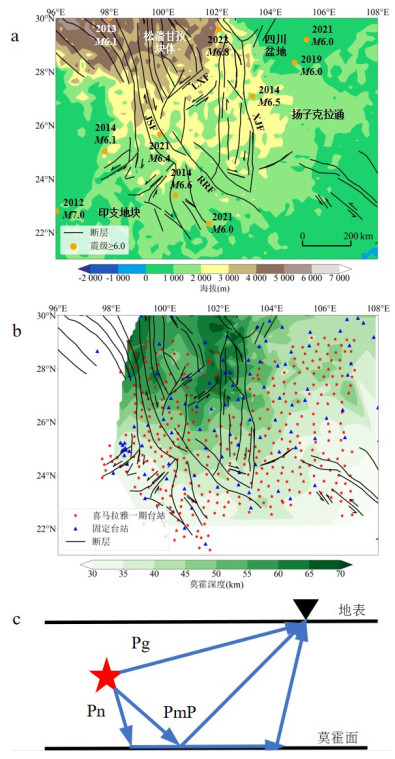
图 1 青藏高原东南缘地区的构造背景
a. 青藏高原东南部示意图,据Han et al.(2020);黑色线为研究区域的断层,橙色点为2009—2022年间震级大于6.0的地震的位置,每个地震都标注了事件年份和震级;b. 青藏高原东南缘处SWChinaCVM-MOHO-1.0莫霍深度图和台站分布图,据Chen et al.(2021);黑色线为研究区域的断层,红点表示CREDIT-X1local数据集(2011—2013年)中的流动台站,蓝点表示CSNCD数据集(2009—2022年)中的固定台站;c. 局部Pg波、PmP波和Pn波的射线路径;其中的红星表示震源,黑色倒三角形表示地表上的台站,蓝色实线表示P波的射线路径
Fig. 1. The tectonic setting of the SE Tibetan Plateau
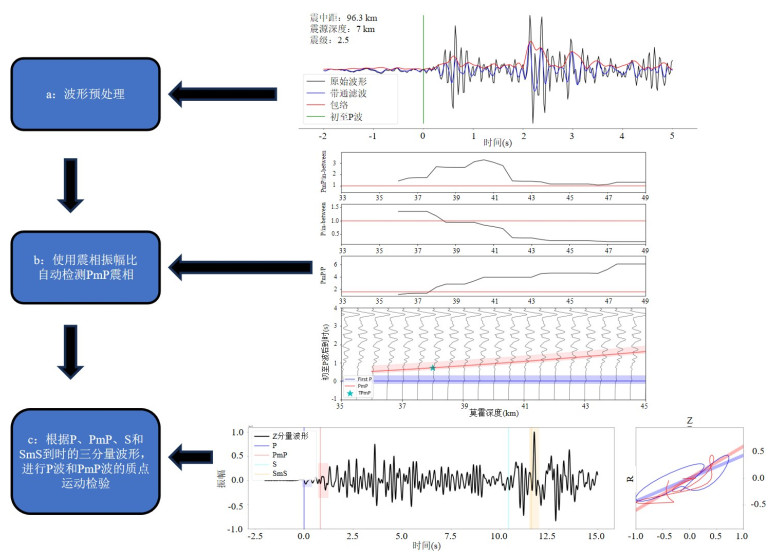
图 2 PmP半自动流程的三个步骤,每一步的示例均展示在右侧
a. 原始波形与其预处理波形的对比;b. 利用振幅比度量自动检测可能的PmP震相的过程;c. 在同一台站记录的垂直分量地震图,以及其对应平面内P波(蓝色曲线)和PmP波(红色曲线)的质点运动,以及它们主要的极化方向
Fig. 2. The three-step process is designed to pick local PmP waves with examples for each step shown on the right-hand side
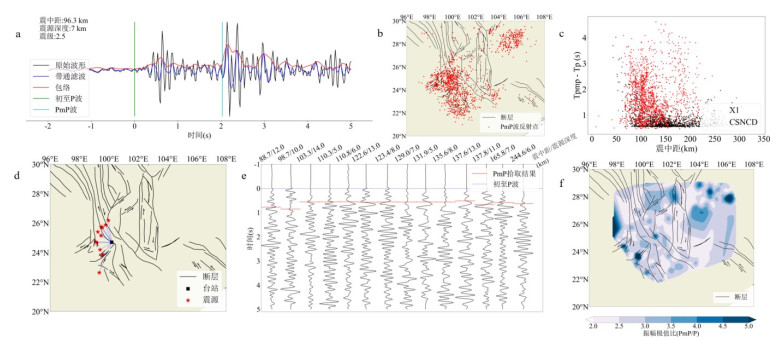
图 3 CREDIT-X1local中通过PmP半自动流程的PmP数据集
a. 原始波形和预处理波形的对比示例;b. 所有被拾取到的PmP波的反射点(红点)的空间分布;c. PmP-P到时差与震中距的相关性;d. 单台多事件示例中台站和震源的方位视图;e. 图d中在各台站记录的PmP震相示例,所有波形按初至P波到时(蓝线)对齐,并根据震源深度(evdp)和震中距(dist)进行排序,PmP到时由红线表示;f. PmP波和Pg波的振幅比分布情况
Fig. 3. PmP datasets in CREDIT-X1local after PmP-picking workflow
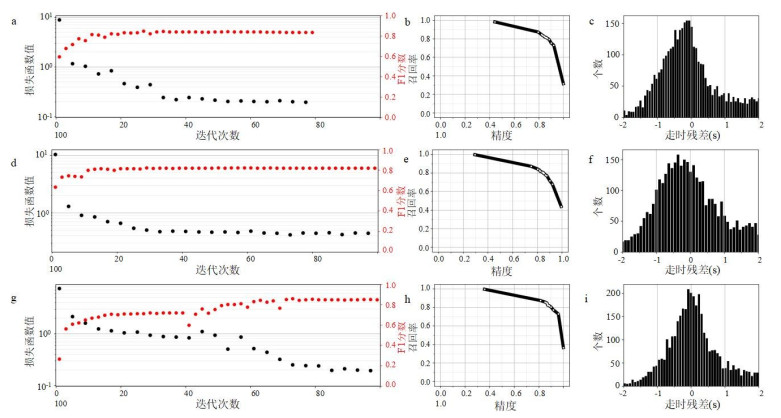
图 5 当使用不同学习率对数据集进行训练时,PmPNet训练和验证的结果
a~c. 使用高学习率训练和验证的结果;d~f. 使用低学习率训练和验证的结果;g~i. 联合使用两种学习率训练和验证的结果.a、d、g. 随着迭代次数的增加,总的损失函数减少,F1分数增加,经过足够多的迭代次数训练后变得稳定;b、e、h.验证集上的精度‒召回率曲线(相关数据见附录A);c、f、i. 验证集上预测值和真实值之间的PmP走时残差
Fig. 5. Training and validation performance of PmPNet when applied to real data with different learning rates
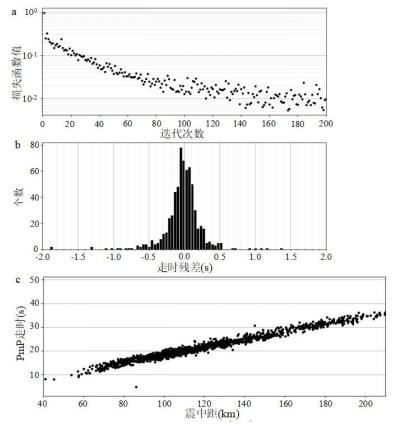
图 6 PmP-traveltime-Net训练和验证的结果
a. 损失函数迭代变化;b. 验证集走时残差分布;c. 震中距与PmP走时关系
Fig. 6. Training and validation performance of PmP- traveltime-Net
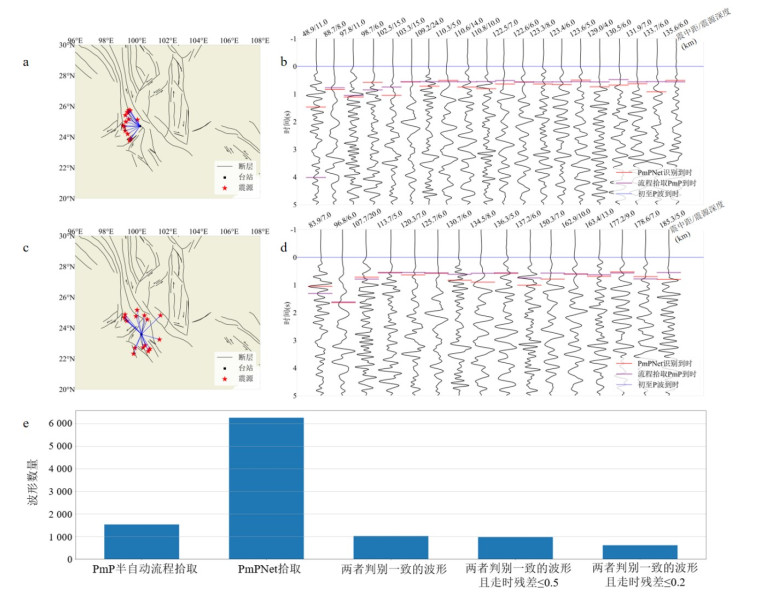
图 7 PmPNet-SET_V1.0和PmP-traveltime-Net-SET_V1.0在CREDIT-X1local的PmP波自动拾取结果
a. 单台多事件示例中震源和台站的分布.PmP震相由同一个台站(黑色方块)记录得到,各个震源由红色星星标记;b. 图a中在各台站记录的PmP震相示例. 所有波形按初至P波到时(蓝线)对齐,并根据震源深度(evdp)和震中距(dist)进行排序.PmP半自动流程拾取的PmP到时由紫线表示,PmPNet-SET_V1.0拾取的PmP到时由红线表示;c~d. 另一组与图a~b相同的示例;e. PmPNet-SET_V1.0拾取的PmP震相与PmP半自动流程选取的震相对比. 它还显示了这两种方法拾取的PmP震相波形一致的数量及其到时差异
Fig. 7. CREDIT-X1local's PmP wave automatic picking result of PmPNet-SET_V1.0 and PmP-traveltime-Net-SET_V1.0
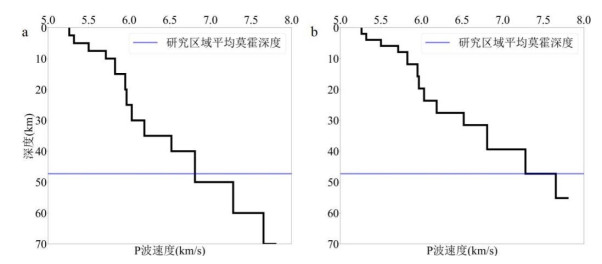
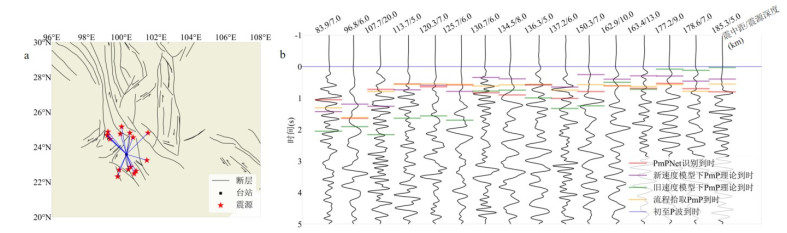
图 9 使用不同的速度模型对CREDIT-X1local的PmP波自动拾取结果
a. 单台多事件震源和台站的分布;b. 多事件PmP震相示例.所有波形按初至P波到时(蓝线)对齐,并根据震源深度(evdp)和震中距(dist)进行排序.PmP半自动流程拾取的PmP到时由橙线表示,PmPNet拾取的PmP到时由红线表示.先前的速度模型计算的PmP理论到时由绿线表示,新的速度模型计算的PmP理论到时由紫线表示
Fig. 9. CREDIT-X1local's PmP wave automatic picking result with different compositions of velocity model
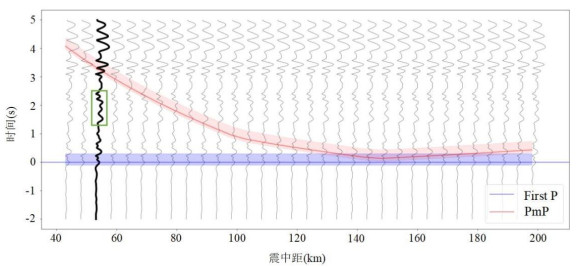
图 10 在其他条件不变的情况下,震中距与PmP-P理论走时之差之间的相关性
蓝色区域是初至P波窗区;红色区域是PmP波窗区;绿框中的波段很容易被误认为是PmP波
Fig. 10. When other conditions remain unchanged, the correlation between epicentral distance and PmP-P travel time
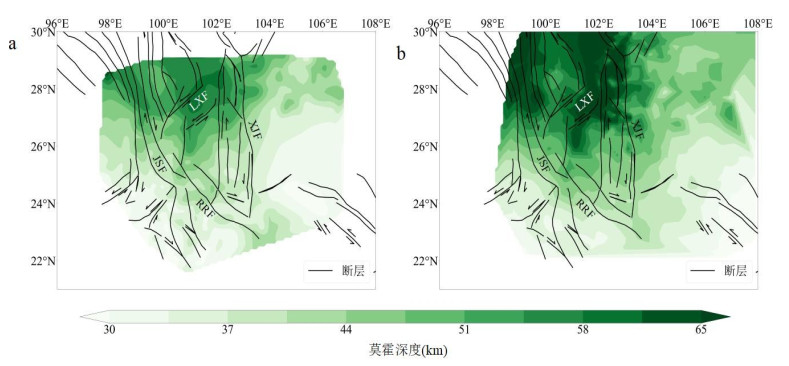
图 11 莫霍深度对比
a. 本研究反演得到的莫霍深度,黑线为研究区域的断层;b. SWChinaCVM-MOHO-1.0模型的莫霍深度
Fig. 11. The comparison of Moho depth
表 1 基于反射点的SWChinaCVM-2.0一维分层速度模型示例
Table 1. A sample of choosing the reflection point's 1-D layered velocity model for choosing the reflection point
模型上边界深度($ \mathrm{k}\mathrm{m} $) P波速度模型($ \mathrm{k}\mathrm{m}\bullet {\mathrm{s}}^{-1} $) 0 5.26 2.5 5.32 5 5.50 7.5 5.71 10 5.83 15 5.95 20 5.97 30 6.03 40 6.19 50 6.52 60 6.81 70 7.28 80 7.65  下载: 导出CSV
表 2 基于反射点的莫霍深度压缩/扩张后的SWChi naCVM-2.0一维分层速度模型示例
Table 2. A sample of compressing the reflection point's model of SWChinaCVM-2.0 according to the reflection point's Moho depth
模型上边界深度($ \mathrm{k}\mathrm{m} $) P波速度模型($ \mathrm{k}\mathrm{m}\bullet {\mathrm{s}}^{-1} $) 0 5.26 1.97 5.32 3.94 5.50 5.91 5.71 7.88 5.83 11.82 5.95 15.76 5.97 19.7 6.03 23.64 6.19 27.58 6.52 31.52 6.81 39.4 7.28 47.28 7.65
下载: 导出CSV
-
Ahmed, S. M. S., Guneyli, H., 2023. Robust Multi-Output Machine Learning Regression for Seismic Hazard Model Using Peak Crust Acceleration Case Study, Turkey, Iraq and Iran. Journal of Earth Science, 34(5): 1447-1464. https://doi.org/10.1007/s12583-022-1616-2 An, Y. R., 2024. Introduction to a Recently Released Dataset Entitled CSNCD: A Comprehensive Dataset of Chinese Seismic Network. Earthquake Research Advances, 4(1): 100255. https://doi.org/10.1016/j.eqrea.2023.100255 An, Y. R., Zhang, Y. Y., Miao, C. L., et al, 2023. CSNCD: A Comprehensive Dataset of Chinese Seismic Network. Online (in Chinese). https://doi.org/10.12080/nedc.11.ds.2023.0001 Beroza, G. C., Segou, M., Mostafa Mousavi, S., 2021. Machine Learning and Earthquake Forecasting—Next Steps. Nature Communications, 12: 4761. https://doi.org/10.1038/s41467-021-24952-6 Chai, C. P., Rose, D., Stewart, S., et al., 2025. PickerXL, a Large Deep Learning Model to Measure Arrival Times from Noisy Seismic Signals. Seismological Research Letters, 96(4): 2394-2404. https://doi.org/10.1785/0220240353 Chen, L. Y., Wang, W. L., Zhang, L., 2021. Crustal Thickness in Southeast Tibet Based on the SWChinaCVM-1.0 Model. Earthquake Science, 34(3): 246-260. https://doi.org/10.29382/eqs-2021-0010 Clark, M. K., Royden, L. H., 2000. Topographic Ooze: Building the Eastern Margin of Tibet by Lower Crustal Flow. Geology, 28(8): 703. https://doi.org/10.1130/0091-7613(2000)28703:tobtem>2.0.co;2 doi: 10.1130/0091-7613(2000)28703:tobtem>2.0.co;2 Crotwell, H. P., Owens, T. J., Ritsema, J., 1999. The TauP Toolkit: Flexible Seismic Travel-Time and Ray-Path Utilities. Seismological Research Letters, 70(2): 154-160. https://doi.org/10.1785/gssrl.70.2.154 Dai, G. H., An, Y. R., 2020. China Earthquake Administration: Chinese Seismic Network. Summary of the Bulletin of the International Seismological Centre, 54: 28-40. https://doi.org/10.31905/xwivrbri Ding, W., Li, T. J., Yang, X., et al., 2022. Deep Neural Networks for Creating Reliable PmP Database with a Case Study in Southern California. Journal of Geophysical Research: Solid Earth, 127(4): e2021JB023830. https://doi.org/10.1029/2021JB023830 Gao, Y., Shi, Y. T., Wang, Q., 2020. Seismic Anisotropy in the Southeastern Margin of the Tibetan Plateau and Its Deep Tectonic Significances. Chinese Journal of Geophysics, 63(3): 802-816 (in Chinese with English abstract). Guo, C., Li, J. L., Wu, W. W., et al., 2025. A New- Generation Source Mechanism Catalogue for Historical Moderate-to-Strong Earthquakes in the Sichuan- Yunnan Region Constrained by a Topographic High- Resolution 3D Velocity Model and Seismic Waveform Matching. Scientia Sinica (Terrae), 55(12): 4297-4320 (in Chinese with English abstract). doi: 10.1360/SSTe-2024-0345 Han, C. R., Xu, M. J., Huang, Z. C., et al., 2020. Layered Crustal Anisotropy and Deformation in the SE Tibetan Plateau Revealed by Markov-Chain-Monte-Carlo Inversion of Receiver Functions. Physics of the Earth and Planetary Interiors, 306: 106522. https://doi.org/10.1016/j.pepi.2020.106522 Han, X. J., Chen, H. F., Zhao, G. F., et al., 2023. Arrangement of Waveform Data from China Earthquake Networks and Construction of Service Platform. Earthquake Research in China, 39(2): 412-424 (in Chinese with English abstract). He, K., Zhang, X., Ren, S., et al., 2016. Deep Residual Learning for Image Recognition. 2016 IEEE Conference on Computer Vision and Pattern Recognition (CVPR), Las Vegas. https://doi.org/10.1109/CVPR.2016.90 .Hunter, J. D., 2007. Matplotlib: A 2D Graphics Environment. Computing in Science & Engineering, 9(3): 90-95. https://doi.org/10.1109/MCSE.2007.55 Johnson, J. M., Khoshgoftaar, T. M., 2019. Survey on Deep Learning with Class Imbalance. Journal of Big Data, 6(1): 27. https://doi.org/10.1186/s40537-019-0192-5 Kong, Q. K., Allen, R. M., Schreier, L., et al., 2016. MyShake: A Smartphone Seismic Network for Earthquake Early Warning and beyond. Science Advances, 2(2): e1501055. https://doi.org/10.1126/sciadv.1501055 Li, L., Wang, W. T., Yu, Z. Y., et al., 2024a. CREDIT-X1local: A Reference Dataset for Machine Learning Seismology from ChinArray in Southwest China. Earthquake Science, 37(2): 139-157. https://doi.org/10.1016/j.eqs.2024.01.018 Li, L., Wang, X., Hou, G. B., et al., 2024b. Two Thin Middle-Crust Low-Velocity Zones Imaged in the Chuan-Dian Region of Southeastern Tibetan Plateau and Their Tectonic Implications. Science China Earth Sciences, 67(5): 1675-1686. https://doi.org/10.1007/s11430-023-1256-0 Li, T. J., Yao, J. Y., Wu, S. C., et al., 2022. Moho Complexity in Southern California Revealed by Local PmP and Teleseismic Ps Waves. Journal of Geophysical Research: Solid Earth, 127(2): e2021JB023033. https://doi.org/10.1029/2021JB023033 Liu, Y., Yu, Z. Y., Zhang, Z. Q., et al., 2023. The High-Resolution Community Velocity Model V2.0 of Southwest China, Constructed by Joint Body and Surface Wave Tomography of Data Recorded at Temporary Dense Arrays. Science China Earth Sciences, 66(10): 2368-2385. https://doi.org/10.1007/s11430-022-1161-7 Ma, H. S., Zhang, G. M., Wen, X. Z., et al., 2008. 3-D P Wave Velocity Structure Tomographic Inversion and Its Tectonic Interpretation in Southwest China. Earth Science, 33(5): 591-602 (in Chinese with English abstract). Ross, Z. E., Yue, Y. S., Meier, M. A., et al., 2019. PhaseLink: A Deep Learning Approach to Seismic Phase Association. Journal of Geophysical Research: Solid Earth, 124(1): 856-869. https://doi.org/10.1029/2018JB016674 Royden, L. H., Burchfiel, B. C., van der Hilst, R. D., 2008. The Geological Evolution of the Tibetan Plateau. Science, 321(5892): 1054-1058. https://doi.org/10.1126/science.1155371 Rumelhart, D. E., McClelland, J. L., 1987. Learning Internal Representations by Error Propagation. Parallel Distributed Processing: Explorations in the Microstructure of Cognition: Foundations. MIT Press, Cambridge. Shi, X. Y., Wang, X. Q., Qiu, Y. R., et al., 2020. Analysis of the Minimum Magnitude of Completeness for Earthquake Catalog in China Seismic Experimental Site. Chinese Journal of Geophysics, 63(10): 3683-3697 (in Chinese with English abstract). Sun, A. H., Zhao, D. P., Gao, Y., et al., 2019. Crustal Seismic Imaging of Northeast Tibet Using First and Later Phases of Earthquakes and Explosions. Geophysical Journal International, 217: 405-421. https://doi.org/10.1093/gji/ggz031 Sun, A. H., Zhao, D. P., Ikeda, M., et al., 2008. Seismic Imaging of Southwest Japan Using P and PmP Data: Implications for Arc Magmatism and Seismotectonics. Gondwana Research, 14(3): 535-542. https://doi.org/10.1016/j.gr.2008.04.004 Wang, J., Xiao, Z. W., Liu, C., et al., 2019. Deep Learning for Picking Seismic Arrival Times. Journal of Geophysical Research: Solid Earth, 124(7): 6612-6624. https://doi.org/10.1029/2019JB017536 Xia, S. H., Zhao, D. P., Qiu, X. L., et al., 2007. Mapping the Crustal Structure under Active Volcanoes in Central Tohoku, Japan Using P and PmP Data. Geophysical Research Letters, 34(10): 2007GL030026. https://doi.org/10.1029/2007GL030026 Zhao, D. P., Todo, S., Lei, J. S., 2005. Local Earthquake Reflection Tomography of the Landers Aftershock Area. Earth and Planetary Science Letters, 235(3-4): 623-631. https://doi.org/10.1016/j.epsl.2005.04.039 Zhu, W. Q., Beroza, G. C., 2019. PhaseNet: A Deep-Neural-Network-Based Seismic Arrival Time Picking Method. Geophysical Journal International, : 216(1): 261-273. https://doi.org/10.1093/gji/ggy423 安艳茹, 张莹莹, 苗春兰等, 2023. 中国测震站网完备数据集(CSNCD). https://data.earthquake.cn,2023 . DOI:10.12080/nedc.11.ds.2023.0001 or CSTR: 12166.11.ds.2023.0001.高原, 石玉涛, 王琼, 2020. 青藏高原东南缘地震各向异性及其深部构造意义. 地球物理学报, 63(3): 802-816. 郭畅, 李俊伦, 吴微微, 等, 2025. 新一代川滇地区历史中强震震源机制解目录: 基于地形起伏高分辨率三维速度模型和波形反演的约束. 中国科学: 地球科学, 55(12): 4297-4320. 韩雪君, 陈宏峰, 赵国峰, 等, 2023. 中国地震台网波形数据整理及服务平台建设. 中国地震, 39(2): 412-424. 马宏生, 张国民, 闻学泽, 等, 2008. 川滇地区三维P波速度结构反演与构造分析. 地球科学, 33(5): 591-602. http://www.earth-science.net/article/id/1679 史翔宇, 王晓青, 邱玉荣, 等, 2020. 川滇地震科学实验场地震目录最小完整性震级分析. 地球物理学报, 63(10): 3683-3697. -
 李澍辰 附录.docx

-

 点击查看大图
计量
- 文章访问数: 382
- HTML全文浏览量: 38
- PDF下载量: 23
- 被引次数: 0
