




Experimental Study on Critical Condition of Initiation of Debris Flow in Channel by Bed Failure Model
-
摘要: 底床失稳模式是形成沟谷泥石流的重要起动模式,目前还没有详细的底床失稳形成泥石流的临界条件.对不同粒径、饱水密度、内摩擦角、渗透系数等泥沙堆积物被起动形成泥石流的起动模式及临界条件开展了一系列的水槽实验.发现无黏聚力的固体物源在底床失稳模式中,形成泥石流的坡度阈值随着泥沙的饱水密度、内摩擦角的增大而增大,最小阈值坡度约17o;当底床坡度大于阈值坡度时,底床失稳的饱水层厚度随坡度的增加而减小,最小饱水厚度可以为0.河流输运模式形成泥石流的径流临界流量远大于底床失稳模式形成泥石流的径流临界流量,底床失稳模式起动形成泥石流的临界流量为水槽宽度、泥沙堆积物的渗透系数和饱水深度之积.Abstract: The bed failure model is the important initiated model for debris flow in channel. However, there is no detail critical condition for bed failure model. In this paper, a series of laboratory experiments were carried out to study the initiation of debris flow by runoff in the channel. The experiments were conducted for the initiation models and critical condition with different particle size, saturated density, internal friction angle, and permeability coefficient. It was found that the slope threshold of debris flow initiation in bed failure model with no cohesion sediment increased with the increasing of sediment saturation density and internal friction. The minimum slope was about 17 degree in the experiments for the bed failure. When the bed slope is greater than the threshold slope, the thickness of the saturated layer of the bed failure decreases with the increase of the bed slope, the minimum sediment saturation thickness may be 0. The critical discharge of debris flow in fluvial transport model is much larger than that in bed failure model. The critical discharge of debris flow in bed failure model is the production of the permeability coefficient of sediment, the depth of saturated water and the width of channel.
-
Key words:
- debris flow /
- fluvial transport /
- bed failure /
- critical discharge /
- engineering geology
-
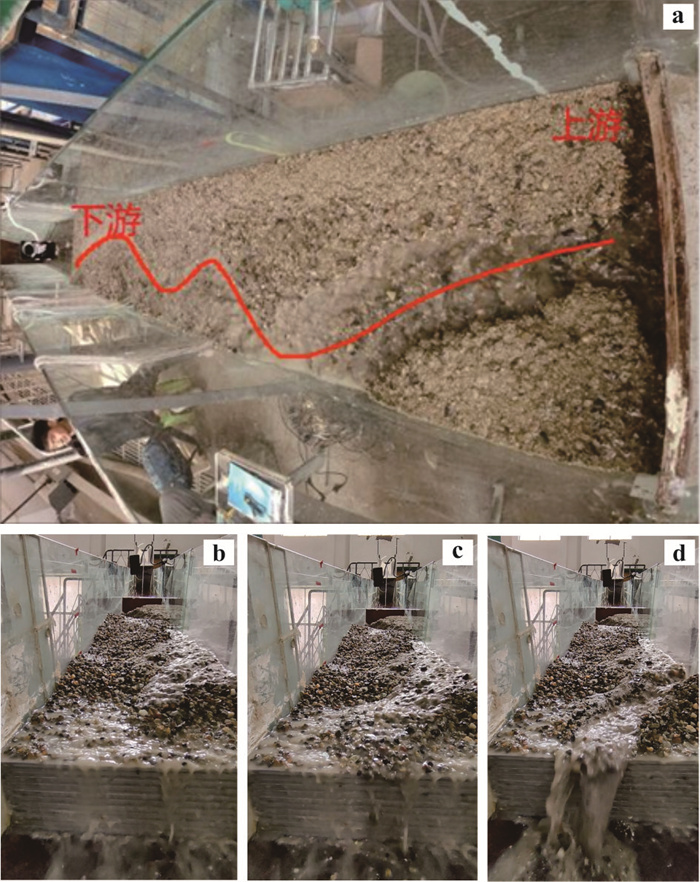
图 3 河流输运模式泥石流(第2次实验)
a.水流通道;b.形成泥石流之前;c.在水槽左侧刚形成泥石流时(形成泥石流的沟道最狭窄处为4.5 cm);d.取样时泥石流;第2次实验,b, c, d的照片从下游往上游拍摄
Fig. 3. The debris flow initiated in fluvial transport model in run 2
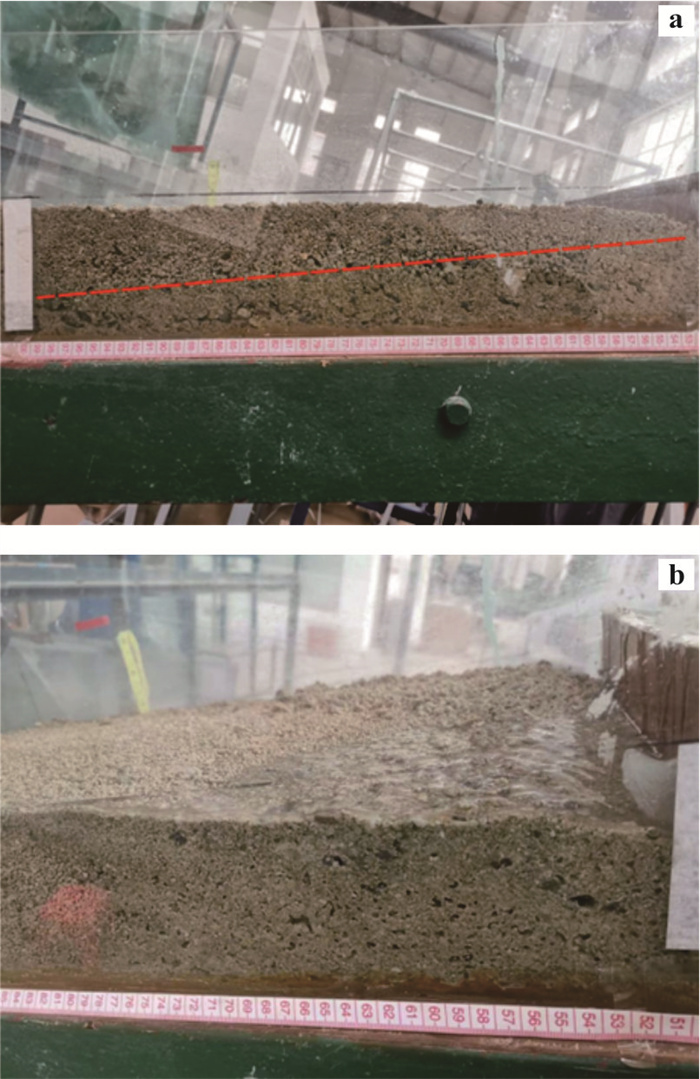
图 4 湿润锋和表面流(第8次实验)
a.湿润锋(0~0.5 m段); b.表面流(0~0.35 m段)
Fig. 4. The wetting lines and surface flow in run 8
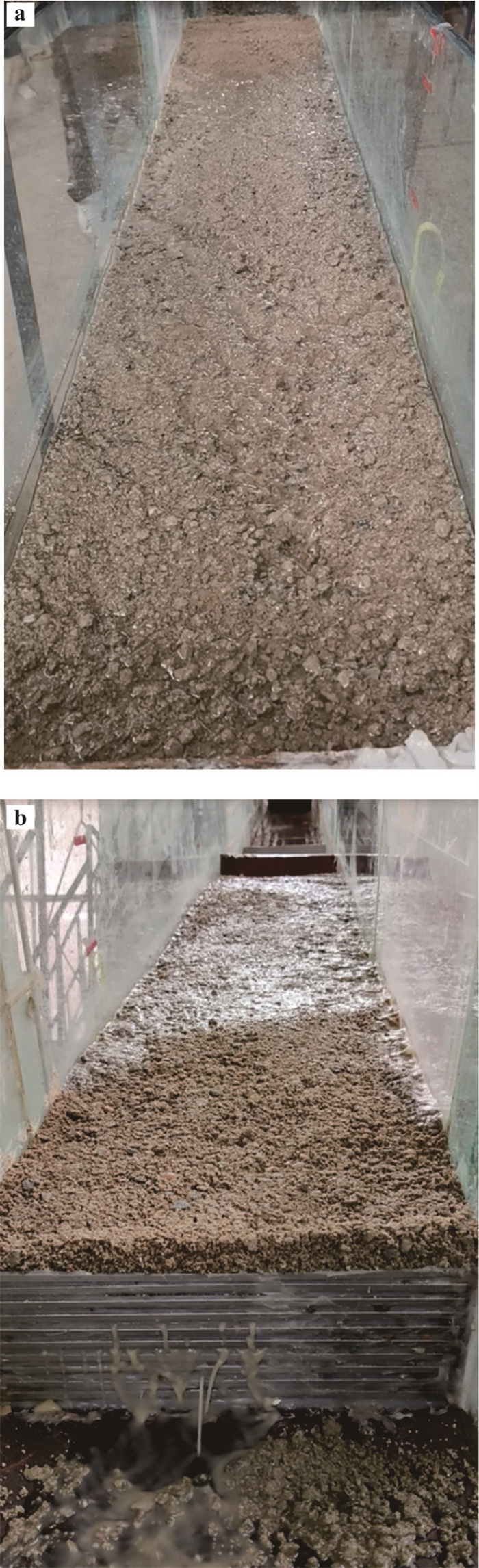
图 5 泥沙堆积物上的表面流(第8次实验)
a.表面流到达下游(从上游往下游拍摄);b.表面流到达下游(从下游往上游拍摄)
Fig. 5. Surface flow on the mixture in run 8
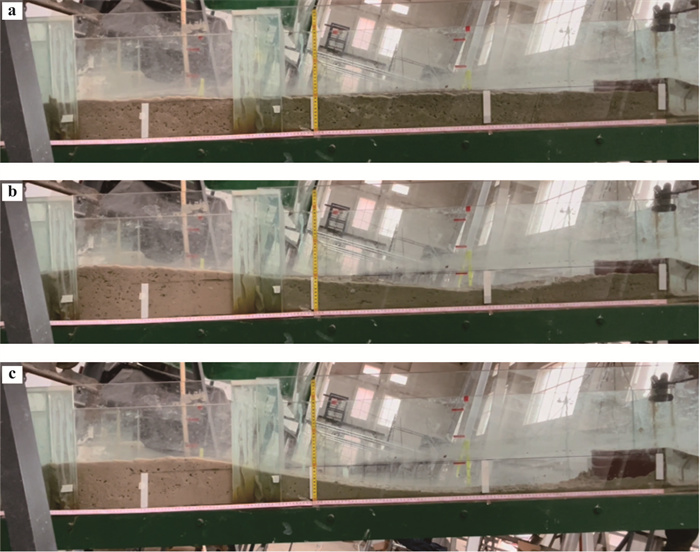
图 6 侧壁观测泥石流起动过程(第8次实验)
图中为0~1.8 m实验段; a.起动前; b.起动中; c.起动后
Fig. 6. The initiation of debris flow from sidewall in run 8
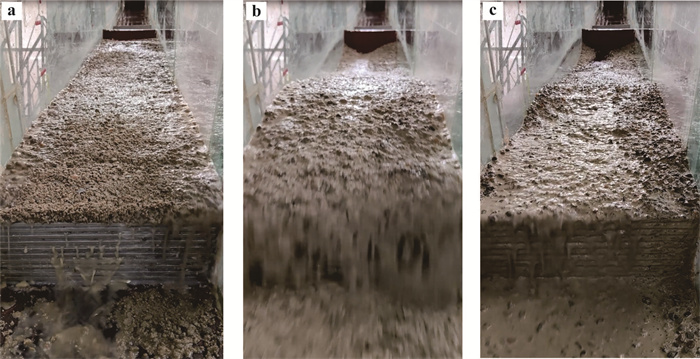
图 7 从下游观测到泥石流起动(第8次实验)
a.刚开始起动; b.起动中; c.起动后
Fig. 7. The initiation of debris flow from downstream in run 8
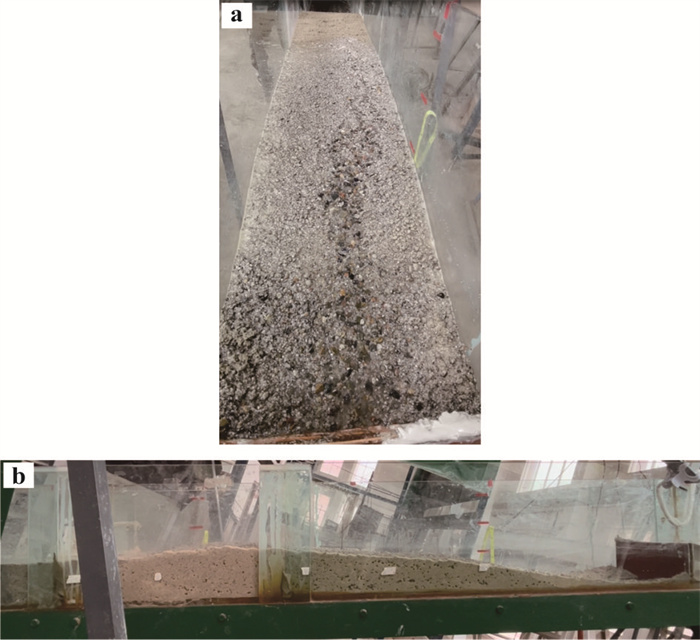
图 8 底床失稳模式的泥石流起动(第14次实验)
a.底床失稳时表面流到达位置(从上游往下游拍摄); b.起动后(侧面),0~1.9 m段,起动的最前端约在1.1 m
Fig. 8. The initiation of bed failure model in run 14
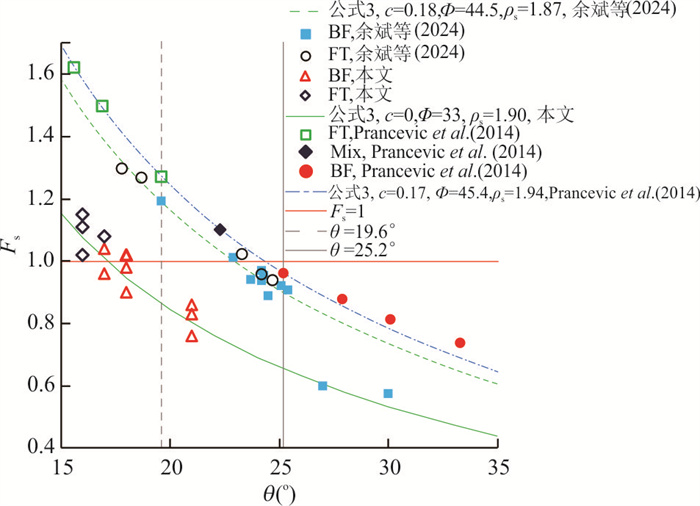
图 9 稳定系数与底坡坡度关系
BF.底床失稳模式;FT.河流输运模式;Mix.混合模式
Fig. 9. Relationship of safety factor and bed slope
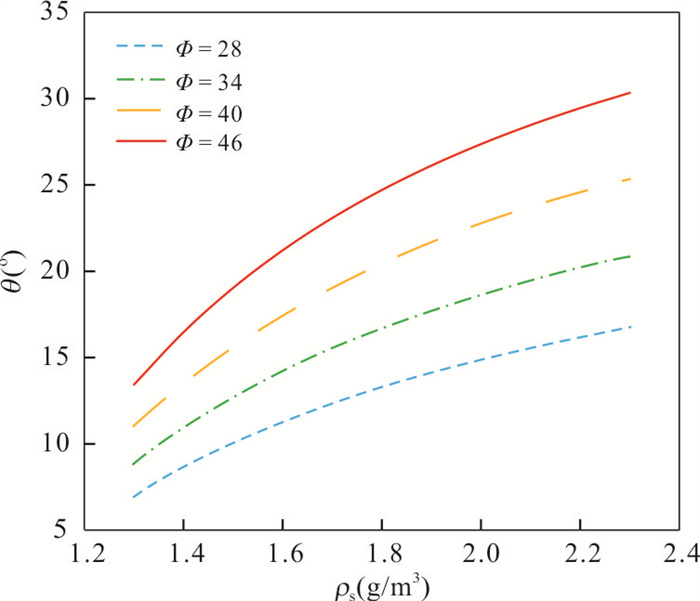
图 10 不同内摩擦角条件下的阈值坡度与饱水密度关系
Fig. 10. The relationship between the threshold slope and the saturation density with different internal friction angle
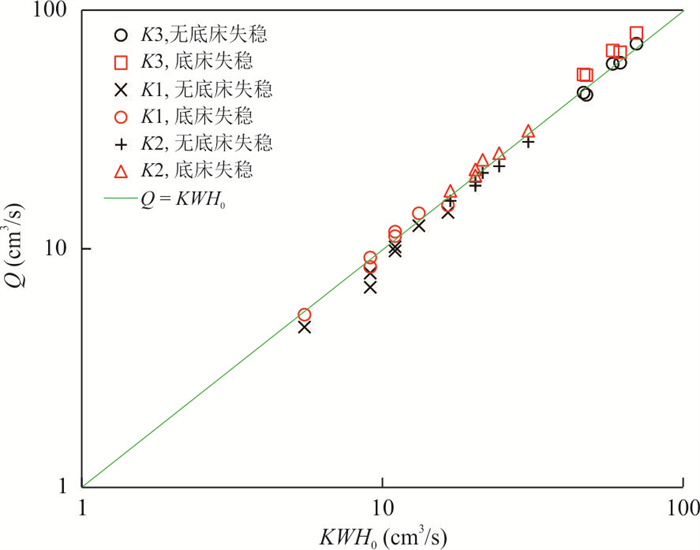
图 11 流量与渗透系数、水槽宽度、饱水深度之积的关系
K1.K=0.036 cm/s; K2.K=0.069 cm/s; K3.K=0.213 cm/s
Fig. 11. The relationship between the discharge and the product of the permeability coefficient, the depth of saturated water, and the width of channel
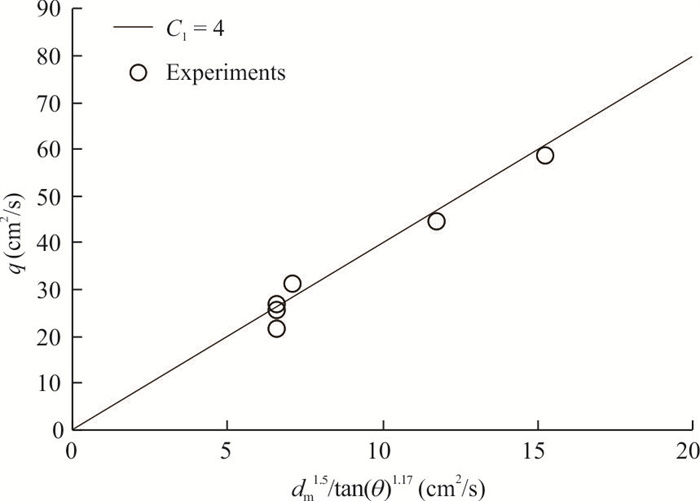
图 12 河流输运模式临界流量与中值粒径和底坡坡度关系
Fig. 12. Relationship between the critical discharge and the meidium diameter and slope
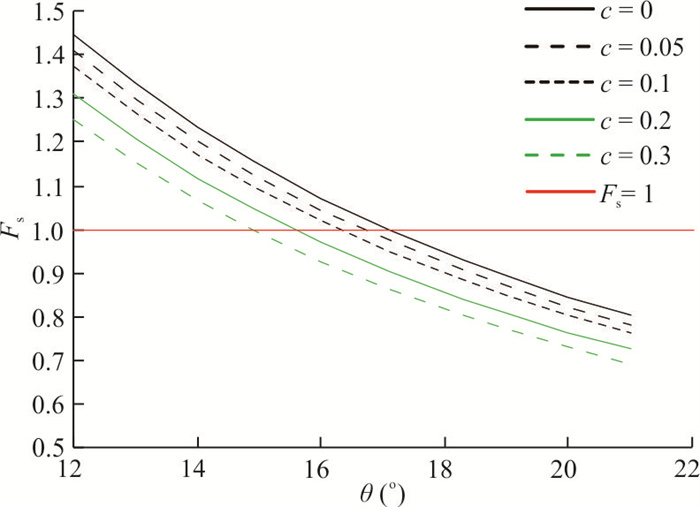
图 13 不同表面流深度下的底坡坡度与稳定系数关系
ρs= 1.9 g/cm3, ϕ = 33o
Fig. 13. Relationship between the safety factor and the slope angle with different surface flow depth
表 1 实验中的泥沙堆积物参数
Table 1. Parameters of sediment in experiments
序号 ρn (g/cm3) ρs (g/cm3) φn (°) ϕ (°) K (cm/s) d50(mm) 计算坡度阈值(°) 实验坡度阈值(°) K1 1.58 1.99 35.1 33.6 0.036 3.0 18.3 18 K2 1.50 1.93 34.5 33.5 0.069 4.2 17.7 17 K3 1.33 1.83 33.9 32.9 0.213 5.0 16.4 17 平均 - 1.92 - 33.3 - 17.5  下载: 导出CSV
表 2 实验中测量参数
Table 2. The parameters in the experiments
序号 K
(cm/s)θ
(°)Hs(cm) 起动模式 起动流量Q(cm3/s) Fs ρD
(g/cm3)1 0.036 16 10 FT 120.0 1.15 1.50 2 0.036 17 10 FT 120.2 1.08 1.58 3 0.036 17 10 FT 121.8 1.08 1.54 4 0.036 17 10 FT 120.5 1.08 1.52 5 0.036 18 5 BF 5.3 1.02 - 6 0.036 18 10 BF 11.8 1.02 2.08 7 0.036 18 10 BF 11.3 1.02 2.0 8 0.036 18 12 BF 14.1 1.02 2.03 9 0.036 18 15 BF 15.2 1.02 - 10 0.036 21 10 BF 9.2 0.86 2.0 11 0.036 21 10 BF 8.4 0.86 1.87 12 0.069 16 10 FT 151 1.11 1.45 13 0.069 17 10 BF 23.6 1.04 - 14 0.069 18 10 BF 20.3 0.98 - 15 0.069 18 10 BF 21.5 0.98 - 16 0.069 18 12 BF 25.2 0.98 - 17 0.069 18 15 BF 31.3 0.98 - 18 0.069 21 10 BF 17.5 0.83 1.97 19 0.213 16 10 FT 165.2 1.02 1.49 20 0.213 17 10 BF 66.7 0.96 - 21 0.213 18 8 BF 53.8 0.90 - 22 0.213 18 10 BF 67.8 0.90 2.05 23 0.213 18 12 BF 80.3 0.90 - 24 0.213 21 10 BF 53.5 0.76 - 注:FT.河流输运模式;BF.底床失稳模式.
下载: 导出CSV
-
Cannon, S. H., Gartner, J. E., Wilson, R. C., et al., 2008. Storm Rainfall Conditions for Floods and Debris Flows from Recently Burned Areas in Southwestern Colorado and Southern California. Geomorphology, 96(3-4): 250-269. https://doi.org/10.1016/j.geomorph.2007.03.019 Doerr, S. H., Ferreira, A. J. D., Walsh, R. P. D., et al., 2003. Soil Water Repellency as a Potential Parameter in Rainfall⁃Runoff Modelling: Experimental Evidence at Point to Catchment Scales from Portugal. Hydrological Processes, 17(2): 363-377. https://doi.org/10.1002/hyp.1129 Fredlund, D. G., Rahardjo, H., 1993. Soil Mechanics for Unsaturated Soils. John Wiley, New York. https://doi.org/10.1002/9780470172759 Gregoretti, C., 2000. The Initiation of Debris Flow at High Slopes: Experimental Results. Journal of Hydraulic Research, 38(2): 83-88. https://doi.org/10.1080/00221680009498343 Lamb, M. P., Dietrich, W. E., Venditti, J. G., 2008. Is the Critical Shields Stress for Incipient Sediment Motion Dependent on Channel⁃Bed Slope? Journal of Geophysical Research: Earth Surface, 113(F2): 2007JF000831. https://doi.org/10.1029/2007jf000831 Lamb, M. P., Scheingross, J. S., Amidon, W. H., et al., 2011. A Model for Fire⁃Induced Sediment Yield by Dry Ravel in Steep Landscapes. Journal of Geophysical Research: Earth Surface, 116F3. https://doi.org/10.1029/2010JF001878 McGuire, L. A., Rengers, F. K., Kean, J. W., et al., 2017. Debris Flow Initiation by Runoff in a Recently Burned Basin: Is Grain⁃by⁃Grain Sediment Bulking or En Masse Failure to Blame? Geophysical Research Letters, 44(14): 7310-7319. https://doi.org/10.1002/2017gl074243 Palucis, M. C., Ulizio, T. P., Lamb, M. P., 2021. Debris Flow Initiation from Ravel⁃Filled Channel Bed Failure Following Wildfire in a Bedrock Landscape with Limited Sediment Supply. GSA Bulletin, 133(9-10): 2079-2096. https://doi.org/10.1130/b35822.1 Parise, M., Cannon, S. H., 2012. Wildfire Impacts on the Processes That Generate Debris Flows in Burned Watersheds. Natural Hazards, 61(1): 217-227. https://doi.org/10.1007/s11069⁃011⁃9769⁃9 Prancevic, J. P., Lamb, M. P., Fuller, B. M., 2014. Incipient Sediment Motion across the River to Debris⁃Flow Transition. Geology, 42(3): 191-194. https://doi.org/10.1130/g34927.1 Qi, X., Yu, B., Wang, T., 2014. Simulation Test of Impact of Gully Slope on Starting Model of Debris Flow. Water Resources and Power, 32(7): 116-119 (in Chinese with English abstract) Shieh, C. L., Chen, Y. S., Tsai, Y. J., et al., 2009. Variability in Rainfall Threshold for Debris Flow after the Chi-Chi Earthquake in Central Taiwan, China. International Journal of Sediment Research, 24(2): 177-188. https://doi.org/10.1016/s1001⁃6279(09)60025⁃1 Takahashi, T., 1978. Mechanical Characteristics of Debris Flow. Journal of the Hydraulics Division, 104(8): 1153-1169. https://doi.org/10.1061/jyceaj.0005046 Tognacca, C., Bezzola, G. B., Minor, H. E., 2000. Threshold Criterion for Debris⁃Flow Initiation Due to Channel⁃Bed Bailure. In: Wieczorek, G. F., Naeser, N. D., eds., Debris⁃Flow Hazards Mitigation: Mechanics, Prediction, and Assessment. Balkema, Rotterdam, 89-97. van Asch, T. W. J., Yu, B., Hu, W., 2018. The Development of a 1⁃D Integrated Hydro⁃Mechanical Model Based on Flume Tests to Unravel Different Hydrological Triggering Processes of Debris Flows. Water, 10(7): 950. https://doi.org/10.3390/w10070950 Wang, X., Deng, Y., Feng, J. J., et al., 2018. Experimental Study on the Underwater Angle of Repose of Frozen Sediment in Static Water Conditions. Journal of Glaciology and Geocryology, 40(5): 979-984 (in Chinese with English abstract) Wang, Y., Cui, P., Wang, Z. Y., et al., 2017. Threshold Criterion for Debris Flow Initiation in Seasonal Gullies. International Journal of Sediment Research, 32(2): 231-239. https://doi.org/10.1016/j.ijsrc.2017.03.003 Wang, Y., Hu, X. W., Wu, L. J., et al., 2022. Evolutionary History of Post⁃Fire Debris Flows in Ren'e Yong Valley in Sichuan Province of China. Landslides, 19(6): 1479-1490. https://doi.org/10.1007/s10346⁃022⁃01867⁃x Xu, Q., 2010. The 13 August 2010 Catastrophic Debris Flows in Sichuan Province: Characteristics, Genetic Mechanism and Suggestions. Journal of Engineering Geology, 18(5): 596-608 (in Chinese with English abstract) Yang, H. J., Yang, T. Q., Zhang, S. J., et al., 2020. Rainfall⁃Induced Landslides and Debris Flows in Mengdong Town, Yunnan Province, China. Landslides, 17(4): 931-941. https://doi.org/10.1007/s10346⁃019⁃01336⁃y Yi, W., Yu, B., Hu, X. W., et al., 2024. On Early Warning of First Debris Flow after a Wildfire. Earth Science, 49(10): 3826-3840 (in Chinese with English abstract). Yu, B., 2008. Study on the Mean Velocity of Viscous Debris Flows. Advances in Earth Science, 23(5): 524-532(in Chinese with English abstract). Yu, B., Yang, L. W., Chang, M., et al., 2021. A New Prediction Model on Debris Flows Caused by Runoff Mechanism. Environmental Earth Sciences, 80(1): 26. https://doi.org/10.1007/s12665⁃020⁃09336⁃1 Yu, B., Yang, Z. Y., Peng, Q. J., 2024. Experimental Study on the Breaching of a Moraine Lake by Overflow. Journal of Glaciology and Geocryology, 46(5): 1463-1480(in Chinese with English abstract) Zhang, S., Zhang, L. M., 2017. Impact of the 2008 Wenchuan Earthquake in China on Subsequent Long⁃Term Debris Flow Activities in the Epicentral Area. Geomorphology, 276: 86-103. https://doi.org/10.1016/j.geomorph.2016.10.009 Zhao, B. J., Yu, B., Chang, M., et al., 2021. Characteristics of Debris Flow in Narrow⁃Steep Channel. Journal of Sediment Research, (5): 61-67, 40(in Chinese with English abstract). Zhao, C., 2020. Study on the Characteristics of Slope Erosion and Sediment Transport during Rainfall in Earthquake Area of Jiuzhaigou Valley (Dissertation). Chengdu University of Technology, Chengdu, 16-55(in Chinese with English abstract). Zhou, C., Chang, M., Xu, L., et al., 2023. Failure Modes and Dynamic Characteristics of the Landslide Dams in Strong Earthquake Area. Earth Science, 48(8): 3115-3126(in Chinese with English abstract). Zhuang, J. Q., Cui, P., Hu, K. H., et al., 2010. Research on Debris Flow Initiation Due to Bed Failure after Wenchuan Earthquake. Journal of Sichuan University (Engineering Science Edition), 42(5): 230-236(in Chinese with English abstract). 亓星, 余斌, 王涛, 2014. 沟道坡度对泥石流起动模式影响的模拟试验研究. 水电能源科学, 32(7): 116-119. 王鑫, 邓云, 冯镜洁, 等, 2018. 静水条件下冰冻泥沙水下休止角的试验研究. 冰川冻土, 40(5): 979-984. 许强, 2010. 四川省8·13特大泥石流灾害特点、成因与启示. 工程地质学报, 18(5): 596-608. 易伟, 余斌, 胡卸文, 等, 2024. 山火后首次泥石流预警. 地球科学, 49(10): 3826-3840. doi: 10.3799/dqkx.2023.145 余斌, 2008. 粘性泥石流的平均运动速度研究. 地球科学进展, 23(5): 524-532. 余斌, 杨治义, 彭秋建, 2024. 冰碛湖溢流溃决实验研究. 冰川冻土, 46(5): 1463-1480. 赵宾杰, 余斌, 常鸣, 等, 2021. 窄陡型泥石流沟特征研究. 泥沙研究, (5): 61-67, 40. 赵程, 2020. 九寨沟震后降雨作用下的坡面侵蚀与物质运移特征研究(硕士学位论文). 成都: 成都理工大学, 16-55. 周超, 常鸣, 徐璐, 等, 2023. 强震区沟道堰塞体失稳模式及其动力学特征. 地球科学, 48(8): 3115-3126. doi: 10.3799/dqkx.2021.127 庄建琦, 崔鹏, 胡凯衡, 等, 2010. 沟道松散物质起动形成泥石流实验研究. 四川大学学报(工程科学版), 42(5): 230-236. -

 点击查看大图
计量
- 文章访问数: 64
- HTML全文浏览量: 7
- PDF下载量: 2
- 被引次数: 0
