




Quantitative Risk Assessment of Solid Waste Landfill Slope Instability-Induced Disasters Based on Depth-Integrated Method and Uncertainty Analysis: A Case Study of Shenzhen's "12•20" Guangming Landslide
-
摘要: 城市固废堆填形成的高陡边坡突发失稳常伴随大量建筑损毁和人员伤亡等灾害.为定量评估人工堆填滑坡的致灾风险,以深圳“12•20”光明滑坡为典型案例,采用基于深度积分法的Massflow软件构建动态数值模型,再现了滑坡失稳启动、高速运动及堆积的演进全过程.通过耦合滑坡物质冲击压力计算方法,定量评估了滑坡运动体对周边建筑物的冲击破坏效应,进而引入不确定性分析框架,将岩土体参数及滑动面特性视为随机变量,通过拉丁超立方抽样构建概率分析模型,揭示了多重因素影响下滑坡运动距离的统计特征,并建立了滑坡运动超越概率与建筑物冲击破坏效应间的关联模型.在此基础上,考虑承灾体易损性,对建筑物及其附近人员进行风险评价.研究结果表明:深度积分法有效捕捉了滑坡的动态演化特征,模拟所得滑裂面形态、运动距离(1 139 m)及堆积形态与实际监测数据高度吻合;滑坡运动物质对建筑物的冲击压力呈现先快速增大至峰值后逐渐衰减的规律,且峰值压力随距滑坡后缘距离增加而显著减小;通过基于参数不确定性的滑坡运动距离超越概率分析,实际堆积范围完全落于计算所得95%置信区间内,建筑物损毁区域与危险性区划结果高度匹配.本研究提出的耦合深度积分法与不确定性分析的承灾风险评价框架,为人工堆填滑坡的定量风险评估提供了新方法,对“无废城市”建设中的固废堆填安全保障具有重要理论价值与实践意义.Abstract: Urban solid waste landfill-induced high-steep slope instability often leads to secondary disasters such as extensive building destruction and casualties. To quantitatively evaluate the disaster risk of artificial landfill landslides, this study takes Shenzhen's "12•20" Guangming landslide as a case study, employing the depth-integrated method-based Massflow software to construct a dynamic numerical model that reproduces the entire evolution process of landslide initiation, high-speed movement, and deposition. By coupling with impact pressure calculation methods for landslide masses, the destructive impact effects on surrounding buildings were quantitatively evaluated. An uncertainty analysis framework was introduced, treating geotechnical parameters and sliding surface properties as random variables. A probabilistic analysis model was developed through Latin hypercube sampling, revealing the statistical characteristics of landslide travel distance under multifactorial influences and establishing a correlation model between landslide motion exceedance probability and building impact damage. Building vulnerability was further considered when conducting risk assessments for structures and nearby personnel. The study demonstrates that the depth-integrated method effectively captures the dynamic evolution of landslides, with simulated failure surface morphology, travel distance (1 139 m), and deposition pattern highly consistent with field monitoring data; impact pressure from landslide masses on buildings exhibits a rapid rise to peak values followed by gradual attenuation, with peak pressure decreasing significantly with distance from the landslide source; probabilistic analysis of landslide travel distance based on parameter uncertainty shows the actual deposition zone entirely falls within the 95% confidence interval, and building damage areas align with hazard zoning results. The proposed risk assessment framework integrating depth-integrated modeling and uncertainty analysis provides a novel methodology for quantitative evaluation of engineered landfill landslides, offering significant theoretical and practical implications for solid waste landfill safety management in the context of "zero-waste city" development.
-
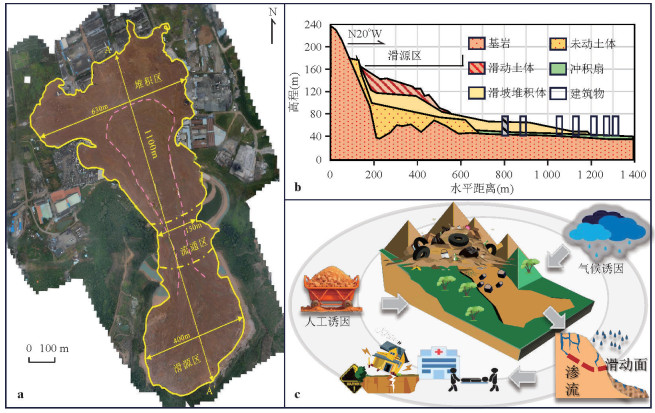
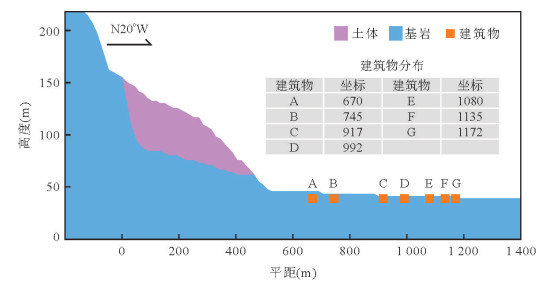
图 2 计算模型(改编自Sun et al.2021)
Fig. 2. Calculation model (adapted from Sun et al., 2021)
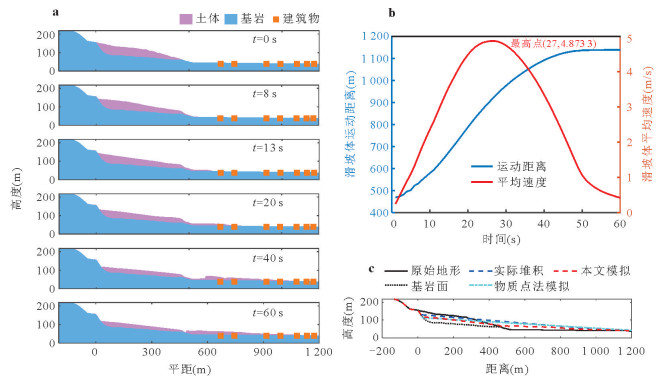
图 3 滑坡运动过程模拟结果
a.滑坡运动过程;b.运动距离与平均滑速随时间变化;c.最终堆积形态对比;物质点法结果改编自王升等(2022)
Fig. 3. Simulation results of landslide movement process
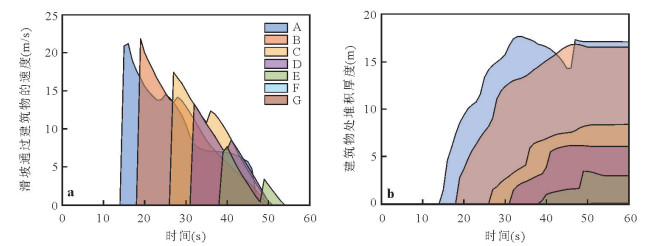
图 4 滑坡物质冲击建筑物时的速度与堆积厚度时程变化
a.滑坡物质冲击建筑物的速度;b.滑坡物质冲击建筑物的堆积厚度
Fig. 4. Temporal variations in velocity and deposition thickness of landslide material passing against buildings
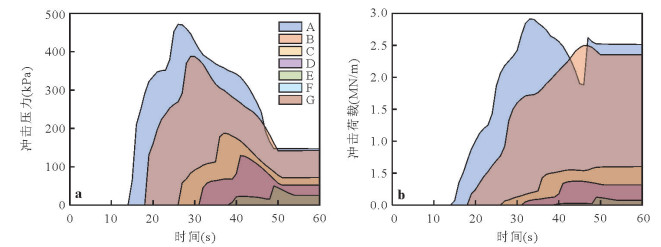
图 5 建筑物受冲击响应时程曲线及荷载累积效应
a.建筑物受瞬时冲击力时程曲线;b.总冲击荷载累积曲线
Fig. 5. Temporal evolution of impact forces and cumulative load effects on buildings
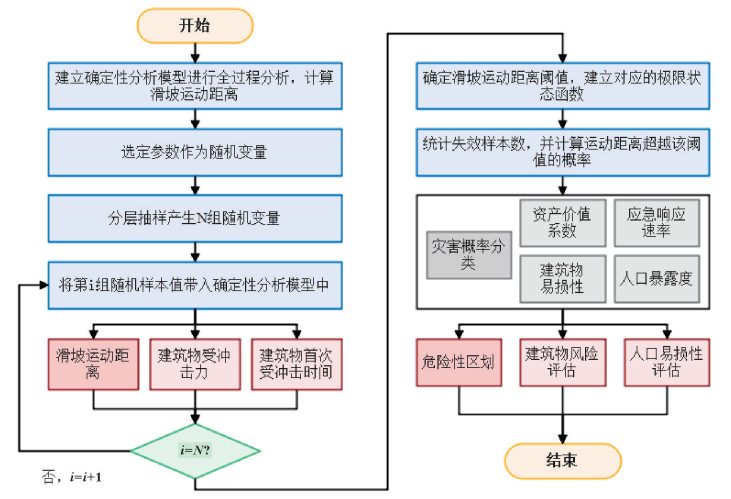
图 6 承灾体易损性风险评价框架主要实施步骤
Fig. 6. Implementation framework for vulnerability assessment of elements at risk
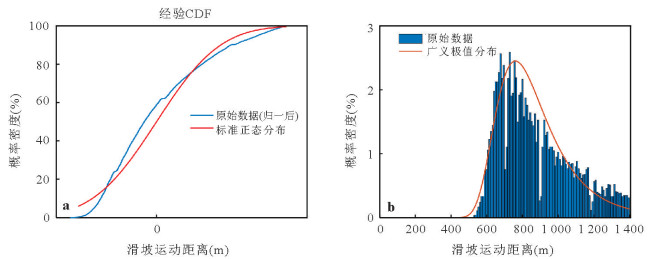
图 7 不确定模型假设检验
a.正态分布检验(h=1,拒绝原假设);b.广义极值分布检验
Fig. 7. Uncertainty quantification of model predictions via hypothesis testing
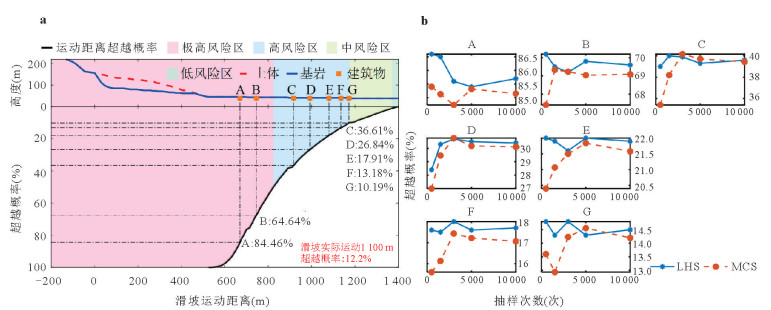
图 8 基于超越概率的滑坡危险性区划与抽样方法验证
a.超越概率及风险区划;b.抽样方法有效性检验
Fig. 8. Landslide hazard zonation based on probability of exceedance and sampling strategy validation
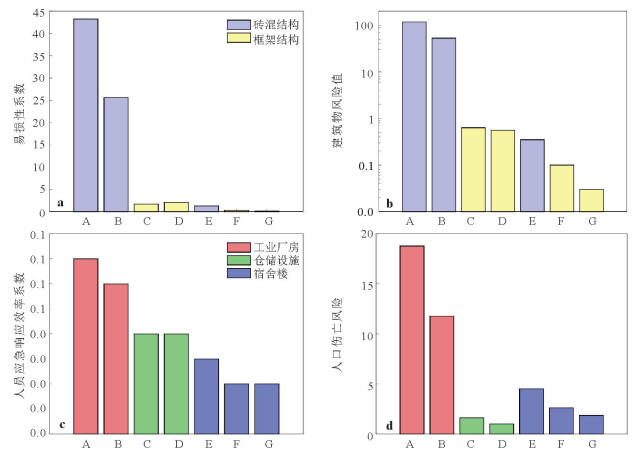
图 9 基于承灾体易损性的风险评估
a.建筑物易损性评价;b.建筑物风险评价;c.建筑物附近的人口应急响应效率系数;d.建筑物附近的人口伤亡风险评价
Fig. 9. Multidimensional risk assessment incorporating vulnerability of elements at risk
表 1 模拟堆积结果对比
Table 1. Comparison of simulated stacking results
滑坡堆积对比 最大滑距(m) 堆积坡角(°) 最大堆高(m) 平均堆高(m) 本研究模拟 1 139 3.99 27.9 8.4 物质点法模拟 1 260 5.2 25.2 10.3 实际堆积 1 100 6.1 21.3 12.9 注:物质点法模拟来自王升等(2022).  下载: 导出CSV
表 2 建筑物冲击响应参数对比
Table 2. Impact response parameters of buildings under simulated landslide loading
建筑物 最大冲击速度(m/s) 首次受到冲击的时间(s) 达到最大冲击速度的时间(s) 建筑物 最大冲击速度
(m/s)首次受到冲击的时间(s) 达到最大冲击速度的时间(s) A 21.2 15 16 E 7.66 39 40 B 21.8 19 19 F 0.003 50 55 C 17.4 27 27 G - - - D 13.3 32 32
下载: 导出CSV
表 3 建筑物受冲击荷载参数对比及滑坡稳定堆积特征
Table 3. Impact load parameters and stable accumulation characteristics of buildings under simulated landslide loading
建筑物 稳定堆积厚度(m) 最大冲击压力(kPa) 最大冲击荷载(MN/m) 稳定冲击荷载(MN/m) 建筑物 稳定堆积厚度(m) 最大冲击压力(kPa) 最大冲击荷载(MN/m) 稳定冲击荷载(MN/m) A 17.1 349.9 2.9 2.5 E 3.0 20.32 0.1 0.1 B 16.6 285.7 2.5 2.4 F - - - - C 8.4 133.1 0.6 0.4 G - - - - D 6.1 81.89 0.4 0.3
下载: 导出CSV
表 4 随机变量的统计特征
Table 4. Statistical parameters of random variables including probability distributions and correlation coefficients
下载: 导出CSV
表 5 建筑物风险等级评估参数取值
Table 5. Parameters for building risk level assessment
参数名称 参数符号 取值依据 计算公式/说明 示例值(建筑物A) 特征高度 L 层高×层数(假设均匀荷载分布) L =层高×层数 6 m×3层=18 m 临界挠度 $ {\omega }_{\mathrm{m}\mathrm{a}\mathrm{x}} $ 《建筑抗震设计规范》临界挠度比1/150 $ {\omega }_{\mathrm{m}\mathrm{a}\mathrm{x}}=L\times \left(\frac{1}{150}\right) $ 18 m×1/150=0.12 m 抗冲击
阈值$ {F}_{crit} $ 悬臂梁模型(EI为抗弯刚度,$ {\beta }_{d} $为荷载放大系数) $ {F}_{crit}=\frac{3\times EI\times {\omega }_{\mathrm{m}\mathrm{a}\mathrm{x}}}{{L}^{3}\times {\beta }_{d}} $ $ {F}_{crit}=\frac{3\times 8\times {10}^{9}\times 0.12}{{18}^{3}\times 2.0}=0.25\mathrm{ }\mathrm{M}\mathrm{N}/\mathrm{m} $ 资产价值系数 $ {C}_{i} $ 《深圳市建筑造价经济指标》、光明区2015年商品房均价(2.8万元/m²) $ {C}_{i} $ =基准单价×结构系数×功能系数×(实际面积/基准面积) 建筑物A的基准单价为2.8万元/$ {\mathrm{m}}^{2} $,实际建筑面积为1.58万$ {\mathrm{m}}^{2} $,基准建筑面积为1万$ {\mathrm{m}}^{2} $.则修正后的资产价值系数为2.8×0.8×0.9×1.58=3.185万元/$ {\mathrm{m}}^{2} $ 损伤累积效应系数 $ \mathit{γ} $ 砖混结构脆性大($ \mathit{γ} =2.0 $),框架结构延性好($ \mathit{γ} =1.5 $) 定性赋值(基于材料力学特性) 砖混结构$ \mathit{γ} =2.0 $
下载: 导出CSV
表 6 建筑物风险等级评估结果汇总
Table 6. Summary of building risk assessment results including vulnerability analysis
建筑物 位置
(m)类型 结构
类型层高
(m)层数 建筑面积
(万$ {\mathrm{m}}^{2} $)$ {10}^{4} $次抽样受到的滑坡冲击力$ {F}_{a,i}( $MN/m) 建筑物抗冲击阈值$ {F}_{crit,i} $(MN/m) 损伤累计效应系数$ \mathit{γ} $ 易损性系数$ {D}_{i} $ 资产价值系数$ {C}_{i} $ 风险值
$ {R}_{b} $A 670 工业厂房 砖混 6 3 1.58 2.3 0.25 2.0 43.24 3.2 116.87 B 745 工业厂房 砖混 6 3 1.58 2.0 0.25 2.0 25.60 3.2 52.95 C 917 仓储设施 框架 4 4 0.32 0.8 0.47 1.5 1.71 1.0 0.63 D 992 仓储设施 框架 4 4 0.32 0.7 0.47 1.5 2.08 1.0 0.56 E 1080 宿舍楼 砖混 3 5 0.60 0.4 0.36 1.8 1.31 1.5 0.35 F 1135 宿舍楼 框架 3 6 0.60 0.2 0.37 1.5 0.33 2.2 0.10 G 1172 宿舍楼 框架 3 5 0.60 0.1 0.53 1.5 0.13 2.2 0.03
下载: 导出CSV
表 7 建筑物周边人口脆弱性评估参数取值
Table 7. Parameters for building risk level assessment
参数名称 参数符号 取值依据 计算公式/说明 示例值
(建筑物A)人口密度 $ \rho $ 《建筑设计防火规范》GB50016-2014及《办公建筑设计标准》JGJ/T67-2019,结合休息日傍晚场景和使用功能确定 工业厂房$ 1.0\mathrm{人}/{\mathrm{m}}^{²} $ $ 1.0\mathrm{人}/{\mathrm{m}}^{²} $ 仓储$ 0.5\mathrm{人}/{\mathrm{m}}^{²} $ 宿舍楼$ 2\mathrm{人}/{\mathrm{m}}^{²} $ 人口暴露系数 $ {V}_{i} $ 人口密度$ \rho $×空间分布系数(对于空间分布系数,假设人口分布服从正态分布,采用变异系数(CV)衡量人口分布的波动性) 低密度(工业厂房):CV = 0.3(人员分布较分散,波动性适中) $ 1.0\times 0.3=0.30 $ 极低密度(仓储设施):CV = 0.2(人员分布极分散,波动性低) 高密度(宿舍楼):CV = 0.4(人员分布集中,波动性较高) 预警响应时间 $ {t}_{resp} $ $ {10}^{4} $次抽样平均首次受冲击时间(未冲击则取滑坡总时间) 不确定分析模型统计值 $ 13.9\mathrm{ }\mathrm{s} $ 撤离效率 $ {\eta }_{evac} $ 结合实际撤离速率与理论最大速率的比值设定.假设理论最大撤离速率为100人/分钟,实际平均速率为65人/分钟,则效率系数为0.65 0.65 0.65 时间敏感系数 k 假设每秒决策延误会导致撤离效率下降2% 0.02 0.02 决策延误时间 $ {t}_{d} $ 关键决策阈值常设定为20 s 20 s 20 s
下载: 导出CSV
表 8 建筑物周边人口脆弱性评估结果
Table 8. Population vulnerability assessment near buildings
建筑物 位置(m) 类型 人口密度
(人/$ {\mathrm{m}}^{2} $)人口分布特征 人口暴露系数$ {V}_{i} $ 预警响应时间$ {t}_{resp,i} $(s) 应急响应效率系数$ {E}_{i} $ 风险值$ {R}_{p} $ A 670 工业厂房 1.0 低密度 0.30 13.9 74.19 18.78 B 745 工业厂房 1.0 低密度 0.30 17.0 60.66 11.77 C 917 仓储设施 0.5 极低密度 0.10 23.3 44.26 1.62 D 992 仓储设施 0.5 极低密度 0.10 27.3 37.78 1.01 E 1080 宿舍楼 2.0 高密度 0.80 32.8 31.44 4.52 F 1135 宿舍楼 2.0 高密度 0.80 41.5 24.85 2.62 G 1172 宿舍楼 2.0 高密度 0.80 45.3 22.77 1.86
下载: 导出CSV
-
Armanini, A., 1997. On the Dynamic Impact of Debris Flow. In: Armanini, A., Michiue, M., eds., Recent Developments on Debris Flows. Springer, Berlin, Heidelberg, 208-226. Chai, L. Y., Ke, Y., Wang, Y. Y., et al., 2025. "Earth Macro-Circulation" of Bulk Hard-to-Dispose Industrial Solid Waste for Its Ecological Return. Strategic Study of Chinese Academy of Engineerng, 27(3): 98-105(in Chinese with English abstract). Christen, M., Kowalski, J., Bartelt, P., 2010. RAMMS: Numerical Simulation of Dense Snow Avalanches in Three-Dimensional Terrain. Cold Regions Science and Technology, 63(1-2): 1-14. https://doi.org/10.1016/j.coldregions.2010.04.005 Galasso, C., Pregnolato, M., Parisi, F., 2021. A Model Taxonomy for Flood Fragility and Vulnerability Assessment of Buildings. International Journal of Disaster Risk Reduction, 53: 101985. https://doi.org/10.1016/j.ijdrr.2020.101985 Gao, Y., 2018. The Study on Long Run-out Mechanism of Artificial Landfill Landslide: Taking Shenzhen Guangming New District Landslide as an Example (Dissertaion). China University of Geosciences, Beijing(in Chinese with English abstract). Gao, Y., Yin, Y. P., Li, B., 2021. Failure Process Simulation Analysis of the Shenzhen "12•20" CDW Landfill Landslide: A Case Study. Arabian Journal of Geosciences, 14(12): 1094. https://doi.org/10.1007/s12517-021-07429-0 Gao, Y., Yin, Y. P., Li, B., et al., 2019. Post-Failure Behavior Analysis of the Shenzhen "12•20" CDW Landfill Landslide. Waste Management, 83: 171-183. https://doi.org/10.1016/j.wasman.2018.11.015 He, X. R., Yin, Y. P., Zhao, L. M., et al., 2024. Disintegration and Fragmentation Effect of High Position Rock Landslide Debris Flow Based on Large Scale Physical Model Test. Earth Science, 49(7): 2650-2661(in Chinese with English abstract) Iverson, R. M., Ouyang, C. J., 2015. Entrainment of Bed Material by Earth-Surface Mass Flows: Review and Reformulation of Depth-Integrated Theory. Reviews of Geophysics, 53(1): 27-58. https://doi.org/10.1002/2013rg000447 Jiang, S. H., Xiong, W., Zhu, G. Y., et al., 2024. Probabilitic Analysis of Reservoir Landslides Considering the Spatial Variation of Seepage Parameters under the Conditions of Rainstorm and Sudden Drop of Water Level. Earth Science, 49(5): 1679-1691(in Chinese with English abstract) Lacasse, S., Nadim, F., 2011. Learning to Live with Geohazards: From Research to Practice. GeoRisk 2011. American Society of Civil Engineers, Atlanta, Georgia, USA. 64-116. . https://doi.org/10.1061/41183(418)4 Li, K., Cheng, Q. G., Lin, Q. W., et al., 2022. State of the Art on Rock Avalanche Dynamics from Granular Flow Mechanics. Earth Science, 47(3): 893-912(in Chinese with English abstract). Li, S., Peng, C., Wu, W., et al., 2020. Role of Baffle Shape on Debris Flow Impact in Step-Pool Channel: An SPH Study. Landslides, 17(9): 2099-2111. https://doi.org/10.1007/s10346-020-01410-w Ministry of Ecology and Environment of the People's Republic of China, 2024. China Statistical Yearbook on Ecology and Environment (2024). Ministry of Ecology and Environment of the People's Republic of China, Beijing(in Chinese). Mo, W. M., Fang, W. H., 2016. Empirical Vulnerability Functions of Building Contents to Flood Based on Post-Typhoon (Fitow, 201323) Questionnaire Survey in Yuyao, Zhejiang. Tropical Geography, 36(4): 633-641, 657(in Chinese with English abstract). Ouyang, C. J., He, S. M., Xu, Q., 2015. MacCormack-TVD Finite Difference Solution for Dam Break Hydraulics over Erodible Sediment Beds. Journal of Hydraulic Engineering, 141(5): 06014026. https://doi.org/10.1061/(asce)hy.1943-7900.0000986 Ouyang, C. J., He, S. M., Xu, Q., et al., 2013. A MacCormack-TVD Finite Difference Method to Simulate the Mass Flow in Mountainous Terrain with Variable Computational Domain. Computers & Geosciences, 52: 1-10. https://doi.org/10.1016/j.cageo.2012.08.024 Ouyang, C. J., Zhou, K. Q., Xu, Q., et al., 2017. Dynamic Analysis and Numerical Modeling of the 2015 Catastrophic Landslide of the Construction Waste Landfill at Guangming, Shenzhen, China. Landslides, 14(2): 705-718. https://doi.org/10.1007/s10346-016-0764-9 Peng, C., Wang, S., Wu, W., et al., 2019. LOQUAT: An Open-Source GPU-Accelerated SPH Solver for Geotechnical Modeling. Acta Geotechnica, 14(5): 1269-1287. https://doi.org/10.1007/s11440-019-00839-1 Sun, X. P., Zeng, P., Li, T. B., et al., 2021. Run-out Distance Exceedance Probability Evaluation and Hazard Zoning of an Individual Landslide. Landslides, 18(4): 1295-1308. https://doi.org/10.1007/s10346-020-01545-w Sun, X. P., Zeng, P., Li, T. B., et al., 2025. Probabilistic Vulnerability Evaluation of Buildings under Landslide Runout Impacts Considering the 3D Dynamic Interaction Processes. Engineering Geology, 354: 108164. https://doi.org/10.1016/j.enggeo.2025.108164 Sun, X. P., Zeng, P., Zhang, T. L., et al., 2021. Assessment of Exceedance Probability of Landslide Run-out Distance and Hazard Zoning. Geological Bulletin of China, 40(9): 1560-1569(in Chinese with English abstract). Sun, Y. J., Song, E. X., 2018. Dynamic Simulation of "12·20" Shenzhen Landslide. Chinese Journal of Geotechnical Engineering, 40(3): 441-448(in Chinese with English abstract). Tang, H. M., Li, C. D., Gong, W. P., et al., 2022. Fundamental Attribute and Research Approach of Landslide Evolution. Earth Science, 47(12): 4596-4608(in Chinese with English abstract). Wang, D., Wang, B., Yuan, W. H., et al., 2023. Investigation of Rainfall Intensity on the Slope Failure Process Using GPU-Accelerated Coupled MPM. Computers and Geotechnics, 163: 105718. https://doi.org/10.1016/j.compgeo.2023.105718 Wang, K., Zhang, S. J., Wei, F. Q., et al., 2020. A Case Study of the Rapid and Long Runout Landslide at Hong'ao Waste Disposal Site in Shenzhen, China. KSCE Journal of Civil Engineering, 24(3): 727-739. https://doi.org/10.1007/s12205-020-1399-x Wang, S., Zeng, P., Li, T. B., et al., 2022. Initiation, Movement and Impact Simulation of Soil Landslide with Material Point Method. Journal of Engineering Geology, 30(4): 1362-1370(in Chinese with English abstract). Xing, A. G., Wang, G., Yin, Y. P., et al., 2014. Dynamic Analysis and Field Investigation of a Fluidized Landslide in Guanling, Guizhou, China. Engineering Geology, 181: 1-14. https://doi.org/10.1016/j.enggeo.2014.07.022 Xu, Q., Peng, D. L., Li, W. L., et al., 2016. Study on Formation Mechanism of Diffuse Failure Landslide. Journal of Southwest Jiaotong University, 51(5): 995-1004(in Chinese with English abstract). Yan, Y. R., Liu, Z. Y., Feng, J., et al., 2023. Research on Transmission Tower Damage Assessment Caused by Earthquake and Landslide. Technology for Earthquake Disaster Prevention, 18(1): 107-117(in Chinese with English abstract). Yang, H., Huang, X. J., Thompson, J. R., et al., 2016. The Crushing Weight of Urban Waste. Science, 351(6274): 674. https://doi.org/10.1126/science.351.6274.674-a Yin, Y. P., Li, B., Wang, W. P., et al., 2016. Mechanism of the December 2015 Catastrophic Landslide at the Shenzhen Landfill and Controlling Geotechnical Risks of Urbanization. Engineering, 2(2): 230-249. https://doi.org/10.1016/J.ENG.2016.02.005 Yubei District Emergency Management Bureau, 2023. Mud Collapse Occurs at a Waste Soil Site in Yubei District, Chongqing. 2023-12-05. http://www.ybq.gov.cn/bm/qyjj/bmdt/202312/t20231215_12712416.html (in Chinese).Zanchetta, G., Sulpizio, R., Pareschi, M. T., et al., 2004. Characteristics of May 5-6, 1998 Volcaniclastic Debris Flows in the Sarno Area (Campania, Southern Italy): Relationships to Structural Damage and Hazard Zonation. Journal of Volcanology and Geothermal Research, 133(1-4): 377-393. https://doi.org/10.1016/S0377-0273(03)00409-8 Zeng, P., Su, Z. H., Fang, W. H., et al., 2022. Typhoon Flooding Loss Assessment in Haikou City Based on High Precision Building Type Data. Journal of Catastrophology, 37(4): 155-165(in Chinese with English abstract). Zhang, S., Liu, Y., Bate, B., et al., 2021. Quantitative Human Risk Analysis of 2015 Shenzhen Dump Failure Considering Influence of Urbanization. Journal of Mountain Science, 18(6): 1439-1457. https://doi.org/10.1007/s11629-020-6260-7 Zhang, S., Wang, S. R., Lei, M. L., et al., 2024. Landslide Risk Level Assessment of a Landfill: A Case Study of a Landfill in Hangzhou. Environmental Sanitation Engineering, 32(1): 1-8(in Chinese with English abstract) Zhong, X. R., 2024. Study on Sudden Departure Mechanism of Low-Potential Energy Landslides on Account of Massing Energy by Spoon-Shape Terrain—Taking the Landslide of Hong'ao Village Construction Solid Waste Landfill in Guangming New District of Shenzhen, Guangdong, China. Chinese Journal of Rock Mechanics and Engineering, 43(10): 2485-2496(in Chinese with English abstract). 柴立元, 柯勇, 王云燕, 等, 2025. 大宗难消纳工业固体废物"地球宏循环" 生态回归研究. 中国工程科学, 27(3): 98-105. 重庆市渝北区应急管理局, 2023. 重庆市渝北区一弃土场发生泥浆坍塌. 2023-12-15. http://www.ybq.gov.cn/bm/qyjj/bmdt/202312/t20231215_12712416.html 高杨, 2018. 人工堆填体滑坡远程滑动机理研究(博士学位论文). 北京: 中国地质大学. 贺旭荣, 殷跃平, 赵立明, 等, 2024. 基于大型物理模型试验的高位岩质滑坡碎屑流解体破碎效应. 地球科学, 49(7): 2650-2661. doi: 10.3799/dqkx.2023.021 蒋水华, 熊威, 朱光源, 等, 2024. 暴雨及水位骤降条件下渗流参数空间变异的水库滑坡概率分析. 地球科学, 49(5): 1679-1691. doi: 10.3799/dqkx.2022.361 李坤, 程谦恭, 林棋文, 等, 2022. 高速远程滑坡颗粒流研究进展. 地球科学, 47(3): 893-912. doi: 10.3799/dqkx.2021.169 莫婉媚, 方伟华, 2016. 浙江省余姚市室内财产洪水脆弱性曲线: 基于台风菲特(201323)灾后问卷调查. 热带地理, 36(4): 633-641, 657. 孙小平, 曾鹏, 张天龙, 等, 2021. 滑坡运动距离超越概率评价及危险性区划. 地质通报, 40(9): 1560-1569. 孙玉进, 宋二祥, 2018. "12·20"深圳滑坡动态模拟. 岩土工程学报, 40(3): 441-448. 唐辉明, 李长冬, 龚文平, 等, 2022. 滑坡演化的基本属性与研究途径. 地球科学, 47(12): 4596-4608. doi: 10.3799/dqkx.2022.461 王升, 曾鹏, 李天斌, 等, 2022. 土质滑坡失稳、运动及冲击压力物质点法模拟研究. 工程地质学报, 30(4): 1362-1370. 许强, 彭大雷, 李为乐, 等, 2016. 溃散性滑坡成因机理初探. 西南交通大学学报, 51(5): 995-1004. 严屹然, 刘泽宇, 冯杰, 等, 2023. 地震滑坡灾害下输电杆塔灾损评估研究. 震灾防御技术, 18(1): 107-117. 曾鹏, 苏朝晖, 方伟华, 等, 2022. 基于高精度房屋类型数据的海口市台风次生洪涝灾害损失评估. 灾害学, 37(4): 155-165. 张帅, 王帅茸, 雷孟麟, 等, 2024. 渣土填埋场滑坡风险等级评估: 以杭州某渣土场为例. 环境卫生工程, 32(1): 1-8. 中华人民共和国生态环境部, 2024. 中国生态环境统计年报(2024). 北京: 中华人民共和国生态环境部. 钟兴荣, 2024. 低势能滑坡束口聚能启程剧动机制研究: 以深圳光明新区红坳建筑弃渣场滑坡为例. 岩石力学与工程学报, 43(10): 2485-2496. -

 点击查看大图
计量
- 文章访问数: 160
- HTML全文浏览量: 7
- PDF下载量: 15
- 被引次数: 0
