




Kinematic Source Model of 2018 Hokkaido Eastern Iburi Mw6.6 Japan Earthquake
-
摘要: 通过观测的地表波形反演震源机制以理解地震震源破裂过程是研究强震动特征非常有效的途径之一.主要针对强震动的产生机制,采用中小震作为经验格林函数,选取0.2~2.0 Hz频段的强震动速度波形进行波形反演2018年日本北海道$ {M}_{w}6.6 $地震的破裂过程,提出了该地震的震源模型.结果表明:该地震的主要最大滑移量区域集中在沿断层面西南部-东北部6 km范围、距离震源~12.0 km的浅层区域内,该区域内最大滑动量约3.5 m;识别出两个最大滑移速度分布区,分别位于断层西南6.0 km、东北4.0 km,距离震源~15.0 km的浅层区域内,最大滑动速度约2.0 m/s,破裂速度为2.0 km/s,该震源模型对应地震震级$ {M}_{W}7.0 $.此外,通过多种组合的中小震记录作为经验的格林函数及近断层强震观测台站探讨了该震源模型的鲁棒性,进一步通过合成未参与反演的台站强震动波形,结果显示合成波形与观测波形的匹配度较高,表明模型的时空特征描述合理;最后,通过与其他已公开发表的震源模型的综合对比发现最大滑移分布相似,该系列对比充分验证了该震源模型是稳定可靠的,可为未来强震动模拟提供重要参考.Abstract: Conducting waveform inversions to estimate the rupture process of media to large size of earthquakes is one of the effective methods to better understand the characteristics of strong ground motions. To investigate the generation mechanism of strong ground motions, this study evaluates the rupture process of the 2018 Hokkaido, Japan, earthquake through waveform inversion based on the corrected empirical Green's functions. It is found that, large slip regions are concentrated along the shallow southwestern- to northeastern-section of the fault around 6.0 km in length and within 12.0 km from the hypocenter. Within this region, the maximum final slip approximates to 3.5 m; two peak slip velocity regions are identified, with the primary one located 6.0 km southwestern, and the secondary one located 4.0 km northeastern, and both within shallow areas 15.0 km from the hypocenter. The maximum peak slip velocity is about 2.0 m/s. A rupture velocity of 2.0 km/s is identified, and the inverted source model corresponds to a magnitude $ {M}_{W}7.0 $. Furthermore, another 3 waveform inversions using different combinations of empirical Green's functions and additional 7 different combinations of near-fault strong motion stations are operated to investigate the robustness and reliability of the source model. Based on the evaluated source model, additional strong motions at stations, which are not used in the waveform inversion, are synthesized and the synthesized and observed velocities could match well. Similarities of the final slip distribution among different source models also could be obtained. Results demonstrate that the major spatiotemporal characteristics of slip are robust and reliable, which could offer useful information for future strong motion simulation and analysis.
-
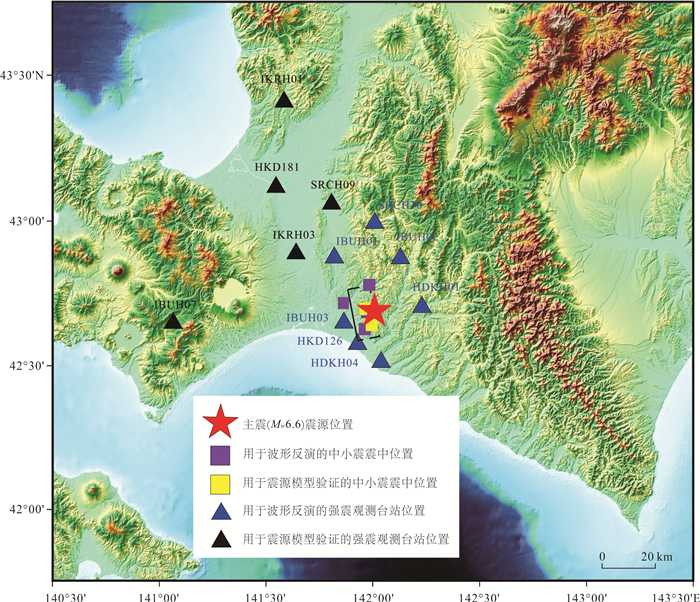
图 1 2018年日本北海道$ {M}_{w}6.6 $地震及波形反演中选用的中小震震中位置、发震断层和所选取的强震观测台站
Fig. 1. Location of hypocenters of the 2018 Hokkaido earthquake and the small events used in the inversion analysis
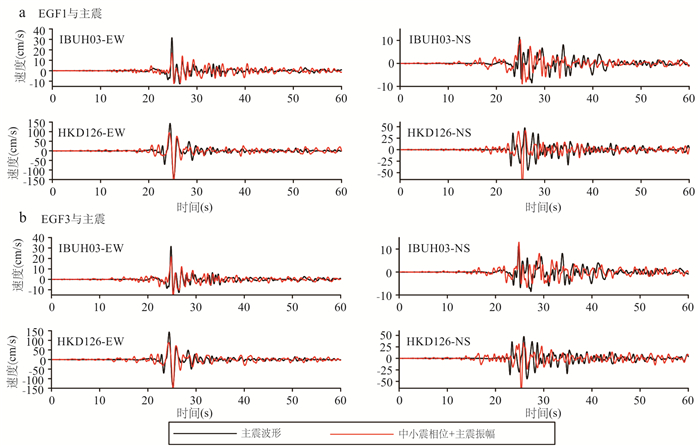
图 2 所选取的典型台站的中小震记录与主震速度波形的相位特性相关性比较示例
每个子图中黑色实线为主震波形,红色实线为中小震相位+主震振幅
Fig. 2. Phase characteristics among mainshock and the selected small events for typical strong-motion stations
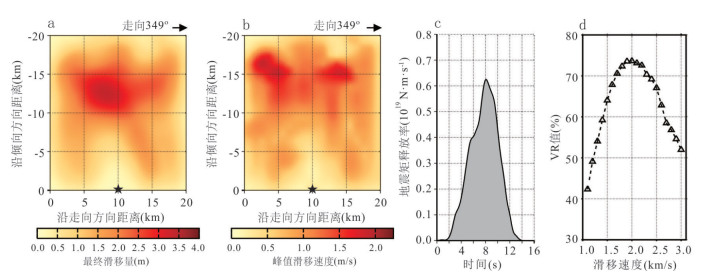
图 3 反演的震源模型
a.最终滑移分布;b. 峰值滑移速度分布;c. 基于反演获得的整个地震震源时间函数;d. VR随地震波破裂速度(Vr)的敏感性分析
Fig. 3. Inverted source models
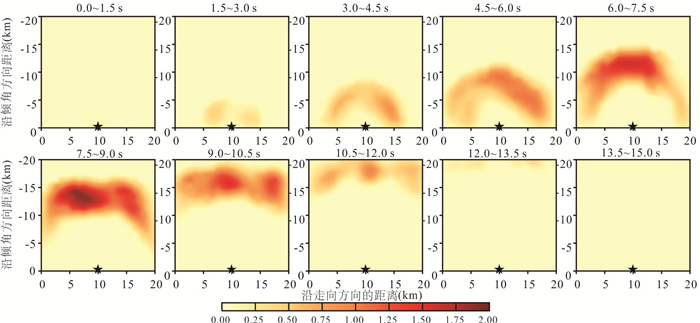
图 4 断层面上滑动量分布的时间增量为1.5 s的快照,图中五角星为JMA发布的破裂起始点
Fig. 4. Snapshot of the rupture slip values for the preferred earthquake source model in every 1.5 s, the star is the JMA rupture start point
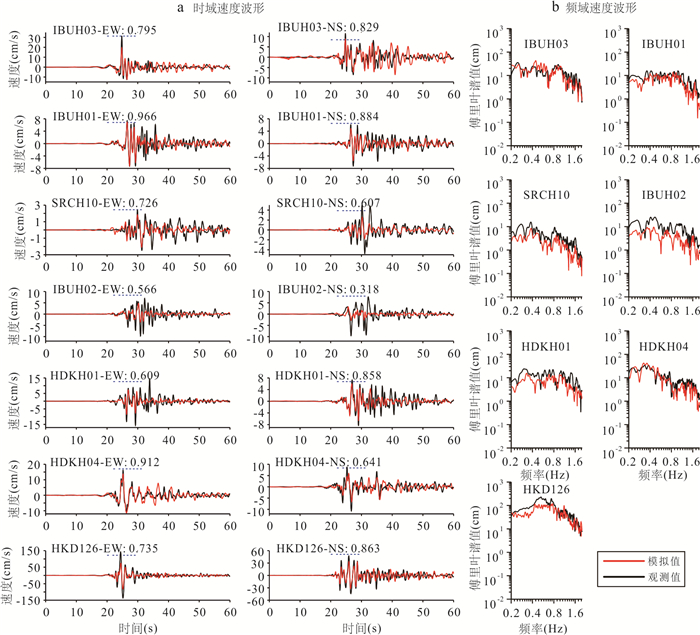
图 5 基于反演的震源模型模拟的强震动速度波形与观测速度波形的比较
a.时域(蓝色虚线段10 s为应用于波形反演的波形数据);b.频域,频率范围为0.2~2.0 Hz
Fig. 5. Comparisons between the simulated strong ground motion based on the preferred source model and the observed velocity waveforms
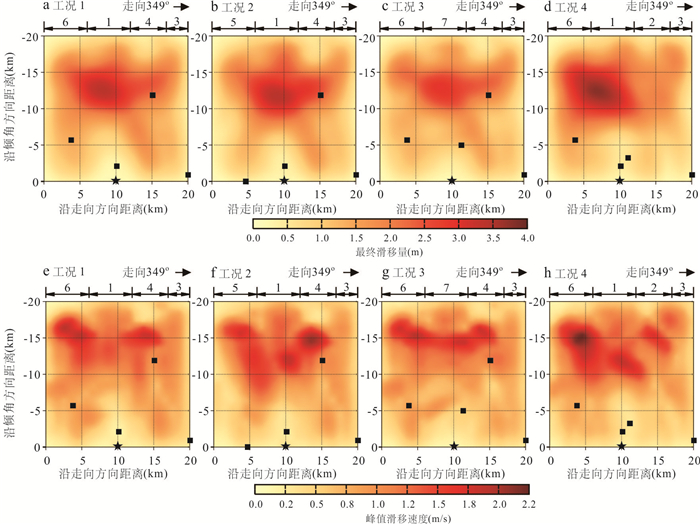
图 6 基于不同EGF组合反演获得的震源模型
Fig. 6. Inverted source models based on different combinations of EGF events
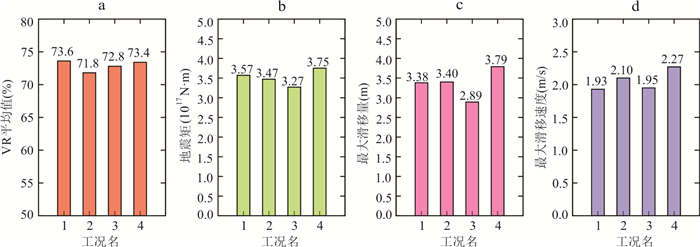
图 7 基于4组不同中小震组合(工况1~工况4)反演获得的(a)VR值、(b)$ {M}_{0} $、(c)最大滑移量及(d)峰值滑移速度的比较
Fig. 7. Comparisons of (a) VR values, (b) $ {M}_{0} $, (c) maximum slip value and (d) maximum peak slip velocity through different waveform inversions on different combinations of EGF events (case 1-case 4)
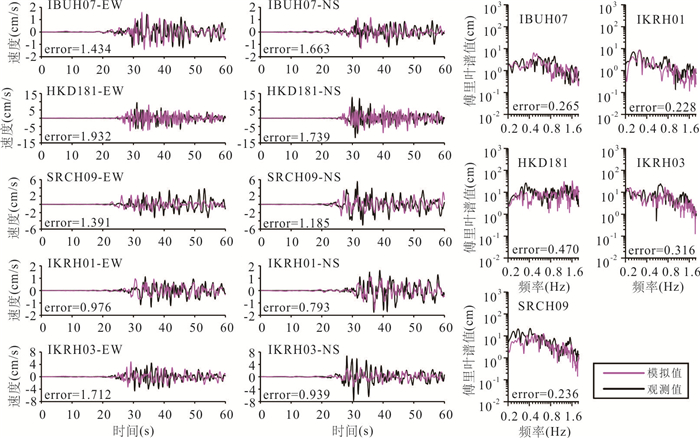
图 8 基于提出的震源模型合成的未参与反演的强震动台站速度波形与观测速度波形(频率范围0.2~2.0 Hz)的比较
Fig. 8. Comparisons of velocity waveforms (target frequency range: 0.2-2.0 Hz) between the simulated strong ground motions based on kinematic source for the sites which are not adopted in the inversion and the observed ones
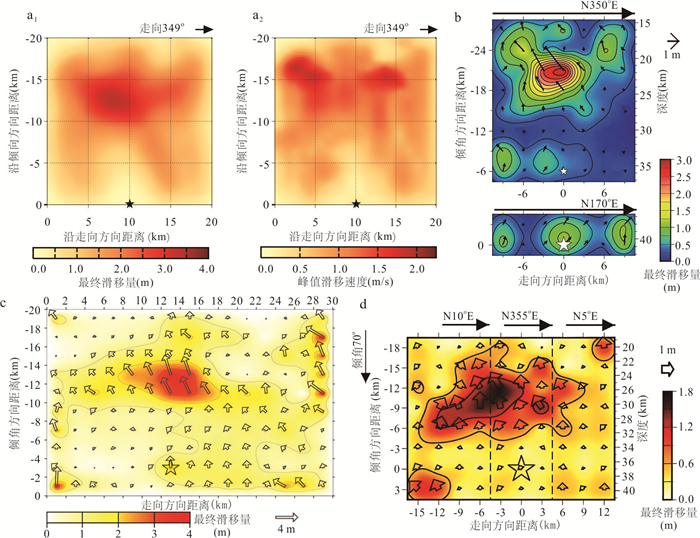
图 9 基于不同频率范围进行反演所提出的不同运动学震源模型间的比较
a.本文提出的震源模型;b. Kobayashi组模型(Kobayashi et al.,2019);c. NIED模型(NIED,2019);d. Asano and Iwata模型(Asano and Iwata, 2019)
Fig. 9. Comparisons among different source models (which are focused on different frequency ranges proposed from different researchers)
表 1 主震及选取的中小震发震时刻、震源位置及震源机制解参数
Table 1. Focal mechanics of the mainshock and EGF events adopted in this calculation
地震 发震时间(JST)a
年‒月‒日
时: 分: 秒震源位置a $ {M}_{j} $a 震源机制b $ {M}_{o} $b
(N∙m)经度
(oE)纬度
(oN)深度
(km)走向
(o)倾角
(o)滑移角
(o)主震 2018‒09‒06 03:07:59.33 142.006 7 42.690 8 37.04 6.7 349 65 107 1.00×10¹⁹ EGF1 2018‒09‒06 16:53:24.31 141.972 8 42.687 8 34.78 4.4 179 79 ‒169 2.76×10¹⁵ EGF2 2018‒09‒08 18:21:07.13 141.968 5 42.696 0 33.78 4.2 215 78 ‒146 1.45×10¹⁵ EGF3 2018‒09‒09 22:55:13.75 141.983 7 42.781 2 34.87 4.9 341 70 100 2.66×10¹⁶ EGF4 2018‒09‒17 02:51:31.63 141.862 8 42.718 0 27.59 4.6 357 39 ‒155 7.43×10¹⁵ EGF5 2018‒09‒21 07:56:08.20 141.994 8 42.641 3 36.55 4.2 133 74 50 1.25×10¹⁵ EGF6 2018‒10‒08 21:53:58.77 141.963 2 42.627 8 31.79 4.3 21 72 110 3.46×10¹⁵ EGF7 2018‒11‒14 19:07:30.10 141.965 3 42.698 0 31.50 4.7 305 51 70 1.44×10¹⁵ 注:a据JMA,b据NIED F-net( Fukuyama et al.,1996 ). 下载: 导出CSV
-
Aki, K., 1967. Scaling Law of Seismic Spectrum. Journal of Geophysical Research, 72(4): 1217-1231. https://doi.org/10.1029/jz072i004p01217 Asano, K., Iwata, T., 2019. Source Rupture Process of the 2018 Hokkaido Eastern Iburi Earthquake Deduced from Strong-Motion Data Considering Seismic Wave Propagation in Three-Dimensional Velocity Structure. Earth, Planets and Space, 71: 1-17. https://doi.org/10.1186/s40623-019-1080-0 Bouchon, M., 1981. A Simple Method to Calculate Green's Functions for Elastic Layered Media. Bulletin of the Seismological Society of America, 71(4): 959-971. https://doi.org/10.1785/bssa0710040959 Cabinet Office, Government of Japan, 2018. Regarding the Damage Situation from the 2018 Hokkaido Eastern Iburi Earthquake. (2018-10-29) [2025-12-20]. https://www.bousai.go.jp/updates/h30jishin_hokkaido/pdf/301030_jishin_hokkaido.pdf Chen, Y. T., Xu, L. S., 2000. A Time‐Domain Inversion Technique for the Tempo‐Spatial Distribution of Slip on a Finite Fault Plane with Applications to Recent Large Earthquakes in the Tibetan Plateau. Geophysical Journal International, 143(2): 407-416. https://doi.org/10.1046/j.1365-246X.2000.01263.x Dhakal, Y. P., Kunugi, T., Kimura, T., et al., 2019. Peak Ground Motions and Characteristics of Nonlinear Site Response during the 2018 MW6.6 Hokkaido Eastern Iburi Earthquake. Earth, Planets and Space, 71: 1-26. https://doi.org/10.1186/s40623-019-1038-2 Dreger, D. S., 1994. Empirical Green's Function Study of the January 17, 1994 Northridge, California Earthquake. Geophysical Research Letters, 21(24): 2633-2636. https://doi.org/10.1029/94gl02661 Fukuyama, E., Ishihida, M., Hori, S., et al. 1996. Broadband Seismic Observation Conducted under the FREESIA Project. Report of the National Research Institute for Earth Science and Disaster Resilience, 57: 23-31 (in Japanese with English abstract). Fukuyama, E., Ishida, M., Douglas, S., et al. 1998. Automated Seismic Moment Tensor Determination by Using On-line Broadband Seismic Waveforms. Zishin (Journal of the Seismological Society of Japan), 51(1): 149-156(in Japanese with English abstract). doi: 10.4294/zisin1948.51.1_149 Gou, T., Huang, Z. C., Zhao, D. P., et al., 2019. Structural Heterogeneity and Anisotropy in the Source Zone of the 2018 Eastern Iburi Earthquake in Hokkaido, Japan. Journal of Geophysical Research: Solid Earth, 124(7): 7052-7066. https://doi.org/10.1029/2019jb017388 Guo, Z. L., Wen, Y. M., Xu, G. Y., et al., 2019. Fault Slip Model of the 2018 MW6.6 Hokkaido Eastern Iburi, Japan, Earthquake Estimated from Satellite Radar and GPS Measurements. Remote Sensing, 11(14): 1667. https://doi.org/10.3390/rs11141667 Hartzell, S. H., Heaton, T. H., 1983. Inversion of Strong Ground Motion and Teleseismic Waveform Data for the Fault Rupture History of the 1979 Imperial Valley, California, Earthquake. Bulletin of the Seismological Society of America, 73(6A): 1553-1583. https://doi.org/10.1785/bssa07306a1553 Hisakawa, T., Ando, R., Yano, T. E., et al., 2020. Dynamic Rupture Simulation of 2018, Hokkaido Eastern Iburi Earthquake: Role of Non-Planar Geometry. Earth, Planets and Space, 72: 1-14. https://doi.org/10.1186/s40623-020-01160-y Hua, Y. Y., Zhao, D. P., Xu, Y. X., et al., 2019. Arc-Arc Collision Caused the 2018 Eastern Iburi Earthquake (M6.7) in Hokkaido, Japan. Scientific Reports, 9: 13914. https://doi.org/10.1038/s41598-019-50305-x Iwasaki, T., Tsumura, N., Ito, T., et al., 2019. Structural Heterogeneity in and around the Fold-and-Thrust Belt of the Hidaka Collision Zone, Hokkaido, Japan and Its Relationship to the Aftershock Activity of the 2018 Hokkaido Eastern Iburi Earthquake. Earth, Planets and Space, 71: 1-19. https://doi.org/10.1186/s40623-019-1081-z Kobayashi, H., Koketsu, K., Miyake, H., 2019. Rupture Process of the 2018 Hokkaido Eastern Iburi Earthquake Derived from Strong Motion and Geodetic Data. Earth, Planets and Space, 71: 1-9. https://doi.org/10.1186/s40623-019-1041-7 Kubo, H., Iwaki, A., Suzuki, W., et al., 2020. Estimation of the Source Process and Forward Simulation of Long-Period Ground Motion of the 2018 Hokkaido Eastern Iburi, Japan, Earthquake. Earth, Planets and Space, 72: 1-11. https://doi.org/10.1186/s40623-020-1146-z Lawson, C. L., Hanson, R. J., 1974. Solving Least Squares Problems. Society for Industrial and Applied Mathematics, Philadelphia. NIED, 2019. Rupture Process of the 2018 Hokkaido Eastern Iburi Earthquake Derived from Strong-Motion Data. (2019-10-11) [2024-7-30]. https://www.kyoshin.bosai.go.jp/kyoshin/topics/Iburi_20180906/inversion_en/ Nozu, A., 2007. Variable-Slip Rupture Model for the 2005 West Off Fukuoka Prefecture, Japan, Earthquake Waveform Inversion with Empirical Green's Functions. Zishin (Journal of the Seismological Society of Japan), 59(3): 253-270 (in Japanese with English abstract). doi: 10.4294/zisin.59.253 Nozu, A., 2012. A Simplified Source Model to Explain Strong Ground Motions from a Huge Subduction Earthquake, Simulation of Strong Ground Motions for the 201l off the Pacific Coast of Tohoku Earthquake with a Pseudo Point-Source Model. Zishin (Journal of the Seismological Society of Japan), 65(1): 45-67 (in Japanese with English abstract). doi: 10.4294/zisin.65.45 Nozu, A., Irikura, K., 2008. Strong-Motion Generation Areas of a Great Subduction-Zone Earthquake: Waveform Inversion with Empirical Green's Functions for the 2003 Tokachi-Oki Earthquake. Bulletin of the Seismological Society of America, 98(1): 180-197. https://doi.org/10.1785/0120060183 Nozu, A., Nagasaka, Y., 2017. Rupture Process of the Main Shock of the 2016 Kumamoto Earthquake with Special Reference to Damaging Ground Motions: Waveform Inversion with Empirical Green's Functions. Earth, Planets and Space, 69: 1-18. https://doi.org/10.1186/s40623-017-0609-3 Osanai, N., Yamada, T., Hayashi, S. I., et al., 2019. Characteristics of Landslides Caused by the 2018 Hokkaido Eastern Iburi Earthquake. Landslides, 16(8): 1517-1528. https://doi.org/10.1007/s10346-019-01206-7 Ren, C. M., Yue, H., Wang, T., et al., 2021. Source Rupture Model of the 2018 MW6.7 Iburi, Hokkaido Earthquake from Joint Inversion of Strong Motion and InSAR Observations. Earthquake Science, 34(1): 88-101. https://doi.org/10.29382/eqs-2020-0065 Satoh, T., 2019. Broadband Source Model and Strong Motions of the 2018 Hokkaido Eastern Iburi Earthquake. Journal of Structural and Construction Engineering, 84(763): 1175-1185. doi: 10.3130/aijs.84.1175 Tomozawa, Y., Kato, K., Nojiri, K., 2019. Estimation of Source, Path and Site Effects of the 2018 Hokkaido Eastern Iburi Earthquake. Journal of Japan Association for Earthquake Engineering, 19(4): 4_170-4_174. doi: 10.5610/jaee.19.4_170 Tozer, B., Sandwell, D. T., Smith, W. H. F., et al., 2019. Global Bathymetry and Topography at 15 Arc Sec: SRTM15+. Earth and Space Science, 6(10): 1847-1864. https://doi.org/10.1029/2019ea000658 Wang, D., Kawakatsu, H., Zhuang, J. C., et al., 2017. Automated Determination of Magnitude and Source Length of Large Earthquakes Using Backprojection and P Wave Amplitudes. Geophysical Research Letters, 44(11): 5447-5456. https://doi.org/10.1002/2017gl073801 Wang, D., Mori, J., 2012. The 2010 Qinghai, China, Earthquake: A Moderate Earthquake with Supershear Rupture. Bulletin of the Seismological Society of America, 102(1): 301-308. https://doi.org/10.1785/0120110034 Wessel, P., Smith, W. H. F., Scharroo, R., et al., 2013. Generic Mapping Tools: Improved Version Released. Eos, Transactions American Geophysical Union, 94(45): 409-410. https://doi.org/10.1002/2013eo450001 Wu, S. L., Nozu, A., Nagasaka, Y., 2021. Rupture Process of the 2021 Fukushima-Ken Oki Earthquake Estimated from Waveform Inversion with Empirical Green's Functions. World Earthquake Engineering, 37(2): 1-12 (in Chinese with English abstract). Wu, S. L., Nozu, A., Nagasaka, Y., 2021. Rupture Process of the Mainshock of the 2019 Ridgecrest Earthquake Sequence from Waveform Inversion with Empirical Green's Functions. Bulletin of the Seismological Society of America, 111(2): 1014-1031. https://doi.org/10.1785/0120200266 Xie, Z. D., Yu, X. W., Zhang, W. B., 2024. Dynamic Rupture Process of the 2018 Hokkaido MW6.6 Earthquake, Japan. Chinese Journal of Geophysics, 67(8): 2972-2989 (in Chinese with English abstract). Xu, L. S., Chen, Y. T., 1996. Extracting the Focal Time Function of Gonghe Earthquake from Long-Period Digital Waveform Data by Empirical Green Function Method. Acta Seismologica Sinica, 18(2): 156-159 (in Chinese with English abstract). Xu, L. S., Chen, Y. T., 2002. Source Time Function and Rupture Process of Earthquake. Seismological and Geomagnetic Observation and Research, 23(6): 1-8 (in Chinese with English abstract). Yamagishi, H., Yamazaki, F., 2018. Landslides by the 2018 Hokkaido Iburi-Tobu Earthquake on September 6. Landslides, 15(12): 2521-2524. https://doi.org/10.1007/s10346-018-1092-z Yao, Q., Wang, D., Fang, L. H., et al., 2019. Rapid Estimation of Magnitudes of Large Damaging Earthquakes in and around Japan Using Dense Seismic Stations in China. Bulletin of the Seismological Society of America, 109(6): 2545-2555. https://doi.org/10.1785/0120190107 Zang, C., Ni, S. D., Shen, Z. C., 2019. Rupture Directivity Analysis of the 2018 Hokkaido Eastern Iburi Earthquake and Its Seismotectonic Implication. Seismological Research Letters, 90(6): 2121-2131. https://doi.org/10.1785/0220190131 Zhang, S., Li, R., Wang, F. W., et al., 2019. Characteristics of Landslides Triggered by the 2018 Hokkaido Eastern Iburi Earthquake, Northern Japan. Landslides, 16(9): 1691-1708. https://doi.org/10.1007/s10346-019-01207-6 Zhang, X., Xu, L. S., 2015. Inversion of the Apparent Source Time Functions for the Rupture Process of the Nepal MS8.1 Earthquake. Chinese Journal of Geophysics, 58(6): 1881-1890 (in Chinese with English abstract). Zhou, H. X., Che, A. L., Wang, L. M., et al., 2021. Investigation and Mechanism Analysis of Disasters under Hokkaido Eastern Iburi Earthquake. Geomatics, Natural Hazards and Risk, 12(1): 1-28. https://doi.org/10.1080/19475705.2020.1856201 吴双兰, 野津厚, 長坂陽介, 2021.2021年日本福岛县冲地震的震源破裂过程分析: 基于采用经验格林函数方法的波形反演. 世界地震工程, 37(2): 1-12. 谢张迪, 于湘伟, 章文波, 2024. 2018年日本北海道MW6.6地震震源动力学破裂过程. 地球物理学报, 67(8): 2972-2989. 许力生, 陈运泰, 1996. 用经验格林函数方法从长周期数字波形资料中提取共和地震的震源时间函数. 地震学报, 18(2): 156-159. 许力生, 陈运泰, 2002. 震源时间函数与震源破裂过程. 地震地磁观测与研究, 23(6): 1-8. 张旭, 许力生, 2015. 利用视震源时间函数反演尼泊尔MS8.1地震破裂过程. 地球物理学报, 58(6): 1881-1890. -

 点击查看大图
计量
- 文章访问数: 178
- HTML全文浏览量: 12
- PDF下载量: 8
- 被引次数: 0
