




Seismic Back-Azimuth Estimation Model Based on WaveNet and Full Waveform Data
-
摘要: 地震定位是地震预警和地球深部结构研究的核心,但其精度仍面临挑战.本研究基于中国大陆测震台网的三分量波形数据,采用深度学习技术,构建了单台地震反方位角估算方法,对比分析了标准卷积神经网络与WaveNet模型在P波、面波和全波形输入下的性能差异.结果显示,WaveNet结合全波形输入的表现最优,其借助扩张卷积与残差连接结构增强了对长时间序列特征的提取能力,反方位角平均偏差仅为0.04°,拟合优度(R2)达到0.99.独立测试结果表明,该模型具备良好的泛化能力,平均绝对偏差和方差相较于传统面波偏振方法分别降低了58.70%和28.21%.基于全波形输入的深度学习方法可显著提高单台定位精度,为地震预警及极端环境下的地震监测提供有效技术支撑.Abstract: Earthquake location is fundamental to both early warning systems and studies of the Earth's deep structure, yet its accuracy remains challenging to be improved. Using three-component waveform data from the China National Seismic Network, this study develops a single-station back-azimuth estimation method based on deep learning. We compare the performance of a standard convolutional neural network with that of a WaveNet architecture under three input settings: P-wave only, surface-wave only, and full-waveform input. Results show that WaveNet combined with full-waveform input performs best, benefiting from dilated convolutions and residual connections that enhance its ability to extract long-range temporal features. The model achieves an average back-azimuth deviation of only 0.04°, with a coefficient of determination (R2) of 0.99. Independent tests demonstrate strong generalization capability, with the mean absolute deviation and variance reduced by 58.70% and 28.21%, respectively, compared with the traditional surface-wave polarization method. The findings indicate that deep learning with full-waveform input can substantially improve single-station location accuracy, offering effective technical support for earthquake early warning and seismic monitoring in challenging environments.
-
Key words:
- earthquake location /
- back-azimuth /
- WaveNet /
- deep learning /
- full waveform /
- seismology
-
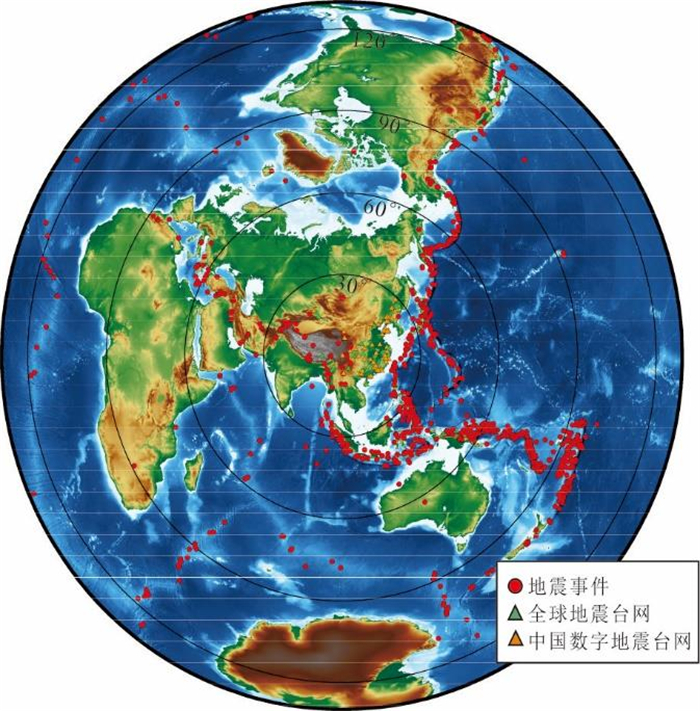
图 1 研究选取的地震台站与地震事件的空间分布
Fig. 1. Spatial distribution of seismic stations and earthquake events in the study
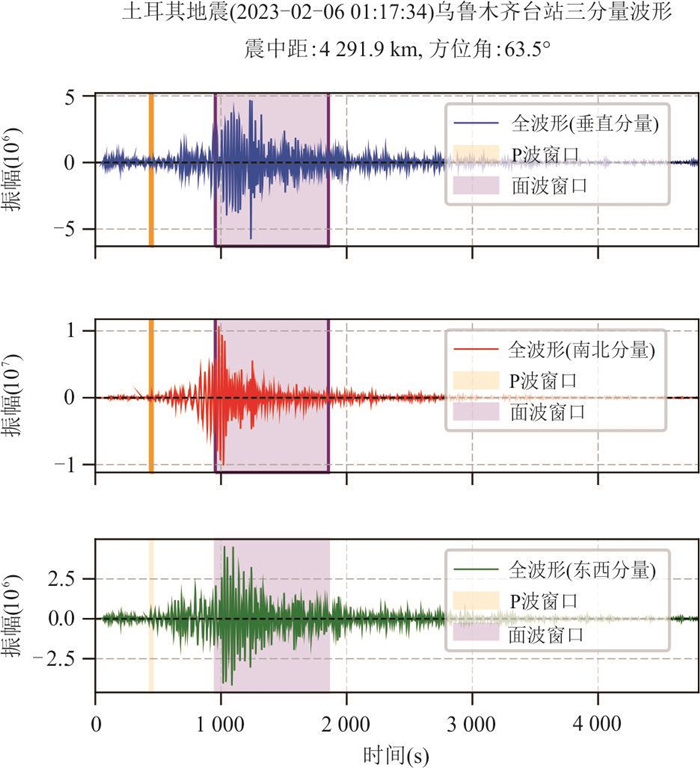
图 2 单台三分量地震波形以及相应的震相信息时间窗口
Fig. 2. Single-station three-component seismic waveforms and earthquake phase windows
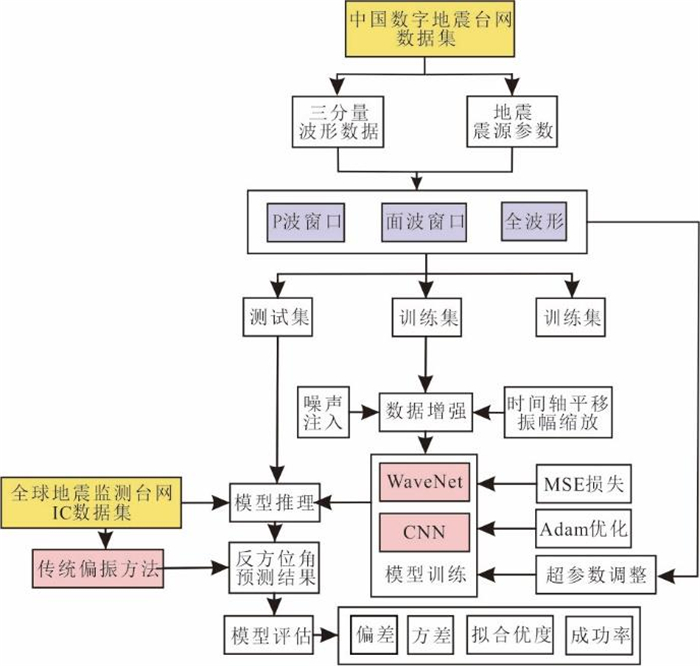
图 3 基于深度学习的单台地震反方位角评估整体流程
Fig. 3. Overall workflow for single-station back-azimuth estimation using deep learning
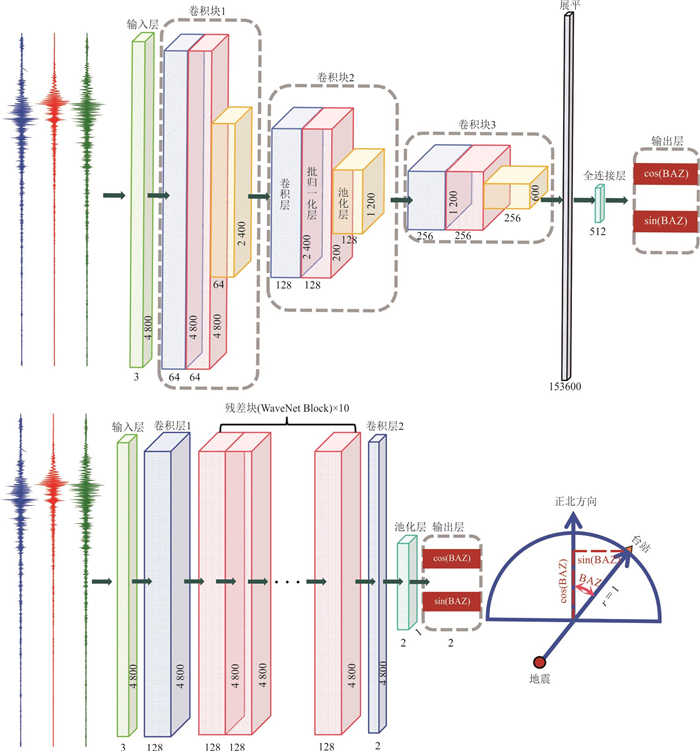
图 4 基于传统CNN的深度学习模型(a)与基于WaveNet的深度学习模型(b)
Fig. 4. Deep learning model based on traditional CNN (a) and deep learning model based on WaveNet (b)
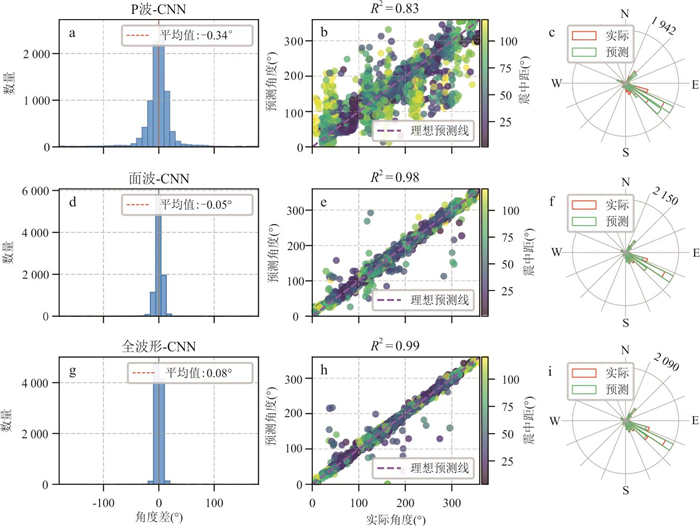
图 5 CNN模型对P波、面波和全波形输入的测试结果
Fig. 5. Testing results of the CNN model for P-wave, surface wave, and full waveform inputs
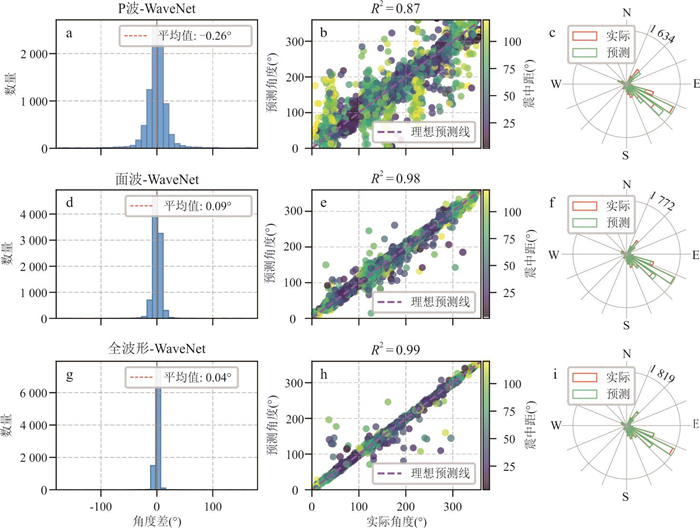
图 6 WaveNet模型对P波、面波和全波形输入的测试结果
Fig. 6. Testing results of the WaveNet model for P-wave, surface wave, and full waveform inputs
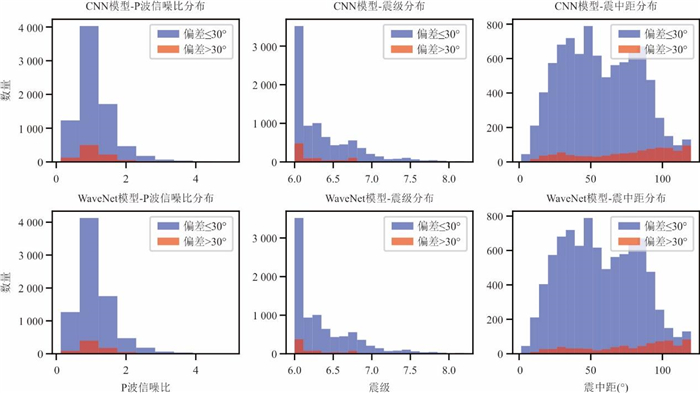
图 7 CNN与WaveNet模型基于P波输入的反方位角预测误差影响因素分析
Fig. 7. Analysis of influencing factors on back-azimuth prediction errors of CNN and WaveNet models based on P-wave input
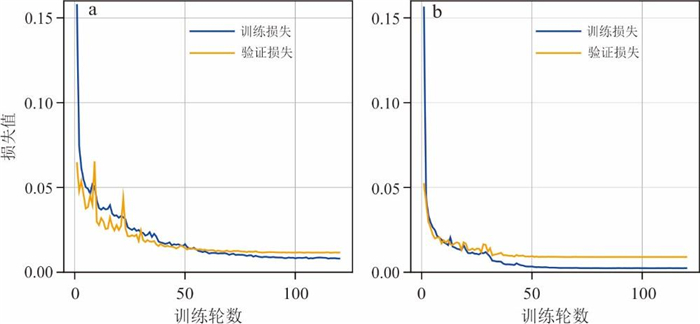
图 8 CNN(a)与WaveNet(b)模型全波形输入损失函数曲线
Fig. 8. Full waveform input loss function curves of the CNN (a) and WaveNet (b) models
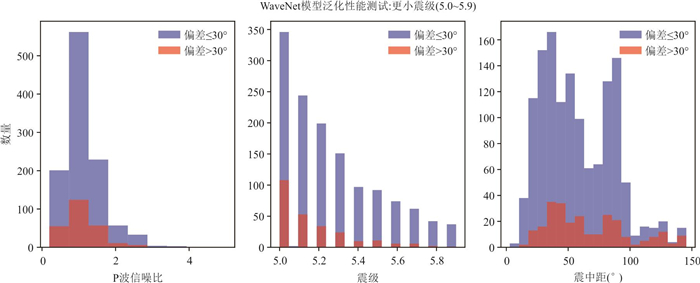
图 9 WaveNet模型对IC.BJT台站更小震级事件的反方位角预测误差分布
Fig. 9. Influencing factors on back-azimuth prediction errors of WaveNet model for smaller magnitude earthquake events at IC.BJT station
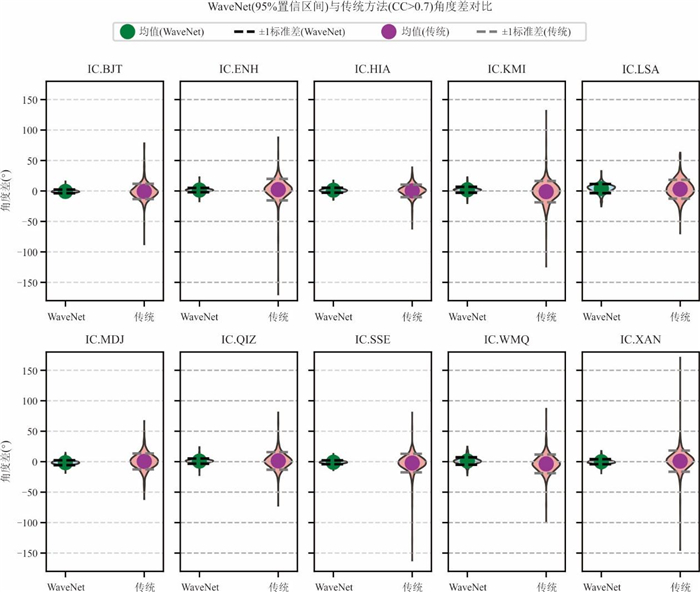
图 10 WaveNet和传统偏振方法在独立测试数据集上的角度误差分布对比
WaveNet选取全波形输入的推理结果.传统面波偏振分析方法为DLOPy,仅统计互相关系数 > 0.7的样本数据.绿色小提琴图展示深度学习方法的误差分布,粉色小提琴图表示传统方法的误差分布,圆点标记平均误差
Fig. 10. Comparison of angular error distributions between WaveNet and traditional polarization methods on the independent test dataset
表 1 模型训练与测试结果统计
Table 1. Statistics of model training and testing results
输入 模型 参数量 训练时长(s)
Nvidia RTX 3090单次推理平均时间(s) MAC M1 平均偏差 平均方差 R2 成功率10°误差 P波 CNN 64 450 6×120 0.000 1 ‒0.34 28.97 0.83 0.559 WaveNet 33 346 7×120 0.000 5 ‒0.26 25.33 0.87 0.580 面波 CNN 15 711 746 11.4×120 0.001 7 ‒0.05 8.86 0.98 0.915 WaveNet 198 146 13.5×120 0.032 9 0.09 9.77 0.98 0.929 全波形 CNN 79 674 882 45×120 0.006 2 0.08 7.65 0.99 0.968 WaveNet 1 970 690 121×120 0.778 1 0.04 6.24 0.99 0.988  下载: 导出CSV
表 2 WaveNet面波输入消融实验结果统计
Table 2. Statistics of the ablation experiment results for surface wave input in the WaveNet model
实验设置 平均偏差 方差 $ {R}^{2} $ 成功率(10°) 完整WaveNet 0.09 9.77 0.98 0.928 9 残差块数=5 ‒0.09 14.38 0.95 0.901 5 残差块数=12 ‒0.22 10.87 0.97 0.932 6 仅时间平移 ‒0.19 11.24 0.97 0.918 8 仅噪声增强 ‒0.14 12.04 0.97 0.913 5 仅振幅缩放 ‒0.15 11.66 0.97 0.925 4 无数据增强 ‒0.19 11.87 0.97 0.907 9 无学习率调度器 0.48 12.04 0.97 0.880 9
下载: 导出CSV
表 3 模型泛化能力测试结果统计
Table 3. Statistics of model generalization capability test results
台站 区域 事件数 平均偏差 方差 $ {R}^{2} $ 成功率(10°) IC.BJT 北京 1 112 ‒0.78 8.47 0.98 0.982 9 IC.ENH 恩施 1 072 1.91 10.65 0.98 0.962 7 IC.HIA 呼伦贝尔 1 107 0.94 8.47 0.98 0.955 7 IC.KMI 昆明 1 054 1.85 11.18 0.98 0.904 2 IC.LSA 拉萨 915 4.45 15.57 0.95 0.780 0 IC.MDJ 牡丹江 1 058 ‒1.5 9.24 0.98 0.957 5 IC.QIZ 琼中 1 111 1.33 11.92 0.98 0.943 3 IC.SSE 上海 1 047 ‒0.8 7.37 0.99 0.975 2 IC.WMQ 乌鲁木齐 1 041 1.5 12.36 0.96 0.871 3 IC.XAN 西安 1 042 ‒0.13 11.67 0.97 0.949 1 平均 0.975 0.928 19
下载: 导出CSV
表 4 WaveNet与传统模型对比结果统计
Table 4. Statistics of comparison results between WaveNet and traditional models
台站名称 区域 方法 有效事件数量 平均绝对偏差 方差 $ {R}^{2} $ IC.BJT 北京 AI 1 112 0.78 8.47 0.98 偏振 695 0.77 12.51 0.98 IC.ENH 恩施 AI 1 072 1.91 10.65 0.98 偏振 605 2.25 17.71 0.95 IC.HIA 呼伦贝尔 AI 1 107 0.94 8.47 0.98 偏振 696 0.26 10.31 0.98 IC.KMI 昆明 AI 1 054 1.85 11.18 0.98 偏振 621 1.10 17.51 0.95 IC.LSA 拉萨 AI 915 4.45 15.57 0.95 偏振 518 2.95 15.45 0.96 IC.MDJ 牡丹江 AI 1 058 1.50 9.24 0.98 偏振 690 0.47 13.02 0.97 IC.QIZ 琼中 AI 1 111 1.33 11.92 0.98 偏振 651 1.33 14.43 0.97 IC.SSE 上海 AI 1 047 0.80 7.37 0.99 偏振 657 2.17 15.19 0.96 IC.WMQ 乌鲁木齐 AI 1 041 1.50 12.36 0.96 偏振 674 3.54 15.33 0.97 IC.XAN 西安 AI 1 042 0.13 11.67 0.97 偏振 642 0.91 17.41 0.95 IC平均 中国大陆 AI 1 055.9 1.52 10.69 0.98 偏振 644.9 3.68 14.89 0.96
下载: 导出CSV
-
Bell, S. W., Forsyth, D. W., Ruan, Y. Y., 2015. Removing Noise from the Vertical Component Records of Ocean-Bottom Seismometers: Results from Year One of the Cascadia Initiative. Bulletin of the Seismological Society of America, 105(1): 300-313. https://doi.org/10.1785/0120140054 Dai, A., Bao, X. Y., Sun, Y. C., et al., 2023. A Novel Method to Estimate Orientations of an Ocean-Bottom Seismometer Array for Accurate Measurement of Waveform Phases and Amplitudes. Seismological Research Letters, 94(4): 1936-1947. https://doi.org/10.1785/0220220363 Deng, W. Z., Han, G. J., Li, J., et al., 2025. Seismometer Orientation Measurements of Broadband Seismic Stations in the China Digital Seismograph Network. Bulletin of the Seismological Society of America, 115(1): 210-227. https://doi.org/10.1785/0120240075 Doran, A. K., Laske, G., 2017. Ocean-Bottom Seismometer Instrument Orientations via Automated Rayleigh-Wave Arrival-Angle Measurements. Bulletin of the Seismological Society of America, 107(2): 691-708. https://doi.org/10.1785/0120160165 Fu, Y. V., Li, L., Xiao, Z., 2019. Lithospheric SH Wave Velocity Structure beneath the Northeastern Tibetan Plateau from Love Wave Tomography. Journal of Geophysical Research: Solid Earth, 124(9): 9682-9693. https://doi.org/10.1029/2019JB017788 Hou, X. R., Guo, Z. W., Gao, D. W., et al., 2024. Review of Recent Advances in Seismic Location Methods. Progress in Geophysics, 39(3): 959-974 (in Chinese with English abstract). Huang, J., Yao, Y. S., Wang, Q. L., et al., 2011. A Integrated Single-Station Seismic Location Method for Early Warning. Journal of Geodesy and Geodynamics, 31(2): 142-144, 148 (in Chinese with English abstract). Jiang, C., Lü, Z. Y., Fang, L. H., 2024. Earthquake Detection Model Trained on Velocity and Acceleration Records and Its Application in Xinfengjiang Reservoir. Earth Science, 49(2): 469-479 (in Chinese with English abstract). Lao, G. Y., Yang, D. H., Liu, S. L., et al., 2024. An Eikonal Equation-Based Earthquake Location Method by Inversion of Multiple Phase Arrivals. Scientia Sinica Terrae, 54(6): 1830-1844 (in Chinese). Lara, P., Bletery, Q., Ampuero, J. P., et al., 2023. Earthquake Early Warning Starting from 3 s of Records on a Single Station with Machine Learning. Journal of Geophysical Research: Solid Earth, 128(11): e2023JB026575. https://doi.org/10.1029/2023JB026575 Lehmann, I., 1958. On Amplitudes of P near the Shadow Zone. Annals of Geophysics, 11(3-4): 154-156. https://doi.org/10.4401/ag-5818 Li, L., Tan, J. Q., Schwarz, B., et al., 2020. Recent Advances and Challenges of Waveform-Based Seismic Location Methods at Multiple Scales. Reviews of Geophysics, 58(1): e2019RG000667. https://doi.org/10.1029/2019RG000667 Li, S. Y., Wang, B. R., Lu, J. Q., et al., 2024. Prediction of Instrumental Intensity for a Single Station Using a LSTM Neural Network. Chinese Journal of Geophysics, 67(2): 587-599 (in Chinese with English abstract). Lin, Z. H., Xiao, Z., Zhang, Y. Y., et al., 2025. Lithospheric Footprint of Mantle Upwelling beneath Late Cenozoic Basalts in the Beibu Gulf Basin, Northwestern South China Sea. Journal of Geophysical Research: Solid Earth, 130(6): e2024JB030379. https://doi.org/10.1029/2024JB030379 Lomax, A., Savvaidis, A., 2022. High-Precision Earthquake Location Using Source-Specific Station Terms and Inter-Event Waveform Similarity. Journal of Geophysical Research: Solid Earth, 127(1): e2021JB023190. https://doi.org/10.1029/2021JB023190 Mousavi, S. M., Beroza, G. C., 2020. Bayesian-Deep-Learning Estimation of Earthquake Location from Single-Station Observations. IEEE Transactions on Geoscience and Remote Sensing, 58(11): 8211-8224. https://doi.org/10.1109/TGRS.2020.2988770 Mousavi, S. M., Beroza, G. C., 2023. Machine Learning in Earthquake Seismology. Annual Review of Earth and Planetary Sciences, 51(1): 105-129. https://doi.org/10.1146/annurev-earth-071822-100323 van den Oord, A., Dieleman, S., Zen, H., et al., 2016. WaveNet: A Generative Model for Raw Audio. https://doi.org/10.48550/arXiv.1609.03499 Ross, Z. E., Meier, M. A., Hauksson, E., et al., 2018. Generalized Seismic Phase Detection with Deep Learning. Bulletin of the Seismological Society of America, 108(5A): 2894-2901. https://doi.org/10.1785/0120180080 Scholz, J. R., Barruol, G., Fontaine, F. R., et al., 2017. Orienting Ocean-Bottom Seismometers from P-Wave and Rayleigh Wave Polarizations. Geophysical Journal International, 208(3): 1277-1289. https://doi.org/10.1093/gji/ggw426 Sun, W. J., Tkalčić, H., Tang, Q. Y., 2024. Single-Station Back-Azimuth Determination with the Receiver Function Rotation Technique Validated by the Locations of Earthquakes, Impacts, and Explosions. Seismological Research Letters, 95(5): 2925-2938. https://doi.org/10.1785/0220240117 Tan, F. Z., Kao, H., Yi, K. M., et al., 2024. Next Generation Seismic Source Detection by Computer Vision: Untangling the Complexity of the 2016 Kaikōura Earthquake Sequence. Journal of Geophysical Research: Solid Earth, 129(5): e2024JB028735. https://doi.org/10.1029/2024JB028735 Thurber, C. H., Rabinowitz, N., 2000. Advances in Seismic Event Location. Springer Netherlands, Dordrecht. https://doi.org/10.1007/978-94-015-9536-0 Tian, X. B., Zhang, J. L., Si, S. K., et al., 2011. SKS Splitting Measurements with Horizontal Component Misalignment. Geophysical Journal International, 185(1): 329-340. https://doi.org/10.1111/j.1365-246X.2011.04936.x Tian, Y., Chen, X. F., 2002. Review of Seismic Location Study. Progress in Geophysics, 17(1): 147-155 (in Chinese with English abstract). Tong, P., Zhao, D., Yang, D., et al., 2014. Wave-Equation-Based Travel-Time Seismic Tomography-Part 1: Method. Solid Earth, 5(2): 1151-1168. https://doi.org/10.5194/se-5-1151-2014 Wagner, M., Husen, S., Lomax, A., et al., 2013. High-Precision Earthquake Locations in Switzerland Using Regional Secondary Arrivals in a 3-D Velocity Model. Geophysical Journal International, 193(3): 1589-1607. https://doi.org/10.1093/gji/ggt052 Xiao, Z., Sun, X. L., Wang, J., et al., 2023. Tectonic Transition Revealed by Upper Mantle Heterogeneities and Anisotropy of the SE Margin of the Tibetan Plateau: Insights into the Cenozoic Intraplate Volcanisms. Tectonophysics, 865: 230046. https://doi.org/10.1016/j.tecto.2023.230046 Zang, C., Wu, W. B., Ni, S. D., et al., 2024. A Reciprocity-Based Efficient Method for Improved Source Parameter Estimation of Submarine Earthquakes with Hybrid 3-D Teleseismic Green's Functions. Journal of Geophysical Research: Solid Earth, 129(5): e2023JB028174. https://doi.org/10.1029/2023JB028174 Zhang, F. X., Li, Y., Chen, Y. P., 2025. A Brief Analysis of Hypocenter Location Accuracy and Its Influencing Factors. Reviews of Geophysics and Planetary Physics, 56(2): 182-192 (in Chinese with English abstract). Zhang, J., 2023. Machine-Learning Based Earthquake Detection, Location, Phase Picking and Polarity Determination (Dissertation). University of Science and Technology of China, Hefei (in Chinese with English abstract). Zheng, H., Fan, J. K., Zhao, D. P., et al., 2019. A New Method to Estimate Ocean-Bottom-Seismometer Orientation Using Teleseismic Receiver Functions. Geophysical Journal International, 221(1): 893-904. https://doi.org/10.1093/gji/ggaa041 Zheng, X. F., Ouyang, B., Zhang, D. N., et al., 2009. Technical System Construction of Data Backup Centre for China Seismograph Network and the Data Support to Researches on the Wenchuan Earthquake. Chinese Journal of Geophysics, 52(5): 1412-1417 (in Chinese with English abstract). Zhu, G. H., Yang, H. F., Lin, J., et al., 2020. Determining the Orientation of Ocean-Bottom Seismometers on the Seafloor and Correcting for Polarity Flipping via Polarization Analysis and Waveform Modeling. Seismological Research Letters, 91(2A): 814-825. https://doi.org/10.1785/0220190239 侯新荣, 郭振威, 高大维, 等, 2024. 地震定位方法最新进展综述. 地球物理学进展, 39(3): 959-974. 黄俊, 姚运生, 王秋良, 等, 2011. 地震预警中的单台综合定位方法. 大地测量与地球动力学, 31(2): 142-144, 148. 蒋策, 吕作勇, 房立华, 2024. 融合处理速度和加速度记录的地震检测模型及其在新丰江水库的应用. 地球科学, 49(2): 469-479. doi: 10.3799/dqkx.2023.186 劳高月, 杨顶辉, 刘少林, 等, 2024. 基于程函方程的多震相走时地震定位方法. 中国科学: 地球科学, 54(6): 1830-1844. 李山有, 王博睿, 卢建旗, 等, 2024. 基于LSTM网络的单台仪器地震烈度预测模型. 地球物理学报, 67(2): 587-599. 田玥, 陈晓非, 2002. 地震定位研究综述. 地球物理学进展, 17(1): 147-155. 张风雪, 李昱, 陈泆平, 2025. 浅析震源位置准确度及其影响因素. 地球与行星物理论评(中英文), 56(2): 182-192. 张基, 2023. 基于机器学习的地震检测、定位以及初动拾取和极性判断的研究(博士学位论文). 合肥: 中国科学技术大学. 郑秀芬, 欧阳飚, 张东宁, 等, 2009. "国家数字测震台网数据备份中心"技术系统建设及其对汶川大地震研究的数据支撑. 地球物理学报, 52(5): 1412-1417. -

 点击查看大图
计量
- 文章访问数: 169
- HTML全文浏览量: 164
- PDF下载量: 18
- 被引次数: 0
