




Probabilistic Prediction of Short-Term Strong Earthquake Hazard Based on Bayesian Network Structure Learning
-
摘要: 为提升区域月尺度强震风险预测能力,基于贝叶斯网络结构学习提出区域性月尺度地震危险性概率预测模型.首先利用区域与全球地震目录数据构建预测指标,作为网络节点变量;其次采用群智能算法自动确定各节点阈值及节点间的有向连接;最后通过参数估计,目标节点输出目标区域未来一月内发生MW5.0及以上强震的概率.实验结果显示,模型预报效能指标平均达0.783,经Molchan检验验证,其有效性显著,表明该模型能够充分挖掘地震预测指标与强震之间的潜在因果关系.Abstract: To enhance the capability for monthly-scale regional strong earthquake risk prediction, this paper introduces a probabilistic seismic hazard prediction model based on Bayesian network structure learning. Initially, a series of predictive indicators, serving as the nodes of the Bayesian network, are derived from the earthquake catalog. Subsequently, the thresholds for each node and the directed connections among nodes are determined using swarm intelligence algorithms. Ultimately, through parameter estimation, the target node outputs the probability of MW5.0+ strong earthquakes occurring in the target region within the next month. Experimental results indicate that the model achieves an average prediction efficiency metric of 0.783, and validation via the Molchan test confirms its significant effectiveness, demonstrating the model's capacity to comprehensively explore the latent causal relationships between seismic precursors and strong earthquakes.
-
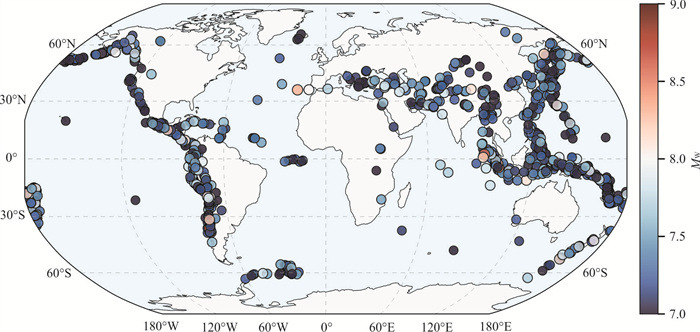
图 1 全球1960-2024年Mw7.0以上的地震分布
Fig. 1. Global distribution of earthquakes with magnitude Mw≥7.0 from 1960 to 2024
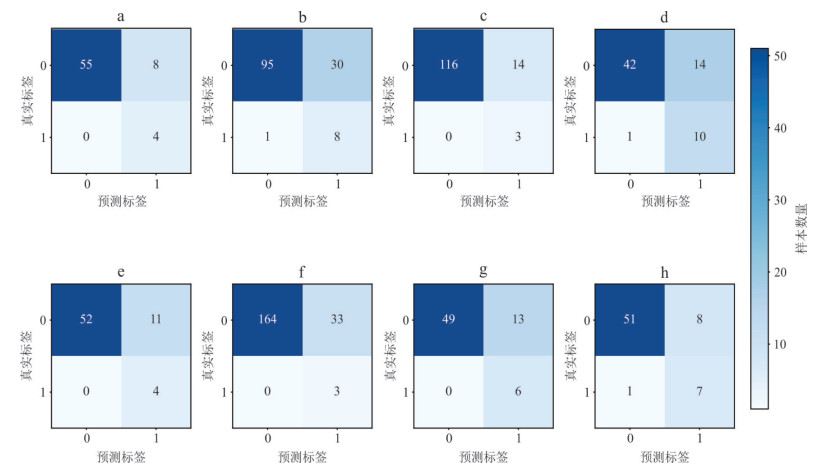
图 3 模型在测试集上推理结果的混淆矩阵
Fig. 3. Confusion matrix for BESBN inference results on the test set
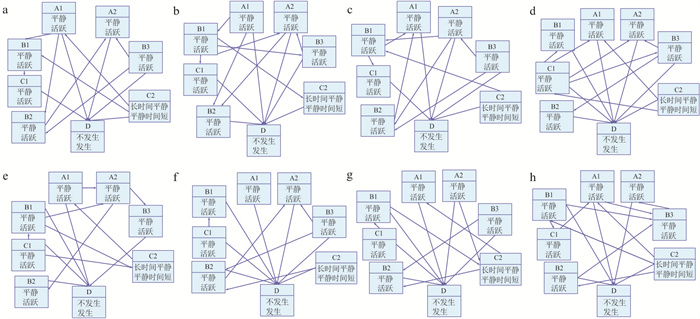
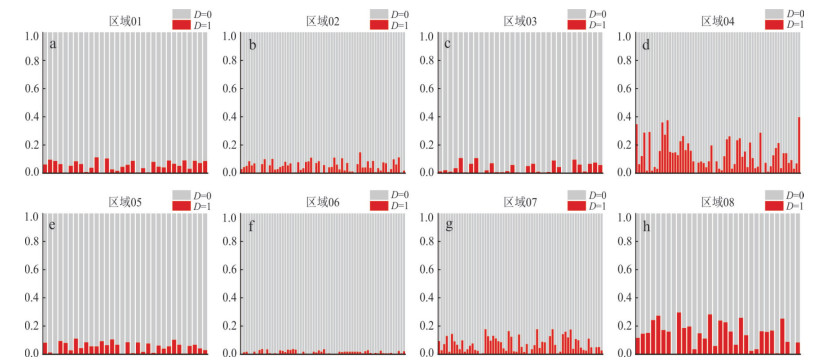
图 4 不同区域的BESBN网络结构对比
Fig. 4. Comparison of BESBN network structures in different regions
表 1 划定研究区域的范围及构造背景
Table 1. Delineation of the extent of the study region and its structural background
研究区域 划分范围 构造背景 T01(HH) 红河断裂带周边 印度‒欧亚板块碰撞应力控制, 历史强震反映走滑断层闭锁 T02(DX) 滇西和澜沧江地震带 滇缅块体走滑‒逆冲复合, 地震机制多样 T03(HX) 河西走廊、六盘山、兰州、天水 闭锁段应力积累特征突出, 历史强震密集 T04(TK) 塔里木盆地西南和昆仑山东部 耦合板缘俯冲受印度板块北向推挤, 应力加载引发逆冲型地震丛集 T05(TS) 天山山脉 印度‒欧亚碰撞远场效应显著, 断层闭锁度高 T06(FB) 福建省东南沿海、渤海地区和山西东部 历史强震受板块内部弱变形与局部应力集中控制 T07(TG) 唐古拉山脉东部 唐古拉山脉东缘走滑断裂网络, 地震活动反映高原东向扩展变形机制 T08(TD) 台湾东部及沿海 高角度逆冲及走滑断层发育, 地震频发源于板块边界强耦合  下载: 导出CSV
表 2 贝叶斯网络每个节点的设计细节
Table 2. Design specifics of each node in the Bayesian network
节点 内容 状态0 状态1 A1 全球10年内MW7.0以上地震频率 平静 活跃 A2 全国3年内MW6.0以上地震频率 平静 活跃 B1 区域3月内ML3.0以上地震频率 平静 活跃 B2 全国1年内MW7.0以上地震频率 平静 活跃 B3 全国1年内MW5.0以上地震频率 平静 活跃 C1 区域1月内ML3.0以上地震频率 平静 活跃 C2 区域MW4.0以上地震平静期天数 长时间平静 平静时间短 D 下个月是否发生MW5.0以上地震 不发生 发生
下载: 导出CSV
表 3 不同算法在8个区域的训练集上性能比较
Table 3. Comparison of average performance of different algorithms on training set of 8 regions
算法 AET ASD AKS 迭代轮数 种群数量 ACO+HC 243±2.5 2.75±1.24 939.52±10.25 50 40 SSA+HC 230±3.1 2.12±0.63 1 142.79±1.16 50 40 GWO+HC 238±1.7 1.83±0.53 1 211.68±3.50 50 40 WOA+HC 202±18.0 3.58±1.37 1 416.37±2.44 50 40 BES+HC 203±8.6 1.03±0.11 2 087.29±0.00 50 40 BES+HC 235±11.3 1.00±0.00 2 099.85±0.00 50 50
下载: 导出CSV
表 4 本研究中混淆矩阵的定义
Table 4. The definition of confusion matrix in this study
混淆矩阵 下个月发生MW5.0以上强震 下个月未发生MW5.0以上强震 后验概率超过报警值 TP FP 后验概率未超过报警值 FN TN
下载: 导出CSV
表 5 不同区域BESBN的阈值
Table 5. Thresholds for BESBN in different regions
模型 αwarn αA1 αA2 αB1 αB2 αB3 αC1 αC2 BESBN-T01 0.065 6 175.41 21.02 52.93 4.44 52.74 82.20 661.75 BESBN-T02 0.055 3 192.86 19.98 25.57 3.48 30.24 10.39 151.57 BESBN-T03 0.047 2 196.42 16.65 9.74 2.48 35.19 2.98 604.50 BESBN-T04 0.194 8 176.32 17.73 75.16 2.81 45.73 11.43 214.70 BESBN-T05 0.057 5 209.92 17.16 5.91 3.81 40.36 12.82 669.81 BESBN-T06 0.014 6 153.80 20.71 7.76 1.90 34.96 3.19 1187.76 BESBN-T07 0.093 8 147.01 22.26 11.48 4.44 34.78 9.18 607.50 BESBN-T08 0.159 3 174.15 17.92 2.97 1.42 79.14 13.96 378.22
下载: 导出CSV
表 6 不同区域的模型性能比较
Table 6. Comparison of model performances in different regions
研究区域 模型 R Acc AUC FPR T01(HH) BESBN-T01
ETAS
Poisson0.873 0.880 0.980 0.127 0.742 0.821 0.876 0.179 0.612 0.746 0.723 0.254 T02(DX) BESBN-T02 0.649 0.768 0.808 0.240 ETAS 0.548 0.716 0.745 0.284 Poisson 0.421 0.642 0.651 0.358 T03(HX) BESBN-T03 0.892 0.894 0.949 0.107 ETAS 0.769 0.835 0.882 0.165 Poisson 0.634 0.752 0.731 0.248 T04(TK) BESBN-T04 0.659 0.777 0.825 0.250 ETAS 0.556 0.716 0.748 0.284 Poisson 0.418 0.627 0.642 0.373 T05(TS) BESBN-T05 0.825 0.836 0.897 0.175 ETAS 0.697 0.776 0.824 0.224 Poisson 0.573 0.701 0.692 0.299 T06(FB) BESBN-T06 0.832 0.835 0.871 0.168 ETAS 0.714 0.775 0.812 0.225 Poisson 0.588 0.695 0.698 0.305 T07(TG) BESBN-T07 0.790 0.809 0.898 0.210 ETAS 0.672 0.750 0.821 0.250 Poisson 0.534 0.676 0.687 0.324 T08(TD) BESBN-T08 0.740 0.866 0.890 0.136 ETAS 0.628 0.806 0.823 0.194 Poisson 0.495 0.731 0.708 0.269
下载: 导出CSV
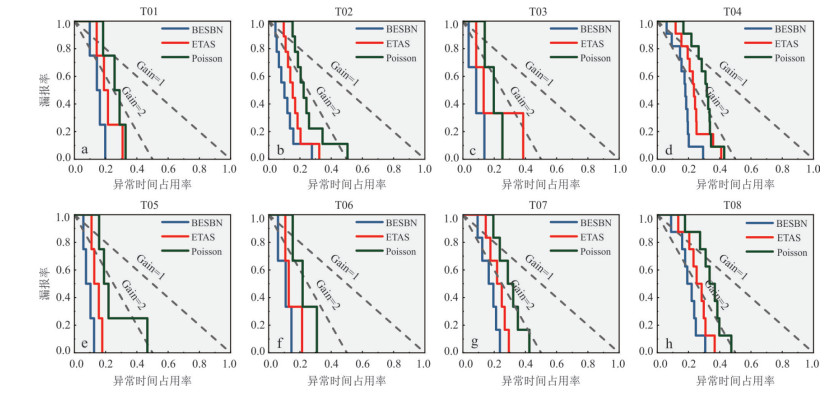
表 7 Molchan检验结果
Table 7. Molchan test results
研究区域 模型 1-S Gavg(0.1τ) Gavg(0.2τ) Gavg Gmax T01(HH) BESBN-T01 0.839 7 2.540 1 3.918 4 3.918 4 5.064 6 ETAS 0.765 5 - 2.197 1 2.781 9 3.490 7 Poisson 0.717 5 - 1.359 1 2.236 5 3.053 5 T02(DX) BESBN-T02 0.872 4 4.375 8 4.993 1 4.840 0 5.717 7 ETAS 0.820 4 1.153 9 2.980 4 3.145 7 4.360 5 Poisson 0.726 4 - 1.275 1 2.089 5 3.010 1 T03(HX) BESBN-T03 0.896 9 8.470 7 8.072 5 8.072 5 9.082 6 ETAS 0.748 6 3.923 8 4.472 9 3.845 7 5.022 0 Poisson 0.784 5 - 2.882 9 3.240 3 3.954 9 T04(TK) BESBN-T04 0.818 8 1.741 3 2.745 9 2.966 7 4.510 2 ETAS 0.746 2 - 1.116 7 2.110 2 3.254 8 Poisson 0.683 3 - 0.543 4 1.673 0 2.643 8 T05(TS) BESBN-T05 0.901 2 5.531 3 6.570 4 6.570 4 7.934 6 ETAS 0.848 5 - 4.151 8 4.151 8 5.605 7 Poisson 0.703 0 - 2.108 8 2.447 8 3.434 2 T06(FB) BESBN-T06 0.881 0 5.593 7 6.195 6 6.195 6 6.864 4 ETAS 0.832 5 - 4.161 6 4.333 2 5.192 5 Poisson 0.747 7 - 2.165 2 2.825 0 3.242 9 T07(TG) BESBN-T07 0.817 0 1.777 6 2.729 0 3.178 6 4.228 1 ETAS 0.762 7 - 1.519 2 2.421 3 3.403 1 Poisson 0.678 0 - 0.855 8 1.800 0 2.368 4 T08(TD) BESBN-T08 0.782 8 1.412 3 1.922 1 2.563 8 3.545 5 ETAS 0.725 4 - 0.930 8 2.004 3 2.835 7 Poisson 0.614 6 - 0.704 7 1.535 3 2.201 9
下载: 导出CSV
-
Adeli, H., Panakkat, A., 2009. A Probabilistic Neural Network for Earthquake Magnitude Prediction. Neural Networks, 22(7): 1018-1024. https://doi.org/10.1016/j.neunet.2009.05.003 Aki, K., 1981. A Probabilistic Synthesis of Precursory Phenomena. In: Simpson D. W., Richards P. G., eds., Earthquake Prediction. American Geophysical Union, Washington, D. C., 566-574. https://doi.org/10.1029/me004p0566 Al-Betar, M. A., 2017. Β-Hill Climbing: An Exploratory Local Search. Neural Computing and Applications, 28(Suppl. 1): 153-168. https://doi.org/10.1007/s00521-016-2328-2 Alsattar, H. A., Zaidan, A. A., Zaidan, B. B., 2020. Novel Meta-Heuristic Bald Eagle Search Optimisation Algorithm. Artificial Intelligence Review, 53(3): 2237-2264. https://doi.org/10.1007/s10462-019-09732-5 Andrić, J. M., Lu, D. G., 2017. Fuzzy Probabilistic Seismic Hazard Analysis with Applications to Kunming City, China. Natural Hazards, 89(3): 1031-1057. https://doi.org/10.1007/s11069-017-3007-z Beroza, G. C., Segou, M., Mostafa Mousavi, S., 2021. Machine Learning and Earthquake Forecasting-Next Steps. Nature Communications, 12: 4761. https://doi.org/10.1038/s41467-021-24952-6 Cooper, G. F., Herskovits, E., 1992. A Bayesian Method for the Induction of Probabilistic Networks from Data. Machine Learning, 9(4): 309-347. https://doi.org/10.1007/BF00994110 Cornell, C. A., 1968. Engineering Seismic Risk Analysis. Bulletin of the Seismological Society of America, 58(5): 1583-1606. https://doi.org/10.1785/bssa0580051583 Deng, S. G., Zhou, L. Q., Ma, Y. W., et al., 2019. Research on Probability Prediction of Earthquake Risk Based on Bayesian Theorem. Earthquake Research in China, 35(1): 1-13 (in Chinese with English abstract). Dieterich, J., Cayol, V., Okubo, P., 2000. The Use of Earthquake Rate Changes as a Stress Meter at Kilauea Volcano. Nature, 408(6811): 457-460. https://doi.org/10.1038/35044054 Dorigo, M., Maniezzo, V., Colorni, A., 1996. Ant System: Optimization by a Colony of Cooperating Agents. IEEE Transactions on Systems, Man, and Cybernetics, Part B (Cybernetics), 26(1): 29-41. https://doi.org/10.1109/3477.484436 Dramsch, J. S., Kuglitsch, M. M., Fernández-Torres, M. Á., et al., 2025. Explainability can Foster Trust in Artificial Intelligence in Geoscience. Nature Geoscience, 18(2): 112-114. https://doi.org/10.1038/s41561-025-01639-x Fleming, S. W., Watson, J. R., Ellenson, A., et al., 2021. Machine Learning in Earth and Environmental Science Requires Education and Research Policy Reforms. Nature Geoscience, 14(12): 878-880. https://doi.org/10.1038/s41561-021-00865-3 He, C. C., Wang, P., Tian, L. Y., et al., 2024. A Novel Structure Learning Method of Bayesian Networks Based on the Neighboring Complete Node Ordering Search. Neurocomputing, 585: 127620. https://doi.org/10.1016/j.neucom.2024.127620 Jiang, M. M., Zhou, S. Y., Chen, Y. J., et al., 2011. A New Multidimensional Stress Release Statistical Model Based on Coseismic Stress Transfer. Geophysical Journal International, 187(3): 1479-1494. https://doi.org/10.1111/j.1365-246X.2011.05208.x Kuglitsch, M. M., Albayrak, A., Luterbacher, J., et al., 2023. When It Comes to Earth Observations in AI for Disaster Risk Reduction, Is It Feast or Famine? A Topical Review. Environmental Research Letters, 18(9): 093004. https://doi.org/10.1088/1748-9326/acf601 Li, D. M., Zheng, J. C., Yuan, Z. Y., 2025. Probabilistic Prediction of the Earthquake Risk in North China and Test of Forecast Efficiency. Journal of Seismological Research, 48(2): 281-288 (in Chinese with English abstract). Liu, H., Zhao, R. Z., Dong, H. B., 2024. Short-Impending Earthquake Prediction Method Based on High-Order Magnetic Anomaly Derivative and High-Order Statistic. Earth Science, 49(8): 2952-2960 (in Chinese with English abstract). Liu, H. R., Cai, Y. B., Shi, Q. R., et al., 2023. An Improved Harris Hawks Optimization for Bayesian Network Structure Learning via Genetic Operators. Soft Computing, 27(20): 14659-14672. https://doi.org/10.1007/s00500-023-09107-7 Ma, Y., Bi, J. M., Dong, D. M., 2024. Seismic Activity Characteristics of the Chinese Continent Based on a "Hybrid" Probability Forecasting Model. Applied Geophysics, 21(4): 1-13. https://doi.org/10.1007/s11770-024-1139-y Mirjalili, S., Lewis, A., 2016. The Whale Optimization Algorithm. Advances in Engineering Software, 95: 51-67. https://doi.org/10.1016/j.advengsoft.2016.01.008 Mirjalili, S., Mirjalili, S. M., Lewis, A., 2014. Grey Wolf Optimizer. Advances in Engineering Software, 69: 46-61. https://doi.org/10.1016/j.advengsoft.2013.12.007 Molchan, G., 2010. Space-Time Earthquake Prediction: The Error Diagrams. In: Savage, M. K., Rhoades, D. A., Smith, E. G. C., et al., eds., Seismogenesis and Earthquake Forecasting: The Frank Evison (Volume Ⅱ). Springer, Basel, 53-63. https://doi.org/10.1007/978-3-0346-0500-7_5 Molchan, G. M., 1991. Structure of Optimal Strategies in Earthquake Prediction. Tectonophysics, 193(4): 267-276. https://doi.org/10.1016/0040-1951(91)90336-Q Ogata, Y., 1988. Statistical Models for Earthquake Occurrences and Residual Analysis for Point Processes. Journal of the American Statistical Association, 83(401): 9-27. https://doi.org/10.1080/01621459.1988.10478560 Panakkat, A., Adeli, H., 2007. Neural Network Models for Earthquake Magnitude Prediction Using Multiple Seismicity Indicators. International Journal of Neural Systems, 17(1): 13-33. https://doi.org/10.1142/S0129065707000890 Pei, W. L., Zhou, S. Y., Zhuang, J. C., et al., 2021. Application and Discussion of Statistical Seismology in the Study of Probability Prediction Method of Seismic Risk. Scientia Sinica Terrae, 51(12): 2035-2047 (in Chinese). doi: 10.1360/SSTe-2021-0080 Peng, K. Y., Yin, X. C., Zhang, L. P., 2006. A Statistical Investigation of the Earthquake Predictions Using LURR. Pure and Applied Geophysics, 163(11): 2353-2362. https://doi.org/10.1007/s00024-006-0124-0 Shi, H. X., Meng, L. Y., Zhang, X. M., et al., 2018. Decrease in b Value Prior to the Wenchuan Earthquake (Ms 8.0). Chinese Journal of Geophysics, 61(5): 1874-1882 (in Chinese with English abstract). Sun, X. L., Xiang, Y., Yang, P. T., 2018. Earthquake Prediction Efficiency Inspection of Water Level in Huize Well and Its Anomaly Mechanism. Acta Seismologica Sinica, 40(2): 185-194 (in Chinese with English abstract). Vere-Jones, D., 1978. Earthquake Prediction-A Statistician's View. Journal of Physics of the Earth, 26(2): 129-146. https://doi.org/10.4294/jpe1952.26.129 Wang, P., Shao, Z. G., Liu, Q., et al., 2019. Probabilistic Forecasting of Earthquakes Based on Multidisciplinary Physical Observations and Its Application in Sichuan and Yunnan. Chinese Journal of Geophysics, 62(9): 3448-3463 (in Chinese with English abstract). Wang, R., Chang, Y., Han, P., et al., 2023. Optimized Traffic Light System with AIC and Application to the 2021 M6.7 Yangbi Earthquake Sequence. Entropy, 25(5): 759. https://doi.org/10.3390/e25050759 Wang, R., Chang, Y., Miao, M., et al., 2021. Assessing Earthquake Forecast Performance Based on b Value in Yunnan Province, China. Entropy, 23(6): 730. https://doi.org/10.3390/e23060730 Xu, J. K., Zhang, H. M., Chen, X. F., 2015. Rupture Phase Diagrams for a Planar Fault in 3-D Full-Space and Half-Space. Geophysical Journal International, 202(3): 2194-2206. https://doi.org/10.1093/gji/ggv284 Xu, W. J., Gao, M. T., 2012. Calculation of Upper Limit Earthquake Magnitude for Northeast Seismic Region of China Based on Truncated G-R Model. Chinese Journal of Geophysics, 55(5): 1710-1717 (in Chinese with English abstract). Xue, J. K., Shen, B., 2020. A Novel Swarm Intelligence Optimization Approach: Sparrow Search Algorithm. Systems Science & Control Engineering, 8(1): 22-34. https://doi.org/10.1080/21642583.2019.1708830 Yang, W. T., Tamssaouet, K., Dauzère-Pérès, S., 2024. Bayesian Network Structure Learning Using Scatter Search. Knowledge-Based Systems, 300: 112149. https://doi.org/10.1016/j.knosys.2024.112149 Zechar, J. D., Jordan, T. H., 2008. Testing Alarm-Based Earthquake Predictions. Geophysical Journal International, 172(2): 715-724. https://doi.org/10.1111/j.1365-246X.2007.03676.x Zhang, Z. G., Xu, J. K., Huang, H. Q., et al., 2017. Seismic Characteristics of Supershear and Sub-Rayleigh Earthquakes: Implication from Simple Cases. Geophysical Research Letters, 44(13): 6712-6717. https://doi.org/10.1002/2017GL074158 邓世广, 周龙泉, 马亚伟, 等, 2019. 基于贝叶斯定理的地震危险性概率预测研究. 中国地震, 35(1): 1-13. 李冬梅, 郑建常, 苑争一, 2025. 华北地区地震风险概率预测及预报效能检验. 地震研究, 48(2): 281-288. 刘欢, 赵润卓, 董浩斌, 2024. 基于高阶磁异常导数与高阶统计量的地震短临预测方法. 地球科学, 49(8): 2952-2960. doi: 10.3799/dqkx.2023.144 裴玮来, 周仕勇, 庄建仓, 等, 2021. 统计地震学在地震危险性概率预测方法研究中的应用与讨论. 中国科学: 地球科学, 51(12): 2035-2047. 史海霞, 孟令媛, 张雪梅, 等, 2018. 汶川地震前的b值变化. 地球物理学报, 61(5): 1874-1882. 孙小龙, 向阳, 杨朋涛, 2018. 云南会泽井水位地震预测效能检验及其机理分析. 地震学报, 40(2): 185-194. 王芃, 邵志刚, 刘琦, 等, 2019. 基于多学科物理观测的地震概率预测方法在川滇地区的应用. 地球物理学报, 62(9): 3448-3463. 徐伟进, 高孟潭, 2012. 根据截断的G-R模型计算东北地震区震级上限. 地球物理学报, 55(5): 1710-1717. -

 点击查看大图
计量
- 文章访问数: 151
- HTML全文浏览量: 7
- PDF下载量: 11
- 被引次数: 0
