




Seismic Velocity Changes of the 2025 Myanmar M7.9 Earthquake
-
摘要: 地震波速度变化是表征地下介质应力状态演化的关键指标,对理解地震孕育机制、破裂过程及震后调节行为具有重要意义.利用2025年3月28日缅甸M7.9级地震震源区4个固定台站的连续波形数据,采用背景噪声自相关方法分析了地震波速在震前、同震及震后三个阶段的动态变化特征.结果表明,在0.1~2 Hz频段范围内,震前阶段所有台站均观测到显著的地震波速下降现象,推测可能与实皆大型走滑断裂带在临震阶段的预滑活动或介质物理性质的渐进性改变有关.同震阶段地震波速变化呈现明显的空间差异性,震中距较近的台站表现出更大的波速变化幅度,表明近场区域受强地面运动的影响更为显著.震后阶段地震波速随时间呈现逐渐恢复的趋势,可能反映了台站下方介质的自愈合过程.研究结果为深入认识大型走滑断裂的孕震机理及震后介质愈合机制提供了新的观测依据.Abstract: Seismic velocity change serves as a crucial indicator for characterizing the evolution of stress states in subsurface structure, providing significant insights into earthquake nucleation mechanisms, rupture processes, and postseismic adjustments. This study utilizes continuous waveform data from four permanent stations located in the source region of the March 28, 2025, Myanmar M7.9 earthquake. By applying the ambient noise autocorrelation method, we analyze the dynamic changes in seismic wave velocity during the pre-seismic, co-seismic, and post-seismic phases. The results reveal that all stations observed a notable decrease in seismic wave velocity within the frequency range of 0.1-2 Hz during the pre-seismic phase, which may be attributed to pre-seismic slip or progressive changes in the physical properties of the media along the Sagaing large-scale strike-slip fault zone. During the co-seismic phase, the velocity changes exhibit significant spatial heterogeneity, with stations closer to the epicenter showing more pronounced variations, indicating stronger near-field ground motion effects. In the post-seismic phase, the wave velocity gradually recovers over time, likely reflecting the self-healing process of the subsurface media beneath the seismic stations. These findings provide new observational evidence for understanding the seismogenic mechanisms of large strike-slip faults and the post-seismic healing processes of subsurface structure.
-
Key words:
- Myanmar M7.9 earthquake /
- autocorrelation /
- seismic velocity changes /
- Sagaing fault /
- geophysics
-
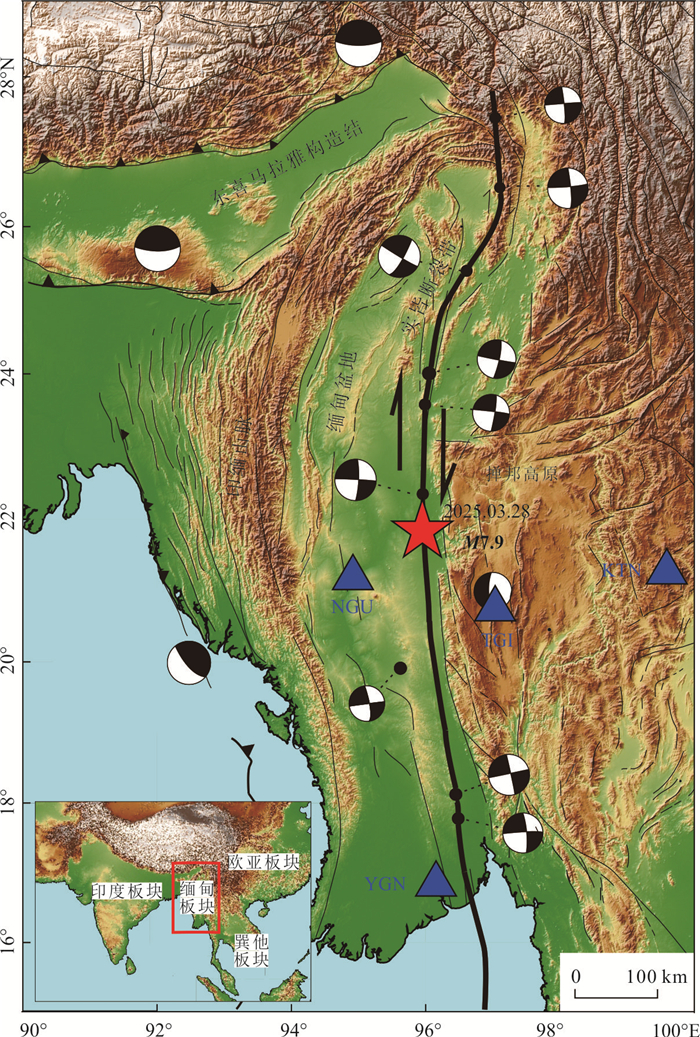
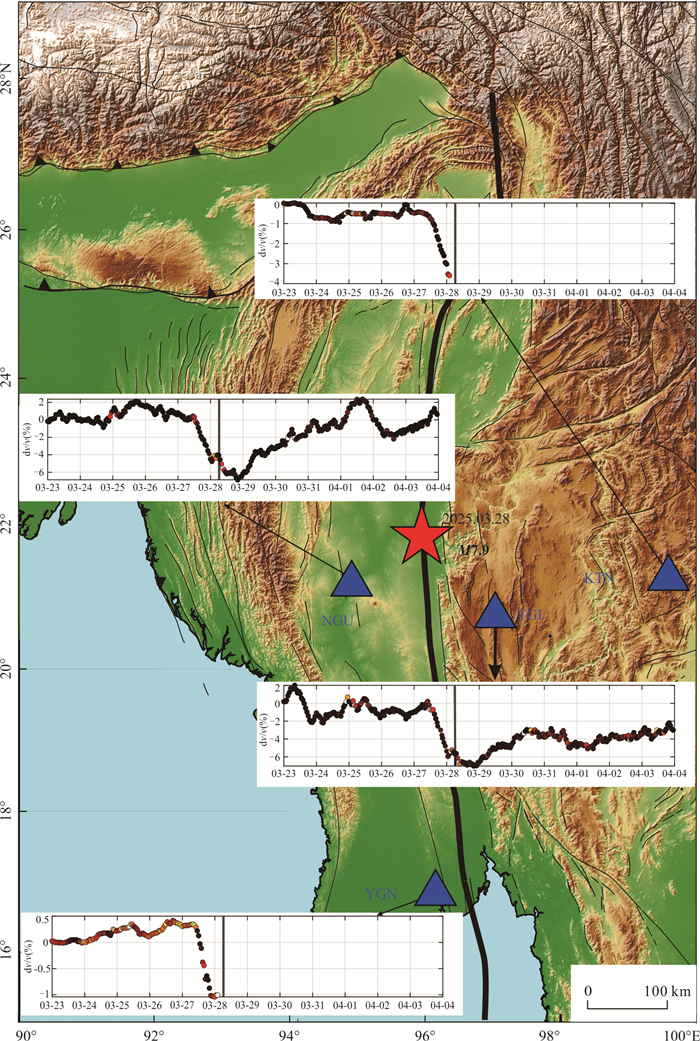
图 1 区域地质构造、台站及历史强震(M > 6.5)分布
红色五角星为2025年3月28日缅甸M7.9级地震震中位置,蓝色三角形为台站位置,震源机制结果代表历史M > 6.5级的地震(Xiong et al.,2017)
Fig. 1. Regional tectonic setting, seismic stations and historical strong earthquake (M > 6.5) in the study region
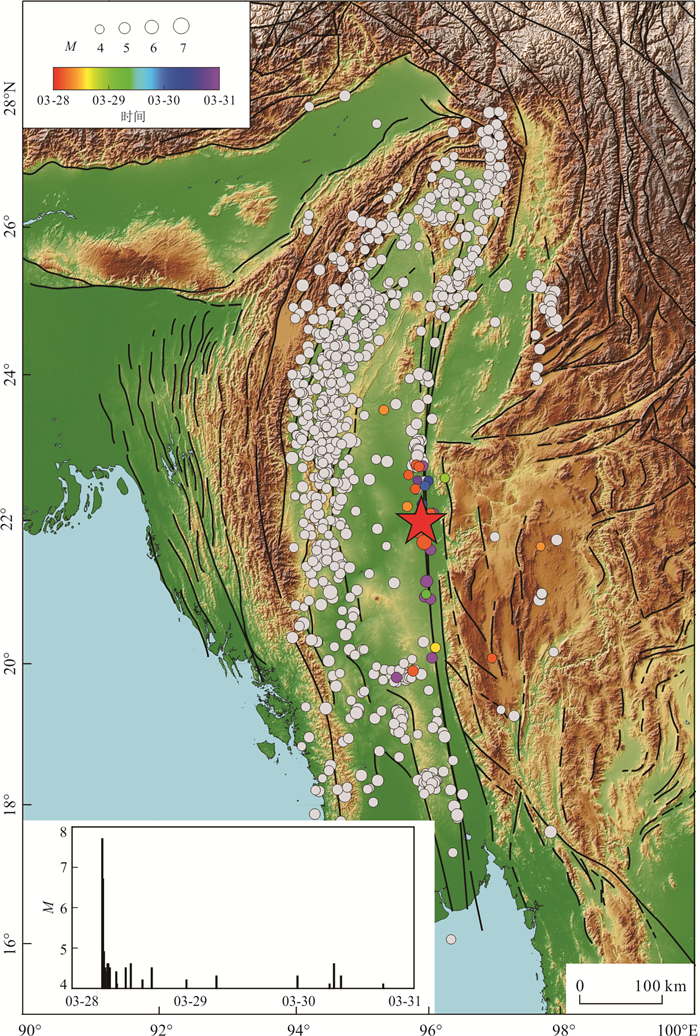
图 2 区域地震活动性
灰色圆圈为1964年-2021年的地震目录,黑色五角星为缅甸M7.9级主震,彩色圆圈为其余震,左下角附图为缅甸地震序列M-T图
Fig. 2. Regional seismic activity
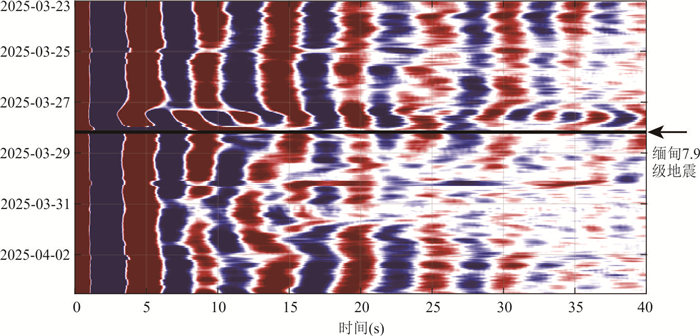
图 3 NGU台5小时叠加窗口的自相关函数(黑色实线为缅甸地震发震时刻)
Fig. 3. The autocorrelation functions with a 5-hour stacking window at station NGU (the black solid line indicates the origin time of the Myanmar earthquake)
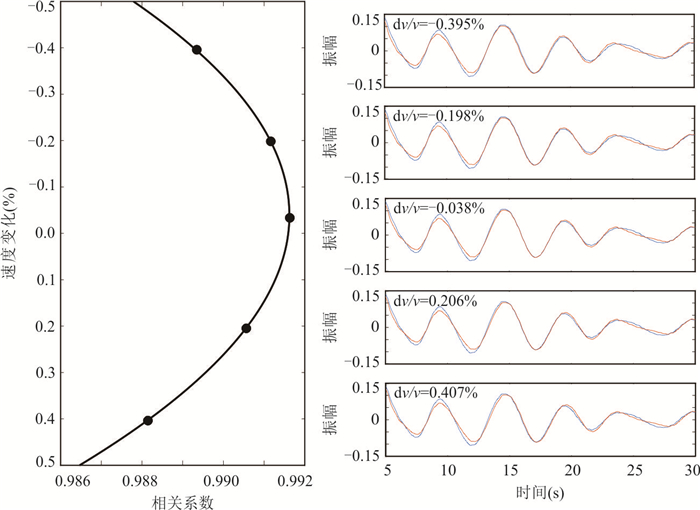
图 4 压缩拉伸法进行波速测量示例
右侧红色曲线为参考波形,蓝色曲线为不同经过不同拉伸系数处理后的波形
Fig. 4. An example of velocity measurement using compression/stretching method
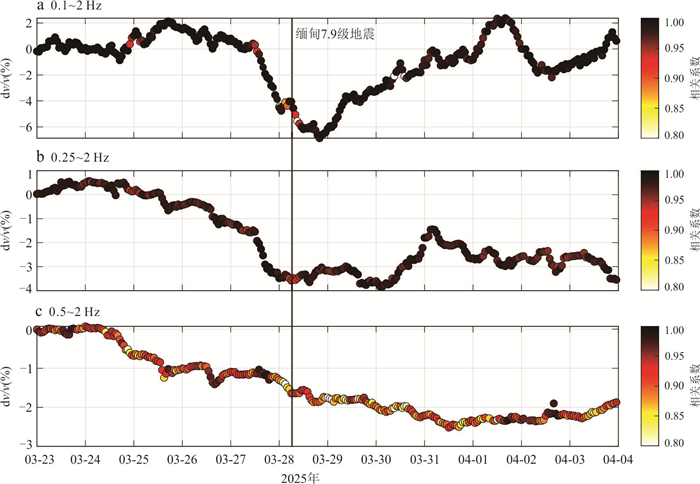
图 5 NGU台不同频率范围随时间的相对波速变化
黑色实线为缅甸地震发震时刻
Fig. 5. Temporal variations in relative velocity changes at station NGU for different frequency bands
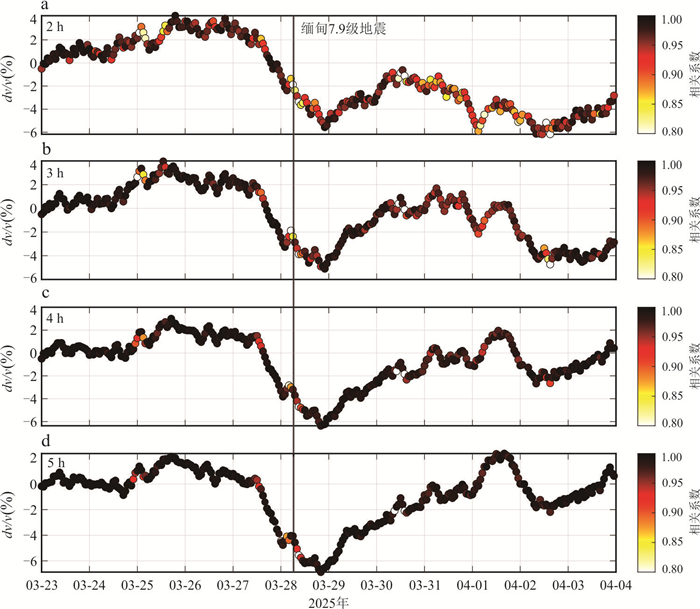
图 6 NGU台0.1~2 Hz频率范围不同滑动窗口的相对波速变化
黑色实线为缅甸地震发震时刻
Fig. 6. Relative velocity changes at NGU station with different stacking time length in a frequency band of 0.1‒2 Hz
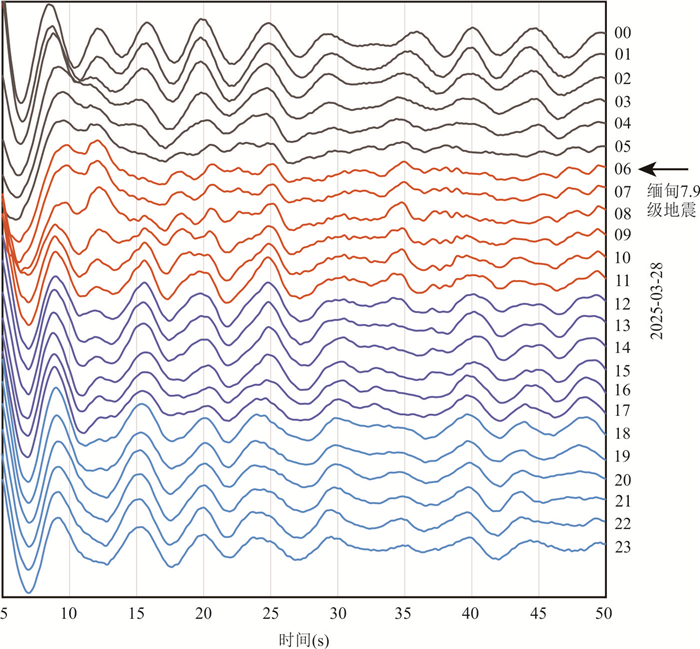
图 7 NGU台2025年3月28日自相关函数变化
Fig. 7. The autocorrelation function variations at NGU station on March 28, 2025
-
An, Y. R., Wang, W. T., Yang, W., et al., 2023. Using Ambient Noise to Study the Co-Seismic and Post-Seismic Velocity Changes of the 2021 Yangbi MS6.4 Earthquake in Yunnan. Chinese Journal of Geophysics, 66(8): 3185-3201 (in Chinese with English abstract). Bensen, G. D., Ritzwoller, M. H., Barmin, M. P., et al., 2007. Processing Seismic Ambient Noise Data to Obtain Reliable Broad-Band Surface Wave Dispersion Measurements. Geophysical Journal International, 169(3): 1239-1260. https://doi.org/10.1111/j.1365-246x.2007.03374.x Bertrand, G., Rangin, C., Maluski, H., et al., 2001. Diachronous Cooling along the Mogok Metamorphic Belt (Shan Scarp, Myanmar): The Trace of the Northward Migration of the Indian Syntaxis. Journal of Asian Earth Sciences, 19(5): 649-659. https://doi.org/10.1016/S1367-9120(00)00061-4 Brenguier, F., Campillo, M., Hadziioannou, C., et al., 2008a. Postseismic Relaxation along the San Andreas Fault at Parkfield from Continuous Seismological Observations. Science, 321(5895): 1478-1481. https://doi.org/10.1126/science.1160943 Brenguier, F., Shapiro, N. M., Campillo, M., et al., 2008b. Towards Forecasting Volcanic Eruptions Using Seismic Noise. Nature Geoscience, 1(2): 126-130. https://doi.org/10.1038/ngeo104 Delouche, E., Stehly, L., 2023. Seasonal Seismic Velocity Variations Measured Using Seismic Noise Autocorrelations to Monitor the Dynamic of Aquifers in Greece. Journal of Geophysical Research: Solid Earth, 128(12): e2023JB026759. https://doi.org/10.1029/2023jb026759 Hobiger, M., Wegler, U., Shiomi, K., et al., 2016. Coseismic and Post-Seismic Velocity Changes Detected by Passive Image Interferometry: Comparison of One Great and Five Strong Earthquakes in Japan. Geophysical Journal International, 205(2): 1053-1073. https://doi.org/10.1093/gji/ggw066 Hurukawa, N., Maung, P. M., 2011. Two Seismic Gaps on the Sagaing Fault, Myanmar, Derived from Relocation of Historical Earthquakes since 1918. Geophysical Research Letters, 38(1): L01310. https://doi.org/10.1029/2010gl046099 Kumar, A., Sanoujam, M., Sunil, L., et al., 2011. Active Deformations at the Churachandpur Mao Fault (CMF) in Indo Burma Ranges: Multidisciplinary Evidences. International Journal of Geosciences, 2(4): 597-609. https://doi.org/10.4236/ijg.2011.24062 Lei, J. S., Zhao, D. P., Su, J. R., et al., 2009. Fine Seismic Structure under the Longmenshan Fault Zone and the Mechanism of the Large Wenchuan Earthquake. Chinese Journal of Geophysics, 52(2): 339-345 (in Chinese with English abstract). Li, C., van der Hilst, R. D., Meltzer, A. S., et al., 2008. Subduction of the Indian Lithosphere beneath the Tibetan Plateau and Burma. Earth and Planetary Science Letters, 274(1-2): 157-168. https://doi.org/10.1016/j.epsl.2008.07.016 Liang, S. S., Xu, Z. G., Huang, X. N., et al., 2024. Regional Seismogenic Environment Revealed by the 3D Crustal Velocity Structure and Focal Mechanism of Moderate and Strong Earthquakes in Jiashi Area, Xinjiang, China. Earth Science, 49(2): 451-468 (in Chinese with English abstract). Liu, Z. K., Huang, J. L., 2010. Temporal Changes of Seismic Velocity around the Wenchuan Earthquake Fault Zone from Ambient Seismic Noise Correlation. Chinese Journal of Geophysics, 53(4): 853-863 (in Chinese with English abstract). Liu, Z. Q., Liang, C. T., Huang, H. X., et al., 2022. Seismic Velocity Variations at Different Depths Reveal the Dynamic Evolution Associated with the 2018 Kilauea Eruption. Geophysical Research Letters, 49(3): e2021GL093691. https://doi.org/10.1029/2021gl093691 Lyu, Z. Q., Lei, J. S., 2016.3-D S-Wave Velocity Structure around the 2015 MS8.1 Nepal Earthquake Source Areas and Strong Earthquake Mechanism. Chinese Journal of Geophysics, 59(12): 4529-4543 (in Chinese with English abstract). Makus, P., Sens-Schönfelder, C., Illien, L., et al., 2023. Deciphering the Whisper of Volcanoes: Monitoring Velocity Changes at Kamchatka's Klyuchevskoy Group with Fluctuating Noise Fields. Journal of Geophysical Research: Solid Earth, 128(4): e2022JB025738. https://doi.org/10.1029/2022jb025738 Mao, S. J., Mordret, A., Campillo, M., et al., 2020. On the Measurement of Seismic Traveltime Changes in the Time-Frequency Domain with Wavelet Cross-Spectrum Analysis. Geophysical Journal International, 221(1): 550-568. https://doi.org/10.1093/gji/ggz495 Mikesell, T. D., Malcolm, A. E., Yang, D., et al., 2015. A Comparison of Methods to Estimate Seismic Phase Delays: Numerical Examples for Coda Wave Interferometry. Geophysical Journal International, 202(1): 347-360. https://doi.org/10.1093/gji/ggv138 Maurin, T., Masson, F., Rangin, C., et al., 2010. First Global Positioning System Results in Northern Myanmar: Constant and Localized Slip Rate along the Sagaing Fault. Geology, 38(7): 591-594. https://doi.org/10.1130/g30872.1 Nimiya, H., Ikeda, T., Tsuji, T., 2017. Spatial and Temporal Seismic Velocity Changes on Kyushu Island during the 2016 Kumamoto Earthquake. Science Advances, 3(11): e1700813. https://doi.org/10.1126/sciadv.1700813 Niu, F. L., Silver, P. G., Daley, T. M., et al., 2008. Preseismic Velocity Changes Observed from Active Source Monitoring at the Parkfield SAFOD Drill Site. Nature, 454(7201): 204-208. https://doi.org/10.1038/nature07111 Ratdomopurbo, A., Poupinet, G., 1995. Monitoring a Temporal Change of Seismic Velocity in a Volcano: Application to the 1992 Eruption of Mt. Merapi (Indonesia). Geophysical Research Letters, 22(7): 775-778. https://doi.org/10.1029/95gl00302 Rubinstein, J. L., Beroza, G. C., 2004. Evidence for Widespread Nonlinear Strong Ground Motion in the MW6.9 Loma Prieta Earthquake. Bulletin of the Seismological Society of America, 94(5): 1595-1608. https://doi.org/10.1785/012004009 Sens-Schönfelder, C., Wegler, U., 2006. Passive Image Interferometry and Seasonal Variations of Seismic Velocities at Merapi Volcano, Indonesia. Geophysical Research Letters, 33: L21302. https://doi.org/10.1029/2006gl027797 Searle, M. P., Noble, S. R., Cottle, J. M., et al., 2007. Tectonic Evolution of the Mogok Metamorphic Belt, Burma (Myanmar) Constrained by U-Th-Pb Dating of Metamorphic and Magmatic Rocks. Tectonics, 26: TC3014. https://doi.org/10.1029/2006tc002083 Silver, P. G., Daley, T. M., Niu, F. L., et al., 2007. Active Source Monitoring of Cross-Well Seismic Travel Time for Stress-Induced Changes. Bulletin of the Seismological Society of America, 97(1B): 281-293. https://doi.org/10.1785/0120060120 Su, J. B., Yang, W., Li, X. B., et al., 2022. Co-Seismic Velocity Changes with Yunnan Yangbi MS6.4 Earthquake Measured by Airgun Source. Chinese Journal of Geophysics, 65(2): 649-662 (in Chinese with English abstract). Takagi, R., Okada, T., Nakahara, H., et al., 2012. Coseismic Velocity Change in and around the Focal Region of the 2008 Iwate-Miyagi Nairiku Earthquake. Journal of Geophysical Research: Solid Earth, 117(B6): B06315. https://doi.org/10.1029/2012jb009252 Vigny, C., Socquet, A., Rangin, C., et al., 2003. Present-Day Crustal Deformation around Sagaing Fault, Myanmar. Journal of Geophysical Research: Solid Earth, 108(B11): 2533. https://doi.org/10.1029/2002jb001999 Wang, Y., Sieh, K., Tun, S. T., et al., 2014. Active Tectonics and Earthquake Potential of the Myanmar Region. Journal of Geophysical Research: Solid Earth, 119(4): 3767-3822. https://doi.org/10.1002/2013jb010762 Xiao, Y., Shan, B., Liu, C. L., et al., 2024. Stress Triggering and Seismic Hazard Assessment of the 2022 Lushan MS6.1 Earthquake. Earth Science, 49(8): 2979-2991 (in Chinese with English abstract). Xiong, X., Shan, B., Zhou, Y. M., et al., 2017. Coulomb Stress Transfer and Accumulation on the Sagaing Fault, Myanmar, over the Past 110 Years and Its Implications for Seismic Hazard. Geophysical Research Letters, 44(10): 4781-4789. https://doi.org/10.1002/2017gl072770 Yan, J., Zhang, L. S., Hong, H. T., et al., 2023. Application of Ambient Noise and Dense Seismic Array Imaging Techniques in Goaf Detection beneath Coal Mines at Haerwusu. Computerized Tomography Theory and Applications, 32(4): 461-470 (in Chinese with English abstract). Zhang, H., Lei, J. S., Song, X. Y., et al., 2025. Direct Surface-Wave Tomography from Ambient Noise in the Shanxi Rift Zone and Adjacent Areas. Computerized Tomography Theory and Applications, 34(2): 175-189 (in Chinese with English abstract). 安艳茹, 王伟涛, 杨微, 等, 2023. 利用背景噪声研究2021年云南漾濞MS6.4地震同震及震后波速变化. 地球物理学报, 66(8): 3185-3201. 雷建设, 赵大鹏, 苏金蓉, 等, 2009. 龙门山断裂带地壳精细结构与汶川地震发震机理. 地球物理学报, 52(2): 339-345. 梁姗姗, 徐志国, 黄小宁, 等, 2024. 新疆伽师地区地壳三维速度结构及中强震震源机制揭示的区域孕震环境. 地球科学, 49(2): 451-468. doi: 10.3799/dqkx.2023.165 刘志坤, 黄金莉, 2010. 利用背景噪声互相关研究汶川地震震源区地震波速度变化. 地球物理学报, 53(4): 853-863. 吕子强, 雷建设, 2016.2015年尼泊尔MS8.1地震震源区S波三维速度结构与强震发生机理研究. 地球物理学报, 59(12): 4529-4543. 苏金波, 杨微, 李孝宾, 等, 2022. 基于气枪震源信号的云南漾濞MS6.4地震前后波速变化. 地球物理学报, 65(2): 649-662. 肖阳, 单斌, 刘成利, 等, 2024.2022年芦山MS6.1地震应力触发及地震危险性分析. 地球科学, 49(8): 2979-2991. doi: 10.3799/dqkx.2023.053 颜杰, 张立树, 洪鹤庭, 等, 2023. 背景噪声和密集台阵成像技术在哈尔乌素露天煤矿采空区的应用. CT理论与应用研究(中英文), 32(4): 461-470. 张浩, 雷建设, 宋晓燕, 等, 2025. 山西断陷带及其邻区背景噪声面波直接反演成像. CT理论与应用研究(中英文), 34(2): 175-189. -

 下载:
下载:
 点击查看大图
计量
- 文章访问数: 135
- HTML全文浏览量: 9
- PDF下载量: 8
- 被引次数: 0
