




Synergistic Effects of Cyanobacteria and Montmorillonite on Formation of Low-Temperature Protodolomite
-
摘要: 白云石[CaMg(CO3)2]的成因机制是地球科学领域长期关注的重要问题.尽管已有研究表明特定微生物功能群和黏土矿物能够分别催化原白云石(有序白云石的关键前驱体)的形成,然而对于蓝细菌这一古老且广泛分布的光合微生物的催化作用,特别是其与黏土矿物的协同效应机制,目前仍缺乏深入认识.研究以耐盐蓝细菌Synechococcus elongatus FACHB⁃410为研究对象,通过对比有无蒙脱石的矿化实验体系,探究了黏土矿物与蓝细菌对碳酸盐矿物沉淀的协同调控作用.实验结果表明,在蓝细菌—蒙脱石共存体系中,X⁃射线衍射(X⁃ray diffraction,XRD)和拉曼光谱证实主要形成原白云石,而不含蒙脱石的体系则生成单水方解石和低镁方解石.通过扫描电镜(scanning electron microscopy,SEM)、聚焦离子束显微镜(focused ion beam microscopy,FIB⁃SEM)和透射电镜(transmission electron microscopy,TEM)等表征技术,发现原白云石以纳米晶粒形式组装并分布于蒙脱石表面.基于密度泛函理论(density functional theory,DFT)的计算模拟进一步表明,蒙脱石促进蓝细菌介导原白云石形成的关键机制在于其表面负电性,即通过强静电作用吸附水合镁离子,有利于其去水合化反应的发生,从而显著降低原白云石的成核能垒.Abstract: The formation mechanism of dolomite [CaMg(CO3)2] remains a longstanding enigma in earth sciences. Previous studies have identified certain microorganisms and clay minerals as catalysts in the crystallization of low-temperature protodolomite, a crucial precursor to ordered dolomite. However, the role of cyanobacteria and particularly their potential synergistic effects with clay minerals remain poorly understood. In this study, we investigated bioprecipitation of carbonate minerals using the halotolerant cyanobacterium Synechococcus elongatus FACHB-410 in the presence and absence of montmorillonite. Our results demonstrated that protodolomite occurred as the predominant solid product in the montmorillonite-amended biosystems as confirmed by X-ray diffraction (XRD) and Raman spectroscopy, whereas monohydrocalcite and low-magnesian calcite were the primary products in the montmorillonite-free biosystems. Multiple microscopic techniques, including scanning electron microscopy (SEM), focused ion beam microscopy (FIB-SEM), and transmission electron microscopy (TEM), revealed that protodolomite nucleated as nanocrystals preferentially on montmorillonite surfaces. Density functional theory (DFT) simulations further elucidated that surface electronegativity of montmorillonite played a key role in promoting protodolomite formation by strongly adsorbing Mg2+ ions through electrostatic interactions, thereby facilitating their dehydration and significantly lowering the nucleation energy barrier.
-
Key words:
- dolomite problem /
- clay minerals /
- protodolomite /
- cyanobacteria /
- microbial mineralization
-

图 1 有无蒙脱石条件下蓝细菌矿化产物的XRD图谱
a.全谱图;b.28°~33° 2θ局部放大
Fig. 1. XRD patterns of precipitates from the bioreactors with and without montmorillonite
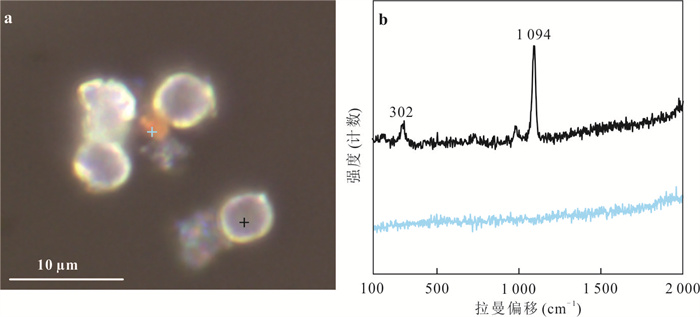
图 2 蒙脱石存在条件下蓝细菌矿化产物形貌(a)及拉曼图谱(b)
Fig. 2. Light microscopic photograph (a) and raman spectra (b) of precipitates from the bioreactors with montmorillonite
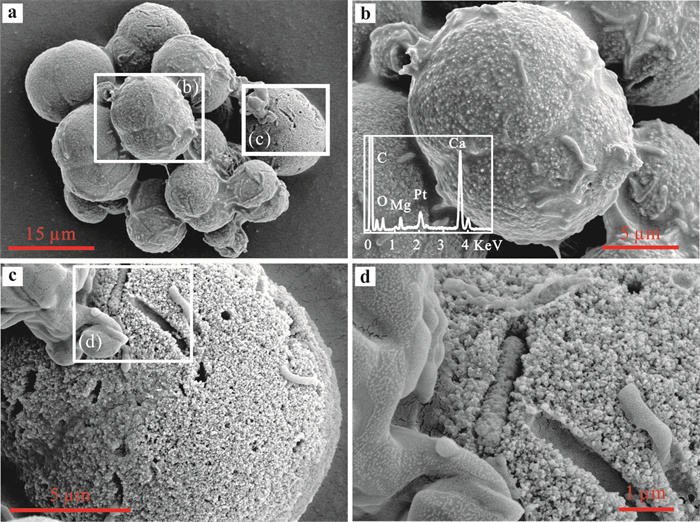
图 3 未添加蒙脱石的体系中蓝细菌矿化产物的SEM图像
Fig. 3. SEM images of precipitates from bioreactors without montmorillonite
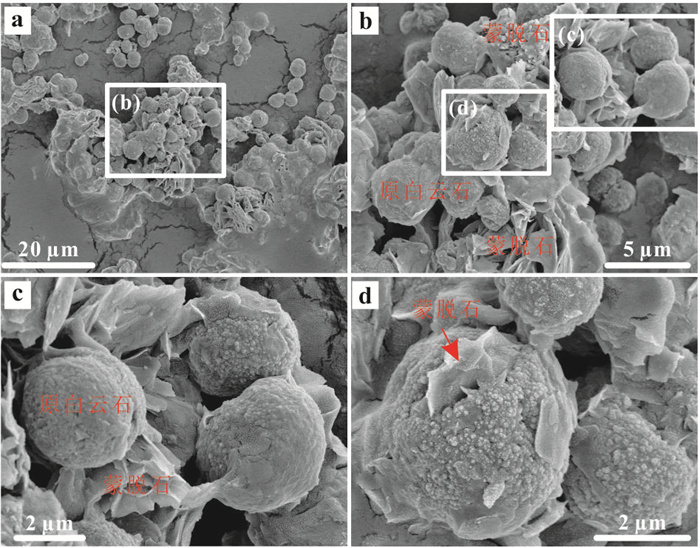
图 4 蒙脱石存在条件下蓝细菌矿化体系产物的SEM图像
Fig. 4. SEM images of precipitates from bioreactors with montmorillonite
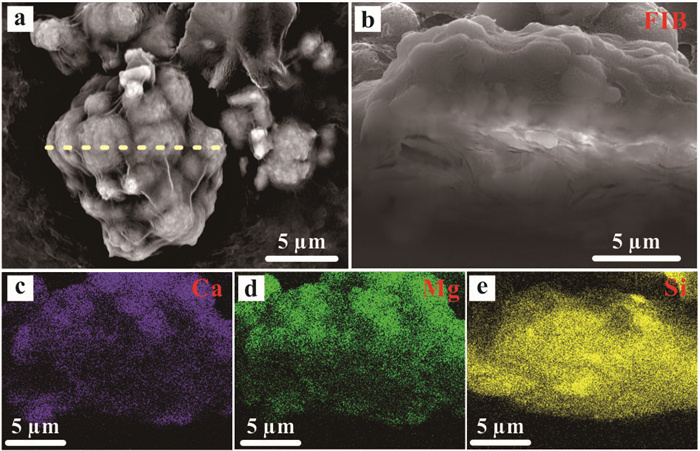
图 5 蒙脱石条件下蓝细菌矿化反应体系产物的FIB⁃SEM-EDS图谱
a.蒙脱石-原白云石聚集体,其中虚线显示切割位置;b~e.蒙脱石-原白云石聚集体切割面及Ca、Mg、Si元素分布
Fig. 5. FIB⁃SEM and EDS images of precipitates from bioreactors with montmorillonite
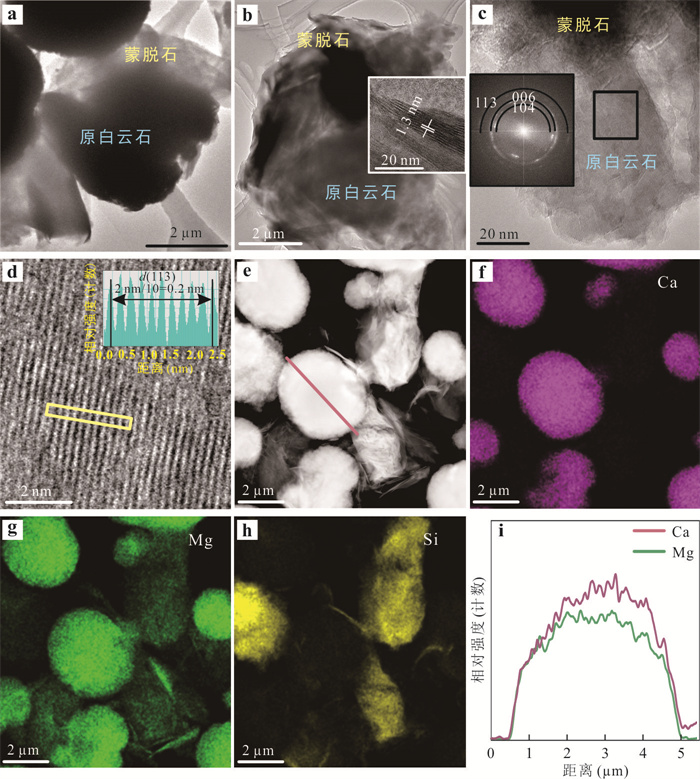
图 6 黏土矿物存在条件下反应体系最终产物的TEM分析
a~c.蒙脱石-原白云石聚集体,其中b和c的插图分别显示了蒙脱石的高分辨晶格条纹以及原白云石的电子衍射谱;d.原白云石(113)晶面的高分辨晶格条纹;e~h.蒙脱石-原白云石聚集体的元素分布图,其中f、g和h分别对应Ca、Mg和Si的元素分布;i沿e中实线扫描路径获得的原白云石颗粒中Ca和Mg元素的EDS线扫描分布
Fig. 6. TEM images of precipitates from reactors with clay minerals
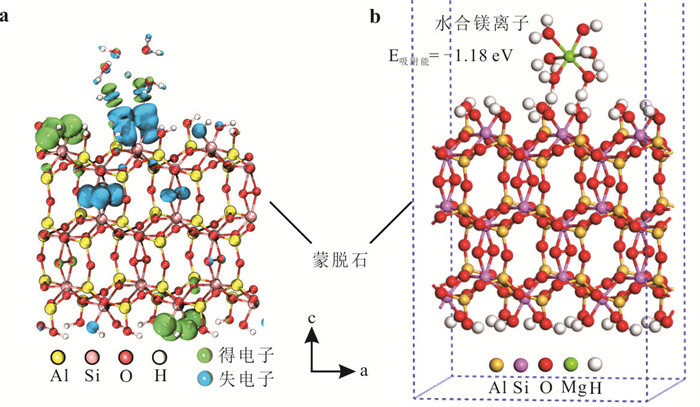
图 7 DFT模拟蒙脱石水合镁离子的吸附过程
a.蒙脱石表面差分电荷图;b.羟基位点与水合镁离子的配位构型
Fig. 7. DFT simulation showing the adsorption process of Mg(H2O)62+ on the montmorillonite (010) surface
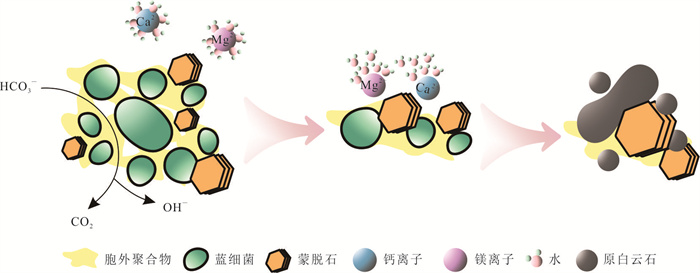
图 8 蓝细菌-蒙脱石协同介导原白云石形成过程的示意
Fig. 8. Schematic illustration of protodolomite formation mediated synergistically by cyanobacteria and montmorillonite
表 1 有无蒙脱石矿物条件下反应体系的水化学参数变化
Table 1. Wet chemistry parameter changes in the biomineralization systems with and without montmorillonite
实验体系 开始培养 结束培养(30 d) pH值 Ca2+ (mmol/L) Mg2+ (mmol/L) pH值 Ca2+ (mmol/L) Mg2+ (mmol/L) 蓝细菌 7.20±0.01 10.05±0.03 80.87±0.21 9.58±0.11 1.35±0.09 78.86±0.43 蓝细菌+蒙脱石 7.21±0.02 10.03±0.06 78.96±0.18 9.27±0.06 1.74±0.13 71.05±0.25  下载: 导出CSV
-
Badger, M. R., Hanson, D., Price, G. D., 2002. Evolution and Diversity of CO2 Concentrating Mechanisms in Cyanobacteria. Functional Plant Biology, 29(3): 161-173. https://doi.org/10.1071/PP01213 Bischoff, W. D., Bishop, F. C., Mackenzie, F. T., 1983. Biogenically Produced Magnesian Calcite; Inhomogeneities in Chemical and Physical Properties; Comparison with Synthetic Phases. American Mineralogist, 68(11-12): 1183-1188. Bontognali, T. R. R., McKenzie, J. A., Warthmann, R. J., et al., 2014. Microbially Influenced Formation of Mg⁃Calcite and Ca⁃Dolomite in the Presence of Exopolymeric Substances Produced by Sulphate⁃Reducing Bacteria. Terra Nova, 26(1): 72-77. https://doi.org/10.1111/ter.12072 Bontognali, T. R. R., Vasconcelos, C., Warthmann, R. J., et al., 2010. Dolomite Formation within Microbial Mats in the Coastal Sabkha of Abu Dhabi (United Arab Emirates). Sedimentology, 57(3): 824-844. https://doi.org/10.1111/j.1365⁃3091.2009.01121.x Brauchli, M., McKenzie, J. A., Strohmenger, C. J., et al., 2016. The Importance of Microbial Mats for Dolomite Formation in the Dohat Faishakh Sabkha, Qatar. Carbonates and Evaporites, 31(3): 339-345. https://doi.org/10.1007/s13146⁃015⁃0275⁃0 Chen, T., Qiu, X., Liu, D., et al., 2024. Dissolved Silicon as a Beneficial Factor for Biomineralization of Disordered Dolomite by a Halophilic Cyanobacterium. Chemical Geology, 670: 122435. https://doi.org/10.1016/j.chemgeo.2024.122435 Deng, S. C., Dong, H. L., Lyu, G., et al., 2010. Microbial Dolomite Precipitation Using Sulfate Reducing and Halophilic Bacteria: Results from Qinghai Lake, Tibetan Plateau, NW China. Chemical Geology, 278(3-4): 151-159. https://doi.org/10.1016/j.chemgeo.2010.09.008 Dong, H., Jaisi, D. P., Kim, J., et al., 2009. Microbe⁃Clay Mineral Interactions. American Mineralogist, 94(11-12): 1505-1519. https://doi.org/10.2138/am.2009.3246 Dong, H. L., Zeng, Q., Liu, D., et al., 2024. Interactions between Clay Minerals and Microbes: Mechanisms and Applications in Environmental Remediation. Earth Science Frontiers, 31(1): 467-485(in Chinese with English abstract). Duan, Y., Yao, Y. C., Qiu, X., et al., 2017. Dolomite Formation Facilitated by Three Halophilic Archaea. Earth Science, 42(3): 389-396(in Chinese with English abstract). Fan, Q. G., Liu, D., Papineau, D., et al., 2023. Precipitation of High Mg⁃Calcite and Protodolomite Using Dead Biomass of Aerobic Halophilic Bacteria. Journal of Earth Science, 34(2): 456-466. https://doi.org/10.1007/s12583⁃020⁃1108⁃1 Fang, Y. H., Hobbs, F., Yang, Y. P., et al., 2023. Dissolved Silica⁃Driven Dolomite Precipitation in the Great Salt Lake, Utah, and Its Implication for Dolomite Formation Environments. Sedimentology, 70(4): 1328-1347. https://doi.org/10.1111/sed.13081. Görgen, S., Benzerara, K., Skouri⁃Panet, F., et al., 2020. The Diversity of Molecular Mechanisms of Carbonate Biomineralization by Bacteria. Discover Materials, 1(1): 2. https://doi.org/10.1007/s43939⁃020⁃00001⁃9 Gregg, J. M., Bish, D. L., Kaczmarek, S. E., et al., 2015. Mineralogy, Nucleation and Growth of Dolomite in the Laboratory and Sedimentary Environment: a Review. Sedimentology, 62(6): 1749-1769. https://doi.org/10.1111/sed.12202 Gunasekaran, S., Anbalagan, G., Pandi, S., 2006. Raman and Infrared Spectra of Carbonates of Calcite Structure. Journal of Raman Spectroscopy, 37(9): 892-899. https://doi.org/10.1002/jrs.1518 Huang, Y. R., Yao, Q. Z., Li, H., et al., 2019. Aerobically Incubated Bacterial Biomass⁃Promoted Formation of Disordered Dolomite and Implication for Dolomite Formation. Chemical Geology, 523: 19-30. https://doi.org/10.1016/j.chemgeo.2019.06.006 Kamennaya, N. A., Ajo⁃Franklin, C. M., Northen, T., et al., 2012. Cyanobacteria as Biocatalysts for Carbonate Mineralization. Minerals, 2(4): 338-364. https://doi.org/10.3390/min2040338 Kenward, P. A., Fowle, D. A., Goldstein, R. H., et al., 2013. Ordered Low⁃Temperature Dolomite Mediated by Carboxyl⁃Group Density of Microbial Cell Walls. AAPG Bulletin, 97(11): 2113-2125. https://doi.org/10.1306/05171312168 Kim, J., Kimura, Y., Puchala, B., et al., 2023. Dissolution Enables Dolomite Crystal Growth near Ambient Conditions. Science, 382(6673): 915-920. https://doi.org/10.1126/science.adi3690 Krause, S., Liebetrau, V., Gorb, S., et al., 2012. Microbial Nucleation of Mg⁃Rich Dolomite in Exopolymeric Substances under Anoxic Modern Seawater Salinity: New Insight into an Old Enigma. Geology, 40(7): 587-590. https://doi.org/10.1130/g32923.1 Land, L. S., 1998. Failure to Precipitate Dolomite at 25 ℃ from Dilute Solution Despite 1 000⁃Fold Oversaturation after 32 Years. Aquatic Geochemistry, 4(3): 361-368. https://doi.org/10.1023/A:1009688315854 Li, B., Yan, J. X., Liu, X. T., et al., 2010. The Organogenic Dolomite Model: Mechanism, Progress and Significance. Journal of Palaeogeography, 12(6): 699-710(in Chinese with English abstract). Lippmann, F., 1973. Sedimentary Carbonate Minerals. Springer-Verlag Berlin, Heidelberg. https://doi.org/10.1007/978⁃3⁃642⁃65474⁃9 Liu, D., Fan, Q. G., Papineau, D., et al., 2020a. Precipitation of Protodolomite Facilitated by Sulfate⁃Reducing Bacteria: The Role of Capsule Extracellular Polymeric Substances. Chemical Geology, 533: 119415. https://doi.org/10.1016/j.chemgeo.2019.119415. Liu, D., Xu, Y. Y., Yu, Q. Q., et al., 2020b. Catalytic Effect of Microbially⁃Derived Carboxylic Acids on the Precipitation of Mg⁃Calcite and Disordered Dolomite: Implications for Sedimentary Dolomite Formation. Journal of Asian Earth Sciences, 193: 104301. https://doi.org/10.1016/j.jseaes.2020.104301 Liu, D., Yu, N., Papineau, D., et al., 2019a. The Catalytic Role of Planktonic Aerobic Heterotrophic Bacteria in Protodolomite Formation: Results from Lake Jibuhulangtu Nuur, Inner Mongolia, China. Geochimica et Cosmochimica Acta, 263: 31-49. https://doi.org/10.1016/j.gca.2019.07.056 Liu, D., Xu, Y. Y., Papineau, D., et al., 2019b. Experimental Evidence for Abiotic Formation of Low⁃Temperature Proto⁃Dolomite Facilitated by Clay Minerals. Geochimica et Cosmochimica Acta, 247: 83-95. https://doi.org/10.1016/j.gca.2018.12.036. McKenzie, J. A., Vasconcelos, C., 2009. Dolomite Mountains and the Origin of the Dolomite Rock of which they Mainly Consist: Historical Developments and New Perspectives. Sedimentology, 56(1): 205-219. https://doi.org/10.1111/j.1365⁃3091.2008.01027.x Meister, P., Reyes, C., Beaumont, W., et al., 2011. Calcium and Magnesium⁃Limited Dolomite Precipitation at Deep Springs Lake, California. Sedimentology, 58(7): 1810-1830. https://doi.org/10.1111/j.1365⁃3091.2011.01240.x Meng, R. R., Han, Z. Z., Gao, X., et al., 2024. Dissolved Ammonia Catalyzes Proto⁃Dolomite Precipitation at Earth Surface Temperature. Earth and Planetary Science Letters, 646: 119012. https://doi.org/10.1016/j.epsl.2024.119012 Netto, P. R. A., Pozo, M., da Silva, M. D., et al., 2022. Paleoenvironmental Implications of Authigenic Magnesian Clay Formation Sequences in the Barra Velha Formation (Santos Basin, Brazil). Minerals, 12(2): 200. https://doi.org/10.3390/min12020200 Obst, M., Dittrich, M., Kuehn, H., 2006. Calcium Adsorption and Changes of the Surface Microtopography of Cyanobacteria Studied by AFM, CFM, and TEM with Respect to Biogenic Calcite Nucleation. Geochemistry, Geophysics, Geosystems, 7(6): 2005GC001172. https://doi.org/10.1029/2005GC001172 Pérez, A. M., Zarza, A. M. A., La Iglesia, Á., et al., 2015. Do Magnesian Clays Play a Role in Dolomite Formation in Alkaline Environments? An Example from Castañar Cave, Cáceres (Spain). Geogaceta, 57: 15⁃18. Perri, E., Tucker, M., 2007. Bacterial Fossils and Microbial Dolomite in Triassic Stromatolites. Geology, 35(3): 207. https://doi.org/10.1130/g23354a.1 Perri, E., Tucker, M. E., Mawson, M., 2013. Biotic and Abiotic Processes in the Formation and Diagenesis of Permian Dolomitic Stromatolites (Zechstein Group, NE England). Journal of Sedimentary Research, 83(10): 896-914. https://doi.org/10.2110/jsr.2013.65 Petrash, D. A., Bialik, O. M., Bontognali, T. R. R., et al., 2017. Microbially Catalyzed Dolomite Formation: From Near⁃Surface to Burial. Earth⁃Science Reviews, 171: 558-582. https://doi.org/10.1016/j.earscirev.2017.06.015 Qiu, X., Wang, H. M., Liu, D., et al., 2012. The Physiological Response of Synechococcus Elongatus to Salinity: A Potential Biomarker for Ancient Salinity in Evaporative Environments. Geomicrobiology Journal, 29(5): 477-483. https://doi.org/10.1080/01490451.2011.581331 Qiu, X., Wang, H. M., Yao, Y. C., et al., 2017. High Salinity Facilitates Dolomite Precipitation Mediated by Haloferax volcanii DS52. Earth and Planetary Science Letters, 472: 197-205. https://doi.org/10.1016/j.epsl.2017.05.018 Qiu, X., Yao, Y. C., Wang, H. M., et al., 2018. Live Microbial Cells Adsorb Mg2+ More Effectively than Lifeless Organic Matter. Frontiers of Earth Science, 12(1): 160-169. https://doi.org/10.1007/s11707⁃017⁃0626⁃3 Riding, R., 2006. Cyanobacterial Calcification, Carbon Dioxide Concentrating Mechanisms, and Proterozoic-Cambrian Changes in Atmospheric Composition. Geobiology, 4(4): 299-316. https://doi.org/10.1111/j.1472⁃4669.2006.00087.x Ritz, M., Vaculíková, L., Kupková, J., et al., 2016. Different Level of Fluorescence in Raman Spectra of Montmorillonites. Vibrational Spectroscopy, 84: 7-15. https://doi.org/10.1016/j.vibspec.2016.02.007 Roberts, J. A., Bennett, P. C., González, L. A., et al., 2004. Microbial Precipitation of Dolomite in Methanogenic Groundwater. Geology, 32(4): 277. https://doi.org/10.1130/g20246.2 Rodriguez⁃Blanco, J. D., Shaw, S., Benning, L. G., 2015. A Route for the Direct Crystallization of Dolomite. American Mineralogist, 100(5-6): 1172-1181. https://doi.org/10.2138/am⁃2015⁃4963 Sánchez⁃Román, M., Romanek, C. S., Fernández⁃Remolar, D. C., et al., 2011. Aerobic Biomineralization of Mg⁃Rich Carbonates: Implications for Natural Environments. Chemical Geology, 281(3-4): 143-150. https://doi.org/10.1016/j.chemgeo.2010.11.020 Sánchez⁃Román, M., Vasconcelos, C., Schmid, T., et al., 2008. Aerobic Microbial Dolomite at the Nanometer Scale: Implications for the Geologic Record. Geology, 36(11): 879. https://doi.org/10.1130/g25013a.1 Sun, J. M., Wu, Z. G., Cheng, H. F., et al., 2014. A Raman Spectroscopic Comparison of Calcite and Dolomite. Spectrochimica Acta Part A: Molecular and Biomolecular Spectroscopy, 117: 158-162. https://doi.org/10.1016/j.saa.2013.08.014 Vasconcelos, C., McKenzie, J. A., Bernasconi, S., et al., 1995. Microbial Mediation as a Possible Mechanism for Natural Dolomite Formation at Low Temperatures. Nature, 377: 220-222. https://doi.org/10.1038/377220a0 Wanas, H. A., Sallam, E., 2016. Abiotically⁃Formed, Primary Dolomite in the Mid⁃Eocene Lacustrine Succession at Gebel El⁃Goza El⁃Hamra, NE Egypt: An Approach to the Role of Smectitic Clays. Sedimentary Geology, 343: 132-140. https://doi.org/10.1016/j.sedgeo.2016.08.003 Wang, X., Kong, X. X., Liu, Q., et al., 2023. Effect of Clay Minerals on Carbonate Precipitation Induced by Cyanobacterium Synechococcus Sp. Microbiology Spectrum, 11(3). https://doi.org/10.1128/spectrum.00363⁃23 Warren, J., 2000. Dolomite: Occurrence, Evolution and Economically Important Associations. Earth⁃Science Reviews, 52(1-3): 1-81. https://doi.org/10.1016/s0012⁃8252(00)00022⁃2 Xie, S. C., Yin, H. F., Liu, D., et al., 2018. On Development from Paleontology to Geobiology: Overview of Innovation and Expansion of Application Fields. Earth Science, 43(11): 3823-3836 (in Chinese with English abstract). Xu, Y. Y., Liu, D., Yu, N., et al., 2018. Advance and Review on Microbial/Organogenic Dolomite Model. Earth Science, 43(Suppl. 1): 63-70 (in Chinese with English abstract). Yao, T. T., Zhu, H. T., Yang, X. H., et al., 2020. Dolomite Origin of Shahejie Formation in Huanghekou Sag, Bohai Bay Basin. Earth Science, 45(10): 3567-3578 (in Chinese with English abstract). Yao, Y. C., Qiu, X., Wang, H. M., et al., 2018. Dolomite Formation Mediated by Halophilic Archaeal Cells under Different Conditions and Carboxylated Microspheres. Earth Science, 43(2): 449-458 (in Chinese with English abstract). You, X. L., Jia, W. Q., Xu, F., et al., 2018. Mineralogical Characteristics of Ankerite and Mechanisms of Primary and Secondary Origins. Earth Science, 43(11): 4046-4055 (in Chinese with English abstract). You, X. L., Sun, S., Zhu, J. Q., et al., 2011. Progress in the Study of Microbial Dolomite Model. Earth Science Frontiers, 18(4): 52-64 (in Chinese with English abstract). You, X. L., Sun, S., Zhu, J. Q., et al., 2013. Microbially Mediated Dolomite in Cambrian Stromatolites from the Tarim Basin, North⁃West China: Implications for the Role of Organic Substrate on Dolomite Precipitation. Terra Nova, 25(5): 387-395. https://doi.org/10.1111/ter.12048 Yu, N., Xu, Y. Y., Liu, D., et al., 2018. Catalytic Role of Anaerobic Bacteria in Dolomite Formation in Lake Jibuhulangtu Nuur, Inner Mongolia. Earth Science, 43(Suppl. 1): 53-62(in Chinese with English abstract). Zhang, F. F., Xu, H. F., Konishi, H., et al., 2012. Dissolved Sulfide⁃Catalyzed Precipitation of Disordered Dolomite: Implications for the Formation Mechanism of Sedimentary Dolomite. Geochimica et Cosmochimica Acta, 97: 148-165. https://doi.org/10.1016/j.gca.2012.09.008 Zhang, F., Xu, H., Shelobolina, E. S., et al., 2015. The Catalytic Effect of Bound Extracellular Polymeric Substances Excreted by Anaerobic Microorganisms on Ca⁃Mg Carbonate Precipitation: Implications for the "Dolomite Problem". American Mineralogist, 100(2/3): 483-494. https://doi.org/10.2138/am⁃2015⁃4999 Zhao, S. B., Liu, Y. C., Yue, L. L., et al., 2025. Types, Characteristics, and Genesis of Lower Carboniferous Baizuo Formation Dolomite in Super⁃Large Huize Pb⁃Zn Orefield. Earth Science, 50(4): 1353-1379 (in Chinese with English abstract). Zhao, Y. Y., Wei, X. Y., Gao, X., et al., 2024. Proto⁃Dolomite Spherulites with Heterogeneous Interior Precipitated in Brackish Water Cultivation of Freshwater Cyanobacterium Leptolyngbya boryana. Science of the Total Environment, 906: 167552. https://doi.org/10.1016/j.scitotenv.2023.167552 Zheng, W. L., Liu, D., Yang, S. S., et al., 2021. Transformation of Protodolomite to Dolomite Proceeds under Dry⁃Heating Conditions. Earth and Planetary Science Letters, 576: 117249. https://doi.org/10.1016/j.epsl.2021.117249 董海良, 曾强, 刘邓, 等, 2024. 黏土矿物-微生物相互作用机理以及在环境领域中的应用. 地学前缘, 31(1): 467-485. 段勇, 药彦辰, 邱轩, 等, 2017. 三株嗜盐古菌诱导形成白云石. 地球科学, 42(3): 389-396. 李波, 颜佳新, 刘喜停, 等, 2010. 白云岩有机成因模式: 机制、进展与意义. 古地理学报, 12(6): 699-710. 谢树成, 殷鸿福, 刘邓, 等, 2018. 再谈古生物学向地球生物学的发展: 服务领域的拓展与创新. 地球科学, 43(11): 3823-3836. doi: 10.3799/dqkx.2018.169 许杨阳, 刘邓, 于娜, 等, 2018. 微生物(有机)白云石成因模式研究进展与思考. 地球科学, 43(增刊1): 63-70. doi: 10.3799/dqkx.2018.513 姚婷婷, 朱红涛, 杨香华, 等, 2020. 渤海湾盆地黄河口凹陷沙河街组白云岩成因机理. 地球科学, 45(10): 3567-3578. doi: 10.3799/dqkx.2020.227 药彦辰, 邱轩, 王红梅, 等, 2018. 不同状态嗜盐古菌细胞及羧基微球诱导白云石沉淀. 地球科学, 43(2): 449-458. doi: 10.3799/dqkx.2017.579 由雪莲, 孙枢, 朱井泉, 等, 2011. 微生物白云岩模式研究进展. 地学前缘, 18(4): 52-64. doi: 10.3799/dqkx.2018.513 由雪莲, 贾文强, 徐帆, 等, 2018. 铁白云石矿物学特征及原生次生成因机制. 地球科学, 43(11): 4046-4055. doi: 10.3799/dqkx.2018.152 于娜, 许杨阳, 刘邓, 等, 2018. 内蒙古吉布胡郎图诺尔盐湖厌氧菌对白云石形成的催化作用. 地球科学,43(增刊 1): 53-62. doi: 10.3799/dqkx.2018.543 赵思博, 刘英超, 岳龙龙, 等, 2025. 会泽铅锌矿区摆佐组地层白云石类型、特征及成因. 地球科学, 50(4): 1353-1379. doi: 10.3799/dqkx.2024.076 -

 点击查看大图
计量
- 文章访问数: 111
- HTML全文浏览量: 10
- PDF下载量: 6
- 被引次数: 0
