




2017 ML4.9/MS4.4 Muli, Sichuan, Earthquake Sequence: A High-Precision Seismic Catalog Reconstruction
-
摘要: 为了认识四川木里2017年ML4.9/MS4.4级地震序列活动特征,基于轻量化人工智能方法、模板匹配技术及地震定位方法,构建了从原始连续地震波形数据到地震震相检测、地震事件识别、地震定位的全流程框架,对四川木里ML4.9/MS4.4级地震震源区周边60 km内2017年9月1日至9月30日期间28个台站记录的原始连续地震波形数据进行了处理,重建了包括前震、主震及余震序列9 252次事件的高分辨率地震目录,结合43次ML≥2.5级地震震源机制解对本次地震序列进行了分析,高精度地震目录反映出了更符合震级‒频度关系分布的规律,并清晰地揭示了地震时空演化特征.本次地震序列发生在锦屏山断裂所围限的NW-SE向复杂走滑型断层系统内部,地震序列自主震向NW和SE双向扩展,初步推测其成因为余滑作用驱动.Abstract: To investigate the characteristics of the 2017 ML4.9/MS4.4 earthquake sequence in Muli, Sichuan, an end-to-end framework, involving raw continuous seismic waveform data processing to seismic phase detection, earthquake event identification, and earthquake location, was constructed based on lightweight artificial intelligence methods, template matching techniques, and earthquake location methods. This system was used to process raw waveform data from 28 stations within a 60 km radius of the epicentral area between September 1 and 30, 2017, reconstructing a high-resolution seismic catalog containing 9 252 foreshocks, mainshocks, and aftershocks. Based on focal mechanism solutions of 43 ML≥2.5 earthquakes, it conducted a comprehensive analysis of the seismicity patterns.The refined catalog exhibits enhanced consistency with Gutenberg-Richter magnitude-frequency statistics and clearly delineates spatiotemporal evolutionary features.The seismic sequence occurred within a complex NW-SE trending strike-slip fault system bounded by the Jinpingshan Fault, with the bilateral expansion of events from the mainshock toward the NW and SE, and it was preliminarily attributed to driving by afterslip.
-
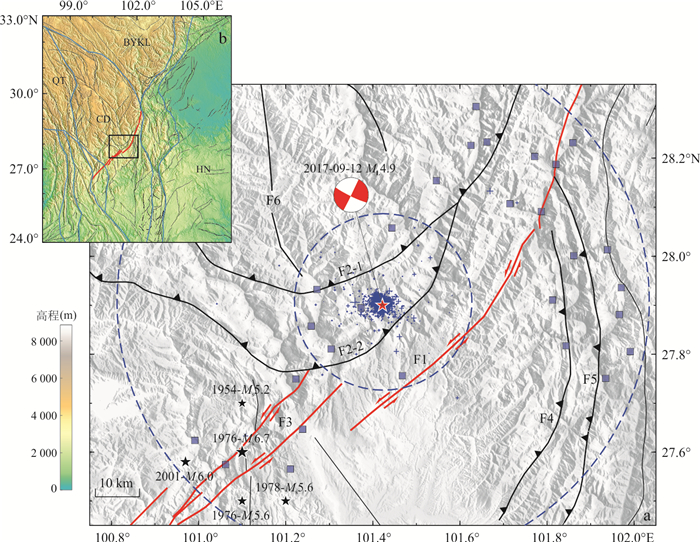
图 1 木里地震震源区构造分布图
a. 实线代表断层(Wu et al.,2024),红色F1、F3. 丽江‒小金河断裂带;黑色F2-1、F2-2. 锦屏山断裂;黑色F4. 盐源断裂;黑色F5. 金河‒箐河断裂;黑色F6. 理塘断裂;红色五角星代表木里地震震中,红色沙滩球代表震源机制解,蓝色十字代表人工拾取余震震中,黑色五角星代表震源区沿着丽江‒小金河断裂震级在MS≥5.0地震事件,蓝色方块代表震源区周边60 km台站分布,蓝色的虚线分别代表距木里地震震中20 km、60 km等值线.b. 黑色方框代表研究区域,红色线条代表丽江‒小金河断裂带,淡蓝色线条代表板块边界(张培震等,2003).CD. 川滇块体;HN. 华南块体;QT. 羌塘块体;BYKL. 巴颜喀拉块体
Fig. 1. Tectonic distribution map of the Muli earthquake seismogenic zone
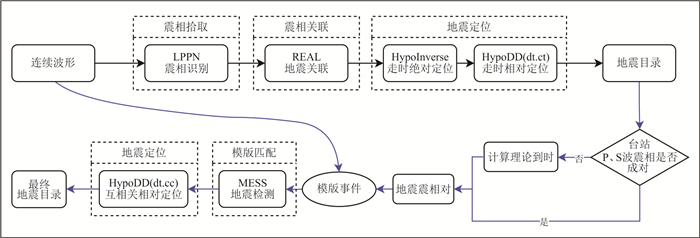
图 2 地震震相检测、事件识别及精定位流程
黑色、蓝色流程线分别代表LPPN、MESS方法输入输出关系
Fig. 2. Integrated workflow of seismic phase detection, event identification and precise hypocenter relocation
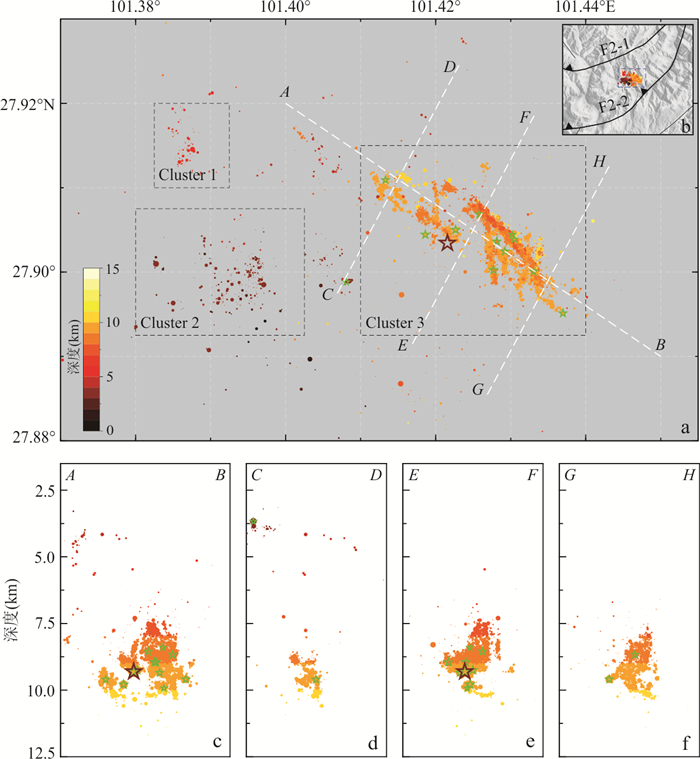
图 3 地震序列分布
彩色的点代表不同深度的地震事件,深度颜色代表深度如左下角色标所示;红色五角星代表木里地震,绿色五角星代表地震序列中ML≥3.0级地震事件;黑色的虚线框代表3个丛集区;白色的虚线代表剖面位置
Fig. 3. Spatial distribution of the earthquake sequence
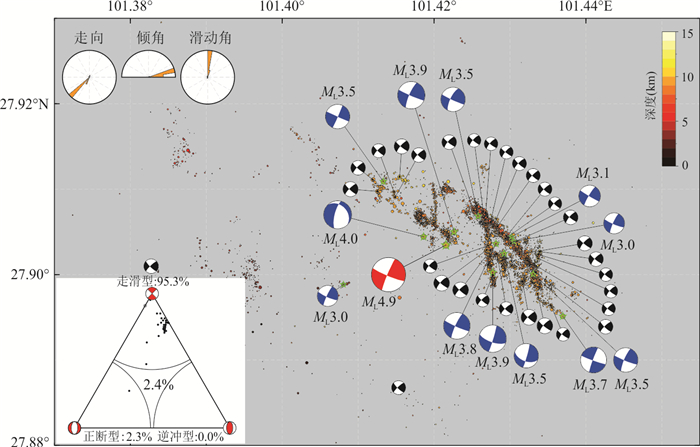
图 4 震源机制解、地震类型三角形图解及节面参数统计分布
彩色的点代表不同深度的地震震中分布,不同颜色代表的深度如右上角色标所示;红色沙滩球代表ML4.9级地震震源机制解,蓝色、黑色沙滩球分别代表ML≥3.0级、2.5≦ML < 3.0级地震事件震源机制解;左下角、左上角分别代表震级ML≥2.5级的43次地震事件类型的三角形图解、震源机制解节面参数统计
Fig. 4. Synoptic representation of focal mechanisms, seismotectonic classification and nodal plane parameterization
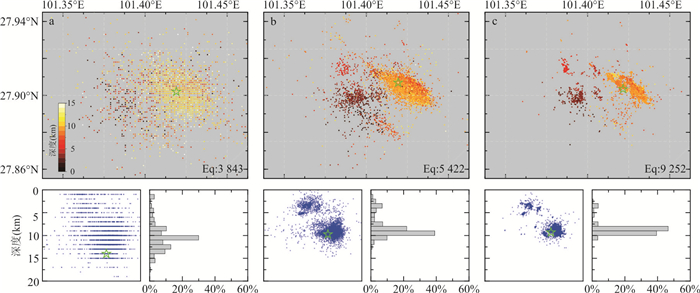
图 5 检测定位结果对比
a.人工拾取分析地震目录;b.人工智能震相检测目录;c.模板匹配震相检测目录. 绿色五角星代表木里地震位置
Fig. 5. Comprehensive benchmarking between manually curated catalogs and algorithmically generated seismicity inventories
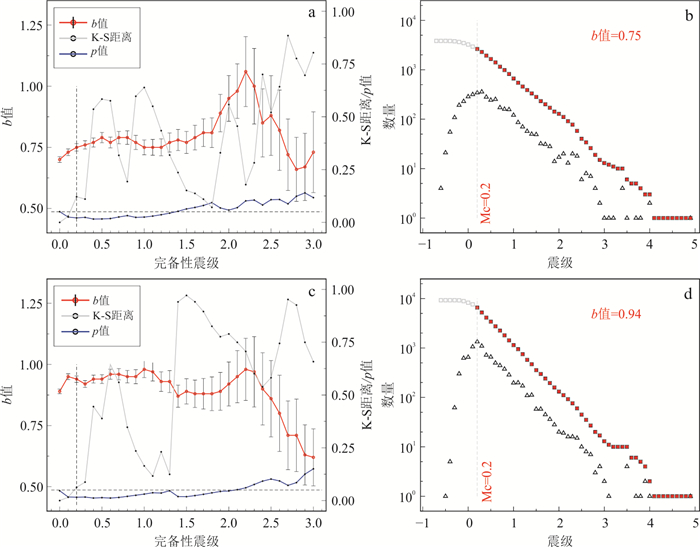
图 6 地震目录统计分析对比
a、b.分别为人工拾取地震目录Mc与b值关系、震级‒频度关系分布;c、d. 分别为本文构建地震目录Mc与b值关系、震级‒频度关系分布.图a、c中b值分布中竖线表示b值计算的残差
Fig. 6. Statistical benchmarking of manually curated and algorithmically generated seismic catalogs
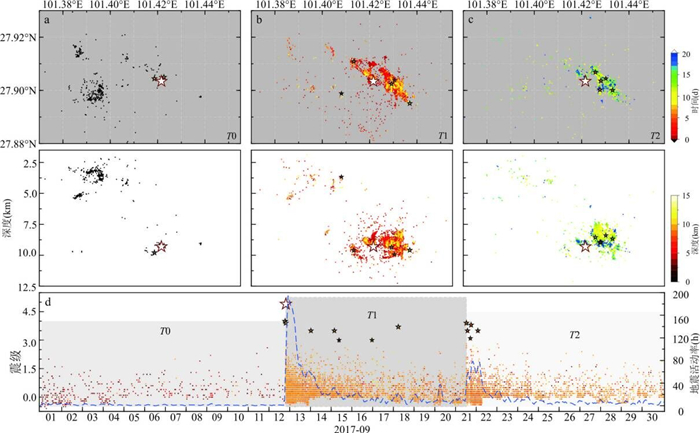
图 7 地震活动时空演化分布
a. T0(9月1日‒9月12日18时)为木里地震前阶段;b. T1(9月12日18时‒9月21日12时)木里地震后、ML3.9级最大余震发生前阶段;c. T2(9月21日12时‒9月30日)ML3.9级最大余震发生后阶段;图a~c中的不同颜色代表以木里地震为参考点的时间;d. 时间与震级、地震活动率分布,蓝色虚线代表地震活动率,不同颜色的点代表地震震源深度.图中红色五角星代表木里地震,黑色五角星代表地震序列中ML≥3.0的地震
Fig. 7. Evolution of seismicity distribution
-
Boore, D. M., 1989. The Richter Scale: Its Development and Use for Determining Earthquake Source Parameters. Tectonophysics, 166(1-3): 1-14. https://doi.org/10.1016/0040-1951(89)90200-X Chen, Y. Q., Ding, R., Zhang, S. M., et al., 2024. Characteristics and Tectonic Implications of the Geomorphic Indices of the Watersheds around the Lijiang-Jinpingshan Fault. Remote Sensing, 16(20): 3826. https://doi.org/10.3390/rs16203826 Ding, R., Ren, J. J., Zhang, S. M., et al., 2018. Late Quaternary Paleoearthquakes on the Middle Segment of the Lijiang-Xiaojinhe Fault, Southeastern Tibet. Seismology and Geology, 40(3): 622-640 (in Chinese with English abstract). Dong, G. J., Liu, S. L., Sun, K. L., et al., 2024. Spatial Distribution of Mid-Lower Crustal Flow in the SE Tibetan Plateau Revealed by P-Wave Velocity and Azimuthal Anisotropy beneath the Lijiang-Xiaojinhe Fault and Its Vicinity. Geophysical Journal International, 237(2): 931-948. https://doi.org/10.1093/gji/ggae080 Fang, L. H., Wu, J. P., Su, J. R., et al., 2018. Relocation of Mainshock and Aftershock Sequence of the Ms7.0 Sichuan Jiuzhaigou Earthquake. Chinese Science Bulletin, 63(7): 649-662 (in Chinese). doi: 10.1360/N972017-01184 Felzer, K. R., Brodsky, E. E., 2006. Decay of Aftershock Density with Distance Indicates Triggering by Dynamic Stress. Nature, 441(7094): 735-738. https://doi.org/10.1038/nature04799 Frohlich, C., 1992. Triangle Diagrams: Ternary Graphs to Display Similarity and Diversity of Earthquake Focal Mechanisms. Physics of the Earth and Planetary Interiors, 75(1-3): 193-198. https://doi.org/10.1016/0031-9201(92)90130-N Gutenberg, B., Richter, C. F., 1944. Frequency of Earthquakes in California. Bulletin of the Seismological Society of America, 34(4): 185-188. https://doi.org/10.1785/bssa0340040185 Ji, H. M., Ren, Z. K., Liu, J. R., 2024. Review of Structural Deformation in the Upper Crust of the Southeastern Margin of the Tibetan Plateau since the Late Cenozoic. Earth Science, 49(2): 480-499 (in Chinese with English abstract). Kilb, D., Gomberg, J., Bodin, P., 2000. Triggering of Earthquake Aftershocks by Dynamic Stresses. Nature, 408(6812): 570-574. https://doi.org/10.1038/35046046 Klein, F. W., 2002. User's Guide to HYPOINVERSE-2000, a Fortran Program to Solve for Earthquake Locations and Magnitudes. Open-File Report. U. S. Geological Survey, Menlo Park. Li, L., Chen, Q. F., Niu, F. L., et al., 2008. Slip Rate along the Lijiang-Ninglang Fault Zone Estimated from Repeating Microearthquakes. Chinese Science Bulletin, 53(23): 2925-2932 (in Chinese). doi: 10.1360/csb2008-53-23-2925 Li, Y. C., Shan, X. J., Gao, Z. Y., et al., 2023. Interseismic Coupling, Asperity Distribution, and Earthquake Potential on Major Faults in Southeastern Tibet. Geophysical Research Letters, 50(8): e2022GL101209. https://doi.org/10.1029/2022GL101209 Liu, M., Li, H. Y., Zhang, M., et al., 2022. Investigation of the 2013 Eryuan, Yunnan, China MS5.5 Earthquake Sequence: Aftershock Migration, Seismogenic Structure and Hazard Implication. Tectonophysics, 837: 229445. https://doi.org/10.1016/j.tecto.2022.229445 Liu, X. X., Shao, Z. G., 2020. Current Fault Movement Characteristics in the Lijiang-Xiaojinhe Fault Zone. Chinese Journal of Geophysics, 63(3): 1117-1126 (in Chinese with English abstract). Liu, Y., Yu, Z. Y., Zhang, Z. Q., et al., 2023. The High-Resolution Community Velocity Model V2.0 of Southwest China, Constructed by Joint Body and Surface Wave Tomography of Data Recorded at Temporary Dense Arrays. Science China Earth Sciences, 66(10): 2368-2385. https://doi.org/10.1007/s11430-022-1161-7 Lomax, A., Savvaidis, A., 2022. High-Precision Earthquake Location Using Source-Specific Station Terms and Inter-Event Waveform Similarity. Journal of Geophysical Research: Solid Earth, 127(1): e2021JB023190. https://doi.org/10.1029/2021JB023190 Mizrahi, L., Nandan, S., Wiemer, S., 2021. The Effect of Declustering on the Size Distribution of Mainshocks. Seismological Research Letters, 92(4): 2333-2342. https://doi.org/10.1785/0220200231 Mousavi, S. M., Ellsworth, W. L., Zhu, W. Q., et al., 2020. Earthquake Transformer—An Attentive Deep-Learning Model for Simultaneous Earthquake Detection and Phase Picking. Nature Communications, 11: 3952. https://doi.org/10.1038/s41467-020-17591-w Peng, Z. G., Zhao, P., 2009. Migration of Early Aftershocks Following the 2004 Parkfield Earthquake. Nature Geoscience, 2(12): 877-881. https://doi.org/10.1038/ngeo697 Richards-Dinger, K., Stein, R. S., Toda, S., 2010. Decay of Aftershock Density with Distance does not Indicate Triggering by Dynamic Stress. Nature, 467(7315): 583-586. https://doi.org/10.1038/nature09402 Richter, C. F., 1935. An Instrumental Earthquake Magnitude Scale. Bulletin of the Seismological Society of America, 25(1): 1-32. https://doi.org/10.1785/bssa0250010001 Ross, Z. E., Meier, M. A., Hauksson, E., 2018. P Wave Arrival Picking and First-Motion Polarity Determination with Deep Learning. Journal of Geophysical Research: Solid Earth, 123(6): 5120-5129. https://doi.org/10.1029/2017JB015251 Trugman, D. T., Shearer, P. M., 2017. GrowClust: A Hierarchical Clustering Algorithm for Relative Earthquake Relocation, with Application to the Spanish Springs and Sheldon, Nevada, Earthquake Sequences. Seismological Research Letters, 88(2A): 379-391. https://doi.org/10.1785/0220160188 Waldhauser, F., Ellsworth, W. L., 2000. A Double-Difference Earthquake Location Algorithm: Method and Application to the Northern Hayward Fault, California. Bulletin of the Seismological Society of America, 90(6): 1353-1368. https://doi.org/10.1785/0120000006 Wessel, P., Luis, J. F., Uieda, L., et al., 2019. The Generic Mapping Tools Version 6. Geochemistry, Geophysics, Geosystems, 20(11): 5556-5564. https://doi.org/10.1029/2019GC008515 Wu, X. Y., Xu, X. W., Yu, G. H., et al., 2024. The China Active Faults Database (CAFD) and Its Web System. Earth System Science Data, 16(7): 3391-3417. https://doi.org/10.5194/essd-16-3391-2024 Wu, J. P., Huang, Y., Zhang, T. Z., et al., 2009. Aftershock Distribution of the MS8.0 Wenchuan Earthquake and Three Dimensional P-Wave Velocity Structure in and around Source Region. Chinese Journal of Geophysics, 52(2): 320-328 (in Chinese with English abstract). Xu, X. W., Wen, X. Z., Zheng, R. Z., et al., 2003. Pattern of Latest Tectonic Motion and Its Dynamics for Active Blocks in Sichuan-Yunnan Region, China. Scientia Sinica Terrae, 33(S1): 151-162 (in Chinese). Xu, X. W., Wu, X. Y., Yu, G. H., et al., 2017. Seismo-Geological Signatures for Identifying M≥7.0 Earthquake Risk Areas and Their Premilimary Application in Mainland China. Seismology and Geology, 39(2): 219-275 (in Chinese with English abstract). Yu, M. L., 1990. Study on the Nappe Structure in Muli Western Stchuan. Regional Geology of China, 9(1): 46-50, 59 (in Chinese with English abstract). Yu, Z. Y., Wang, W. T., 2022. LPPN: A Lightweight Network for Fast Phase Picking. Seismological Research Letters, 93(5): 2834-2846. https://doi.org/10.1785/0220210309 Zhang, J., Chen, X. B., Cai, J. T., et al., 2022. Deep Electrical Structure and Tectonic Implications beneath the Muli-Yanyuan Area. Chinese Journal of Geophysics, 65(1): 268-279 (in Chinese with English abstract). Zhang, L., Fang, L. H., 2025. Characterizing Pick Error Models for Local Seismic Phases. Journal of Earth Science, 1-22. https://doi.org/10.1007/s12583-025-0203-8 Zhang, M., Ellsworth, W. L., Beroza, G. C., 2019. Rapid Earthquake Association and Location. Seismological Research Letters, 90(6): 2276-2284. https://doi.org/10.1785/0220190052 Zhang, P. Z., Deng, Q. D., Zhang, G. M., et al., 2003. Active Tectonic Blocks and Strong Earthquakes in the Continent of China. Scientia Sinica Terrae, 33(S1): 12-20 (in Chinese). Zhang, T. J., Jin, M. P., Li, Q. F., et al., 2024. The Study of Crustal Thickness and Poisson's Ratio on Both Sides of the Lijiang-Xiaojinhe Fault by H-κ-c Method. Chinese Journal of Geophysics, 67(6): 2075-2089 (in Chinese with English abstract). Zhou, Y. J., Ghosh, A., Fang, L. H., et al., 2021. A High-Resolution Seismic Catalog for the 2021 MS6.4/MW6.1 Yangbi Earthquake Sequence, Yunnan, China: Application of AI Picker and Matched Filter. Earthquake Science, 34(5): 390-398. https://doi.org/10.29382/eqs-2021-0031 Zhou, Y. J., Yue, H., Fang, L. H., et al., 2022. An Earthquake Detection and Location Architecture for Continuous Seismograms: Phase Picking, Association, Location, and Matched Filter (PALM). Seismological Research Letters, 93(1): 413-425. https://doi.org/10.1785/0220210111 Zhu, W. Q., Hou, A. B., Yang, R., et al., 2022. QuakeFlow: A Scalable Machine-Learning-Based Earthquake Monitoring Workflow with Cloud Computing. Geophysical Journal International, 232(1): 684-693. https://doi.org/10.1093/gji/ggac355 丁锐, 任俊杰, 张世民, 等, 2018. 丽江‒小金河断裂中段晚第四纪古地震历史. 地震地质, 40(3): 622-640. 房立华, 吴建平, 苏金蓉, 等, 2018. 四川九寨沟Ms7.0地震主震及其余震序列精定位. 科学通报, 63(7): 649-662. 计昊旻, 任治坤, 刘金瑞, 2024. 青藏高原东南缘上地壳晚新生代构造变形综述. 地球科学, 49(2): 480-499. doi: 10.3799/dqkx.2023.160 李乐, 陈棋福, 钮凤林, 等, 2008. 利用"重复地震"估算丽江‒宁蒗断裂带的深部滑动速率. 科学通报, 53(23): 2925-2932. 刘晓霞, 邵志刚, 2020. 丽江‒小金河断裂带现今断层运动特征. 地球物理学报, 63(3): 1117-1126. 吴建平, 黄媛, 张天中, 等, 2009. 汶川Ms8.0级地震余震分布及周边区域P波三维速度结构研究. 地球物理学报, 52(2): 320-328. 徐锡伟, 闻学泽, 郑荣章, 等, 2003. 川滇地区活动块体最新构造变动样式及其动力来源. 中国科学: 地球科学, 33(S1): 151-162. 徐锡伟, 吴熙彦, 于贵华, 等, 2017. 中国大陆高震级地震危险区判定的地震地质学标志及其应用. 地震地质, 39(2): 219-275. 余明烈, 1990. 川西木里推覆构造的厘定. 中国区域地质, 9(1): 46-50, 59. 张炯, 陈小斌, 蔡军涛, 等, 2022. 木里‒盐源地区深部电性结构及构造意义. 地球物理学报, 65(1): 268-279. 张培震, 邓起东, 张国民, 等, 2003. 中国大陆的强震活动与活动地块. 中国科学: 地球科学, 33(S1): 12-20. 张天继, 金明培, 李秋凤, 等, 2024. 利用H-κ-c方法研究丽江‒小金河断裂两侧的地壳厚度与泊松比. 地球物理学报, 67(6): 2175-2189. -

 下载:
下载:
 点击查看大图
计量
- 文章访问数: 168
- HTML全文浏览量: 13
- PDF下载量: 13
- 被引次数: 0
