




A Comprehensive Brittleness Evaluation Method for Deep Coal Reservoirs Based on Pre- and Post-Peak Energy Characteristics under Confining Pressure Constraints
-
摘要: 深部煤岩储层压裂开发中,脆性评价的准确性直接影响压裂效果,但现有方法多针对页岩设计,难以适用于煤岩复杂的原生裂隙和围压敏感特性.通过三轴压缩试验获取煤岩应力‒应变曲线,引入损伤变量量化峰前裂纹演化对能量分配的非线性影响,构建损伤‒能量双参数峰前脆性指标Bpre;结合围压动态约束效应,建立应力降速率‒围压耦合的峰后脆性指数Bpost,并采用调和平均法得到了基于峰前‒峰后能量特征与围压约束的煤岩脆性指数Bcoal.试验结果表明,Bcoal能有效区分不同围压下煤岩的脆性差异,在5~20 MPa围压下评价结果可靠,且相较于传统方法具有更高的敏感性和可靠性.该研究提升了煤岩脆性评价准确性,为煤层气压裂优化提供重要理论支撑.Abstract: The accuracy of brittleness evaluation critically influences the effectiveness of hydraulic fracturing in deep coal reservoirs; however, conventional methods, largely developed for shale, are inadequate for coal rocks owing to their complex cleat systems and pronounced sensitivity to confining pressure. To address this, triaxial compression tests were conducted to obtain the stress-strain curves of coal rocks. A damage variable was introduced to quantify the nonlinear impact of pre-peak crack evolution on energy distribution, formulating a dual-parameter pre-peak brittleness index, Bpre, based on damage and energy. Incorporating the dynamic constraint effect of confining pressure, a post-peak brittleness index, Bpost, was established by coupling the stress drop rate with confining pressure. Subsequently, a comprehensive coal brittleness index, Bcoal, was derived by employing the harmonic mean method, integrating both pre- and post-peak energy characteristics and confining pressure constraints. Experimental results demonstrate that Bcoal effectively differentiates the brittleness of coal rocks across varying confining pressures, demonstrating reliable evaluation within the confining pressure range of 5 to 20 MPa, and exhibiting superior sensitivity and reliability over traditional methods. This study enhances the accuracy of coal brittleness evaluation, thereby providing crucial theoretical support for the optimization of coalbed methane fracturing strategies.
-
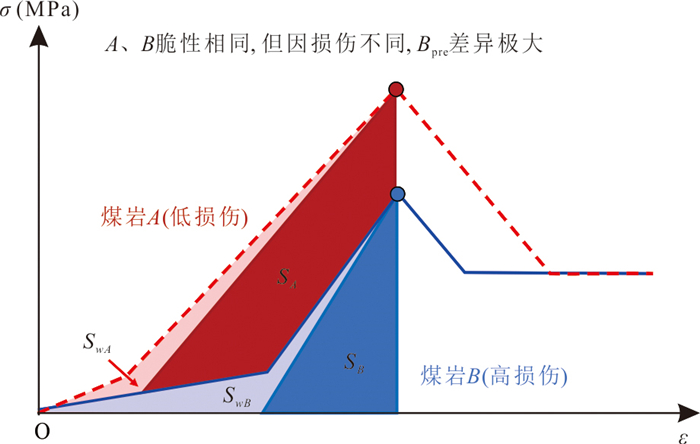
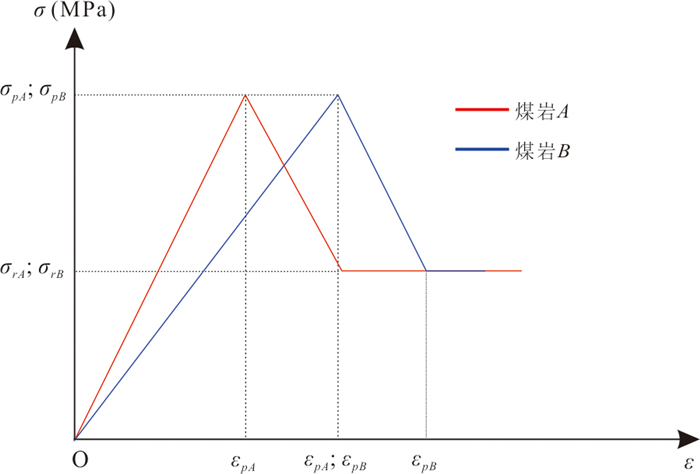
图 1 同脆性异损伤煤岩应力‒应变对比
Fig. 1. Comparative analysis of stress-strain curves for coal-rock specimens with identical brittleness but varying damage levels
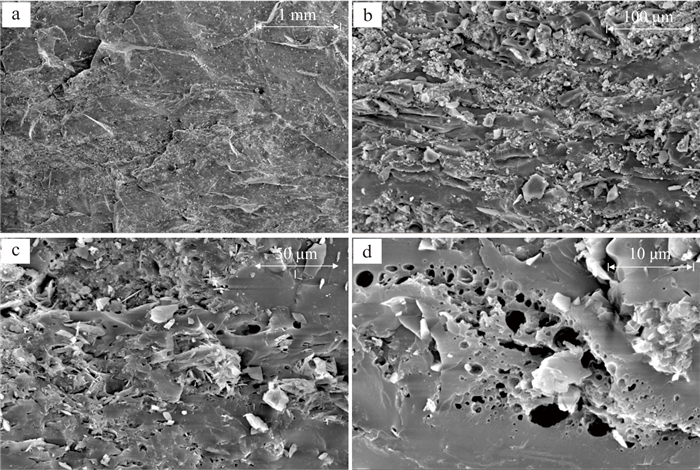
图 3 煤岩微观结构扫描电镜图
a. 放大100倍;b. 放大1 000倍;c. 放大2 000倍;d. 放大10 000倍
Fig. 3. Scanning electron microscope images of coal-rock microstructure
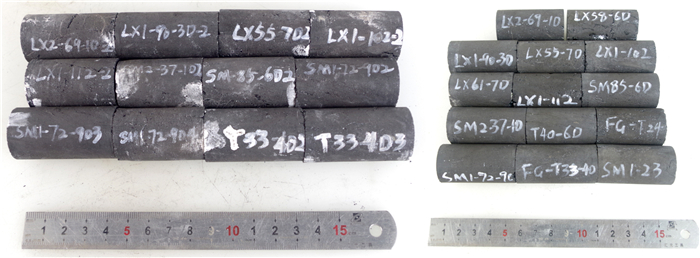
图 4 试验所用标准岩心柱样品
Fig. 4. Representative standard core plug samples utilized in the testing
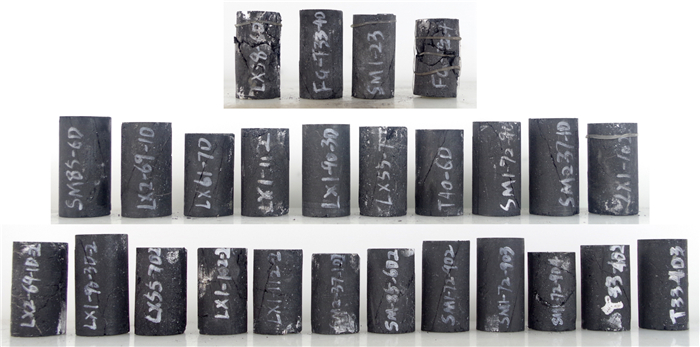
图 6 不同围压条件下煤岩压缩试验破坏特征
Fig. 6. Failure characteristics of coal-rock under triaxial compression at varying confining pressures
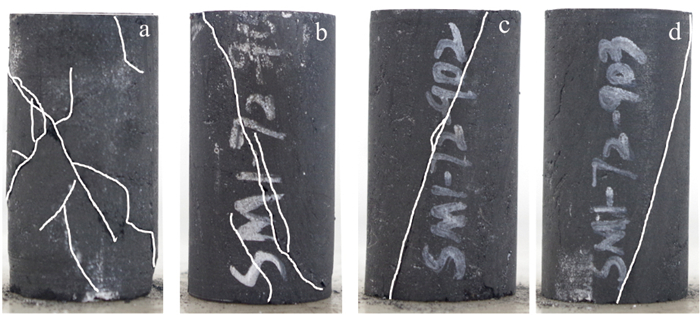
图 7 F-T33-4D岩心在不同围压下的破坏形态
Fig. 7. Failure morphology of core F-T33-4D under varying confining pressures
a. 5 MPa; b. 10 MPa; c. 15 MPa; d.20 MPa
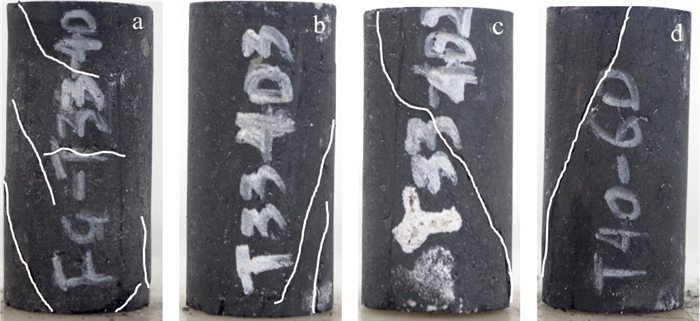
图 8 S-72-9D岩心在不同围压下的破坏形态
Fig. 8. Failure morphology of core S-72-9D under varying confining pressures
a. 5 MPa; b. 10 MPa; c. 15 MPa; d.20 MPa
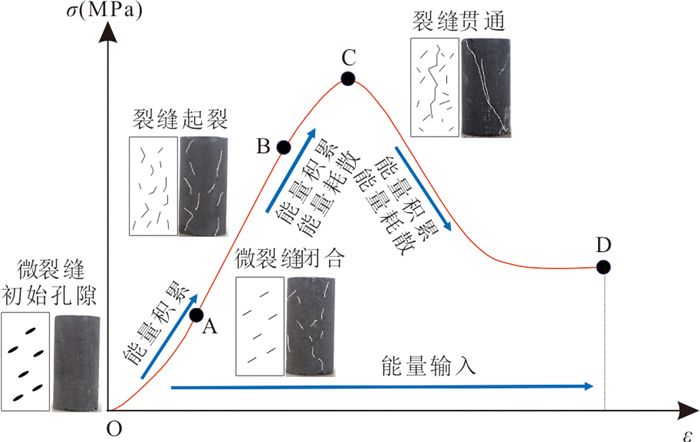
图 9 岩石应力‒应变曲线及能量转化示意图
Fig. 9. Schematic of rock stress-strain behavior and associated energy conversion
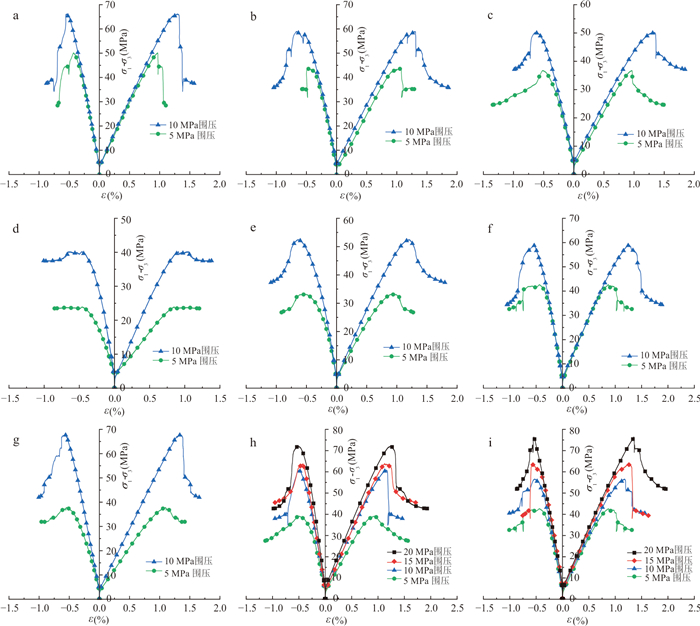
图 10 不同围压下应力应变曲线
Fig. 10. Stress-strain curves under varying confining pressures
a. L-90-3D; b. L-102; c. L-112; d. L-69-1D; e. L-55-7D; f. S-37-1D; g. S-85-6D; h. F-T33-4D; i. S-72-9D
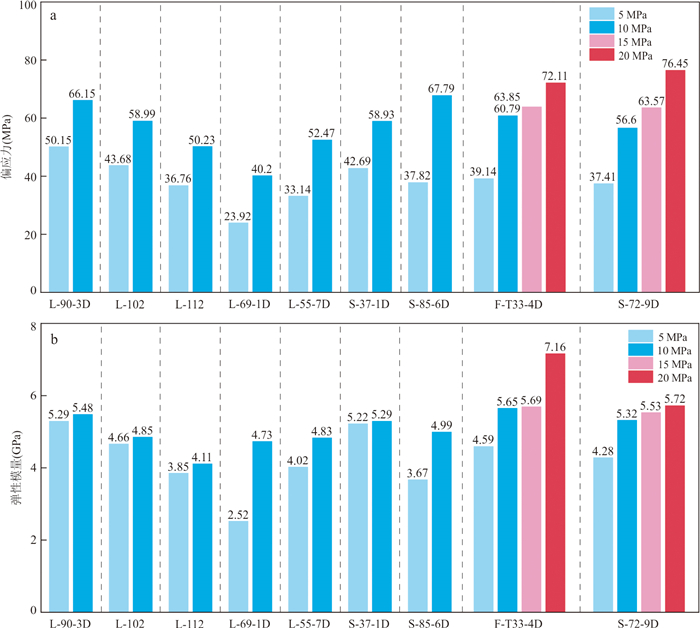
图 11 不同围压下煤岩力学参数
a. 偏应力;b. 弹性模量
Fig. 11. Mechanical parameters of coal and rock under different confining pressures
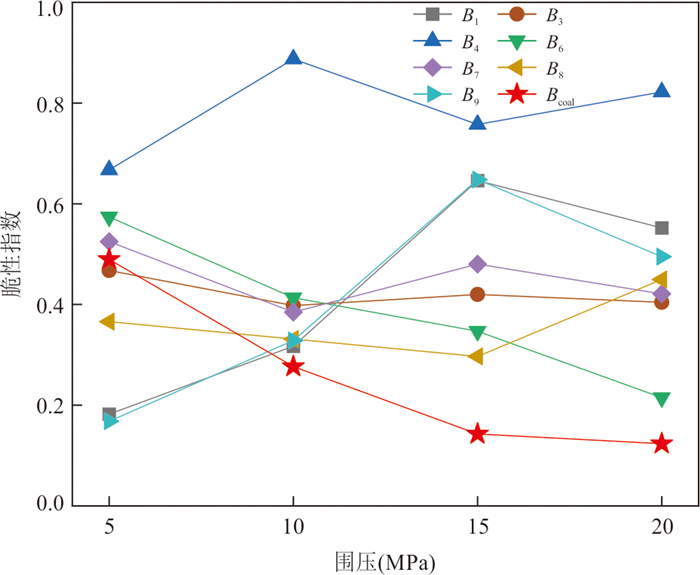
图 12 不同围压条件下煤岩的脆性指标评价结果
Fig. 12. Evaluation of coal-rock brittleness indices under varying confining pressures
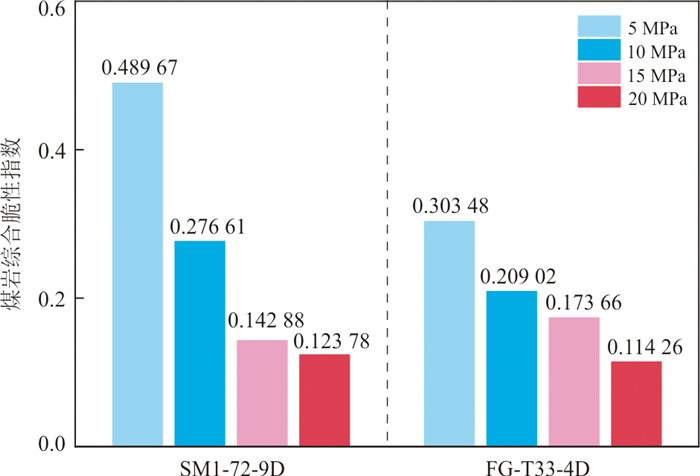
图 13 不同围压下两组煤岩的脆性指数对比
Fig. 13. Comparison of brittleness indices between two coal-rock groups under varying confining pressures
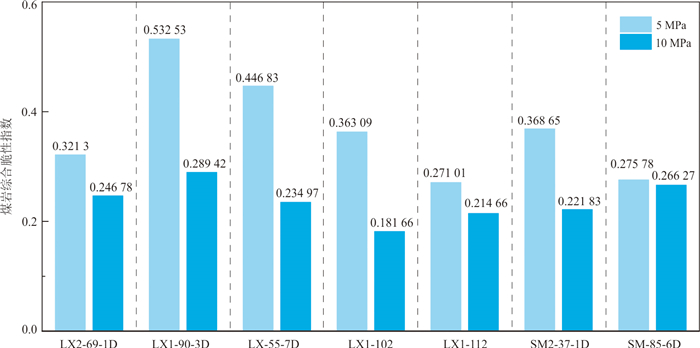
图 14 不同围压下7组煤岩的脆性指数
Fig. 14. Brittleness indices for seven coal-rock groups under varying confining pressures
表 1 已有岩石脆性评价方法
Table 1. Rock brittleness evaluation methodologies
类别 公式 公式来源 公式说明 基于应力‒应变曲线特征 $ {B}_{1}=\frac{({\sigma }_{\mathrm{p}}-{\sigma }_{\mathrm{r}})/{\sigma }_{\mathrm{p}}}{|\left({\epsilon }_{\mathrm{c}\mathrm{r}}-{\epsilon }_{\mathrm{c}\mathrm{p}}\right)/{\epsilon }_{\mathrm{c}\mathrm{p}}|} $ 杨景祥等(2022) $ {\epsilon }_{\mathrm{c}\mathrm{p}} $为侧向峰值应变;$ {\epsilon }_{\mathrm{c}\mathrm{r}} $为侧向残余应变;$ {\sigma }_{p} $为峰值应力;$ {\sigma }_{r} $为残余应力;$ {{k}_{\mathrm{a}\mathrm{c}}}_{\left(AC\right)} $从屈服起始点到残余起始点的连线的斜率;$ {\sigma }_{\mathrm{c}\mathrm{i}} $为起裂应力;$ {\epsilon }_{\mathrm{c}\mathrm{i}} $为起裂应变;$ {\epsilon }_{p} $为峰值应变;$ \mathrm{\Delta }S $为峰后特定区域面积 $ {B}_{2}=\frac{S}{S+{S}_{w}}\cdot {\mathrm{e}}^{\frac{\left|{\epsilon }_{\mathrm{c}\mathrm{r}}-{\epsilon }_{\mathrm{c}\mathrm{p}}\right|}{{\sigma }_{\mathrm{p}}-{\sigma }_{\mathrm{r}}}} $ 宋昊等(2023) $ {B}_{3}=\frac{1}{{\epsilon }_{\mathrm{p}}}\cdot \frac{{\sigma }_{\mathrm{p}}-{\sigma }_{\mathrm{c}\mathrm{i}}}{{\epsilon }_{\mathrm{p}}-{\epsilon }_{\mathrm{c}\mathrm{i}}}\cdot {\mathrm{e}}^{\frac{10({\epsilon }_{\mathrm{p}}-{\epsilon }_{\mathrm{r}})}{{\sigma }_{\mathrm{p}}-{\sigma }_{\mathrm{r}}}} $ 匡智浩等(2022) $ {B}_{4}=\frac{{\epsilon }_{\mathrm{p}}({\sigma }_{\mathrm{p}}-{\sigma }_{\mathrm{i}})}{{\sigma }_{\mathrm{p}}({\epsilon }_{\mathrm{p}}-{\epsilon }_{\mathrm{i}})}+\frac{{\epsilon }_{\mathrm{p}}({\sigma }_{\mathrm{p}}-{\sigma }_{\mathrm{r}})}{{\sigma }_{\mathrm{p}}({\epsilon }_{\mathrm{r}}-{\epsilon }_{\mathrm{p}})} $ 陈国庆等(2018) $ {B}_{5}=(S\times {\epsilon }_{\mathrm{c}\mathrm{i}})/\left(\mathrm{\Delta }S\times ({\epsilon }_{\mathrm{p}}-{\epsilon }_{\mathrm{c}\mathrm{i}})\right) $ 高美奔等(2022) $ {B}_{6}=\frac{({\sigma }_{\mathrm{p}}-{\sigma }_{\mathrm{r}})}{({\epsilon }_{\mathrm{r}}-{\epsilon }_{\mathrm{p}})}+\frac{({\sigma }_{\mathrm{p}}-{\sigma }_{\mathrm{r}})({\epsilon }_{\mathrm{r}}-{\epsilon }_{\mathrm{p}})}{{\sigma }_{\mathrm{p}}{\epsilon }_{\mathrm{p}}} $ Xia et al. (2017) $ {B}_{7}=({\sigma }_{\mathrm{p}}-{\sigma }_{\mathrm{r}})\mathrm{l}\mathrm{g}\frac{\left|{k}_{\mathrm{a}\mathrm{c}\left(AC\right)}\right|}{10} $ Meng(2015) 基于能量演化机制 $ {B}_{8}=\frac{\mathrm{d}{W}_{\mathrm{d}}^{\mathrm{*}}}{\mathrm{d}{W}_{\mathrm{e}\left(B\right)}-\mathrm{d}{W}_{\mathrm{e}\left(A\right)}}\frac{\mathrm{d}{W}_{\mathrm{f}}}{\mathrm{d}{W}_{\mathrm{e}\left(B\right)}-\mathrm{d}{W}_{\mathrm{e}\left(C\right)}} $ 张军等(2017) $ \mathrm{d}{W}_{\mathrm{d}}^{\mathrm{*}} $为塑性屈服阶段的能量增量;$ \mathrm{d}{W}_{\mathrm{e}\left(i\right)} $为岩石内部积累的弹性能增量;$ \mathrm{d}{W}_{\mathrm{d}} $为峰前耗散能;$ \mathrm{d}{W}_{\mathrm{f}} $为破坏所需的断裂能;$ \mathrm{d}{W}_{\mathrm{r}} $为发生宏观断裂的断裂能;$ {W}_{\mathrm{p}\mathrm{r}\mathrm{e}}^{\mathrm{c}\mathrm{e}} $、$ {W}_{\mathrm{p}\mathrm{o}\mathrm{s}\mathrm{t}}^{\mathrm{r}\mathrm{e}} $为峰前积聚的弹性能密度、岩样内部的残余弹性能;M为峰后模量;E1、E2、t1、t2分别为屈服前累积能量、破坏后残余能量、裂纹损伤及最终破坏时间 $ {B}_{9}=\frac{\mathrm{d}{W}_{\mathrm{r}}}{\mathrm{d}W({\epsilon }_{\mathrm{a}\mathrm{r}}, {\epsilon }_{\mathrm{r}\mathrm{r}})}\times \frac{\mathrm{d}{W}_{\mathrm{r}}}{\mathrm{d}{W}_{\mathrm{e}}({\epsilon }_{\mathrm{a}\mathrm{p}}, {\epsilon }_{\mathrm{r}\mathrm{p}})}+\frac{\mathrm{d}{W}_{\mathrm{d}}}{\mathrm{d}{W}_{\mathrm{e}}({\epsilon }_{\mathrm{a}\mathrm{p}}, {\epsilon }_{\mathrm{r}\mathrm{p}})} $ 刘俊新等(2022) $ {B}_{10}=2/\left(1/\frac{{c}_{\mathrm{b}\mathrm{i}\mathrm{t}}{W}_{\mathrm{p}\mathrm{r}\mathrm{e}}^{\mathrm{c}\mathrm{e}}}{{c}_{\mathrm{b}\mathrm{i}\mathrm{t}}{W}_{\mathrm{p}\mathrm{r}\mathrm{e}}^{\mathrm{c}\mathrm{e}}+{c}_{\mathrm{i}\mathrm{n}\mathrm{b}\mathrm{i}\mathrm{t}}{W}_{\mathrm{p}\mathrm{r}\mathrm{e}}^{\mathrm{o}\mathrm{u}\mathrm{t}}}+1/\frac{{c}_{\mathrm{b}\mathrm{i}\mathrm{t}}\left({W}_{\mathrm{p}\mathrm{r}\mathrm{e}}^{\mathrm{c}\mathrm{e}}-{W}_{\mathrm{p}\mathrm{o}\mathrm{s}\mathrm{t}}^{\mathrm{r}\mathrm{e}}\right)}{{c}_{\mathrm{b}\mathrm{i}\mathrm{t}}\left({W}_{\mathrm{p}\mathrm{r}\mathrm{e}}^{\mathrm{c}\mathrm{e}}-{W}_{\mathrm{p}\mathrm{o}\mathrm{s}\mathrm{t}}^{\mathrm{r}\mathrm{e}}\right)+{c}_{\mathrm{i}\mathrm{n}\mathrm{b}\mathrm{i}\mathrm{t}}{W}_{\mathrm{p}\mathrm{o}\mathrm{s}\mathrm{t}}^{\mathrm{i}\mathrm{n}}}\right) $ 任岚等(2023) $ {B}_{11}=(M-E)/M $ Tarasov et al. (2013) $ {B}_{12}=E/M $ Tarasov et al. (2013) $ {B}_{13}=\frac{{E}_{2}-{E}_{1}}{{E}_{2}}\mathrm{l}\mathrm{g}\frac{{E}_{2}-{E}_{1}}{{t}_{2}-{t}_{1}} $ 侯鹏等(2016) $ {B}_{14}=\frac{{W}_{\mathrm{d}2}-{W}_{\mathrm{d}1}+{W}_{\mathrm{e}2}-{W}_{\mathrm{e}1}}{{W}_{\mathrm{e}2}-{W}_{\mathrm{e}1}}\times \frac{{W}_{\mathrm{e}2}-{W}_{\mathrm{e}3}}{{W}_{\mathrm{e}2}-{W}_{\mathrm{e}3}+{W}_{1}-{W}_{2}} $ 温韬等(2021) 基于矿物组分与弹性参数 $ {B}_{15}=\frac{E+\mu }{2} $ Rickman et al. (2008) qz为石英含量;car为碳酸盐矿物含量;fels为长石含量;clay为黏土含量;dol为白云石含量;lm为方解石含量;TOC为总有机碳含量;ω为粒径小于0.6 mm的岩屑颗粒含量 $ {B}_{16}=\frac{qz+car}{qz+fels+car+clay}\times 100 $ Lai et al. (2015) $ {B}_{17}=50\left(\frac{E-{E}_{\mathrm{m}\mathrm{i}\mathrm{n}}}{{E}_{\mathrm{m}\mathrm{a}\mathrm{x}}-{E}_{\mathrm{m}\mathrm{i}\mathrm{n}}}+\frac{\mu -{\mu }_{\mathrm{m}\mathrm{a}\mathrm{x}}}{{\mu }_{\mathrm{m}\mathrm{i}\mathrm{n}}-{\mu }_{\mathrm{m}\mathrm{a}\mathrm{x}}}\right) $ 郭京哲等(2023) 基于强度参数与破坏特征 $ {B}_{18}=({\sigma }_{\mathrm{c}}\cdot {\sigma }_{\mathrm{t}})/2 $ Yarali et al. (2011) σc、σt分别为岩石的单轴抗压强度和抗拉强度;Fmax为在岩石样品上的最大施加力;P为最大力对应的穿透深度;ρ为岩石密度;εf、εb为峰前、后应变;H为硬度;KIC为断裂韧性 $ {B}_{19}={F}_{\mathrm{m}\mathrm{a}\mathrm{x}}/P $ Yagiz (2009) $ {B}_{20}=0.198{\sigma }_{\mathrm{c}}-2.174{\sigma }_{\mathrm{t}}+0.913\rho -3.807 $ Yagiz (2009) $ {B}_{21}=(\alpha \cdot {\sigma }_{\mathrm{c}}\cdot {\epsilon }_{\mathrm{f}})/{\sigma }_{\mathrm{t}}{\epsilon }_{\mathrm{b}} $ 冯涛等(2000) $ {B}_{22}={\sigma }_{\mathrm{c}}/{\sigma }_{\mathrm{t}} $ Hucka et al. (1974) $ {B}_{23}=({\sigma }_{\mathrm{c}}-{\sigma }_{\mathrm{t}})/({\sigma }_{\mathrm{c}}+{\sigma }_{\mathrm{t}}) $ Hucka et al. (1974) $ {B}_{24}=H/{K}_{\mathrm{I}\mathrm{C}} $ Lawn et al. (1979) $ {B}_{25}=(H\cdot E)/{K}_{\mathrm{I}\mathrm{C}}^{2} $ Quinn et al. (1997)  下载: 导出CSV
表 2 试样的物性参数
Table 2. Physical properties of the tested specimens
编号 围压(MPa) 平均高度(mm) 平均直径(mm) 平均密度(g/cm³) 平均质量(g) 实验组数 1 5 46.80 25.23 1.36 31.03 9 2 10 47.76 25.25 1.35 32.34 9 3 15 46.71 25.26 1.39 32.55 2 4 20 49.46 25.24 1.43 35.30 2
下载: 导出CSV
表 3 三轴压缩试验结果
Table 3. Triaxial compression test results
岩心号 围压
(MPa)偏应力(MPa) 弹性模量(GPa) 泊松比 L-90-3D-2 5 50.15 5.29 0.402 L-90-3D 10 66.15 5.48 0.399 L-102-2 5 43.68 4.66 0.385 L-102 10 58.99 4.85 0.383 L-112-2 5 36.76 3.85 0.419 L-112 10 50.23 4.11 0.426 L-69-1D-2 5 23.92 2.52 0.383 L-69-1D 10 40.20 4.73 0.380 L-55-7D-2 5 33.14 4.02 0.370 L-55-7D 10 52.47 4.83 0.396 S-37-1D-2 5 42.69 5.22 0.402 S-37-1D 10 58.93 5.29 0.390 S-85-6D-2 5 37.82 3.67 0.398 S-85-6D 10 67.79 4.99 0.389 F-T33-4D 5 39.14 4.59 0.385 F-T33-4D-3 10 60.79 5.65 0.372 F-T33-4D-2 15 63.85 5.69 0.383 F-T33-6D 20 72.11 7.16 0.387 S-72-9D-4 5 37.41 4.28 0.377 S-72-9D 10 56.60 5.32 0.386 S-72-9D-2 15 63.57 5.53 0.394 S-72-9D-3 20 76.45 5.72 0.408
下载: 导出CSV
-
An, Q., Yang, F., Yang, R. Y., et al., 2024. Practice and Understanding of Deep Coalbed Methane Massive Hydraulic Fracturing in Shenfu Block, Ordos Basin. Journal of China Coal Society, 49(5): 2376-2393 (in Chinese with English abstract). Aubertin, M., Simon, R., 1997. A Damage Initiation Criterion for Low Porosity Rocks. International Journal of Rock Mechanics and Mining Sciences, 34(3-4): 17. e1-17. e15. https://doi.org/10.1016/S1365-1609(97)00145-7 Bai, X. F., Wang, M., Wang, X., et al., 2024. Evaluation of Shale Oil Sweet Spot and Rich Area in Jurassic Lianggaoshan Formation, Northeast Sichuan Basin. Earth Science, 49(12): 4483-4500 (in Chinese with English abstract). Chen, G. Q., Zhao, C., Wei, T., et al., 2018. Evaluation Method of Brittle Characteristics of Rock Based on Full Stress-Strain Curve and Crack Initiation Stress. Chinese Journal of Rock Mechanics and Engineering, 37(1): 51-59 (in Chinese with English abstract). Feng, T., Xie, X. B., Wang, W. X., et al., 2000. Brittleness of Rocks and Brittleness Indexes for Describing Rockburst Proneness. Mining and Metallurgical Engineering, 20(4): 18-19 (in Chinese with English abstract). Gao, M. B., Li, T. B., Chen, G. Q., et al., 2022. Brittleness Evaluation Method Based on Pre-Peak Crack Initiation and Post-Peak Characteristics of Rock. Chinese Journal of Geotechnical Engineering, 44(4): 762-768 (in Chinese with English abstract). Gong, C. X., Zhang, L. Y., Ma, C., et al., 2022. Analysis of Brittleness Index Based on Fracture Energy Ratio of Rock Mass. Mining Research and Development, 42(2): 82-89 (in Chinese with English abstract). Guo, J. Z., Guo, X. J., Zhao, M., et al., 2023. Conventional Logging Evaluation Method of Brittleness Index of Tight Sandstone Based on Multi-Mineral Model: A Case Study of Chang 7 Member in Tongchuan Area, Ordos Basin. Progress in Geophysics, 38(4): 1590-1602 (in Chinese with English abstract). Guo, X. S., 2022. Discussion and Research Direction of Future Onshore Oil and Gas Exploration in China. Earth Science, 47(10): 3511-3523 (in Chinese with English abstract). Guo, Z. Q., Li, X. Y., Liu, C., et al., 2013. A Shale Rock Physics Model for Analysis of Brittleness Index, Mineralogy and Porosity in the Barnett Shale. Journal of Geophysics and Engineering, 10(2): 025006. https://doi.org/10.1088/1742-2132/10/2/025006 Hou, P., Gao, F., Zhang, Z. Z., et al., 2016. Evaluation Method of Rock Brittleness Based on Acoustic Emission and Energy Evolution. Journal of China University of Mining & Technology, 45(4): 702-708 (in Chinese with English abstract). Hucka, V., Das, B., 1974. Brittleness Determination of Rocks by Different Methods. International Journal of Rock Mechanics and Mining Sciences & Geomechanics Abstracts, 11(10): 389-392. https://doi.org/10.1016/0148-9062(74)91109-7 Kuang, Z. H., Li, S. J., Du, C. X., et al., 2022. Evaluation Index of Rock Brittleness Considering Stress Change Rate. Rock and Soil Mechanics, 43(S1): 293-300 (in Chinese with English abstract). Lai, J., Wang, G. W., Huang, L. X., et al., 2015. Brittleness Index Estimation in a Tight Shaly Sandstone Reservoir Using Well Logs. Journal of Natural Gas Science and Engineering, 27(3): 1536-1545. https://doi.org/10.1016/j.jngse.2015.10.020 Lawn, B. R., Marshall, D. B., 1979. Hardness, Toughness, and Brittleness: An Indentation Analysis. Journal of the American Ceramic Society, 62(7-8): 347-350. https://doi.org/10.1111/j.1151-2916.1979.tb19075.x Li, G., Feng, J. X., Yang, X., et al., 2025. Research on the Microstructure and Mechanical Damage and Failure Characteristics of Coal Rock in Benxi Formation, Ordos Basin. Drilling & Production Technology, 48(3): 204-210 (in Chinese with English abstract). Li, X. W., Liu, H. T., Ning, C. B., et al., 2025. The Hydrocarbon Generation Characteristics of the Upper Paleozoic Coaly Bearing Source Rocks and Its Main Controlling Factors in the North of the Jizhong Depression. Earth Science, 50(5): 1917-1932 (in Chinese with English abstract). Liu, J. X., Li, J. R., Yin, B. R., et al., 2022. New Brittleness Index Based on Energy Balance and Analysis of Failure Mechanism of Shale. Chinese Journal of Rock Mechanics and Engineering, 41(4): 734-747 (in Chinese with English abstract). Medhurst, T. P., Brown, E. T., 1998. A Study of the Mechanical Behaviour of Coal for Pillar Design. International Journal of Rock Mechanics and Mining Sciences, 35(8): 1087-1105. https://doi.org/10.1016/S0148-9062(98)00168-5 Meng, F. Z., Zhou, H., Zhang, C. Q., et al., 2015. Evaluation Methodology of Brittleness of Rock Based on Post-Peak Stress-Strain Curves. Rock Mechanics and Rock Engineering, 48(5): 1787-1805. https://doi.org/10.1007/s00603-014-0694-6 Quinn, J. B., Quinn, G. D., 1997. Indentation Brittleness of Ceramics: A Fresh Approach. Journal of Materials Science, 32(16): 4331-4346. https://doi.org/10.1023/a:1018671823059 Ren, L., Jiang, H., Zhao, J. Z., et al., 2023. An Evaluation Method of Rock Brittleness for the Ultra-Deep and High-Temperature Shale Based on Energy Evolution. Chinese Journal of Underground Space and Engineering, 19(1): 148-156 (in Chinese with English abstract). Rickman, R., Mullen, M., Petre, E., et al., 2008. A Practical Use of Shale Petrophysics for Stimulation Design Optimization: All Shale Plays are not Clones of the Barnett Shale. SPE Annual Technical Conference and Exhibition. Society of Petroleum Engineers, Colorado. https://doi.org/10.2118/115258-ms Song, H., Xia, M., Ren, G. M., 2023. Rock Brittleness Evaluation Method Based on Pre-Peak Energy Evolution and Post-Peak Lateral Deformation Characteristics. Journal of Chengdu University of Technology (Science & Technology Edition), 50(6): 723-733 (in Chinese with English abstract). Tarasov, B. G., Randolph, M. F., 2011. Superbrittleness of Rocks and Earthquake Activity. International Journal of Rock Mechanics and Mining Sciences, 48(6): 888-898. https://doi.org/10.1016/j.ijrmms.2011.06.013 Tarasov, B., Potvin, Y., 2013. Universal Criteria for Rock Brittleness Estimation under Triaxial Compression. International Journal of Rock Mechanics and Mining Sciences, 59: 57-69. https://doi.org/10.1016/j.ijrmms.2012.12.011 Wang, H. Q., Chen, J. B., Zhang, J., et al., 2016. A New Method of Fracability Evaluation of Shale Gas Reservoir Based on Weight Allocation. Petroleum Drilling Techniques, 44(3): 88-94 (in Chinese with English abstract). Wen, T., Zhang, X., Sun, J. S., et al., 2021. Brittle Evaluation Based on Energy Evolution at Pre-Peak and Post-Peak Stage. Earth Science, 46(9): 3385-3396 (in Chinese with English abstract). Wu, H. B., Dong, S. H., Zhang, P. S., et al., 2021. Brittleness Index Calculation and Analysis for Coal Samples Based on Ultrasonic Test Data. Progress in Geophysics, 36(3): 1138-1144 (in Chinese with English abstract). Xia, Y. J., Li, L. C., Tang, C. A., et al., 2017. A New Method to Evaluate Rock Mass Brittleness Based on Stress-Strain Curves of Class Ⅰ. Rock Mechanics and Rock Engineering, 50(5): 1123-1139. https://doi.org/10.1007/s00603-017-1174-6 Yagiz, S., 2009. Assessment of Brittleness Using Rock Strength and Density with Punch Penetration Test. Tunnelling and Underground Space Technology, 24(1): 66-74. https://doi.org/10.1016/j.tust.2008.04.002 Yang, J. X., Feng, T., Zeng, Y. W., et al., 2022. A New Method to Evaluate the Brittleness of Granite Based on Lateral Deformation. Engineering Journal of Wuhan University, 55(8): 786-792 (in Chinese with English abstract). Yarali, O., Kahraman, S., 2011. The Drillability Assessment of Rocks Using the Different Brittleness Values. Tunnelling and Underground Space Technology, 26(2): 406-414. https://doi.org/10.1016/j.tust.2010.11.013 Zhang, J., Ai, C., Li, Y. W., et al., 2017. Brittleness Evaluation Index Based on Energy Variation in the Whole Process of Rock Failure. Chinese Journal of Rock Mechanics and Engineering, 36(6): 1326-1340 (in Chinese with English abstract). Zhao, Z. Y., Yan, C. L., Xue, J. C., et al., 2025. Study on the Rock Mechanical Properties and Anisotropy of Paleocene Huxiang Reservoirs: A Case Study of the Shahejie Formation in the Southeastern Bohai Bay Basin. Progress in Geophysics, 40(2): 806-816 (in Chinese with English abstract). 安琦, 杨帆, 杨睿月, 等, 2024. 鄂尔多斯盆地神府区块深部煤层气体积压裂实践与认识. 煤炭学报, 49(5): 2376-2393. 白雪峰, 王民, 王鑫, 等, 2024. 四川盆地东北部侏罗系凉高山组页岩油甜点与富集区评价. 地球科学, 49(12): 4483-4500. doi: 10.3799/dqkx.2024.910 陈国庆, 赵聪, 魏涛, 等, 2018. 基于全应力‒应变曲线及起裂应力的岩石脆性特征评价方法. 岩石力学与工程学报, 37(1): 51-59. 冯涛, 谢学斌, 王文星, 等, 2000. 岩石脆性及描述岩爆倾向的脆性系数. 矿冶工程, 20(4): 18-19. 高美奔, 李天斌, 陈国庆, 等, 2022. 基于岩石峰前起裂及峰后特征的脆性评价方法. 岩土工程学报, 44(4): 762-768. 龚诚鑫, 张连英, 马超, 等, 2022. 基于岩体断裂能比值的脆性指标分析. 矿业研究与开发, 42(2): 82-89. 郭京哲, 郭小军, 赵明, 等, 2023. 基于多矿物模型的致密砂岩脆性指数常规测井评价方法——以鄂尔多斯盆地桐川地区长7段为例. 地球物理学进展, 38(4): 1590-1602. 郭旭升, 2022. 我国陆上未来油气勘探领域探讨与攻关方向. 地球科学, 47(10): 3511-3523. doi: 10.3799/dqkx.2022.873 侯鹏, 高峰, 张志镇, 等, 2016. 基于声发射和能量演化规律评价岩石脆性的方法. 中国矿业大学学报, 45(4): 702-708. 匡智浩, 李邵军, 杜灿勋, 等, 2022. 考虑应力变化速率的岩石脆性评价指标. 岩土力学, 43(S1): 293-300. 李皋, 冯佳歆, 杨旭, 等, 2025. 鄂尔多斯盆地本溪组煤岩微组构及力学损伤破坏特征研究. 钻采工艺, 48(3): 204-210. 李熹微, 刘海涛, 宁才倍, 等, 2025. 冀中坳陷北部上古生界煤系烃源岩生烃特征及发育的主控因素. 地球科学, 50(5): 1917-1932. doi: 10.3799/dqkx.2024.123 刘俊新, 李军润, 尹彬瑞, 等, 2022. 基于能量平衡的新脆性指标与页岩失效机制分析. 岩石力学与工程学报, 41(4): 734-747. 任岚, 蒋豪, 赵金洲, 等, 2023. 基于能量演化的超深层高温页岩脆性评价方法. 地下空间与工程学报, 19(1): 148-156. 宋昊, 夏敏, 任光明, 2023. 基于峰前能量演化及峰后侧向变形特征的岩石脆性评价方法. 成都理工大学学报(自然科学版), 50(6): 723-733. 王汉青, 陈军斌, 张杰, 等, 2016. 基于权重分配的页岩气储层可压性评价新方法. 石油钻探技术, 44(3): 88-94. 温韬, 张馨, 孙金山, 等, 2021. 基于峰前和峰后能量演化特征的岩石脆性评价. 地球科学, 46(9): 3385-3396. doi: 10.3799/dqkx.2020.342 吴海波, 董守华, 张平松, 等, 2021. 基于超声波测试的煤样脆性指数计算与分析. 地球物理学进展, 36(3): 1138-1144. 杨景祥, 冯韬, 曾亚武, 等, 2022. 基于侧向变形的花岗岩脆性特征评价新方法. 武汉大学学报(工学版), 55(8): 786-792. 张军, 艾池, 李玉伟, 等, 2017. 基于岩石破坏全过程能量演化的脆性评价指数. 岩石力学与工程学报, 36(6): 1326-1340. 赵珠宇, 闫传梁, 薛锦春, 等, 2025. 古近系湖相储层岩石力学特性及各向异性研究——以渤海湾盆地东南部沙河街组为例. 地球物理学进展, 40(2): 806-816. -

 点击查看大图
计量
- 文章访问数: 335
- HTML全文浏览量: 25
- PDF下载量: 57
- 被引次数: 0
