




Evolution of Functional Diversity in Terrestrial Vertebrates from the Late Jurassic to Early Cretaceous in Asia
-
摘要: 在侏罗纪-白垩纪转折期,全球生态系统经历显著重组,约20%的海洋生物灭绝,陆地上鳄形目、翼龙及四足动物多样性锐减,体型较大的类群受影响尤甚. 然而,该时期陆地生态多样性的演化仍缺乏系统约束. 亚洲地区保存连续的晚侏罗世至早白垩世地层,脊椎动物化石丰富,为重建该转折期陆地生态演化提供理想材料. 收集亚洲脊椎动物出现记录,结合生活习性、食性与体型信息建立生态分类体系,并通过体型量化与重采样校正采样偏差. 结果显示,大型蜥臀目恐龙(下降50%~80%)、龟类(40%~50%)和哺乳动物(60%~70%)多样性显著下降,而淡水鱼类及部分爬行动物受影响较小. 生态空间分析表明,该转折期亚洲陆地生态系统在物种多样性与功能结构上均发生显著调整. 此外,相关性分析表明植被更替促进了水生类群多样性上升,而气候变暖与干旱化趋势对陆生类群多样性产生明显抑制作用.Abstract: During the Jurassic-Cretaceous (J-K) transition, global ecosystems underwent profound changes. Studies on biodiversity during this period indicate that approximately 20% of marine species went extinct in shallow-sea environments, while on land, crocodyliform diversity declined by 55%-75%, and tetrapods and pterosaurs experienced a 75%-80% reduction in diversity. Overall, larger-bodied taxa were disproportionately affected. However, the evolutionary trajectory of terrestrial ecological diversity during this pivotal transition remains poorly constrained.In Asia, stratigraphic successions spanning the Late Jurassic to Early Cretaceous are well developed and have yielded abundant vertebrate fossils, making the region a key area for reconstructing the evolutionary history of terrestrial ecological diversity across the J-K transition. In this study, we compiled occurrence data of vertebrate fossils from the Late Jurassic to Early Cretaceous of Asia and integrated species-level ecological traits for analysis. Ecological classification was established based on habitat, diet, and body size, with body size data measured to refine trait differentiation. Resampling methods were applied to correct for sampling bias and uneven sample sizes.The results show that large-bodied saurischian dinosaurs (by approximately 50%-80%), turtles (about 40%-50%), and mammals (about 60%-70%) experienced marked declines in diversity across the J-K boundary, whereas freshwater fishes and some other reptilian groups were less affected. Analyses of ecospace structure reveal substantial adjustments in both species diversity and functional structure within Asian terrestrial ecosystems during the J-K transition. Furthermore, responses to environmental factors varied markedly among clades: overall, vegetation changes appear to have promoted increases in aquatic diversity, whereas climatic warming and increasing aridity exerted strong suppressive effects on the diversity of terrestrial groups.
-
Key words:
- Early Cretaceous /
- taxonomic diversity /
- functional diversity /
- ecospace /
- biota /
- geobiology
-
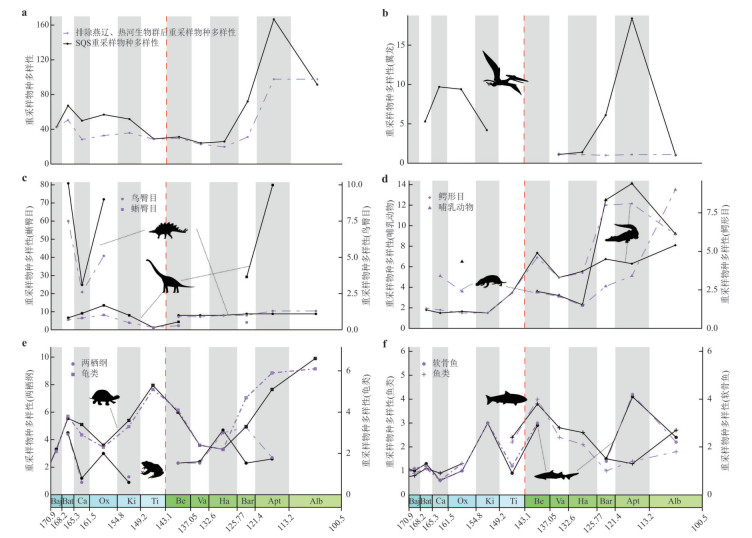
图 1 晚侏罗世至早白垩世亚洲地区陆地脊椎动物重采样物种多样性变化
a.亚洲地区所有陆地脊椎动物出现点数据重采样物种多样性(q=0.3);b.翼龙重采样物种多样性;c.蜥臀目(方形)和鸟臀目(圆形)重采样物种多样性;d.鳄形目(菱形)和哺乳动物(三角形)重采样物种多样性;e.两栖类(圆形)和龟类(方形)重采样物种多样性;f.软骨鱼类(圆形)和其它鱼类(十字形)重采样物种多样性;黑色实线代表所有出现点数据重采样结果,紫色虚线代表排除热河、燕辽生物群后重采样结果;Baj. 巴柔阶;Bat. 巴通阶;Ca. 卡洛夫阶;Ox. 牛津阶;Ki. 钦莫利阶;Ti. 提塘阶;Be. 贝里阿斯阶;Va. 瓦兰今阶;Ha. 欧特里夫阶;Bar. 巴雷姆阶;Apt. 阿普特阶;Alb. 阿尔布阶
Fig. 1. Subsampled diversity of terrestrial vertebrates in Asia from the Late Jurassic to the Early Cretaceous
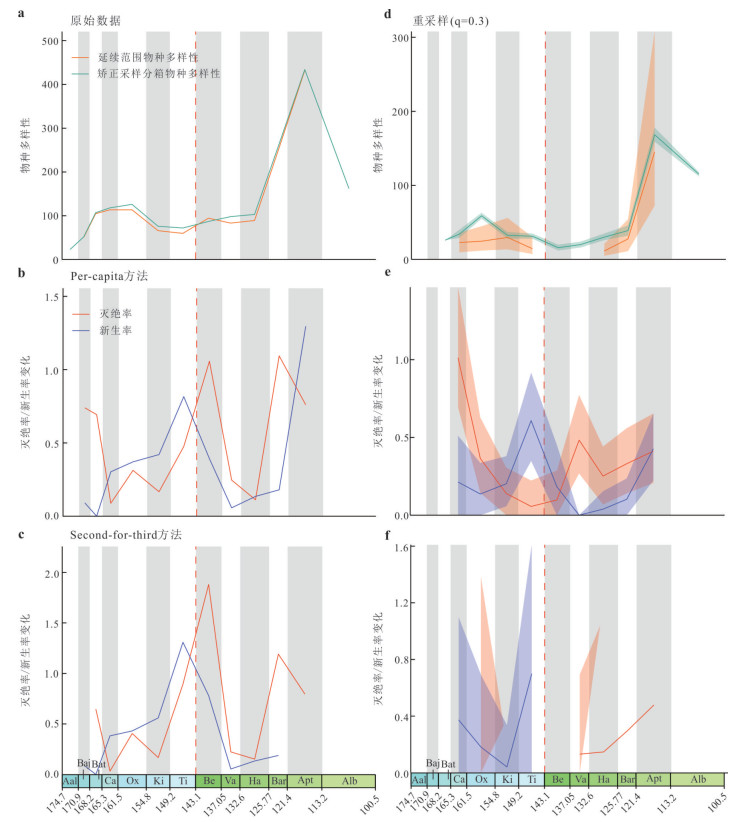
图 2 晚侏罗世至早白垩世亚洲地区陆地脊椎动物原始数据与重采样后物种多样性与新生率、灭绝率变化
a~c.使用原始数据所得物种多样性与新生率、灭绝率变化;d~f.重采样(q=0.3)后所得物种多样性与新生率、灭绝率变化,淡色区域为95%置信区间;a,d. 基于延续范围(橙色实线;假设物种在其首次和末次出现之间连续存在,即使中间阶段没有采样到,也被视为仍存在)与矫正采样分箱(绿色实线;仅统计在特定时间箱中实际采集到的化石种类,但通过统计方法对采样量差异进行校正)的物种多样性曲线;b,e. 使用per-capita方法计算的灭绝率与新生率. 红色为灭绝率,蓝色为新生率;c,f. 使用second-for-third方法计算的灭绝率与新生率;红色为灭绝率,蓝色为新生率;Aal. 阿林阶;Baj. 巴柔阶;Bat. 巴通阶;Ca. 卡洛夫阶;Ox. 牛津阶;Ki. 钦莫利阶;Ti. 提塘阶;Be. 贝里阿斯阶;Va. 瓦兰今阶;Ha. 欧特里夫阶;Bar. 巴雷姆阶;Apt. 阿普特阶;Alb. 阿尔布阶
Fig. 2. Changes in species diversity, speciation and extinction rate of Asian terrestrial vertebrates from the Late Jurassic to the Early Cretaceous based on raw and subsampled data
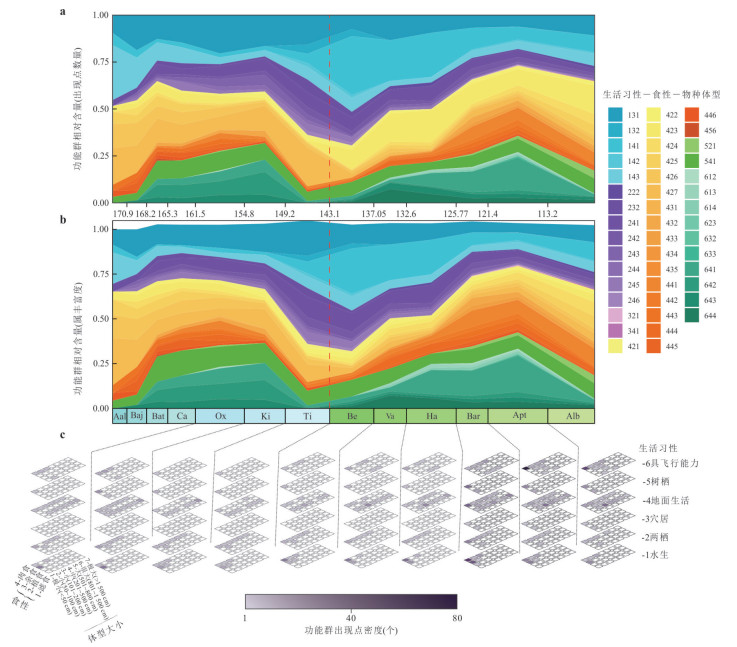
图 3 晚侏罗世至早白垩世亚洲地区陆地生物空间格子与各功能群相对含量
a.功能群相对含量,以出现点数量为计数;b.功能群相对含量,以属数量为计数;c. 空间格子分布随时间变化,以出现点数量为计数;Aal. 阿林阶;Baj. 巴柔阶;Bat. 巴通阶;Ca. 卡洛夫阶;Ox. 牛津阶;Ki. 钦莫利阶;Ti. 提塘阶;Be. 贝里阿斯阶;Va. 瓦兰今阶;Ha. 欧特里夫阶;Bar. 巴雷姆阶;Apt. 阿普特阶;Alb. 阿尔布阶
Fig. 3. Relative abundanceand ecospace cubesof functional groups of Asian terrestrial species from the Late Jurassic to the Early Cretaceous
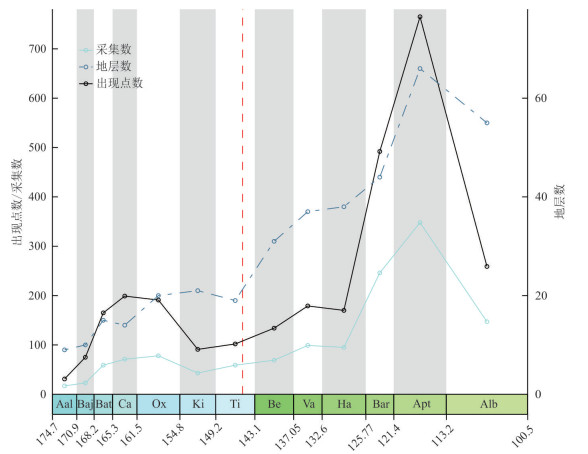
图 4 晚侏罗世至早白垩世亚洲地区地层数以及采集数和出现点数分布
Aal. 阿林阶;Baj. 巴柔阶;Bat. 巴通阶;Ca. 卡洛夫阶;Ox. 牛津阶;Ki. 钦莫利阶;Ti. 提塘阶;Be. 贝里阿斯阶;Va. 瓦兰今阶;Ha. 欧特里夫阶;Bar. 巴雷姆阶;Apt. 阿普特阶;Alb. 阿尔布阶
Fig. 4. Distribution of the count of formations, collections, and occurrences of Asian terrestrial vertebrates from the Late Jurassic to the Early Cretaceous
表 1 陆地生物生态特征划分标准
Table 1. Classification Criteria for Ecological Characteristics of Terrestrial Organisms
生态特征 描述 例子 生活习性(tiering) 1-水生(aquatic) 在水中繁殖,生活 鱼类 2-两栖(amphibious) 能短暂离开水体,但依然依靠水体繁殖 肺鱼和两栖类 3-穴居(troglobitic) 在地下生活(例如洞穴) 少数哺乳动物 4-地面生活(ground dwelling) 地面上生活 大部分爬行动物,部分哺乳动物 5-树上生活(arboreal) 大部分时间在高植被上生活 大部分哺乳动物 6-空中生活(aerial) 大量时间在空中,且需要利用飞行完成日常活动 鸟类、翼龙 食性(diet) 1-滤食性(filter feeding) 通过滤食水体中的食物颗粒存活 翼龙 2-植食性(herbivore) 以植物作为主要能量来源 部分哺乳动物,爬行类 3-杂食性(omnivore) 以动物组织,植物为食 部分哺乳动物,爬行类 4-肉食性(carnivore) 通过腐食、捕食到的动物组织作为主要能量来源 爬行类,哺乳动物,鱼类 体型(size of body) 1-非常小(tiny) < 50 cm 鱼类,哺乳动物,青蛙 2-很小(very small) 50~100 cm 部分爬行类,哺乳动物 3-小(small) 101~200 cm 部分爬行类 4-中(medium) 201~500 cm 部分爬行类 5-大(large) 501~800 cm 爬行类,以恐龙为主 6-很大(very large) 801~1 500 cm 爬行类,以恐龙为主 7-非常大(extremely large) > 1 500 cm 爬行类,以蜥臀目恐龙为主  下载: 导出CSV
表 2 各门类生物多样性与环境因子之间的模型拟合关系
Table 2. Biodiversity-environment relationships modeled for different taxonomic group
种群 环境因子 Spearman Pearson AICc Rho P值 r P值 AICc 权重 对数似然 翼龙 海平面变化 0.561 0.116 0.497 0.173 67.589 0.152 -28.395 鸟臀目 温度 -0.597 0.090 -0.781 0.013 52.747 0.716 -20.973 蜥臀目 裸子植物 -0.817 0.011 -0.772 0.015 67.555 0.493 -28.378 温度 -0.717 0.037 -0.743 0.022 68.469 0.312 -28.834 哺乳类 温度 -0.496 0.175 -0.608 0.082 60.137 0.296 -24.668 鳄形目 裸子植物 0.862 0.003 0.944 0.000 35.387 0.949 -12.293 龟类 二氧化碳浓度 -0.644 0.061 -0.660 0.053 45.781 0.271 -17.490 亚洲大陆极移 -0.610 0.108 -0.572 0.138 44.404 0.539 -16.202 鱼类 裸子植物 0.812 0.008 0.895 0.001 54.255 0.809 -21.728 软骨鱼 被子植物 0.753 0.019 0.659 0.053 36.874 0.301 -13.037 地层数 0.596 0.090 0.645 0.061 37.170 0.260 -13.185 裸子植物 0.596 0.090 0.621 0.074 37.624 0.207 -13.412
下载: 导出CSV
-
Alroy, J., 2010. Geographical, Environmental and Intrinsic Biotic Controls on Phanerozoic Marine Diversification: Controls on Phanerozoic Marine Diversification. Palaeontology, 53(6): 1211-1235. https://doi.org/10.1111/j.1475-4983.2010.01011.x Alroy, J., 2020. On Four Measures of Taxonomic Richness. Paleobiology, 46(2): 158-175 doi: 10.1017/pab.2019.40 Bambach, R. K., Bush, A. M., Erwin, D. H., 2007. Autecology and the Filling of Ecospace: Key Metazoan Radiations. Palaeontology, 50(1): 1-22. https://doi.org/10.1111/j.1475-4983.2006.00611.x Benson, R. B. J., Frigot, R. A., Goswami, A., et al., 2014. Competition and Constraint Drove Cope's Rule in the Evolution of Giant Flying Reptiles. Nature Communications, 5: 3567. https://doi.org/10.1038/ncomms4567 Benton, M. J., 2024. The Dinosaur Boom in the Cretaceous. Geological Society, London, Special Publications, 544(1): 453-475. https://doi.org/10.1144/sp544-2023-70 Bush, A. M., Bambach, R. K., Daley, G. M., 2007. Changes in Theoretical Ecospace Utilization in Marine Fossil Assemblages between the Mid-Paleozoic and Late Cenozoic. Paleobiology, 33(1): 76-97. https://doi.org/10.1666/06013.1 Butler, R. J., Benson, R. B. J., Barrett, P. M., 2013. Pterosaur Diversity: Untangling the Influence of Sampling Biases, Lagerstätten, and Genuine Biodiversity Signals. Palaeogeography, Palaeoclimatology, Palaeoecology, 372: 78-87. https://doi.org/10.1016/j.palaeo.2012.08.012 Butler, R. J., Benson, R. B. J., Carrano, M. T., et al., 2011. Sea Level, Dinosaur Diversity and Sampling Biases: Investigating the 'common Cause' Hypothesis in the Terrestrial Realm. Proceedings: Biological Sciences, 278(1709): 1165-1170. Castillo-Visa, O., Luján, À. H., Galobart, À., et al., 2022. A Gigantic Bizarre Marine Turtle (Testudines: Chelonioidea) from the Middle Campanian (Late Cretaceous) of South-Western Europe. Scientific Reports, 12: 18322. https://doi.org/10.1038/s41598-022-22619-w Chen, Z. Q., Benton, M. J., 2012. The Timing and Pattern of Biotic Recovery Following the End-Permian Mass Extinction. Nature Geoscience, 5(6): 375-383. https://doi.org/10.1038/ngeo1475 Cribb, A. T., Formoso, K. K., Woolley, C. H., et al., 2023. Contrasting Terrestrial and Marine Ecospace Dynamics after the End-Triassic Mass Extinction Event. Proceedings of the Royal Society B: Biological Sciences, 290(2012): 20232232. https://doi.org/10.1098/rspb.2023.2232 Foster, G. L., Royer, D. L., Lunt, D. J., 2017. Future Climate Forcing Potentially without Precedent in the last 420 Million Years. Nature Communications, 8: 14845. https://doi.org/10.1038/ncomms14845 Hammer, O., Harper, D. A. T., Ryan, P. D., et al., 2001. PAST: Paleontological Statistics Software Package for Education and Data Analysis. Palaeontol Electron, 4(1): 1-9 Haq, B. U., 2014. Cretaceous Eustasy Revisited. Global and Planetary Change, 113: 44-58. https://doi.org/10.1016/j.gloplacha.2013.12.007 Hou, Y. F., Zhao, P., Qin, H. F., et al., 2024. Completing the Loop of the Late Jurassic-Early Cretaceous True Polar Wander Event. Nature Communications, 15: 2183. https://doi.org/10.1038/s41467-024-46466-7 Huang, Y. G., Chen, Z. Q., Roopnarine, P. D., et al., 2021. Ecological Dynamics of Terrestrial and Freshwater Ecosystems across Three Mid-Phanerozoic Mass Extinctions from Northwest China. Proceedings of the Royal Society B: Biological Sciences, 288(1947): rspb. 2021.0148. https://doi.org/10.1098/rspb.2021.0148 Huang, Y. G., Chen, Z. Q., Roopnarine, P. D., et al., 2023. The Stability and Collapse of Marine Ecosystems during the Permian-Triassic Mass Extinction. Current Biology, 33(6): 1059-1070.e4. https://doi.org/10.1016/j.cub. 2023. 02.007 doi: 10.1016/j.cub.2023.02.007 Huang, Y. G., Xin, B. L., Guo, Z., et al., 2025. Modeling Method Enhances Temporal Resolution of Deep-Time Food Web Stability Evolution: a Case Study on Permian-Triassic Ecological Record from the Meishan Section. Earth Science, 50(3): 951-963(in Chinese with English abstract). Judd, E. J., Tierney, J. E., Lunt, D. J., et al., 2024. A 485-Million-Year History of Earth's Surface Temperature. Science, 385(6715): eadk3705. https://doi.org/10.1126/science.adk3705 Kirkland, J. I., Sertich, J. J. W., Titus, A. L., 2025. Dinosaur Biostratigraphy of the Non-Marine Cretaceous of Utah. Geological Society, London, Special Publications, 545(1): 65-90. https://doi.org/10.1144/sp545-2023-211 Kocsis, Á. T., Reddin, C. J., Alroy, J., et al., 2019. The r Package divDyn for Quantifying Diversity Dynamics Using Fossil Sampling Data. Methods in Ecology and Evolution, 10(5): 735-743. https://doi.org/10.1111/2041-210X. 13161 doi: 10.1111/2041-210X.13161 Lehtonen, S., Silvestro, D., Karger, D. N., et al., 2017. Environmentally Driven Extinction and Opportunistic Origination Explain Fern Diversification Patterns. Scientific Reports, 7: 4831. https://doi.org/10.1038/s41598-017-05263-7 Mannion, P. D., Benson, R. B. J., Carrano, M. T., et al., 2015. Climate Constrains the Evolutionary History and Biodiversity of Crocodylians. Nature Communications, 6: 8438. https://doi.org/10.1038/ncomms9438 Mannion, P. D., Upchurch, P., Carrano, M. T., et al., 2011. Testing the Effect of the Rock Record on Diversity: a Multidisciplinary Approach to Elucidating the Generic Richness of Sauropodomorph Dinosaurs through Time. Biological Reviews, 86(1): 157-181. https://doi.org/10.1111/j.1469-185X.2010.00139.x Meiri, S., 2011. Bergmann's Rule: What's in a Name? Global Ecology and Biogeography, 20(1): 203-207. https://doi.org/10.1111/j.1466-8238.2010.00577.x Melott, A. L., Bambach, R. K., 2014. Analysis of Periodicity of Extinction Using the 2012 Geological Timescale. Paleobiology, 40(2): 177-196. https://doi.org/10.1666/13047 Miller, K. G., Kominz, M. A., Browning, J. V., et al., 2005. The Phanerozoic Record of Global Sea-Level Change. Science, 310(5752): 1293-1298. https://doi.org/10.1126/science.1116412 Nicholson, D. B., Holroyd, P. A., Benson, R. B. J., et al., 2015. Climate-Mediated Diversification of Turtles in the Cretaceous. Nature Communications, 6: 7848. https://doi.org/10.1038/ncomms8848 O'Connor, J., Zheng, X. T., Dong, L. P., et al., 2019. Microraptor with Ingested Lizard Suggests Non-Specialized Digestive Function. Current Biology, 29(14): 2423-2429.e2. https://doi.org/10.1016/j.cub.2019.06.020 Pan, Y. H., Sha, J. G., Zhou, Z. H., et al., 2013. The Jehol Biota: Definition and Distribution of Exceptionally Preserved Relicts of a Continental Early Cretaceous Ecosystem. Cretaceous Research, 44: 30-38. https://doi.org/10.1016/j.cretres.2013.03.007 Reeves, J. C., Moon, B. C., Benton, M. J., et al., 2021. Evolution of Ecospace Occupancy by Mesozoic Marine Tetrapods. Palaeontology, 64(1): 31-49. https://doi.org/10.1111/pala.12508 Remane, J., 1991. The Jurassic-Cretaceous Boundary: Problems of Definition and Procedure. Cretaceous Research, 12(5): 447-453. https://doi.org/10.1016/0195-6671(91)90001-S Ren, W. X., Hu, B., Tang, D. L., et al., 2025. Palynological Assemblage and Its Significance of the Lower Cretaceous Chijinbao Formation in the Zhongkouzi Basin, Beishan Area. Earth Science, 50(3): 1234-1249(in Chinese with English abstract). Renne, P. R., Ernesto, M., Pacca, I. G., et al., 1992. The Age of Parana Flood Volcanism, Rifting of Gondwanaland, and the Jurassic-Cretaceous Boundary. Science, 258(5084): 975-979. https://doi.org/10.1126/science. 258. 5084.975 doi: 10.1126/science.258.5084.975 Rogov, M. A., Zakharov, V. A., Nikitenko, B. L., 2010. The Jurassic-Cretaceous Boundary Problem and the Myth on J/K Boundary Extinction. Earth Sci. Front, 17: 13-14. Rong, J. Y., Huang, B., 2014. Thirty Years' Research on Biological Extinction. Scientia Sinica (Terrae), 44(3): 377-404(in Chinese with English abstract). doi: 10.1360/zd-2014-44-3-377 Shen, S. Z., Zhang, H., 2017. What Caused the Five Mass Extinctions? Chinese Science Bulletin, 62(11): 1119-1135(in Chinese with English abstract). doi: 10.1360/N972017-00013 Tennant, J. P., Mannion, P. D., Upchurch, P., 2016a. Environmental Drivers of Crocodyliform Extinction across the Jurassic/Cretaceous Transition. Proceedings of the Royal Society B: Biological Sciences, 283(1826): 20152840. https://doi.org/10.1098/rspb.2015.2840 Tennant, J. P., Mannion, P. D., Upchurch, P., 2016b. Sea Level Regulated Tetrapod Diversity Dynamics through the Jurassic/Cretaceous Interval. Nature Communications, 7: 12737. https://doi.org/10.1038/ncomms12737 Tennant, J. P., Mannion, P. D., Upchurch, P., et al., 2017. Biotic and Environmental Dynamics through the Late Jurassic-Early Cretaceous Transition: Evidence for Protracted Faunal and Ecological Turnover. Biological Reviews, 92(2): 776-814. https://doi.org/10.1111/brv. 12255 doi: 10.1111/brv.12255 Upchurch, P., Mannion, P. D., Benson, R. B. J., et al., 2011. Geological and Anthropogenic Controls on the Sampling of the Terrestrial Fossil Record: a Case Study from the Dinosauria. Geological Society, London, Special Publications, 358(1): 209-240. https://doi.org/10.1144/sp358.14 van der Meer, D. G., Scotese, C. R., Mills, B. J. W., et al., 2022. Long-Term Phanerozoic Global Mean Sea Level: Insights from Strontium Isotope Variations and Estimates of Continental Glaciation. Gondwana Research, 111: 103-121. https://doi.org/10.1016/j.gr.2022.07.014 Van der Voo, R., Spakman, W., Bijwaard, H., 1999. Mesozoic Subducted Slabs under Siberia. Nature, 397(6716): 246-249. https://doi.org/10.1038/16686 Wilberg, E. W., Turner, A. H., Brochu, C. A., 2019. Evolutionary Structure and Timing of Major Habitat Shifts in Crocodylomorpha. Scientific Reports, 9: 514. https://doi.org/10.1038/s41598-018-36795-1 Yi, Z. Y., Liu, Y. Q., Meert, J. G., 2019. A True Polar Wander Trigger for the Great Jurassic East Asian Aridification. Geology, 47(12): 1112-1116. https://doi.org/10.1130/g46641.1 Yu, Y. L., Zhang, C., Xu, X., 2023. Complex Macroevolution of Pterosaurs. Current Biology, 33(4): 770-779.e4. https://doi.org/10.1016/j.cub.2023.01.007 Zhou, Z. H., Barrett, P. M., Hilton, J., 2003. An Exceptionally Preserved Lower Cretaceous Ecosystem. Nature, 421(6925): 807-814. https://doi.org/10.1038/nature01420 Zhou, Z. H., Meng, Q. R., Zhu, R. X., et al., 2021. Spatiotemporal Evolution of the Jehol Biota: Responses to the North China Craton Destruction in the Early Cretaceous. Proceedings of the National Academy of Sciences of the United States of America, 118(34): e2107859118. https://doi.org/10.1073/pnas.2107859118 Zhou, Z. H., Wang, Y., 2010. Vertebrate Diversity of the Jehol Biota as Compared with Other Lagerstätten. Science China Earth Sciences, 53(12): 1894-1907. https://doi.org/10.1007/s11430-010-4094-9 Zhou, Z. H., Wang, Y., 2017. Vertebrate Assemblages of the Jurassic Yanliao Biota and the Early Cretaceous Jehol Biota: Comparisons and Implications. Palaeoworld, 26(2): 241-252. https://doi.org/10.1016/j.palwor.2017.01.002 Zhu, R. X., Zhou, Z. H., Meng, Q. R., 2020. Destruction of the North China Craton and Its Influence on Surface Geology and Terrestrial Biotas. Chinese Science Bulletin, 65(27): 2955-2965, 2954(in Chinese with English abstract). 黄元耕, 辛佰仑, 郭镇, 等, 2025. 计算模拟方法提高深时食物网稳定性演变的时间分辨率: 以煤山剖面二叠纪-三叠纪生态记录为例. 地球科学, 50(3): 951-963. doi: 10.3799/dqkx.2025.022 任文秀, 胡斌, 唐德亮, 等, 2025. 北山地区中口子盆地下白垩统赤金堡组孢粉组合及其意义. 地球科学, 50(3): 1234-1249. doi: 10.3799/dqkx.2022.237 戎嘉余, 黄冰, 2014. 生物大灭绝研究三十年. 中国科学: 地球科学, 44(3): 377-404. 沈树忠, 张华, 2017. 什么引起五次生物大灭绝? 科学通报, 62(11): 1119-1135. 朱日祥, 周忠和, 孟庆任, 2020. 华北克拉通破坏对地表地质与陆地生物的影响. 科学通报, 65(27): 2955-2965, 2954. -
 喻宇宸附件2-原始数据.xlsx
 喻宇宸附件1-环境因子与各种群拟合情况.xlsx
喻宇宸ES-2025-0482_喻宇宸附件.docx
喻宇宸附件1-环境因子与各种群拟合情况.xlsx
喻宇宸ES-2025-0482_喻宇宸附件.docx
-

 点击查看大图
计量
- 文章访问数: 188
- HTML全文浏览量: 56
- PDF下载量: 19
- 被引次数: 0
