




Genesis of Garnet in Calc-Alkaline Volcanic Rocks from Xishan Complex in Nanling Region, and Its Geological Significance
-
摘要: 保存在钙碱性火山岩中的石榴子石不仅可以限定岩浆结晶的温压条件,而且可以揭示寄主岩浆的演化历史,具有重要的成因意义. 然而,全球范围内产出在钙碱性火山岩中的石榴子石非常稀少,且目前对于该类岩石中石榴子石的成因还存在很大争议. 西山侏罗纪含榴英安岩中产出了岩浆型、变质型、转熔型3种成因石榴子石晶体. 岩浆型石榴子石,多数以单晶形式存在,不发育反应边,成分上贫MgO(0.92%~2.37%)、CaO(1.21%~2.85%)、MnO(0.82%~1.64%),富FeO(36.01%~39.82%);变质型石榴子石,发育钠长石反应边,成分上富MgO(7.42%~8.46%)、FeO(27.80%~30.99%),贫CaO(1.32%~1.33%)、MnO(0.56%~0.60%);转熔型石榴子石,MgO(2.89%~3.55%)、FeO(34.57%~37.39%)、CaO(2.08%~2.51%)、MnO(0.72%~1.17%)含量介于岩浆型、变质型石榴子石之间. 在稀土元素组成上,三类石榴子石均显示出LREE强烈亏损的特征,但岩浆型石榴子石富集HREE,Eu负异常(Eu/Eu*=0.004~0.005)最显著;变质型石榴子石亏损HREE,稀土元素总含量(∑REE=64×10-6~72×10-6)明显低于岩浆型石榴子石(∑REE=681×10-6~906×10-6),具弱负Eu异常(Eu/Eu*=0.24);转熔型石榴子石稀土元素特征总体上介于岩浆型、变质型石榴子石之间(∑REE=673×10-6~2 731×10-6;Eu/Eu*=0.02~0.03),且含量变化范围较大. 岩相学、矿物化学等特征一致表明西山含榴英安岩中的岩浆型石榴子石是下地壳高温(740~959 ℃)、高压(> 7 kbar)、低氧逸度logfO2(-23.67~-12.32)岩浆演化早期结晶的产物;变质型石榴子石是在岩浆型石榴子石晶出之后,经由火山喷发作用从源岩捕获的变质晶体;转熔型石榴子石则是研究区下地壳变泥质岩减压部分熔融过程中,由黑云母脱水部分熔融形成的. 结合区域地质背景以及岩石中锆石、石榴子石Hf-O同位素等特征,认为西山含榴英安岩可能源于成熟度较高的变沉积岩,且形成于伸展构造背景.Abstract: Garnets preserved in calc-alkaline volcanic rocks can not only constrain the temperature and pressure conditions of magma crystallization, but also can reveal the evolution history of the host magma, presenting significant genetic implications. However, garnet occurring in calc-alkaline volcanic rocks is extremely rare globally, and there remain substantial controversies regarding the genesis of such garnets. In the Jurassic garnet-bearing dacite from Xishan complex, three genetic types of garnet crystals coexist: magmatic garnet, metamorphic garnet and peritectic garnet. Magmatic garnets mostly occur as single crystals without reaction rims, characterized by low MgO (0.92%~2.37%), CaO (1.21%~2.85%), and MnO (0.82%~1.64%) contents, but high FeO (36.01%~39.82%) contents. Metamorphic garnets develop albite reaction rims. In terms of composition, they are rich in MgO (7.42%~8.46%) and FeO (27.80%~30.99%), and poor in CaO (1.32%~1.33%) and MnO (0.56%~0.60%). For peritectic garnets, the contents of MgO (2.89%~3.55%), FeO (34.57%~37.39%), CaO (2.08%~2.51%), and MnO (0.72%~1.17%) are all between those of the former two types. In terms of rare earth elements (REE), all three types of garnet exhibit strong depletion in light REE(LREE). Notably, magmatic garnets are enriched in heavy REE(HREE), with the most significant Eu negative anomaly (Eu/Eu*=0.004~0.005). Metamorphic garnets are depleted in HREE, and the total rare earth element content (∑REE=64×10-6~72×10-6) is significantly lower than those of the magmatic garnets (∑REE=681×10-6~906×10-6), with a weaker Eu negative anomaly (Eu/Eu*=0.24). The characteristics of rare earth element of peritectic garnets are generally between those of magmatic and metamorphic garnets (∑REE=673×10-6~2 731×10-6; Eu/Eu*=0.02~0.03), and the content variation range is relatively large. Petrographic and mineral chemical characteristics consistently indicate that the magmatic garnets in the garnet-bearing dacite from Xishan complex is a product of early crystallization during magma evolution under high-temperature (740~959 ℃), high-pressure (> 7 kbar), and low oxygen fugacity (logfO2: -23.67 to -12.32) conditions in the lower crust. In contrast, the metamorphic garnets are metamorphic crystal captured from the source rock by volcanic eruption after the former crystallized. The peritectic garnets were formed by partial melting of biotite dehydration during the decompression partial melting process of metapelitic rocks in the lower crust of the study area. Combining with the regional geological context and Hf-O isotopic characteristics of zircon and garnet, this study suggests that the Xishan garnet-bearing dacite may be derived from relatively mature metasedimentary rocks and formed in an extensional tectonic setting.
-
Key words:
- garnet /
- dacite /
- extensional tectonic setting /
- Xishan complex /
- Nanling Region /
- structural geology
-
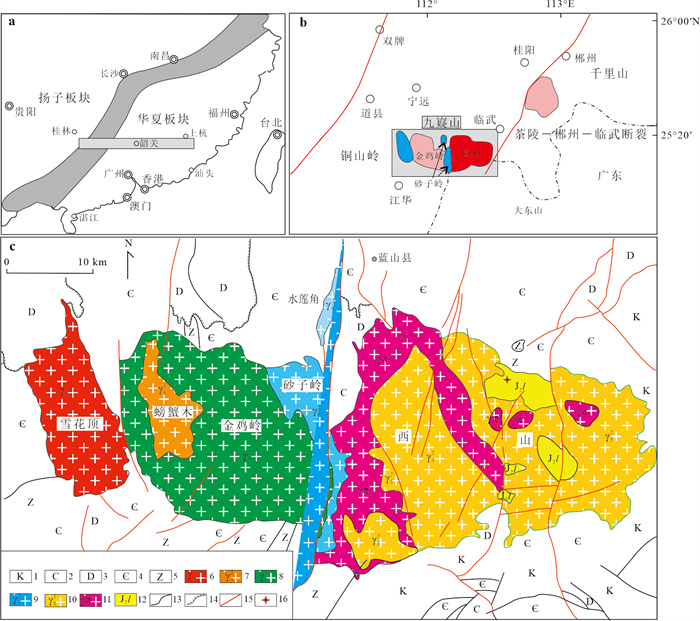
图 1 九嶷山复式岩体地质简图
1. 白垩系;2. 石炭系;3. 泥盆系;4. 寒武系;5. 震旦系;6. 志留纪花岗岩;7. 中侏罗世细粒斑状二长花岗岩;8. 中侏罗世粗中粒斑状正长花岗岩;9. 中侏罗世中细粒花岗闪长岩、二长花岗岩;10. 中侏罗世浅色碎斑熔岩;11. 中侏罗世黑色碎斑熔岩;12. 中侏罗世英安/流纹(斑)岩;13. 地质界线;14. 不整合界线;15. 断层;16. 采样点
Fig. 1. Simplified geological map of the Jiuyishan composite pluton
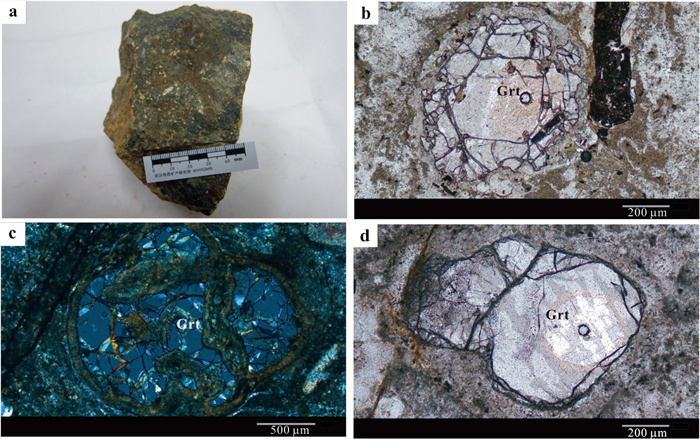
图 2 西山含榴英安岩手标本以及岩石中不同类型石榴子石显微照片
a. 含榴英安岩手标本;b. 类型Ⅰ石榴子石,晶体自形程度较好,整体形态相对完整,均发育裂隙,受熔蚀现象显著,部分晶体形态因熔蚀和破碎显得较为不规则,均无明显的反应边结构;c. 类型Ⅱ石榴子石,可见非常明显的反应边结构,反应边围绕石榴子石晶体生长,与石榴子石主体在光学特征、矿物组成方面均存在显著差异;d. 类型Ⅲ石榴子石,自形程度较差,晶体形态相对不规则,晶体轮廓较清晰,内部未见明显包裹矿物
Fig. 2. Hand specimen and microphotographs of different types of garnets in the garnet-bearing dacite from Xishan complex
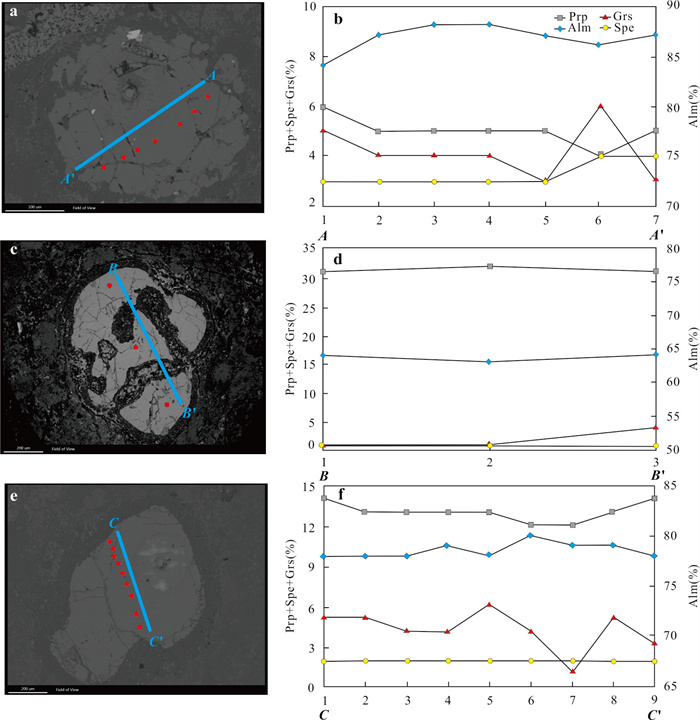
图 3 西山含榴英安岩中3种类型石榴子石EPMA端元成分剖面图
a,b. 类型Ⅰ石榴子石;c,d. 类型Ⅱ石榴子石;e,f. 类型Ⅲ石榴子石
Fig. 3. EPMA composition profiles of typical magmatic garnets in the garnet-bearing dacite from Xishan complex
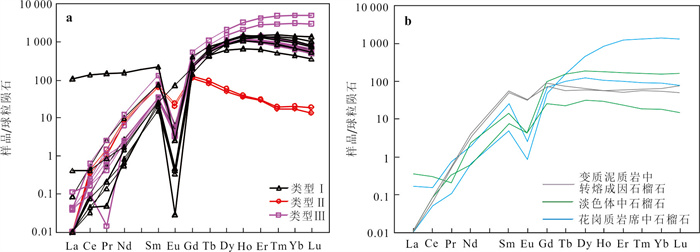
图 4 西山含榴英安岩中3种类型石榴子石球粒陨石标准化稀土配分图(a)和斯威士兰姆洪多谷变质岩套中转熔成因石榴子石标准化稀土配分图(b)
图b数据来源于Taylor and Stevens(2010);标准化值据Sun and McDonough(1989)
Fig. 4. Chondrite-normalized Rare Earth Element(REE) distribution patterns of three types of garnets in garnet-bearing dacite from Xishan complex (a) and peritectic garnets from the Mkhondo Valley Metamorphic Suite in Swaziland (b)
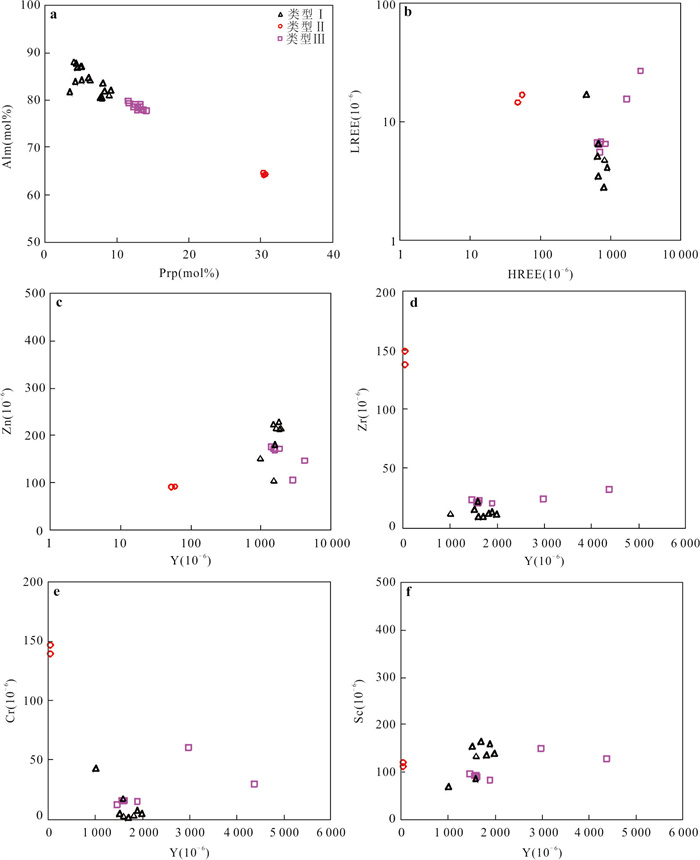
图 5 西山含榴英安岩中3种类型石榴子石代表性稀土、微量元素二元图解
Fig. 5. Binary diagrams of representative rare earth and trace elements of three types of garnets in the garnet-bearing dacite from Xishan complex
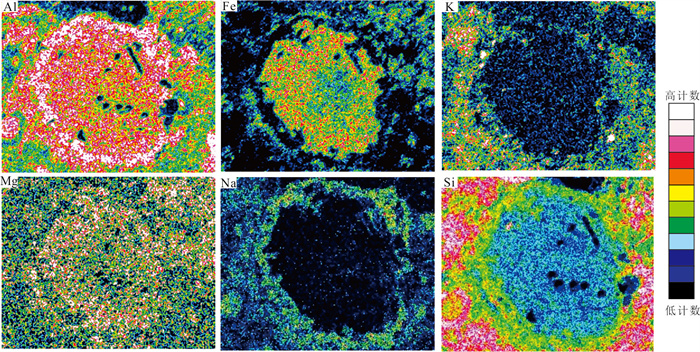
图 6 类型Ⅰ石榴子石能谱面扫描元素分布图
Fig. 6. Energy dispersive spectroscopy (EDS) surface scanning elemental distribution map of Type Ⅰ Garnet
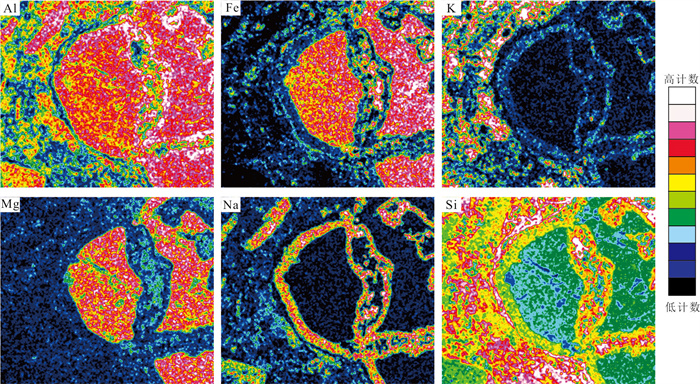
图 7 类型Ⅱ石榴子石能谱面扫描元素分布图
Fig. 7. Energy dispersive spectroscopy (EDS) surface scanning elemental distribution map of Type Ⅱ
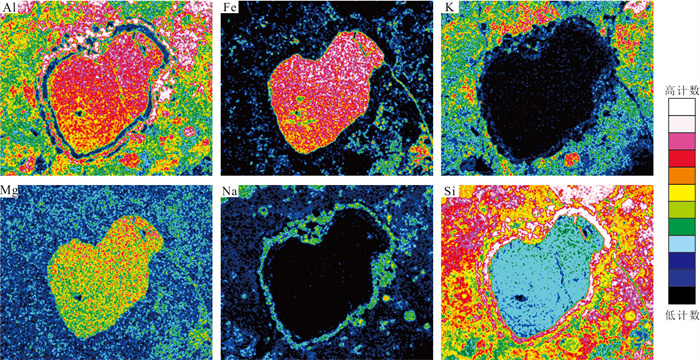
图 8 类型Ⅲ石榴子石能谱面扫描元素分布图
Fig. 8. Energy dispersive spectroscopy (EDS) surface scanning elemental distribution map of Type Ⅲ Garnet
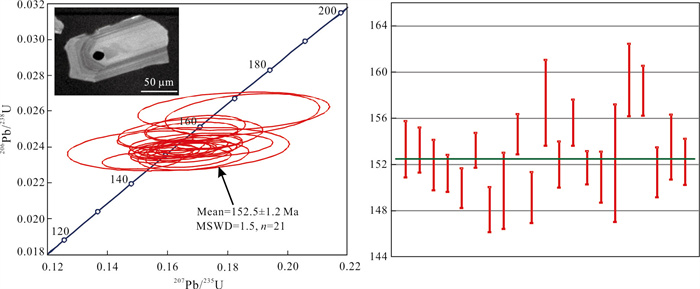
图 9 西山含榴英安岩LA-ICP-MS锆石U-Pb年龄谐和图及加权平均年龄图
Fig. 9. LA-ICP-MS zircon U-Pb concordia diagram and weighted mean age diagram for the garnet-bearing dacite from Xishan complex
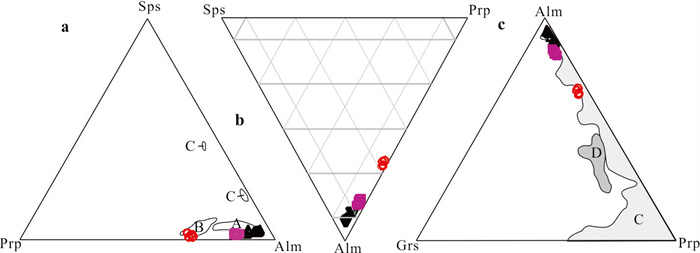
图 10 石榴子石分类三角图
a,b.引自Hamer et al.(1982);c. 引自Dahlquist et al.(2007);A. 火山岩浆中晶出的石榴子石组分;B. 变质成因的石榴子石组分;C. 深成侵入岩浆中晶出的石榴子石组分Alm. 铁铝榴石;Sps. 锰铝榴石;Grs. 钙铝榴石;Prp. 镁铝榴石;图例同图 5
Fig. 10. Triangular variation diagrams of garnet composition
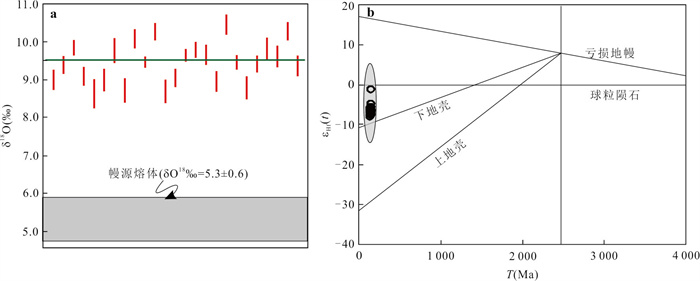
图 11 西山含榴英安岩δ18O‰加权平均图(a)和εHf(t)-T(Ma)图(b)
图b中阴影部分为南岭西段岩体分布范围(舒徐洁,2014)
Fig. 11. δ18O‰ weighted mean diagram (a) and εHf(t) vs. T(Ma) (b) diagram(b) of garnet-bearing dacite from Xishan complex
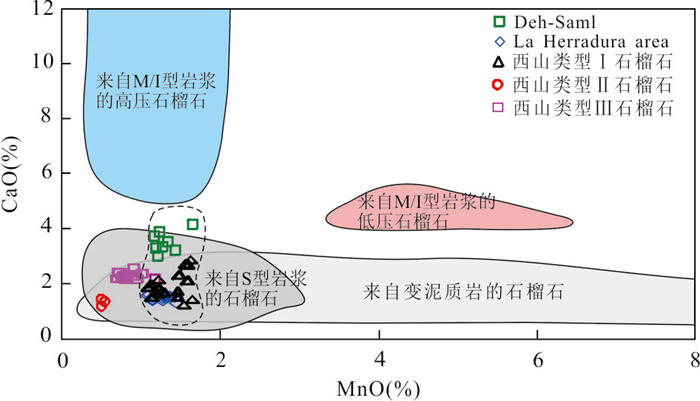
图 12 石榴子石MnO-CaO二元图解
底图引自Harangi et al.(2001);Deh-Saml和La Herradura地区的石榴子石数据分别引自Mirnejad et al.(2008b)和Sieck et al.(2019)
Fig. 12. MnO vs. CaO binary diagram of garnets
-
Abbott, R. N., 1981. The Role of Manganese in the Paragenesis of Magmatic Garnet: an Example from the Old Woman-Piute Range, California: a Discussion. The Journal of Geology, 89 (6): 767-769. https://doi.org/10.1086/628645 Allan, B. D., and Clarke, D. B., 1981. Occurrence and Origin of Garnets in the South Mountain Batholith, Nova Scotia. Canadian Mineralogist, 19(1): 19-24. https://doi.org/10.1007/BF01087170 Alonso-Perez, R., Müntener, O., Ulmer, P., 2009. Igneous Garnet and Amphibole Fractionation in the Roots of Island Arcs: Experimental Constraints on Andesitic Liquids. Contributions to Mineralogy and Petrology, 157(4): 541-558. https://doi.org/10.1007/s00410-008-0351-8 Bach, P., Smith, I. E. M., Malpas, J. G., 2012. The Origin of Garnets in Andesitic Rocks from the Northland Arc, New Zealand, and Their Implication for Sub-Arc Processes. Journal of Petrology, 53(6): 1169-1195. https://doi.org/10.1093/petrology/egs012 Baxter, E. F., Caddick, M. J., Dragovic, B., 2017. Garnet: a Rock-Forming Mineral Petrochronometer. Reviews in Mineralogy and Geochemistry, 83(1): 469-533. https://doi.org/10.2138/rmg.2017.83.15 Bizimis, M., Sen, G., Salters, V. J. M., et al., 2005. Hf-Nd-Sr Isotope Systematics of Garnet Pyroxenites from Salt Lake Crater, Oahu, Hawaii: Evidence for a Depleted Component in Hawaiian Volcanism. Geochimica et Cosmochimica Acta, 69(10): 2629-2646. https://doi.org/10.1016/j.gca.2005.01.005 Black, L. P., Kamo, S. L., Allen, C. M., et al., 2004. Improved 206Pb/238U Microprobe Geochronology by the Monitoring of a Trace-Element-Related Matrix Effect; SHRIMP, ID-TIMS, ELA-ICP-MS and Oxygen Isotope Documentation for a Series of Zircon Standards. Chemical Geology, 205(1/2): 115-140. https://doi.org/10.1016/j.chemgeo.2004.01.003 Caddick, M. J., Kohn, M. J., 2013. Garnet: Witness to the Evolution of Destructive Plate Boundaries. Elements, 9(6): 427-432. https://doi.org/10.2113/gselements.9.6.427 Caffe, P. J., Trumbull, R. B., Siebel, W., 2012. Petrology of the Coyaguayma Ignimbrite, Northern Puna of Argentina: Origin and Evolution of a Peraluminous High-SiO2 Rhyolite Magma. Lithos, 134: 179-200. https://doi.org/10.1016/j.lithos.2011.12.013 Carlson, W., Schwarze, E., 1997. Petrological Significance of Prograde Homogenization of Growth Zoning in Garnet: an Example from the Llano Uplift. Journal of Metamorphic Geology, 15(5): 631-644. https://doi.org/10.1111/j.1525-1314.1997.tb00640.x Chappell, B. W., White, A. J. R., 1974. Two Contrasting Granite Types. Pacific Geology, 8(1): 173-174. https://doi.org/10.1046/j.1440-0952.2001.00882.x Cheng, Z. G., Zhang, Z. C., Santosh, M., et al., 2017. Late Carboniferous to Early Permian Partial Melting of the Metasedimentary Rocks and Crustal Reworking in the Central Asian Orogenic Belt: Evidence from Garnet-Bearing Rhyolites in the Chinese South Tianshan. Lithos, 282: 373-387. https://doi.org/10.1016/j.lithos. 2017. 03.017 doi: 10.1016/j.lithos.2017.03.017 Cheng, Z. G., Zhang, Z. C., Santosh, M., et al., 2014. Carbonate- and Silicate-Rich Globules in the Kimberlitic Rocks of Northwestern Tarim Large Igneous Province, NW China: Evidence for Carbonated Mantle Source. Journal of Asian Earth Sciences, 95: 114-135. https://doi.org/10.1016/j.jseaes.2014.04.018 Clemens, J. D., Phillips, G. N., 2014. Inferring a Deep-Crustal Source Terrane from a High-Level Granitic Pluton: The Strathbogie Batholith, Australia. Contributions to Mineralogy and Petrology, 168(5): 1070. https://doi.org/10.1007/s00410-014-1070-y Coira, B., Kay, S. M., Viramonte, J. G., et al., 2018. Origin of Late Miocene Peraluminous Mn-Rich Garnet-Bearing Rhyolitic Ashes in the Andean Foreland (Northern Argentina). Journal of Volcanology and Geothermal Research, 364: 20-34. https://doi.org/10.1016/j.jvolgeores.2018.08.020 Dahlquist, J. A., Galindo, C., Pankhurst, R. J., et al., 2007. Magmatic Evolution of the Peñón Rosado Granite: Petrogenesis of Garnet-Bearing Granitoids. Lithos, 95(3/4): 177-207. https://doi.org/10.1016/j.lithos.2006.07.010 Das, S., Goswami, B., Basak, A., et al., 2020. A Grenvillian Magmatic Almandine Garnet-Bearing Ferroan Granite Intrusion in the Chhotanagpur Gneissic Complex, Eastern India: Petrology, Petrochemistry, Petrogenesis and Geodynamic Implications. Lithos, 376/377: 105749. https://doi.org/10.1016/j.lithos.2020.105749 Devoir, A., Bloch, E., Müntener, O., 2021. Residence Time of Igneous Garnet in Si-Rich Magmatic Systems: Insights from Diffusion Modeling of Major and Trace Elements. Earth and Planetary Science Letters, 560: 116771. https://doi.org/10.1016/j.epsl.2021.116771 Dong, J., Wei, C. J., Clarke, G. L., et al., 2018. Metamorphic Evolution during Deep Subduction and Exhumation of Continental Crust: Insights from Felsic Granulites in South Altyn Tagh, West China. Journal of Petrology, 59: 1965-1990. https://doi.org/10.1093/petrology/egy086 Dong, Z. X., 1997. Pyropes from China: Peridotite Xenoliths from Kimberlites versus Megacrysts in Basalts. International Geology Review, 39(2): 141-150. https://doi.org/10.1080/00206819709465264 Dorais, M. J., Campbell, S., 2023. An Oxygen Isotopic Study of Garnet and Zircon of the Flagstaff Lake Igneous Complex: Identification of Peritectic and Phenocrystic Garnet with Implications for the Petrogenesis of Strongly Peraluminous Granites. Lithos, 440: 107042. https://doi.org/10.1016/j.lithos.2023.107042 Feng, F., Xu, Z. Y., Dong, X. J., et al., 2022. Microstructure and Mineralogical Evidence for Peritectic Garnet in Thegarnet Granite in the Wulashan Area, Inner Mongolia. Acta Geologica Sinica, 96(11): 3819-3833 (in Chinese with English abstract). Ferrero, S., Wannhoff, I., Laurent, O., et al., 2021. Embryos of TTGS in Gore Mountain Garnet Megacrysts from Water-Fluxed Melting of the Lower Crust. Earth and Planetary Science Letters, 569: 117058. https://doi.org/10.1016/j.epsl.2021.117058 Fu, J. M., Ma, C. Q., Xie, C. F., et al., 2004. Geochemistry and Tectonic Setting of Xishan Aluminous A-Type Granitic Volcanic-Intrusive Complex, Southern Hunan. Journal of Earth Science and Enivronmental, 26(4): 15-23 (in Chinese with English abstract). Gadas, P., Novák, M., Talla, D., et al., 2013. Compositional Evolution of Grossular Garnet from Leucotonalitic Pegmatite at Ruda Nad Moravou, Czech Republic; A Complex EMPA, LA-ICP-MS, IR and CL Study. Mineralogy and Petrology, 107(2): 311-326. https://doi.org/10.1007/s00710-012-0232-8 Gao, L. E., Zeng, L. S., Zhao, L. H., et al., 2017. Multiphase Growth of Garnet in Gneisses from the Himalayan Orogenic Belt. Acta Petrologica Sinica, 33(12): 3729-3740 (in Chinese with English abstract). Gilbert, J. S., Rogers, N. W., 1989. The Significance of Garnet in the Permo-Carboniferous Volcanic Rocks of the Pyrenees. Journal of the Geological Society, 146(3): 477-490. https://doi.org/10.1144/gsjgs.146.3.0477 Gill, J. B., 1981. Orogenic Andesites and Plate Tectonics. Springer Science & Business Media, 390. https://doi.org/10.1016/0040-1951(82)90212-8 Green, D. H., Ringwood, A. E., 1972. A Comparison of Recent Experimental Data on the Gabbro-Garnet Granulite-Eclogite Transition. The Journal of Geology, 80(3): 277-288 doi: 10.1086/627731 Green, T. H., 1977. Garnet in Silicic Liquids and Its Possible Use as a P-T Indicator. Contributions to Mineralogy and Petrology, 65(1): 59-67. https://doi.org/10.1007/BF00373571 Guillot, S., Mahéo, G., de Sigoyer, J., et al., 2008. Tethyan and Indian Subduction Viewed from the Himalayan High- to Ultrahigh-Pressure Metamorphic Rocks. Tectonophysics, 451(1/2/3/4): 225-241. https://doi.org/10.1016/j.tecto.2007.11.059 Hamer, R. D., Moyes, A. B., 1982. Composition and Origin of Garnet from the Antarctic Peninsula Volcanic Group of Trinity Peninsula. Journal of the Geological Society, 139(6): 713-720. https://doi.org/10.1144/gsjgs.139.6.0713 Harangi, S., Downes, H., Kósa, L., et al., 2001. Almandine Garnet in Calc-Alkaline Volcanic Rocks of the Northern Pannonian Basin (Eastern-Central Europe): Geochemistry, Petrogenesis and Geodynamic Implications. Journal of Petrology, 42(10): 1813-1843. https://doi.org/10.1093/petrology/42.10.1813 He, C., Liu, W. B., Hu, W. J., et al., 2025. Petrogenesis and Geological Significance of Highly Differentiated A-Type Granites in Bankeng Pluton, Nanling Region, South China. Earth Science, 50(7): 2525-2547 (in Chinese with English abstract). doi: 10.3799/dqkx.2024.158 Hogan, J. P., 1996. Insights from Igneous Reaction Space: a Holistic Approach to Granite Crystallisation. Earth and Environmental Science Transactions of the Royal Society of Edinburgh, 87(1/2): 147-157. https://doi.org/10.1017/s0263593300006568 Hönig, S., Čopjaková, R., Škoda, R., et al., 2014. Garnet as a Major Carrier of the Y and REE in the Granitic Rocks: an Example from the Layered Anorogenic Granite in the Brno Batholith, Czech Republic. American Mineralogist, 99(10): 1922-1941. https://doi.org/10.2138/am-2014-4728 Hua, R. M., 2005. Differences between Rock-Forming and Related Ore-Forming Times for the Mesozoic Granitoids of Crust Remelting Types in the Nanling Range, South China, and Its Geological Significance. Geological Review, 51(6): 633-639 (in Chinese with English abstract). Huang, H. Q., Li, X. H., Li, W. X., et al., 2008. Age and Origin of the Dadongshan Granite from the Nanling Range: SHRIMP U-Pb Zircon Age, Geochemistry and Sr-Nd-Hf Isotopes. Geological Journal of China Universities, 14(3): 317-333 (in Chinese with English abstract). Ickert, R. B., Hiess, J., Williams, I. S., et al., 2008. Determining High Precision, in Situ, Oxygen Isotope Ratios with a SHRIMP Ⅱ: Analyses of MPI-DING Silicate-Glass Reference Materials and Zircon from Contrasting Granites. Chemical Geology, 257(1/2): 114-128. https://doi.org/10.1016/j.chemgeo.2008.08.024 Jiao, S. J., Guo, J. H., and Peng, S. B. 2013. Petrogenesis of Garnet in the Darongshan-Shiwandashan Granitic Suite of the South China Block and the Metamorphism of the Granulite Enclave. Acta Petrologica Sinica, 29(5): 1740-1758 (in Chinese with English abstract). Kawabata, H., Takafuji, N., 2005. Origin of Garnet Crystals in Calc-Alkaline Volcanic Rocks from the Setouchi Volcanic Belt, Japan. Mineralogical Magazine, 69(6): 951-971. https://doi.org/10.1180/0026461056960301 Kebede, T., Koeberl, C., Koller, F., 2001. Magmatic Evolution of the Suqii-Wagga Garnet-Bearing Two-Mica Granite, Wallagga Area, Western Ethiopia. Journal of African Earth Sciences, 32(2): 193-221. https://doi.org/10.1016/S0899-5362(01)90004-1 Lackey, J. S., Romero, G. A., Bouvier, A. S., et al., 2012. Dynamic Growth of Garnet in Granitic Magmas. Geology, 40(2): 171-174. https://doi.org/10.1130/g32349.1 Lantai, C., 1991. Genesis of Garnets from Andesite of Karanca Mountains. Acta Geologica Hungarica, 34: 133-154. Li, J. S., Zhang, J. J., Liu, W., et al., 2022. Mineralogical Characteristics and Constraints of Formation Conditions of Garnet in Kimberlite in Shizhuang Area, Southern He'nan Province. Geological Bulletin of China, 41(5): 824-835 (in Chinese with English abstract). Li, W. K., Cheng, Y. Q., Yang, Z. M., 2019. Geo-fO2: Integrated Software for Analysis of Magmatic Oxygen Fugacity. Geochemistry, Geophysics, Geosystems, 20(5): 2542-2555. https://doi.org/10.1029/2019gc008273 Liu, C. Q., Masuda, A., Xie, G. H., 1992. Isotope and Trace-Element Geochemistry of Alkali Basalts and Associated Megacrysts from the Huangyishan Volcano, Kuandian, Liaoning, NE China. Chemical Geology, 97(3/4): 219-231. https://doi.org/10.1016/0009-2541(92)90077-I Liu, Y. S., Hu, Z. C., Gao, S., et al., 2008. In Situ Analysis of Major and Trace Elements of Anhydrous Minerals by LA-ICP-MS without Applying an Internal Standard. Chemical Geology, 257(1/2): 34-43. https://doi.org/10.1016/j.chemgeo.2008.08.004 Lucci, F., Rossetti, F., Becchio, R., et al., 2018. Magmatic Mn-Rich Garnets in Volcanic Settings: Age and Longevity of the Magmatic Plumbing System of the Miocene Ramadas Volcanism (NW Argentina). Lithos, 322: 238-249. https://doi.org/10.1016/j.lithos.2018.10.016 Ludwig, K. R., 2003. User's Manual for a Geochronological Toolkit for Microsoft Excel(Isoplot/Ex version 3.0). Geochronology Center, Berkeley. Mahdy, N. M., Iizuka, T., Pease, V., et al., 2023. Origin, Dynamics, and Chemical Evolution of Garnet-Bearing Leucogranitic Magma, Eastern Desert of Egypt: Controls on the Rare-Metal Enrichment in the A-Type Magmatism. Geochemistry, 83(4): 126025. https://doi.org/10.1016/j.chemer.2023.126025 Meng, F. C., Tian, G. K., Duan, X. P., et al., 2018. Evidence from Garnet for Genesis of Garnet-Cordierite-Granite in the Jinshuikou Area, Eastern Segment of the East Kunlun Mountains. Bulletin of Mineralogy, Petrology and Geochemistry, 37(2): 192-204 (in Chinese with English abstract). Miller, C. F., Stoddard, E. F., 1981. The Role of Manganese in the Paragenesis of Magmatic Garnet: an Example from the Old Woman-Piute Range, California. The Journal of Geology, 89(2): 233-246 doi: 10.1086/628582 Mirnejad, H., Blourian, G. H., Kheirkhah, M., et al., 2008a. Garnet-Bearing Rhyolite from Deh-Salm Area, Lut Block, Eastern Iran: Anatexis of Deep Crustal Rocks. Mineralogy and Petrology, 94(3): 259-269. https://doi.org/10.1007/s00710-008-0015-4 Mirnejad, H., Blourian, G. H., Kheirkhah, M., et al., 2008b. Garnet-Bearing Rhyolite from Deh-Salm Area, Lut Block, Eastern Iran: Anatexis of Deep Crustal Rocks. Mineralogy and Petrology, 94(3): 259-269. https://doi.org/10.1007/s00710-008-0015-4 Mitropoulos, P., Katerinopoulos, A., Kokkinakis, A., 1999. Occurrence of Primary Almandine-Spessartine-Rich Garnet and Zinnwaldite Phenocrysts in a Neogene Rhyolite on the Island of Chios, Aegean Sea, Greece. Mineralogical Magazine, 63 (4): 503-510. https://doi.org/10.1180/002646199548673 Müller, A., Kearsley, A., Spratt, J., et al., 2012. Petrogenetic Implications of Magmatic Garnet in Granitic Pegmatites from Southern Norway. Canadian Mineralogist, 50 (4): 1095-1115. https://doi.org/10.3749/canmin.50.4.1095 Narduzzi, F., Farina, F., Stevens, G., et al., 2017. Magmatic Garnet in the Cordilleran-Type Galiléia Granitoids of the Araçuaí Belt (Brazil): Evidence for Crystallization in the Lower Crust. Lithos, 282: 82-97. https://doi.org/10.1016/j.lithos.2017.02.017 Patiño Douce, A. E., Harris, N., 1998. Experimental Constraints on Himalayan Anatexis. Journal of Petrology, 39(4): 689-710. https://doi.org/10.1093/petroj/39.4.689 Patranabis-Deb, S., Schieber, J., Basu, A., 2009. Almandine Garnet Phenocrysts in a ~1 Ga Rhyolitic Tuff from Central India. Geological Magazine, 146(1): 133-143. https://doi.org/10.1017/s0016756808005293 René, M., Stelling, J., 2007. Garnet-Bearing Granite from the Třebíč Pluton, Bohemian Massif (Czech Republic). Mineralogy and Petrology, 91(1): 55-69. https://doi.org/10.1007/s00710-007-0188-2 Rubatto, D., Hermann, J., 2007. Experimental Zircon/Melt and Zircon/Garnet Trace Element Partitioning and Implications for the Geochronology of Crustal Rocks. Chemical Geology, 241(1/2): 38-61. https://doi.org/10.1016/j.chemgeo. 2007.01.027 doi: 10.1016/j.chemgeo.2007.01.027 Samadi, R., Miller, N. R., Mirnejad, H., et al., 2014a. Origin of Garnet in Aplite and Pegmatite from Khajeh Morad in Northeastern Iran: a Major, Trace element, and Oxygen Isotope Approach. Lithos, 208: 378-392. https://doi.org/10.1016/j.lithos.2014.08.023 Samadi, R., Mirnejad, H., Kawabata, H., et al., 2014b. Magmatic Garnet in the Triassic (215 Ma) Dehnow Pluton of NE Iran and Its Petrogenetic Significance. International Geology Review, 56 (5): 596-621. https://doi.org/10.1080/00206814.2014.880659 Shu, X. J., 2014. Petrogenesis and Crustal Evolution of the Mesozoic Granites from Nanling, South China (Dissertation). Nanjing University, Nanjing (in Chinese with English abstract). Sieck, P., Rubén, L. D., Pablo, D. Harris., et al., 2019. Almandine Garnet-Bearing Rhyolites Associated to Bimodal Volcanism in the Mesa Central of Mexico: Geochemical, Petrological and Geochronological Evolution. Journal of South American Earth Sciences, 92: 310-328. https://doi.org/10.1016/j.jsames.2019.03.018 Stevens, G., Villaros, A., Moyen, J. F., 2007. Selective Peritectic Garnet Entrainment as the Origin of Geochemical Diversity in S-Type Granites. Geology, 35(1): 9-12. https://doi.org/10.1130/G22959A.1 Sun, S. S., McDonough, W. F., 1989. Chemical and Isotopic Systematics of Oceanic Basalts: Implications for Mantle Composition and Processes. Geological Society, London, Special Publications, 42(1): 313-345. https://doi.org/10.1144/gsl.sp.1989.042.01.19 Tacchetto, T., Bartoli, O., Cesare, B., et al., 2019. Multiphase Inclusions in Peritectic Garnet from Granulites of the Athabasca Granulite Terrane (Canada): Evidence of Carbon Recycling during Neoarchean Crustal Melting. Chemical Geology, 508: 197-209. https://doi.org/10.1016/j.chemgeo.2018.05.043 Taylor, J., Stevens, G., 2010. Selective Entrainment of Peritectic Garnet into S-Type Granitic Magmas: Evidence from Archaean Mid-Crustal Anatectites. Lithos, 120(3/4): 277-292. https://doi.org/10.1016/j.lithos.2010.08.015 Taylor, R. J. M., Harley, S. L., Hinton, R. W., et al., 2015. Experimental Determination of REE Partition Coefficients between Zircon, Garnet and Melt: a Key to Understanding High-T Crustal Processes. Journal of Metamorphic Geology, 33(3): 231-248. https://doi.org/10.1111/jmg. 12118 doi: 10.1111/jmg.12118 Tracy, R. J., Robinson, P., Thompson, A. B., 1976. Garnet Composition and Zoning in the Determination of Temperature and Pressure of Metamorphism, Central Massachusetts. American Mineralogist, 61(7-8): 762-775. Valley, J. W., Lackey, J. S., Hanchar, J. M., et al., 2005. Oxygen Isotope Evidence for Widespread Crustal Recycling in the Mantle. Geology, 33(9): 761-764. https://doi.org/10.1130/G21709.1 Villaros, A., Stevens, G., Moyen, J. F., et al., 2009. The Trace Element Compositions of S-Type Granites: Evidence for Disequilibrium Melting and Accessory Phase Entrainment in the Source. Contributions to Mineralogy and Petrology, 158(4): 543-561. https://doi.org/10.1007/s00410-009-0396-3 Wang, L. T., Yu, S. Y., Li, C. Z., et al., 2025. Peritectic Garnet Entrainment Obscures Iron Isotopic Fractionation during Crustal Anatexis: Evidence from Cogenetic TTG-Like Leucosomes and Tonalite Pluton. Lithos, 508/509: 108096. https://doi.org/10.1016/j.lithos.2025.108096 Wiedenbeck, M., Hanchar, J. M., Peck, W. H., et al., 2004. Further Characterisation of the 91500 Zircon Crystal. Geostandards and Geoanalytical Research, 28(1): 9-39. https://doi.org/10.1111/j.1751-908X.2004.tb01041.x Xi, Z., Liu, Q. Q., Wu, D. H., et al., 2024. Geochronology, Geochemistry and Tectonic Implications of Triassic A-Type Granites in Pingtian Area, Northern Guangdong. Earth Science, 49(7): 2508-2525 (in Chinese with English abstract). doi: 10.3799/dqkx.2023.010 Xia, Q. X., Wang, H. Z., Zhou, L. G., et al., 2016. Growth of Metamorphic and Peritectic Garnets in Ultrahigh-Pressure Metagranite during Continental Subduction and Exhumation in the Dabie Orogen. Lithos, 266/267: 158-181. https://doi.org/10.1016/j.lithos.2016.08.043 Xia, Q. X., 2019. Different Origins of Garnet in High to Ultrahigh Pressure Metamorphic Rocks. Earth Science, 44(12): 4042-4049 (in Chinese with English abstract). doi: 10.3799/dqkx.2019.235 Xu, L. J., Xiao, Y. L., Wu, F., et al., 2013. Anatomy of Garnets in a Jurassic Granite from the South-Eastern Margin of the North China Craton: Magma Sources and Tectonic Implications. Journal of Asian Earth Sciences, 78: 198-221. https://doi.org/10.1016/j.jseaes. 2012. 11.026 doi: 10.1016/j.jseaes.2012.11.026 Xu, X. S., 2008. Several Problems Worthy to be Noticed in the Research of Granites and Volcanic Rocks in SE China. Geological Journal of China Universities, 14(3): 283-294 (in Chinese with English abstract). Yan, L. L., He, Z. Y., 2022. Rejuvenation of Silicic Magmatic Systems: Insights from the Formation of Garnet-Bearing, Crystal-Rich Tuff in Southeast China. Lithos, 432: 106895. https://doi.org/10.1016/j.lithos.2022.106895 Yu, J. H., O'Reilly, S. Y., 2001. The Megacrysts of Almandine in Basalt of Yingfengling, Leizhou Peninsula and the Genesis of Its Parent Magma. Chinese Science Bulletin, 46(6): 492-497 (in Chinese) doi: 10.1007/BF03187265 Zeng, L. S., Asimow, P. D., Saleeby, J. B., 2005. Coupling of Anatectic Reactions and Dissolution of Accessory Phases and the Sr and Nd Isotope Systematics of Anatectic Melts from a Metasedimentary Source. Geochimica et Cosmochimica Acta, 69(14): 3671-3682. https://doi.org/10.1016/j.gca.2005.02.035 Zeng, L. S., Gao, L., Dong, C. Y., et al., 2012. High-Pressure Melting of Metapelite and the Formation of Ca-Rich Granitic Melts in the Namche Barwa Massif, Southern Tibet. Gondwana Research, 21(1): 138-151. https://doi.org/10.1016/j.gr.2011.07.023 Zhang, C. W., Yang, Y., Liu, Y. C., et al., 2023. UHP Metamorphism, Decompression Anatexis and Retrogression of Garnet-Bearing Metagranite and Granitic Gneiss from the Dabie Orogen during Continental Collision. Lithos, 456: 107339. https://doi.org/10.1016/j.lithos.2023.107339 Zhang, H. F., Lu, F. X., 2000. Major and Trace Elements of Garnet and Megacryst Garnet in Paleozoic Mantle Xenoliths from North China. Science in China (Series D), 30(2): 128-134 (in Chinese with English abstract). Zhang, J. Y., Ma, C. Q., She, Z. B., 2012. An Early Cretaceous Garnet-Bearing Metaluminous A-Type Granite Intrusion in the East Qinling Orogen, Central China: Petrological, Mineralogical and Geochemical Constraints. Geoscience Frontiers, 3(5): 635-646. https://doi.org/10.1016/j.gsf.2011.11.011 Zhang, X., Wang, M. T., Ma, Z. L., et al., 2025. Petrogenesis of Granitic Pegmatites in the Chinese Altay: Insights from Apatite, Garnet, and Quartz Geochemistry. Lithos, 516: 108250. https://doi.org/10.1016/j.lithos.2025.108250 Zhou, J. H., Feng, C. Y., Li, D. X., 2017. Geochemistry of the Garnets in the Baiganhu W-Sn Orefield, NW China. Ore Geology Reviews, 82: 70-92. https://doi.org/10.1016/j.oregeorev.2016.11.019 Zhou, L. G., Xia, Q. X., Zheng, Y. F., et al., 2011. Multistage Growth of Garnet in Ultrahigh-Pressure Eclogite during Continental Collision in the Dabie Orogen: Constrained by Trace Elements and U-Pb Ages. Lithos, 127(1/2): 101-127. https://doi.org/10.1016/j.lithos.2011.08.010 Zhou, L. T., Chen, J. F., Du, Y., et al., 2022. Monazite U-Pb Geochronology of Granites in the Shaping Tungsten Deposit, Western Nanling Metallogenic Belt and Its Geological Significance. South China Geology, 38(3): 486-495 (in Chinese with English abstract). Zhou, X. M., 2007. Genesis of Late Mesozoic Granites and Lithospheric Dynamic Evolution in the Nanling Region. Science Press, Beijing, 1-691 (in Chinese). Zhu, J. C., Chen, J., Wang, R. C., et al., 2008. Early Yanshanian NE Trending Sn/W-Bearing A-Type Granites in the Western-Middle Part of the Nanling Mts Region. Geological Journal of China Universities, 14(4): 474-484 (in Chinese with English abstract). Zhu, L., Chen, R. X., Zheng, Y. F., et al., 2022. Multistage Growth of Garnet Fingerprints the Behavior and Property of Metamorphic Fluids in a Paleotethyan Oceanic Subduction Zone. Lithos, 430/431: 106851. https://doi.org/10.1016/j.lithos.2022.106851 Zong, K. Q., Klemd, R., Yuan, Y., et al., 2017. The Assembly of Rodinia: The Correlation of Early Neoproterozoic (Ca. 900Ma) High-Grade Metamorphism and Continental Arc Formation in the Southern Beishan Orogen, Southern Central Asian Orogenic Belt (CAOB). Precambrian Research, 290: 32-48. https://doi.org/10.1016/j.precamres.2016.12.010 冯帆, 徐仲元, 董晓杰, 等, 2022. 内蒙古乌拉山地区石榴子石花岗岩中石榴子石转熔成因的显微结构及矿物学证据. 地质学报, 96(11): 3819-3833. 付建明, 马昌前, 谢才富, 等, 2004. 湘南西山铝质A型花岗质火山-侵入杂岩的地球化学及其形成环境. 地球科学与环境学报, 26(4): 15-23. 高利娥, 曾令森, 赵令浩, 等, 2017. 喜马拉雅造山带片麻岩中石榴子石的多期生长. 岩石学报, 33(12): 3729-3740. 何川, 刘文斌, 胡文洁, 等, 2025. 南岭半坑高分异A型花岗岩成因及其地质意义. 地球科学, 50(7): 2525-2547. doi: 10.3799/dqkx.2024.158 华仁民, 2005. 南岭中生代陆壳重熔型花岗岩类成岩-成矿的时间差及其地质意义. 地质论评, 51(6): 633-642. 黄会清, 李献华, 李武显, 等, 2008. 南岭大东山花岗岩的形成时代与成因——SHRIMP锆石U-Pb年龄、元素和Sr-Nd-Hf同位素地球化学. 高校地质学报, 14(3): 317-333. 焦淑娟, 郭敬辉, 彭松柏, 2013. 华南大容山——十万大山花岗岩体中石榴石成因以及麻粒岩包体变质作用研究. 岩石学报, 29(5): 1740-1758. 李积山, 张军杰, 刘伟, 等, 2022. 豫南史庄一带金伯利岩中石榴子石矿物学特征及其形成条件的约束. 地质通报, 41(5): 824-835. 孟繁聪, 田广阔, 段雪鹏, 等, 2018. 东昆仑东段金水口石榴堇青石花岗岩成因——石榴子石证据. 矿物岩石地球化学通报, 37(2): 192-204. 牛贺才, 张海祥, 单强, 等, 2007. 扎河坝石榴辉石岩中超硅-超钛石榴子石的发现及其地质意义. 科学通报. 52(18): 2169-2174. 舒徐洁, 2014. 华南南岭地区中生代花岗岩成因与地壳演化(博士学位论文). 南京: 南京大学. 席振, 刘清泉, 吴德华, 等, 2024. 粤北坪田地区三叠纪A型花岗岩年代学、地球化学及其构造意义. 地球科学, 49(7): 2508-2525. doi: 10.3799/dqkx.2023.010 夏琼霞, 2019. 高压-超高压变质岩石中不同成因的石榴石. 地球科学, 44(12): 4042-4049. doi: 10.3799/dqkx.2019.235 徐夕生, 2008. 华南花岗岩-火山岩成因研究的几个问题. 高校地质学报, 14(3): 283-294. 于津海, O'Reilly, S. Y., 2001. 雷州半岛英峰岭玄武岩中的铁铝榴石巨晶及母岩浆成因. 科学通报, 46(6): 492-497. 张宏福, 路风香, 2000. 华北古生代地幔岩捕虏体中石榴石和巨晶石榴石的主、微量元素. 中国科学(D辑), 30(2): 128-134. 周立同, 陈剑锋, 杜云, 等, 2022. 南岭西段沙坪钨矿区花岗岩独居石U-Pb定年及地质意义. 华南地质, 38(3): 486-495. 周新民, 2007. 南岭地区晚中生代花岗岩成因与岩石圈动力学演化. 北京: 科学出版社, 1-691. 朱金初, 陈骏, 王汝成, 等, 2008. 南岭中西段燕山早期北东向含锡钨A型花岗岩带. 高校地质学报, 14(4): 474-484. -
 丁丽雪附表.docx

-

 下载:
下载:
 点击查看大图
计量
- 文章访问数: 88
- HTML全文浏览量: 32
- PDF下载量: 11
- 被引次数: 0
