




Coupled Thermal-Hydraulic-Mechanism Simulation during Geological CO2 Storage in Heterogeneous Saline Aquifers
-
摘要: 深入理解储层非均质性及多场耦合效应对于准确评估封存过程中CO2运移、转化及封存机制具有重要意义.本文综合考虑了气-水两相流动机制、储层孔渗结构的动态演化及非等温条件下温度对CO2物性的影响,构建了热-水-气-力耦合模型,旨在探讨非均质咸水层中CO2的迁移动态与封存效率.模拟结果表明,储层非均质性对平均孔隙压力的积聚具有显著影响,低孔隙度地层中孔隙压力增幅约为1.96 MPa,而较高孔隙度地层中仅约为1.64 MPa,进而影响了CO2的物性参数与运移路径.同时,热锋的最大迁移距离仅约为161 m,而CO2羽流的最大横向迁移距离可达1 782 m.在CO2注入过程中,储层渗透率和孔隙度分别以1.01~1.13的比率和2.10%~12.8%的幅度变化,且低渗储层的孔渗结构对压力扰动更为敏感.在低渗非均质储层中,CO2最大封存效率系数约为0.88,显著高于高渗储层,证明了在此类地层中保持低于岩石破裂压力的注气速率有助于提升CO2的有效封存能力与长期稳定性.Abstract: A deep understanding of reservoir heterogeneity and multi-field coupling effects is important for assessing CO2 flow and migration behavior during geological CO2 storage. This study comprehensively considers the two-phase flow mechanism, the dynamic evolution of reservoir porosity and permeability structures, and the influence of temperature on the physical properties of CO2 under non-isothermal conditions. A thermal-hydraulic-gas-mechanical (THGM) coupled model is developed to investigate CO2 migration behavior and storage efficiency behavior in heterogeneous saline aquifers. Simulation results indicate that reservoir heterogeneity significantly influences average pressure build-up within the reservoir. In low-porosity reservoirs, the increase in pore pressure is approximately 1.96 MPa, whereas in higher-porosity reservoirs, it is only approximately 1.64 MPa, thereby affecting the physical properties and migration pathways of injected CO2. Additionally, the maximum migration distance of the thermal front is only approximately 161 m, while the maximum lateral migration distance of the CO2 plume can reach approximately 1 782 m. The permeability and porosity within the reservoir vary at a ratio of approximately 1.01-1.13 and an amplitude of 2.10%-12.8% during CO2 injection, respectively. The porosity and permeability of low-permeability reservoirs is more sensitive to pressure disturbances. The maximum CO2 storage efficiency factor reached approximately 0.88 in low-permeability heterogeneous reservoirs, significantly higher than those in high-permeability reservoirs, demonstrating that maintaining an injection rate below the rock fracture pressure in such formations helps enhance the effective storage capacity and long-term stability of CO2.
-
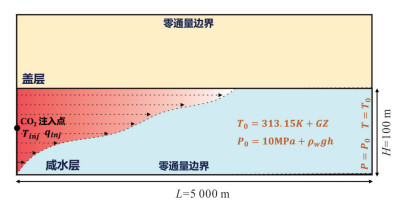
图 1 CO2深部咸水层封存概念模型示意
Fig. 1. Schematic diagram of the conceptual model for CO2 storage in deep saline aquifers
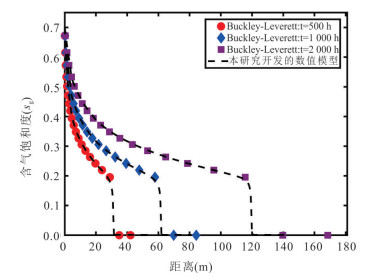
图 2 本研究所提出数值模型与Buckley and Leverett (1942)解析模型的含气饱和度曲线对比
Fig. 2. Comparison of the gas saturation curves of the numerical model proposed in this study with the analytical model of Buckley and Leverett (1942)
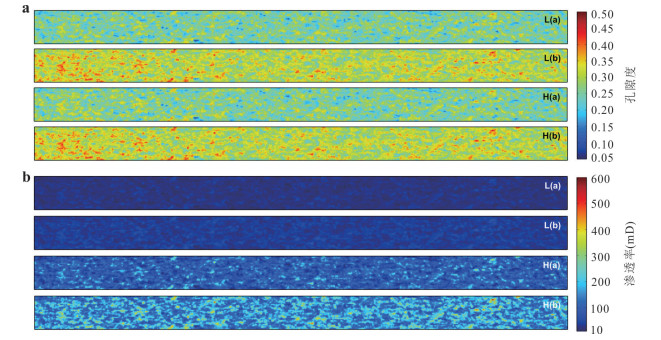
图 3 具有不同孔渗分布特征的非均质咸水层
a.孔隙度分布特征;b. 渗透率分布特征;y轴放大5倍
Fig. 3. Heterogeneous saline aquifers with different cases of porosity and permeability distributions
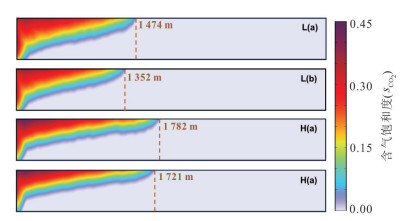
图 4 不同非均质条件下1 500 d时超临界CO2饱和度的分布
y轴放大5倍
Fig. 4. Gas saturation distribution of CO2 at 1 500 days for different heterogeneous conditions
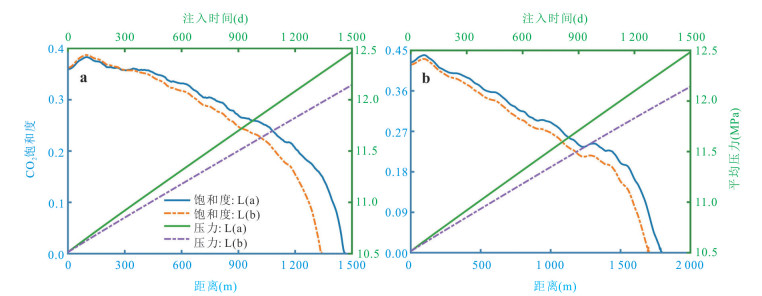
图 5 不同非均质条件下储层平均压力和沿顶部边界CO2饱和度的变化
a. 低渗情况;b.高渗情况
Fig. 5. Variations in the average pressure and CO2 saturation along the top boundary for different heterogeneous conditions
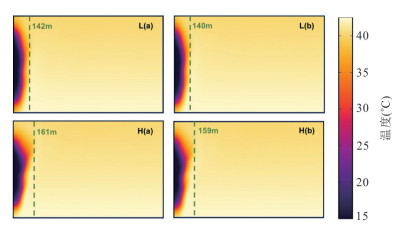
图 6 不同非均质条件下热锋的空间变化
y轴放大5倍
Fig. 6. Spatial variation in the thermal front for different heterogeneous conditions
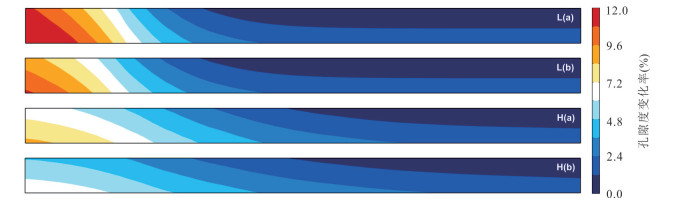
图 7 1 500 d时储层孔隙度的空间变化
y轴放大5倍
Fig. 7. Spatial variation of porosity of the reservoir at 1 500 days
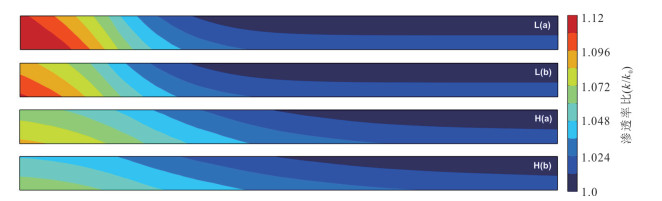
图 8 1 500 d时储层渗透率的空间变化
y轴放大5倍
Fig. 8. Spatial variation of permeability of the reservoir at 1 500 days
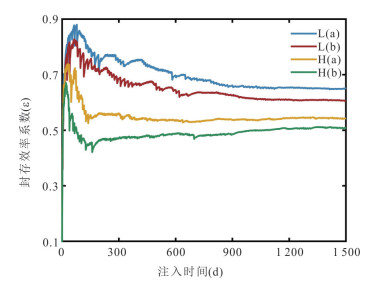
图 9 不同非均质条件下咸水层封存效率系数($ \epsilon $)的时间变化
Fig. 9. Temporal variation in the storage efficiency coefficient ($ \epsilon $) of the saline aquifer for different het- erogeneous conditions
表 1 本研究中数值模型使用的参数
Table 1. Parameters used in the numerical model in this study
参数 取值 参数 取值 注入速率($ {M}_{inj} $) 0.02 kg/m/s 水相粘度($ {\mu }_{w} $) 0.001 Pa·s 残余水饱和度($ {s}_{wr} $) 0.1 水相热导率($ {\lambda }_{w} $) 0.59 W/(m·K) 残余气饱和度($ {s}_{gr} $) 0.05 固相密度($ {\rho }_{r} $) 2 600 kg/m3 储层长度(L) 5 000 m 固相比热容($ {C}_{pr} $) 874 J/(kg·K) 储层厚度(H) 100 m 固相热导率($ {\lambda }_{r} $) 1.5 W/(m·K) 储层上边界温度($ {T}_{0} $) 313.15 K 孔隙大小分布指数($ \lambda $) 2 储层上边界压力($ {p}_{0} $) 10 MPa 储层孔隙压缩系数($ {c}_{\varphi } $) 1×10⁻⁸ Pa-1 水相密度($ {\rho }_{w} $) 1 000 kg/m3 储层渗透率压缩系数($ {c}_{k} $) 1×10⁻⁸ Pa-1 水相比热容($ {C}_{pw} $) 4 200 J/(kg·K) 注入温度($ {T}_{inj} $) 288.15 K 注:参数来源: Pavan et al.(2024) ;魏子俊和高科(2025);Wei et al.(2025 ). 下载: 导出CSV
表 2 本研究构建的3种非均质场景及参数范围
Table 2. Four heterogeneous scenarios and parameter ranges constructed in this study
案例 平均孔隙度 渗透率范围(mD) 平均渗透率(mD) L(a) 0.25 2.32~79.4 26.40 L(b) 0.30 6.16~102 36.80 H(a) 0.25 1.12~534 92.70 H(b) 0.30 6.64~788 160.0
下载: 导出CSV
-
Ali, M., Yekeen, N., Ali, M., et al., 2022. Effects of Various Solvents on Adsorption of Organics for Porous and Nonporous Quartz/CO2/Brine Systems: Implications for CO2 Geo-Storage. Energy Fuels, 36(18): 11089-11099 doi: 10.1021/acs.energyfuels.2c01696 Allen, M. R., Frame, D. J., Friedlingstein, P., et al., 2025. Geological Net Zero and the Need for Disaggregated Accounting for Carbon Sinks. Nature, 638: 343-350. https://doi.org/10.1038/s41586-024-08326-8 Bachu, S., 2015. Review of CO2 Storage Efficiency in Deep Saline Aquifers. International Journal of Greenhouse Gas Control, 40: 188-202. https://doi.org/10.1016/j.ijggc.2015.01.007 Bashir, A., Ali, M., Patil, S., et al., 2024. Comprehensive Review of CO2 Geological Storage: Exploring Principles, Mechanisms, and Prospects. Earth-Science Reviews, 249: 104672. https://doi.org/10.1016/j.earscirev.2023.10467 Brooks, R. H., Corey, A. T., 1966. Properties of Porous Media Affecting Fluid Flow. Journal of the Irrigation and Drainage Division, 92(2): 61-88. https://doi.org/10.1061/jrcea4.0000425 Buckley, S. E., Leverett, M. C., 1942. Mechanism of Fluid Displacement in Sands. Transactions of the AIME, 146(1): 107-116. https://doi.org/10.2118/942107-g Costa, A., 2006. Permeability-Porosity Relationship: A Reexamination of the Kozeny-Carman Equation Based on a Fractal Pore-Space Geometry Assumption. Geophysical Research Letters, 33(2): 2005GL025134. https://doi.org/10.1029/2005GL025134 Dong, J. J., Hsu, J. Y., Wu, W. J., et al., 2010. Stress-Dependence of the Permeability and Porosity of Sandstone and Shale from TCDP Hole-A. International Journal of Rock Mechanics and Mining Sciences, 47(7): 1141-1157. https://doi.org/10.1016/j.ijrmms.2010.06.019 Ershadnia, R., Wallace, C. D., Soltanian, M. R., 2020. CO2 Geological Sequestration in Heterogeneous Binary Media: Effects of Geological and Operational Conditions. Advances in Geo-Energy Research, 4(4): 392-405. https://doi.org/10.46690/ager.2020.04.05 Fujii, T., Oikawa, Y., Lei, X. L., et al., 2024. Experimental Investigation of the Hydro-Mechanical Response of Soft Rocks in the CO2 Injection Process—Impacts of Fracture Roughness and Brittleness Index on the Evolution of Permeability Behavior. International Journal of Rock Mechanics and Mining Sciences, 177: 105742. https://doi.org/10.1016/j.ijrmms.2024.105742 GhojehBeyglou, M., 2021. Geostatistical Modeling of Porosity and Evaluating the Local and Global Distribution. Journal of Petroleum Exploration and Production Technology, 11(12): 4227-4241. https://doi.org/10.1007/s13202-021-01308-w Gudala, M., Govindarajan, S. K., Yan, B. C., et al., 2023. Comparison of Supercritical CO2 with Water as Geofluid in Geothermal Reservoirs with Numerical Investigation Using Fully Coupled Thermo-Hydro-Geomechanical Model. Journal of Energy Resources Technology, 145(6): 061302. https://doi.org/10.1115/1.4055538 Guo, X., Zou, G. F., Wang, Y. H., et al., 2017. Investigation of the Temperature Effect on Rock Permeability Sensitivity. Journal of Petroleum Science and Engineering, 156: 616-622. https://doi.org/10.1016/j.petrol.2017.06.045 Hosseini, M., Ali, M., Fahimpour, J., et al., 2024. Energy Storage in Carbonate and Basalt Reservoirs: Investigating Secondary Imbibition in H2 and CO2 Systems. Advances in Geo-Energy Research, 11(2): 132-140. https://doi.org/10.46690/ager.2024.02.05 Jiang, S., Zhang, K., Du, F. S., et al., 2023. Progress and Prospects of CO2 Storage and Enhanced Oil, Gas and Geothermal Recovery. Earth Science, 48(7): 2733-2749 (in Chinese with English abstract). Jonk, R., Bohacs, K. M., Davis, J. S., 2022. Evaluating Top Seals within a Sequence-Stratigraphic Framework: Impact on Geological Carbon Sequestration. Marine and Petroleum Geology, 146: 105920. https://doi.org/10.1016/j.marpetgeo.2022.105920 Keykhosravi, A., Nguyen, C., Loi, G., et al., 2025. Permeability Decline Due to Fines Migration during CO2 Injection in Sandstones. Gas Science and Engineering, 138: 205613. https://doi.org/10.1016/j.jgsce.2025.205613 Kim, M., Kim, K. Y., Han, W. S., et al., 2019. Density-Driven Convection in a Fractured Porous Media: Implications for Geological CO2 Storage. Water Resources Research, 55(7): 5852-5870. https://doi.org/10.1029/2019WR024822 Leverett, M. C., 1941. Capillary Behavior in Porous Solids. Transactions of the AIME, 142(1): 152-169. https://doi.org/10.2118/941152-g Li, B. X., Benson, S. M., 2015. Influence of Small-Scale Heterogeneity on Upward CO2 Plume Migration in Storage Aquifers. Advances in Water Resources, 83: 389-404. https://doi.org/10.1016/j.advwatres.2015.07.010 Liang, T., Yang, J. H., Hao, Q. Y., et al., 2024. Research Progress on CO2 Storage Potential in Saltwater Layers at Sea. Geological Review, 70(S1): 201-204(in Chinese with English abstract). Lin, Z. T., Kuang, Y. M., Li, W. Q., et al., 2024. Research Status and Prospects of CO2 Geological Sequestration Technology from Onshore to Offshore: A Review. Earth-Science Reviews, 258: 104928. https://doi.org/10.1016/j.earscirev.2024.104928 Massarweh, O., Abushaikha, A. S., 2024. CO2 Sequestration in Subsurface Geological Formations: A Review of Trapping Mechanisms and Monitoring Techniques. Earth-Science Reviews, 253: 104793. https://doi.org/10.1016/j.earscirev.2024.104793 Nath, F., Mahmood, M. N., Yousuf, N., 2024. Recent Advances in CCUS: A Critical Review on Technologies, Regulatory Aspects and Economics. Geoenergy Science and Engineering, 238: 212726. https://doi.org/10.1016/j.geoen.2024.212726 Pavan, T. N. V., Devarapu, S. R., Govindarajan, S. K., 2024. Numerical Investigations on the Performance of Sc-CO2 Sequestration in Heterogeneous Deep Saline Aquifers under Non-Isothermal Conditions. Gas Science and Engineering, 130: 205437. https://doi.org/10.1016/j.jgsce.2024.205437 Pettersson, P., Tveit, S., Gasda, S. E., 2022. Dynamic Estimates of Extreme-Case CO2 Storage Capacity for Basin-Scale Heterogeneous Systems under Geological Uncertainty. International Journal of Greenhouse Gas Control, 116: 103613. https://doi.org/10.1016/j.ijggc.2022.103613 Pini, R., Benson, S. M., 2017. Capillary Pressure Heterogeneity and Hysteresis for the Supercritical CO2/Water System in a Sandstone. Advances in Water Resources, 108: 277-292. https://doi.org/10.1016/j.advwatres.2017.08.011 Qu, Z. Q., Zhang, W., Guo, T. K., 2017. Influence of Different Fracture Morphology on Heat Mining Performance of Enhanced Geothermal Systems Based on COMSOL. International Journal of Hydrogen Energy, 42(29): 18263-18278. https://doi.org/10.1016/j.ijhydene.2017.04.168 Safari, H., Balcom, B. J., Afrough, A., 2021. Characterization of Pore and Grain Size Distributions in Porous Geological Samples—An Image Processing Workflow. Computers Geosciences, 156: 104895. https://doi.org/10.1016/j.cageo.2021.104895 Sheng, D. N., Wang, H. M., Sheng, J. C., et al., 2025. Effect of Random Fracture Network Orientations on Sealing Performance of Caprock in CO2 Geological Sequestration. Earth Science, 50(1): 349-360 (in Chinese with English abstract). Shi, J. Q., Xue, Z. Q., Durucan, S., 2011. Supercritical CO2 Core Flooding and Imbibition in Tako Sandstone—Influence of Sub-Core Scale Heterogeneity. International Journal of Greenhouse Gas Control, 5(1): 75-87. https://doi.org/10.1016/j.ijggc.2010.07.003 Wei, Z. J., Gao, K., 2025. CO2 Sequestration in Deep Saline Aquifers with Integrated Thermo-Hydromechanical Model. Bulletin of Geological Science and Technology, 44(4): 129-141(in Chinese with English abstract). Wei, Z. J., Gao, K., Li, S. B., 2025. Integrated Thermo-Hydro-Mechanical Workflow for Modeling CO2 Storage with Fault Activation Risk. SPE Journal, 30(5): 2975-2995. https://doi.org/10.2118/225428-pa Wen, D. G., Guo, J. Q., Zhang, S. Q., et al., 2014. The Progress in the Research on Carbon Dioxide Geological Storage in China. Geology in China, 41(5): 1716-1723(in Chinese with English abstract). Yuan, Z., Ren, P. G., Liu, J. H., et al., 2025. Research on Whole Strata Geological Modeling Technology for CO2 Geological Storage in Salt Water Layer. Earth Science, 50(5): 1987-1998(in Chinese with English abstract). 蒋恕, 张凯, 杜凤双, 等, 2023. 二氧化碳地质封存及提高油气和地热采收率技术进展与展望. 地球科学, 48(7): 2733-2749. doi: 10.3799/dqkx.2023.084 梁涛, 杨婧晖, 郝清源, 等, 2024. 海上咸水层CO2封存潜力研究进展. 地质论评, 70(增刊1): 201-204. 盛丹娜, 王惠民, 盛金昌, 等, 2025. CO2地质封存中随机裂隙网络走向对盖层密封性影响. 地球科学, 50(1): 349-360. doi: 10.3799/dqkx.2023.192 魏子俊, 高科, 2025. 深部咸水层CO2封存的热-水-力模型研究. 地质科技通报, 44(4): 129-141. 文冬光, 郭建强, 张森琦, 等, 2014. 中国二氧化碳地质储存研究进展. 中国地质, 41(5): 1716-1723. 袁哲, 任培罡, 刘金华, 等, 2025. 咸水层CO2地质封存全地层地质建模技术研究. 地球科学, 50(5): 1987-1998. doi: 10.3799/dqkx.2024.107 -

 点击查看大图
计量
- 文章访问数: 325
- HTML全文浏览量: 17
- PDF下载量: 43
- 被引次数: 0
