




Advances in Intelligent Processing of Seismic Data: Focal Mechanisms, Fault Zone Head Waves and Dynamic Triggering Detection and Analysis
-
摘要: 近年来,海量数字地震观测资料的积累对高效、智能的数据处理方法提出了迫切需求.系统介绍了研究组发展的一系列地震资料智能化处理新方法,包括基于顺序统计量与信息熵的P波初动极性自动判别(POSE)、面向双材料界面识别的断层首波自动检测算法,以及基于高频能量积分比值的远震动态触发检测方法(HiFi).这些方法不仅显著提升了小震震源机制解与应力场反演的分辨率,也为精细刻画断层两侧介质性质、及研究动态应力扰动对小震活动的调制效应提供了新工具.通过对2023年土耳其双震和2025年缅甸曼德勒Mw 7.7地震的应用实例,展示了POSE方法在震源机制解与区域应力场反演中的优势,断层首波检测在揭示双材料界面速度对比方面的有效性,以及HiFi方法在大震远场动态触发识别中的可靠性.这些新观测可为断层结构解析、破裂动力学研究及地震危险性评估提供重要支撑,凸显了智能化技术在地震学研究中的广阔前景.Abstract: In recent years, the rapid accumulation of massive digital seismic observations has created an urgent demand for efficient and intelligent data-processing methods. This paper presents a suite of new intelligent approaches to seismic data processing developed by our research group, including: POSE, an automatic P-wave first-motion polarity determination method based on Order Statistics and Entropy theory; an automatic detection algorithm for fault zone head waves designed to identify bimaterial interfaces; and HiFi, a method for detecting remote dynamic triggering based on the High-Frequency Power Integral Ratio. These methods not only significantly enhance the resolution of focal mechanism solutions and stress field inversions for small earthquakes, but also provide new tools for characterizing medium contrasts across faults and for investigating how dynamic stress perturbations modulate small earthquake activity. Through application to the 2023 Turkey earthquake doublet and the 2025 Mw 7.7 Mandalay, Myanmar earthquake, we demonstrate the advantages of POSE in focal mechanism determination and regional stress field inversion, the effectiveness of fault zone head-wave detection in revealing velocity contrasts across bimaterial fault interfaces, and the robustness of the HiFi method in identifying long-range dynamic triggering associated with large earthquakes. These new observations offer important support for fault-zone structural imaging, rupture dynamics studies, and seismic hazard assessment, and highlight the broad prospects of intelligent techniques in seismological research.
-
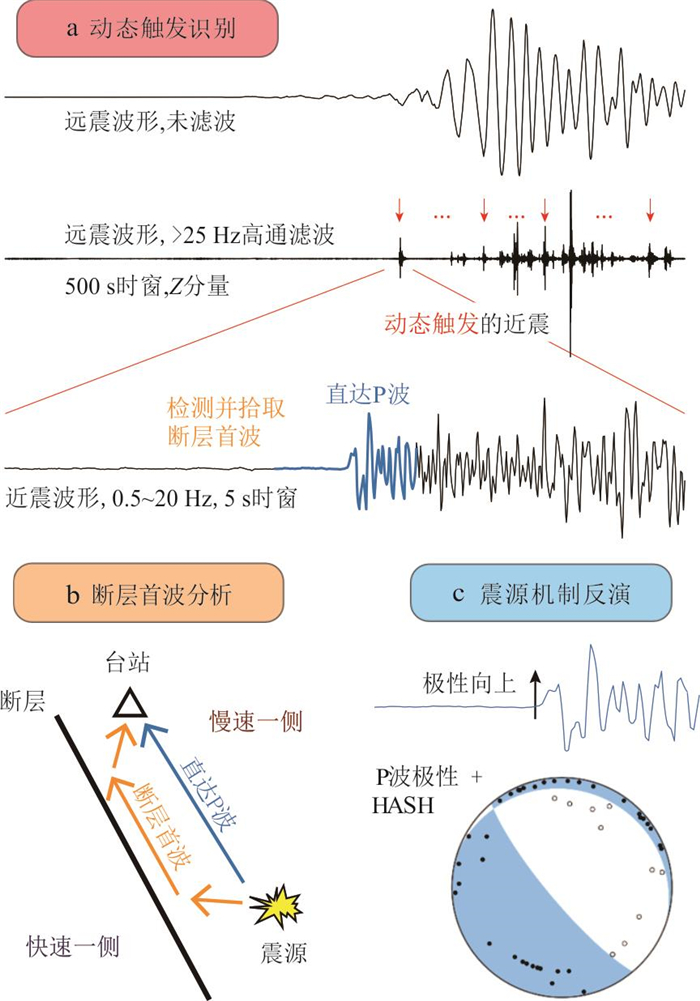
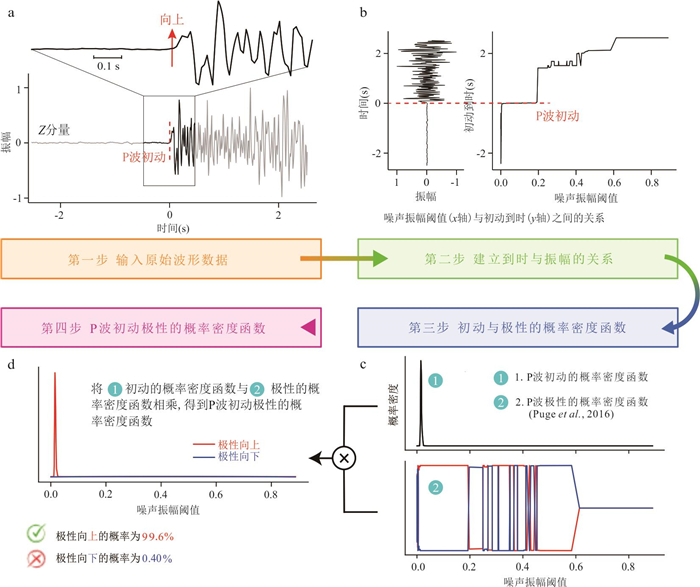
图 1 各种基于波形的自动化算法
a.自动检测远震动态触发的HiFi算法;b.断层首波的自动检测算法;c.自动拾取P波极性的POSE算法
Fig. 1. Automated algorithms based on seismic waveforms
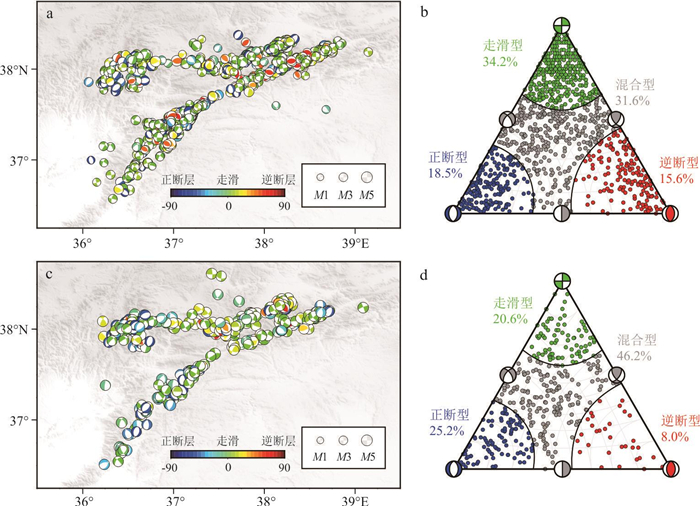
图 3 土耳其双震余震序列震源机制解
采用下半球投影,沙滩球的颜色为$ {\mathit{\boldsymbol{\gamma}}} _{\mathrm{f}\mathrm{s}} $(Bailey et al.,2010),用于表示断层类型.a.基于POSE方法获得的震源机制解;b.基于POSE方法获得的震源机制解的分类;c.来自AFAD的震源机制解;d.AFAD数据集中震源机制解的分类
Fig. 3. Focal mechanisms of the aftershock sequence of the Turkey earthquake doublet
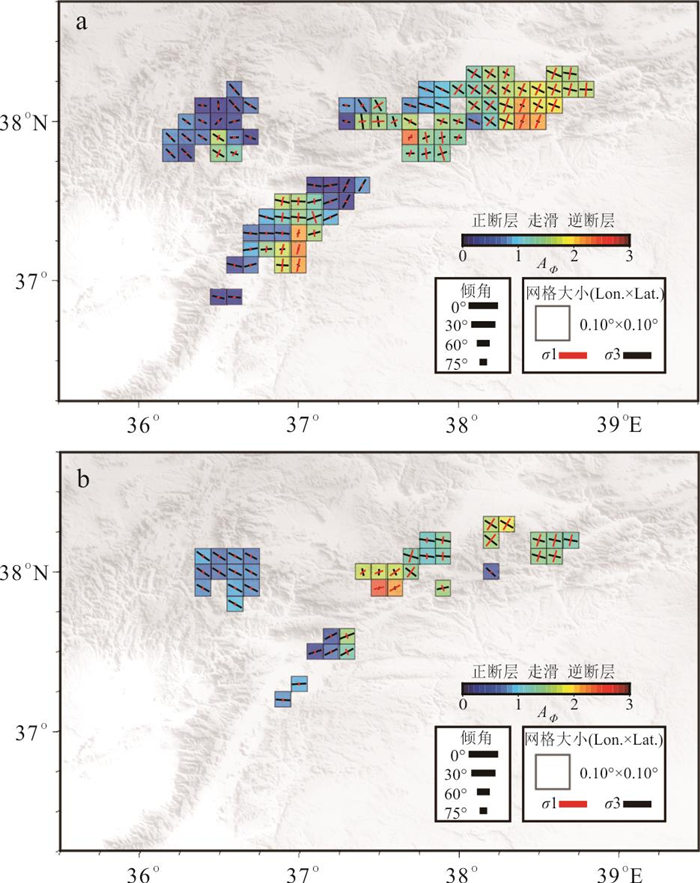
图 4 基于POSE(a)与AFAD(b)震源机制解的应力场反演结果
网格颜色根据$ {A}_{{\mathit{\Phi}} } $划分,交叉短线指示了最大(σ1,红色)和最小(σ3,黑色)主压应力轴的水平投影方向
Fig. 4. Stress-field inversions from POSE-derived (a) and AFAD (b) focal mechanisms
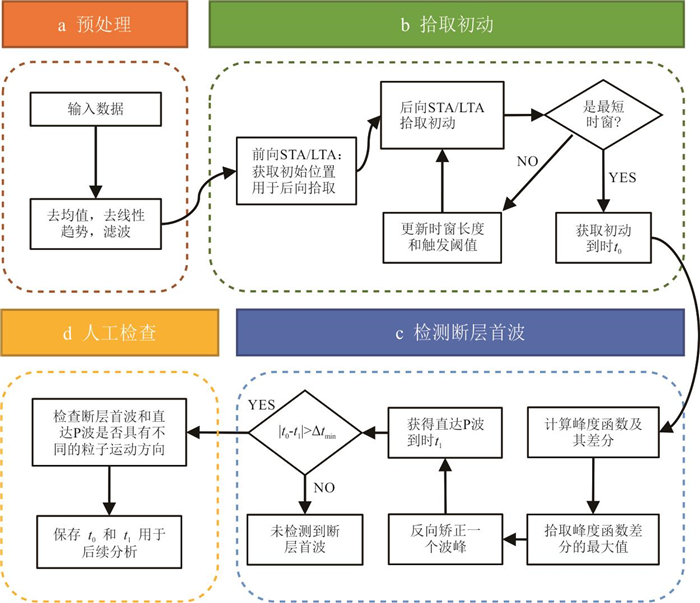
图 5 断层首波拾取策略流程图
Fig. 5. Workflow of the semi-automatic detection algorithm for FZHW
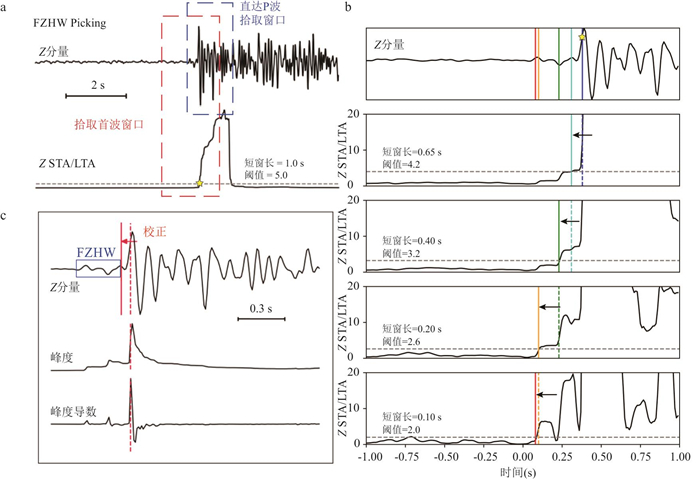
图 6 断层首波检测示例
a. 红色和蓝色虚线框分别表示初动和直达P波拾取窗口;在此示例中,算法进行了0.5~20 Hz的滤波.b. 使用不同短窗长度和阈值的长短窗特征函数,蓝线和黄色五角星标记了图a中黄色五角星的相同位置,橙色直线是初动拾取的最终结果.c. 从垂直分量计算的峰度函数及其导数,红色实线是直达P波的最终拾取结果,蓝色方框标注了断层首波的波形.改自Wang et al.(2023)
Fig. 6. Demonstration of the FZHW detection algorithm
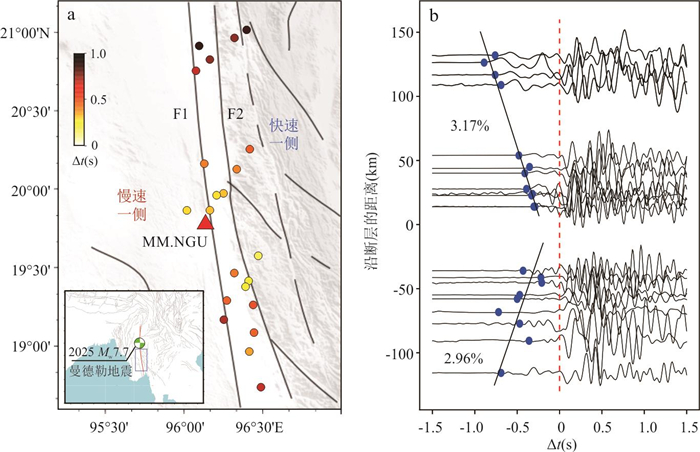
图 7 实皆断裂附近的断层首波波形与分布
a.产生断层首波的地震的位置分布,点的颜色反映了断层首波与直达P波的到时差大小,F1、F2为可能存在速度差异断层的断层迹线.b.MM.NPW台站(红色三角)记录到的带有断层首波的波形数据,图中波形按照直达P波到时对齐(0时刻,红色虚线),蓝色圆点为断层首波的到时拾取
Fig. 7. FZHW waveforms and their spatial distribution around the Sagaing Fault
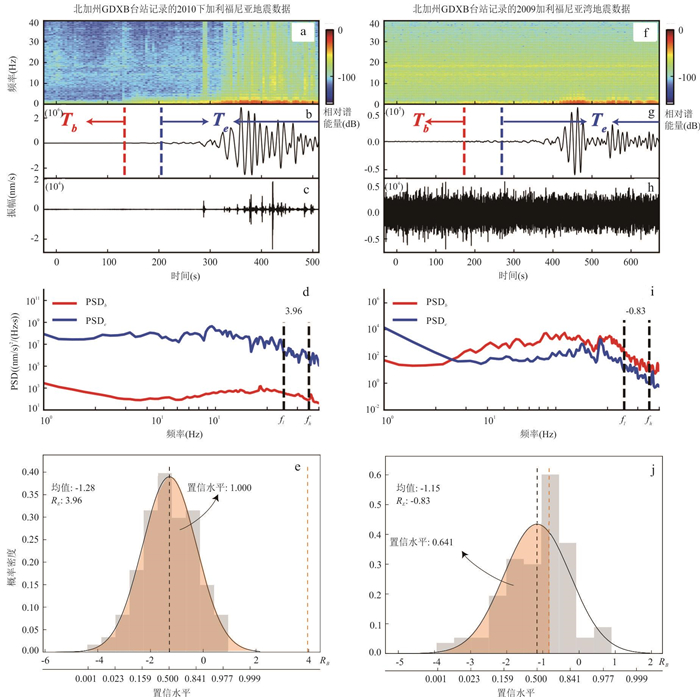
图 8 2010年4月4日M7.2下加利福尼亚州地震和2009年8月5日M5.8加利福尼亚湾地震的动态触发检测结果
a~c. 北加州地震台网(Northern California Seismic Network)的GDXB站记录的2010年下加利福尼亚州地震原始波形的频谱、原始波形以及高通滤波(> 25 Hz)之后的波形.红色和蓝色虚线分别标记P波和一个波速为5 km/s的震相的到时.$ {T}_{b} $和$ {T}_{e} $分别为P波到达前5小时以及5 km/s与2 km/s震相到时之间的时间段.d.红线和蓝线分别对应$ {T}_{b} $和$ {T}_{e} $时间窗内原始波形数据的功率谱密度(PSD).黑色虚线标记对PSD积分的频率范围.右上角数字是两个时间窗内频率积分结果的对数比值($ {R}_{E} $).e. 背景天内高频能量对数比值($ {R}_{B} $)的分布及动态触发置信水平(Confidence Level,CL).直方图是$ {R}_{B} $数据集的概率密度分布,黑色实线为利用正态分布拟合直方图得到的概率密度函数,并用黑色虚线标记均值;橙色虚线对应的横坐标为$ {R}_{E} $的大小;黑色实线和橙色虚线包围的橙色阴影区域为计算CL时对PDF进行积分的区域,不同的$ {R}_{E} $值对应的CL标记在最底部单独的坐标轴上.图f、j与图a、e中的标记含义相同,但展示的是加利福尼亚湾地震的检测结果.改自Yun et al.(2019)
Fig. 8. Dynamic triggering detection for the 4 April 2010 M7.2 Baja California and 5 August 2009 M5.8 Gulf of California
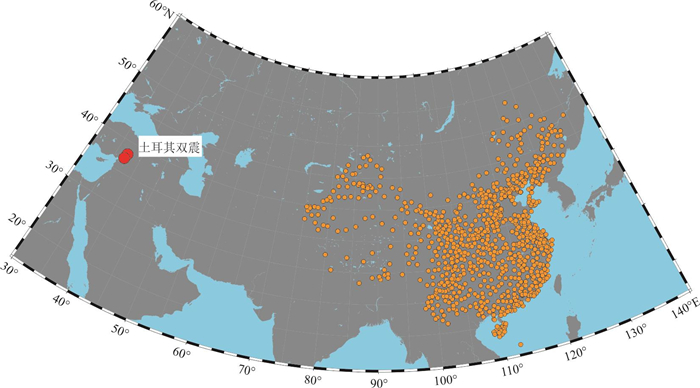
图 10 2023年土耳其双震(红色圆圈)以及全国固定台网分布(黄色圆圈)
Fig. 10. The 2023 Turkey earthquake doublet (red circles) and the distribution of China's permanent seismic network (yellow circles)
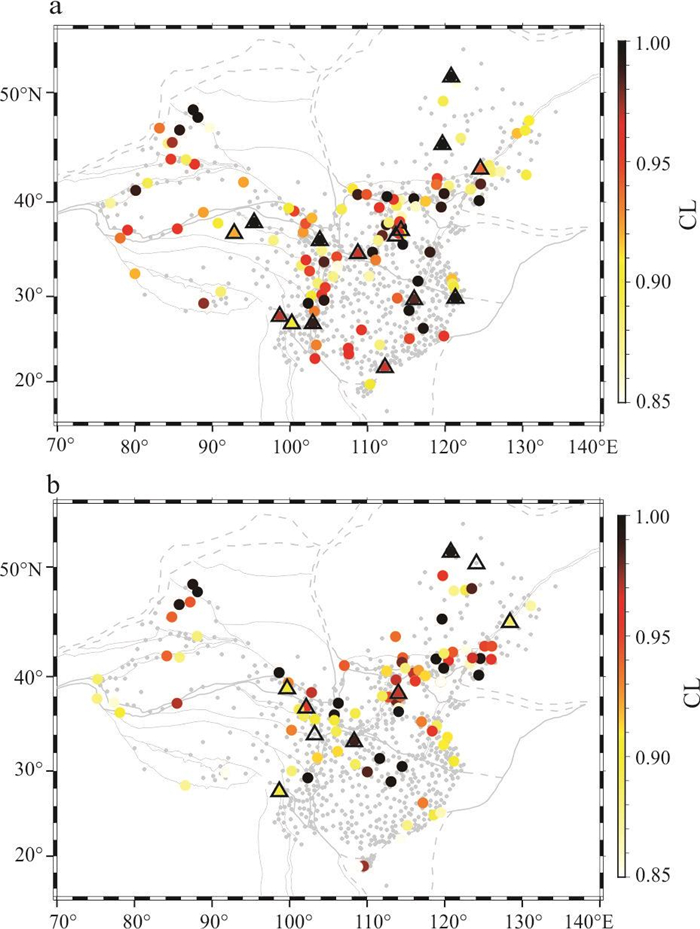
图 11 2023年土耳其Mw7.8地震(a)和Mw7.6(b)地震在我国固定台网的动态触发检测结果
灰色点表示所有被检测的台站.带有颜色的圆圈表示利用DynTriPy程序包计算得到的动态触发置信水平$ \mathbf{C}\mathbf{L} $值大于0.85的台站,颜色表示$ \mathbf{C}\mathbf{L} $值的具体大小.黑色三角形表示通过人工检测发现被触发的区域小地震信号的台站
Fig. 11. Dynamic triggering detection across China's permanent network for the 2023 Turkey Mw7.8 (a) and Mw7.6 (b) earthquakes
表 1 震源机制解质量评价指标
Table 1. Quality control criteria
解平面的平均不确定度 解的可靠概率 极性拟合残差 A < 25° > 0.8 < 0.2 B < 35° > 0.6 < 0.3 C < 45° > 0.5 < 0.4 D > 45° < 0.5 > 0.4  下载: 导出CSV
-
Akgün, E., İnceöz, M., 2021. Tectonic Evolution of the Central Part of the East Anatolian Fault Zone, Eastern Turkey. Turkish Journal of Earth Sciences, 30(7): 928-947. https://doi.org/10.3906/yer-2104-15 Aki, K., Richards, P. G., 2002. Quantitative Seismology (2nd ed. ). University Science Books, Mill Valley. https://go.exlibris.link/5ldYn0FC Allen, R. V., 1978. Automatic Earthquake Recognition and Timing from Single Traces. Bulletin of the Seismological Society of America, 68(5): 1521-1532. https://doi.org/10.1785/bssa0680051521 Ampuero, J. P., Ben-Zion, Y., 2008. Cracks, Pulses and Macroscopic Asymmetry of Dynamic Rupture on a Bimaterial Interface with Velocity-Weakening Friction. Geophysical Journal International, 173(2): 674-692. https://doi.org/10.1111/j.1365-246X.2008.03736.x Bailey, I. W., Becker, T. W., Ben-Zion, Y., 2009. Patterns of Co-Seismic Strain Computed from Southern California Focal Mechanisms. Geophysical Journal International, 177(3): 1015-1036. https://doi.org/10.1111/j.1365-246x.2009.04090.x Bailey, I. W., Ben-Zion, Y., Becker, T. W., et al., 2010. Quantifying Focal Mechanism Heterogeneity for Fault Zones in Central and Southern California: Focal Mechanism Heterogeneity. Geophysical Journal International, 183(1): 433-450. https://doi.org/10.1111/j.1365-246x.2010.04745.x Baillard, C., Crawford, W. C., Ballu, V., et al., 2014. An Automatic Kurtosis-Based P- and S-Phase Picker Designed for Local Seismic Networks. Bulletin of the Seismological Society of America, 104(1): 394-409. https://doi.org/10.1785/0120120347 Ben-Zion, Y., 1989. The Response of Two Joined Quarter Spaces to SH Line Sources Located at the Material Discontinuity Interface. Geophysical Journal International, 98(2): 213-222. https://doi.org/10.1111/j.1365-246X.1989.tb03346.x Ben-Zion, Y., 1990. The Response of Two Half Spaces to Point Dislocations at the Material Interface. Geophysical Journal International, 101(3): 507-528. https://doi.org/10.1111/j.1365-246X.1990.tb05567.x Ben-Zion, Y., 2001. Dynamic Ruptures in Recent Models of Earthquake Faults. Journal of the Mechanics and Physics of Solids, 49(9): 2209-2244. https://doi.org/10.1016/S0022-5096(01)00036-9 Ben-Zion, Y., 2008. Collective Behavior of Earthquakes and Faults: Continuum-Discrete Transitions, Progressive Evolutionary Changes, and Different Dynamic Regimes. Reviews of Geophysics, 46(4): 2008RG000260. https://doi.org/10.1029/2008rg000260 Ben-Zion, Y., Malin, P., 1991. San Andreas Fault Zone Head Waves near Parkfield, California. Science, 251(5001): 1592-1594. http://www.jstor.org/stable/2875727 Bozkurt, E., 2001. Neotectonics of Turkey-A Synthesis. Geodinamica Acta, 14(1-3): 3-30. https://doi.org/10.1080/09853111.2001.11432432 Bulut, F., Ben-Zion, Y., Bohnhoff, M., 2012. Evidence for a Bimaterial Interface along the Mudurnu Segment of the North Anatolian Fault Zone from Polarization Analysis of P Waves. Earth and Planetary Science Letters, 327-328: 17-22. https://doi.org/10.1016/j.epsl.2012.02.001 Chen, Y. K., Saad, O. M., Savvaidis, A., et al., 2024. Deep Learning for P-Wave First-Motion Polarity Determination and Its Application in Focal Mechanism Inversion. IEEE Transactions on Geoscience and Remote Sensing, 62: 1-11. https://doi.org/10.1109/TGRS.2024.3407060 Cheng, Y. F., Hauksson, E., Ben-Zion, Y., 2023. Refined Earthquake Focal Mechanism Catalog for Southern California Derived with Deep Learning Algorithms. Journal of Geophysical Research: Solid Earth, 128(2): e2022JB025975. https://doi.org/10.1029/2022jb025975 Ding, H. Y., Zhou, Y. J., Ge, Z. X., et al., 2023. High-Resolution Seismicity Imaging and Early Aftershock Migration of the 2023 Kahramanmaraş (SE Türkiye) MW7.9 & 7.8 Earthquake Doublet. Earthquake Science, 36(6): 417-432. https://doi.org/10.1016/j.eqs.2023.06.002 Duman, T. Y., Emre, Ö., 2013. The East Anatolian Fault: Geometry, Segmentation and Jog Characteristics. Geological Society, London, Special Publications, 372(1): 495-529. https://doi.org/10.1144/sp372.14 Erickson, B. A., Day, S. M., 2016. Bimaterial Effects in an Earthquake Cycle Model Using Rate-and-State Friction. Journal of Geophysical Research: Solid Earth, 121(4): 2480-2506. https://doi.org/10.1002/2015jb012470 Fano, R. M., 1961. Transmission of Information: A Statistical Theory of Communications. The MIT Press, NewYork. Frohlich, C., 1992. Triangle Diagrams: Ternary Graphs to Display Similarity and Diversity of Earthquake Focal Mechanisms. Physics of the Earth and Planetary Interiors, 75(1-3): 193-198. https://doi.org/10.1016/0031-9201(92)90130-n Glover, C., Robertson, A., 1998. Neotectonic Intersection of the Aegean and Cyprus Tectonic Arcs: Extensional and Strike-Slip Faulting in the Isparta Angle, SW Turkey. Tectonophysics, 298(1-3): 103-132. https://doi.org/10.1016/S0040-1951(98)00180-2 Goebel, T. H. W., Kwiatek, G., Becker, T. W., et al., 2017. What Allows Seismic Events to Grow Big? : Insights from b-Value and Fault Roughness Analysis in Laboratory Stick-Slip Experiments. Geology, 45(9): 815-818. https://doi.org/10.1130/g39147.1 Güvercin, S. E., Karabulut, H., Konca, A. Ö., et al., 2022. Active Seismotectonics of the East Anatolian Fault. Geophysical Journal International, 230(1): 50-69. https://doi.org/10.1093/gji/ggac045 Han, J., Kim, S., Sheen, D. H., 2025. RPNet: Robust P-Wave First-Motion Polarity Determination Using Deep Learning. Seismological Research Letters, 96(4): 2405-2417. https://doi.org/10.1785/0220240384 Hardebeck, J. L., 2002. A New Method for Determining First-Motion Focal Mechanisms. Bulletin of the Seismological Society of America, 92(6): 2264-2276. https://doi.org/10.1785/0120010200 Hardebeck, J. L., 2003. Using S/P Amplitude Ratios to Constrain the Focal Mechanisms of Small Earthquakes. Bulletin of the Seismological Society of America, 93(6): 2434-2444. https://doi.org/10.1785/0120020236 Hardebeck, J. L., Michael, A. J., 2006. Damped Regional-Scale Stress Inversions: Methodology and Examples for Southern California and the Coalinga Aftershock Sequence. Journal of Geophysical Research: Solid Earth, 111(B11): B11310. https://doi.org/10.1029/2005JB004144 Heidbach, O., Rajabi, M., Cui, X. F., et al., 2018. The World Stress Map Database Release 2016: Crustal Stress Pattern across Scales. Tectonophysics, 744: 484-498. https://doi.org/10.1016/j.tecto.2018.07.007 Hill, D. P., Reasenberg, P. A., Michael, A., et al., 1993. Seismicity Remotely Triggered by the Magnitude 7.3 Landers, California, Earthquake. Science, 260(5114): 1617-1623. http://www.jstor.org/stable/2881709 Hirano, S., Doke, R., Maeda, T., 2025. Supershear-Subshear-Supershear Rupture Sequence during the 2025 Mandalay Earthquake in Myanmar. arXiv: 2506.09652. https://doi.org/10.48550/arxiv.2506.09652 Hurukawa, N., Maung, M. P., 2011. Two Seismic Gaps on the Sagaing Fault, Myanmar, Derived from Relocation of Historical Earthquakes since 1918. Geophysical Research Letters, 38(1): L01330. https://doi.org/10.1029/2010GL046099 Inbal, A., Ziv, A., Lior, I., et al., 2023. Non-Triggering and then Triggering of a Repeating Aftershock Sequence in the Dead Sea by the 2023 Kahramanmaraş Earthquake Pair: Implications for the Physics of Remote Delayed Aftershocks. Geophysical Research Letters, 50(18): e2023GL104908. https://doi.org/10.1029/2023GL104908 Jiang, C., Fang, L. H., Fan, L. P., et al., 2021. Comparison of the Earthquake Detection Abilities of PhaseNet and EQTransformer with the Yangbi and Maduo Earthquakes. Earthquake Science, 34(5): 425-435. https://doi.org/10.29382/eqs-2021-0038 Jiang, X. Y., Song, X. D., Li, T., et al., 2023. Moment Magnitudes of Two Large Turkish Earthquakes on February 6, 2023 from Long-Period Coda. Earthquake Science, 36(2): 169-174. https://doi.org/10.1016/j.eqs.2023.02.008 Lapins, S., Goitom, B., Kendall, J. M., et al., 2021. A Little Data Goes a Long Way: Automating Seismic Phase Arrival Picking at Nabro Volcano with Transfer Learning. Journal of Geophysical Research: Solid Earth, 126(7): e2021JB021910. https://doi.org/10.1029/2021jb021910 Li, Z. F., Peng, Z. G., 2016. Automatic Identification of Fault Zone Head Waves and Direct P Waves and Its Application in the Parkfield Section of the San Andreas Fault, California. Geophysical Journal International, 205(3): 1326-1341. https://doi.org/10.1093/gji/ggw082 Martínez-Garzón, P., Kwiatek, G., Ickrath, M., et al., 2014. MSATSI: A MATLAB Package for Stress Inversion Combining Solid Classic Methodology, a New Simplified User-Handling, and a Visualization Tool. Seismological Research Letters, 85(4): 896-904. https://doi.org/10.1785/0220130189 Matthews, M. V., Reasenberg, P. A., 1988. Statistical Methods for Investigating Quiescence and Other Temporal Seismicity Patterns. Pure and Applied Geophysics, 126(2-4): 357-372. https://doi.org/10.1007/BF00879003 Michael, A. J., 1987. Use of Focal Mechanisms to Determine Stress: A Control Study. Journal of Geophysical Research: Solid Earth, 92(B1): 357-368. https://doi.org/10.1029/JB092iB01p00357 Pankow, K. L., Arabasz, W. J., Pechmann, J. C., et al., 2004. Triggered Seismicity in Utah from the 3 November 2002 Denali Fault Earthquake. Bulletin of the Seismological Society of America, 94(6B): S332-S347. https://doi.org/10.1785/0120040609 Pei, W. L., Zhuang, J. C., Zhou, S. Y., 2025. Stochastic Determination of Arrival Time and Initial Polarity of Seismic Waveform. Earth, Planets and Space, 77(1): 36. https://doi.org/10.1186/s40623-025-02161-5 Peng, Z. G., Shelly, D. R., Ellsworth, W. L., 2015. Delayed Dynamic Triggering of Deep Tremor along the Parkfield-Cholame Section of the San Andreas Fault Following the 2014 M6.0 South Napa Earthquake. Geophysical Research Letters, 42(19): 7916-7922. https://doi.org/10.1002/2015GL065277 Peng, Z. G., Lei, X. L., Wang, D., et al., 2025. Mainshock Rupture Properties, Aftershock Activities and Remotely Triggered Seismicity Associated with the 2025 Mw7.7 Sagaing Fault Earthquake in Myanmar. Earthquake Research Advances, 5(4): 100413. https://doi.org/10.1016/j.eqrea.2025.100413 Pugh, D. J., White, R. S., Christie, P. A. F., 2016. Automatic Bayesian Polarity Determination. Geophysical Journal International, 206(1): 275-291. https://doi.org/10.1093/gji/ggw146 Reasenberg, P. A., Simpson, R. W., 1992. Response of Regional Seismicity to the Static Stress Change Produced by the Loma Prieta Earthquake. Science, 255(5052): 1687-1690. http://www.jstor.org/stable/2876633 Reilinger, R., McClusky, S., Vernant, P., et al., 2006. GPS Constraints on Continental Deformation in the Africa-Arabia-Eurasia Continental Collision Zone and Implications for the Dynamics of Plate Interactions. Journal of Geophysical Research: Solid Earth, 111(B5): B05411. https://doi.org/10.1029/2005JB004051 Ren, C. M., Wang, Z. X., Taymaz, T., et al., 2024. Supershear Triggering and Cascading Fault Ruptures of the 2023 Kahramanmaraş, Türkiye, Earthquake Doublet. Science, 383(6680): 305-311. https://doi.org/10.1126/science.adi1519 Ross, Z. E., Ben-Zion, Y., 2014. Automatic Picking of Direct P, S Seismic Phases and Fault Zone Head Waves. Geophysical Journal International, 199(1): 368-381. https://doi.org/10.1093/gji/ggu267 Ross, Z. E., Meier, M. A., Hauksson, E., 2018. P Wave Arrival Picking and First-Motion Polarity Determination with Deep Learning. Journal of Geophysical Research: Solid Earth, 123(6): 5120-5129. https://doi.org/10.1029/2017jb015251 Shannon, C. E., 1948. A Mathematical Theory of Communication. The Bell System Technical Journal, 27(3): 379-423. https://doi.org/10.1002/j.1538-7305.1948.tb01338.x Shelly, D. R., Peng, Z. G., Hill, D. P., et al., 2011. Triggered Creep as a Possible Mechanism for Delayed Dynamic Triggering of Tremor and Earthquakes. Nature Geoscience, 4(6): 384-388. https://doi.org/10.1038/ngeo1141 Simpson, R. W., 1997. Quantifying Anderson's Fault Types. Journal of Geophysical Research: Solid Earth, 102(B8): 17909-17919. https://doi.org/10.1029/97jb01274 Taymaz, T., Yilmaz, Y., Dilek, Y., 2007. The Geodynamics of the Aegean and Anatolia: Introduction. Geological Society, London, Special Publications, 291(1): 1-16. https://doi.org/10.1144/sp291.1 Wang, L. T., 2025. Seismicity and Regional Tectonic Stress Field Study at Eastern Boundary of the Sichuan-Yunnan Block (Dissertation). Peking University, Beijing (in Chinese with English abstract). Wang, L. T., Zhou, Y. J., Zhou, S. Y., et al., 2023. Detection of Fault Zone Head Waves and the Fault Interface Imaging in the Xianshuihe-Anninghe Fault Zone (Eastern Tibetan Plateau). Geophysical Journal International, 234(2): 1157-1167. https://doi.org/10.1093/gji/ggad131 Weertman, J., 2002. Subsonic Type Earthquake Dislocation Moving at Approximately×Shear Wave Velocity on Interface between Half Spaces of Slightly Different Elastic Constants. Geophysical Research Letters, 29(10): 109-1-109-4. https://doi.org/10.1029/2001gl013916 Weiss, J. R., Walters, R. J., Morishita, Y., et al., 2020. High-Resolution Surface Velocities and Strain for Anatolia from Sentinel-1 InSAR and GNSS Data. Geophysical Research Letters, 47(17): e2020GL087376. https://doi.org/10.1029/2020gl087376 Wesnousky, S. G., 2006. Predicting the Endpoints of Earthquake Ruptures. Nature, 444(7117): 358-360. https://doi.org/10.1038/nature05275 Wesnousky, S. G., 2008. Displacement and Geometrical Characteristics of Earthquake Surface Ruptures: Issues and Implications for Seismic-Hazard Analysis and the Process of Earthquake Rupture. Bulletin of the Seismological Society of America, 98(4): 1609-1632. https://doi.org/10.1785/0120070111 Yang, H. F., Yao, S. L., He, B., et al., 2019. Earthquake Rupture Dependence on Hypocentral Location along the Nicoya Peninsula Subduction Megathrust. Earth and Planetary Science Letters, 520: 10-17. https://doi.org/10.1016/j.epsl.2019.05.030 Yao, S. L., Yang, H. F., 2022. Hypocentral Dependent Shallow Slip Distribution and Rupture Extents along a Strike-Slip Fault. Earth and Planetary Science Letters, 578: 117296. https://doi.org/10.1016/j.epsl.2021.117296 Yoshida, K., 2024. Spatial Variation in Stress Orientation in and around Türkiye: Rupture Propagation across the Stress Regime Transition in the 2023 Mw 7.8 Kahramanmaraş Earthquake. Geophysical Journal International, 238(3): 1582-1594. https://doi.org/10.1093/gji/ggae230 Yun, N. D., 2024. Stress Analysis Adjacent to Faults: Estimation by Dynamic Earthquake Triggering and Inversion by Large Earthquake (Dissertation). Peking University, Beijing (in Chinese with English abstract). Yun, N. D., Yang, H. F., Zhou, S. Y., 2021. DynTriPy: A Python Package for Detecting Dynamic Earthquake Triggering Signals. Seismological Research Letters, 92(1): 543-554. https://doi.org/10.1785/0220200216 Yun, N. D., Zhou, S. Y., Yang, H. F., et al., 2019. Automated Detection of Dynamic Earthquake Triggering by the High-Frequency Power Integral Ratio. Geophysical Research Letters, 46(22): 12977-12985. https://doi.org/10.1029/2019gl083913 Zhang, H. Y., Ke, S. Y., Liu, W. Q., et al., 2024. A Combining Earthquake Forecasting Model between Deep Learning and Epidemic-Type Aftershock Sequence (ETAS) Model. Geophysical Journal International, 239(3): 1545-1556. https://doi.org/10.1093/gji/ggae349 Zhang, J., Li, Z. F., Zhang, J., 2023. Simultaneous Seismic Phase Picking and Polarity Determination with an Attention-Based Neural Network. Seismological Research Letters, 94(2A): 813-828. https://doi.org/10.1785/0220220247 Zhao, M., Xiao, Z. W., Zhang, M., et al., 2023. DiTingMotion: A Deep-Learning First-Motion-Polarity Classifier and Its Application to Focal Mechanism Inversion. Frontiers in Earth Science, 11: 1103914. https://doi.org/10.3389/feart.2023.1103914 Zhou, Y. J., Ghosh, A., 2025. Abundant Quasi-Repeating Earthquakes Occurring within Repeater Sequences on the Erkenek-Pütürge Fault (SE Turkey). Geophysical Research Letters, 52(6): e2024GL114367. https://doi.org/10.1029/2024gl114367 Zhou, Y. J., Yue, H., Fang, L. H., et al., 2022. An Earthquake Detection and Location Architecture for Continuous Seismograms: Phase Picking, Association, Location, and Matched Filter (PALM). Seismological Research Letters, 93(1): 413-425. https://doi.org/10.1785/0220210111 Zhu, J., Li, Z. F., Fang, L. H., 2023. USTC-Pickers: A Unified Set of Seismic Phase Pickers Transfer Learned for China. Earthquake Science, 36(2): 95-112. https://doi.org/10.1016/j.eqs.2023.03.001 汪龙潭, 2025. 川滇块体东缘断裂带地震活动与区域构造应力场研究(博士学位论文). 北京: 北京大学. 运乃丹, 2024. 断层附近应力研究: 基于远震动态触发估计和利用大地震反演(博士学位论文). 北京: 北京大学. -


 点击查看大图
计量
- 文章访问数: 137
- HTML全文浏览量: 13
- PDF下载量: 17
- 被引次数: 0
