




Application of Artificial Intelligence Real-Time Earthquake Processing System (AIRES) under a Sparse Seismic Network: A Case Study of 2025 Dingri Earthquake
-
摘要: 2025年1月7日西藏定日发生MW7.1地震,造成严重人员伤亡.利用定日地震周边12个固定台站与震后布设的6个流动台站数据,应用AIRES(Artificial Intelligence Real-time Earthquake processing System)智能实时地震处理系统对余震序列进行处理,评估AIRES在稀疏台网下的应用效果.AIRES基于深度学习算法,自动从实时波形中完成地震检测、震相到时拾取、事件关联及震源参数反演.与人工目录对比表明,AIRES检测余震11 242次,是人工目录的2.53倍,完备震级降至ML1.5;两个目录的平均震中差异为4.69 km、平均震源深度差异为5.71 km、平均震级差为-0.02.定日地震的余震分布在南北向长度约80 km,东西向宽度约30 km的区域内,并具有明显的分段和拐折特征.研究表明,在台网稀疏场景下,AIRES仍能保持稳健的检测能力与定位精度,可为密集地震序列实时监测和地震应急提供技术支撑.Abstract: On January 7, 2025, an MW7.1 earthquake struck Dingri, Xizang, causing severe casualties. This study employs data from 12 permanent and 6 temporary seismic stations deployed around the epicentral area to process the aftershock sequence using the AIRES (Artificial Intelligence Real-time Earthquake processing System). The goal is to evaluate the performance of AIRES under a sparse seismic network configuration. AIRES, based on deep learning algorithms, automatically conducts earthquake detection, phase picking, event association, and source parameter inversion from real-time waveforms. Comparison with the manual catalog demonstrates that AIRES detected 11 242 aftershocks, which is 2.53 times the size of the manual catalog, effectively lowering the magnitude of completeness to ML1.5. The average differences between the two catalogs are 4.69 km in epicenter, 5.71 km in focal depth, and -0.02 in local magnitude. The aftershocks are distributed in a north- south-trending zone approximately 80 km long and 30 km wide, exhibiting distinct segmentation and bending features. The study demonstrates that AIRES maintains robust detection capability and location accuracy even under sparse network conditions, providing strong technical support for real-time monitoring of dense aftershock sequences and earthquake emergency response.
-
Key words:
- Dingri Earthquake /
- AIRES /
- sparse seismic network /
- aftershock sequence /
- earthquake detection /
- seismology
-
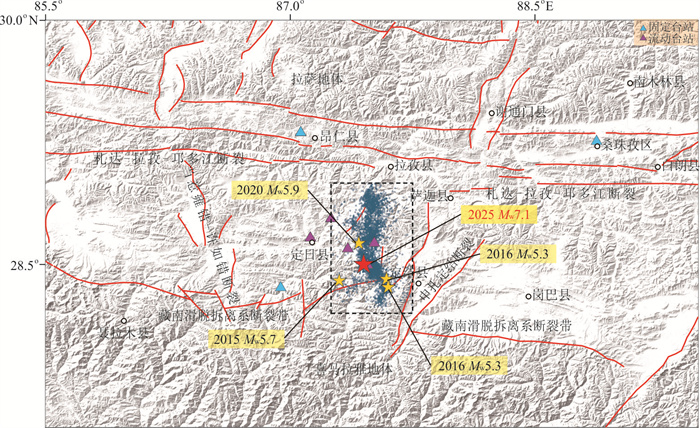
图 1 定日Mw7.1地震周边构造背景
震中周围断裂、余震分布以及台站分布.正三角形符号代表可用台站,其中紫色三角代表流动台,蓝色三角代表固定台;红色五角星代表Mw7.1主震,黄色五角星代表十年内(不包含本次地震)历史五级以上地震;断层数据来源于中国活动构造图(屈春燕,2008)
Fig. 1. Tectonic background of the MW7.1 Dingri Earthquake
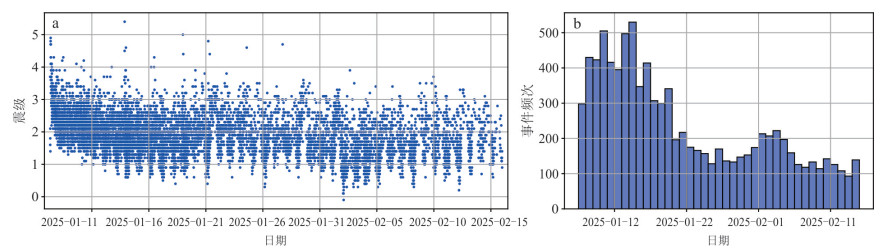
图 2 人工目录震级分布
a. 人工目录自2025年1月7日至2月16日的余震震级分布;b. 余震事件的日分布统计图,时间范围同图a
Fig. 2. Magnitude distribution of manual catalog
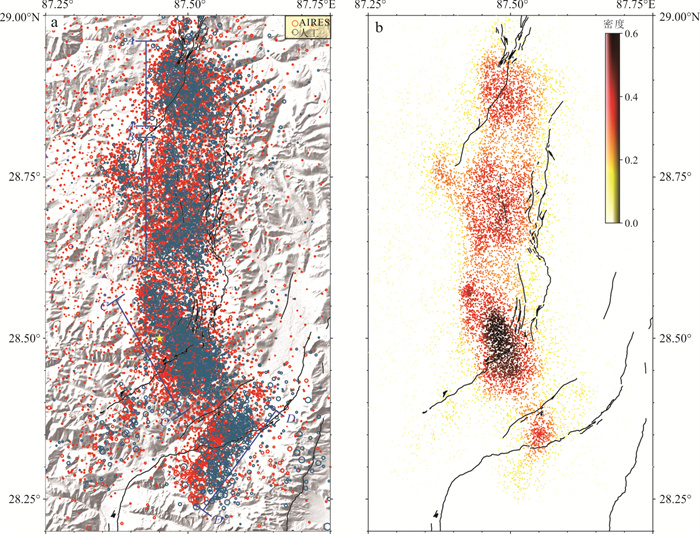
图 4 AIRES与人工目录震中分布对比(a)及AIRES地震密度图(b)
断层数据来自杨婷等(2025)
Fig. 4. Epicenter distribution between AIRES and the manual catalog (a), and seismic density map from AIRES (b)
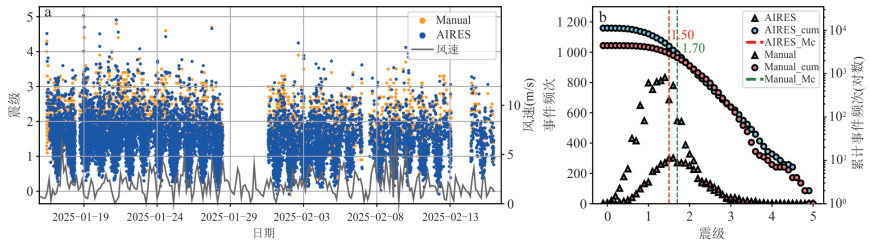
图 5 AIRES与人工目录震级分布
a. 人工目录与AIRES目录的震级分布图以及历史风速平均值,部分检测空白是由于服务器硬盘空间不足,AIRES系统暂停运行导致;b. 人工目录和AIRES目录的震级频次及累计频次统计图,完备震级分别为1.7和1.5
Fig. 5. Magnitude distribution of the AIRES and manual catalogs
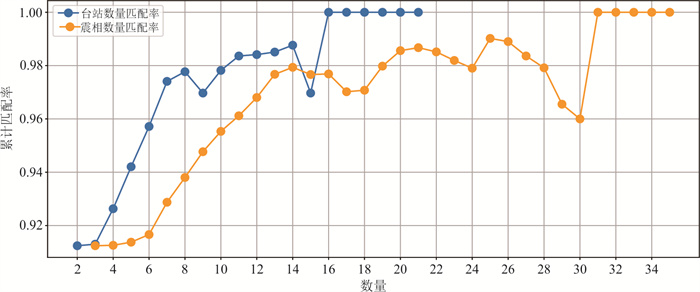
图 6 召回率随震相数和台站数变化的关系
Fig. 6. Variation of recall rate with the number of phases and stations
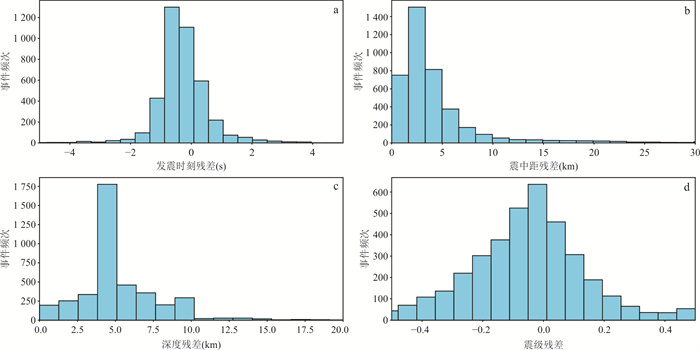
图 7 AIRES与人工目录匹配事件残差分布
Fig. 7. Distribution of residuals for matched events between AIRES and the manual catalog
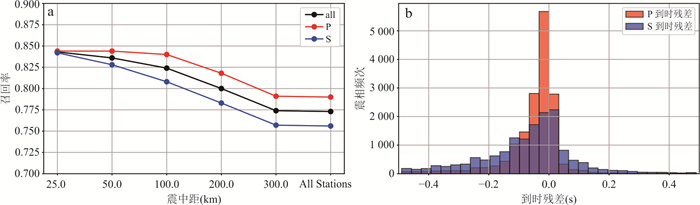
图 8 召回率‒震中距关系(a)与P/S残差分布(b)
Fig. 8. Variation of recall rate with epicentral distance (a) and distribution of P/S phase residuals (b)
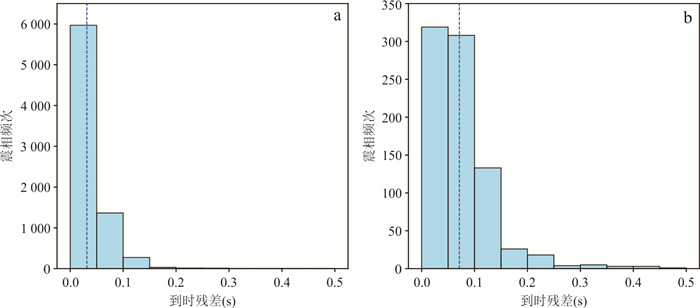
图 9 到时残差频次分布
a. P波初动极性匹配一致的震相到时残差分布,平均残差为0.031 4 s;b. P波初动极性匹配不一致的震相到时残差分布,平均残差为0.071 4 s
Fig. 9. Frequency distribution of arrival-time residuals
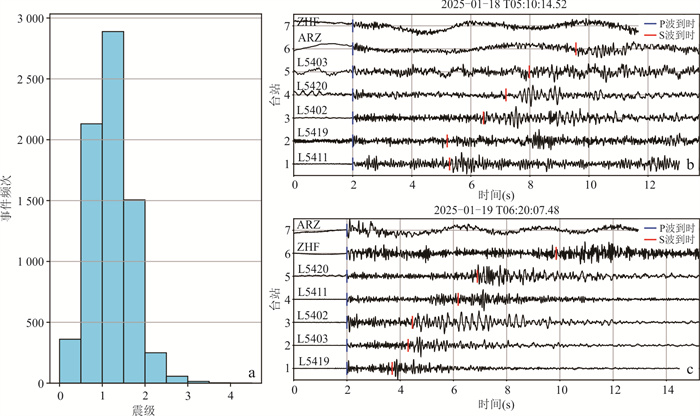
图 10 多检测事件震级频次及典型波形
a. 多检测事件的震级分布;b、c. 多检测事件典型垂直分量波形,均按照P波到时对齐
Fig. 10. Frequency distribution of magnitudes and typical waveforms for extra events
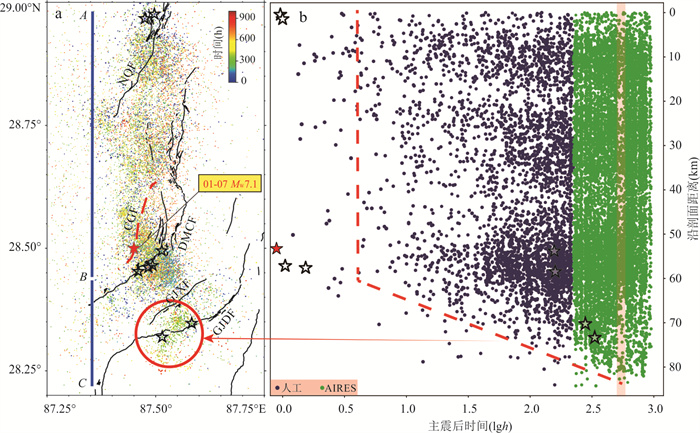
图 12 余震分布(a)及时空演化(b)
余震目录由人工目录(2025年1月7日至1月16日10时)以及AIRES目录(2025年1月16日10时至2月16日)组合而成,投影线纬度范围为28.22º(C点)~28.98ºN(A点);NQF.弄曲断裂,CGF.措果断裂,DMCF.登么错断裂,GJXF.郭嘉西断裂,GJDF.郭嘉东断裂;其中CGF为推测断层(田婷婷和吴中海,2023),用红色虚线表示.图b中红色虚线揭示可能的余震时空演化,部分AIRES检测空区(图 5)由人工目录补充,补充时间段在图b中使用粉色半透明遮罩表示;红色五角星代指主震,无填充五角星代指ML4.5级以上地震
Fig. 12. Aftershock distribution (a) and its spatiotemporal evolution (b)
-
Baimasangbu, Danzengquzhu, Cidanzhuoma, et al., 2024. Analysis of the Impact of Observing Environmental Changes on the Observation Quality of Shigatse Seismic Station. Seismological and Geomagnetic Observation and Research, 45(5): 67-73 (in Chinese with English abstract). He, J., Yang, K., Tang, W. J., et al., 2020. The First High-Resolution Meteorological Forcing Dataset for Land Process Studies over China. Scientific Data, 7: 1-11. https://doi.org/10.1038/s41597-020-0369-y Jia, K., Zhou, S. Y., 2024. Machine Learning Applications in Seismology. Applied Sciences, 14(17): 7857. https://doi.org/10.3390/app14177857 Jiang, C., 2025. Research and Application of Intelligent Processing Algorithms of Regional Seismic Network Data (Dissertation). Institute of Geophysics, China Earthquake Administration, Beijing (in Chinese with English abstract). Kato, A., Obara, K., 2014. Step-like Migration of Early Aftershocks Following the 2007 MW6.7 Noto-Hanto Earthquake, Japan: Kato and Obara: Step-Like Migration of Early Aftershocks. Geophysical Research Letters, 41(11): 3864-3869. https://doi.org/10.1002/2014gl060427 Kuyuk, H. S., Allen, R. M., 2013. Optimal Seismic Network Density for Earthquake Early Warning: A Case Study from California. Seismological Research Letters, 84(6): 946-954. https://doi.org/10.1785/0220130043 Li, S., Fang, L. H., Xiao, Z. W., et al., 2023. FocMech-Flow: Automatic Determination of P-Wave First- Motion Polarity and Focal Mechanism Inversion and Application to the 2021 Yangbi Earthquake Sequence. Applied Sciences, 13(4): 1-13. https://doi.org/10.3390/app13042233 Liao, S. R., Zhang, H. C., Fan, L. P., et al., 2021. Development of a Real-Time Intelligent Seismic Processing System and Its Application in the 2021 Yunnan Yangbi MS6.4 Earthquake. Chinese Journal of Geophysics, 64(10): 3632-3645 (in Chinese with English abstract). Liu, M., Zhang, M., Zhu, W. Q., et al., 2020. Rapid Characterization of the July 2019 Ridgecrest, California, Earthquake Sequence from Raw Seismic Data Using Machine-Learning Phase Picker. Geophysical Research Letters, 47(4): e2019GL086189. https://doi.org/10.1029/2019gl086189 Liu, R. F., Chen, Y. T., Xue, F., et al., 2018. How to Use the New National Standard of Magnitude Correctly. Seismological and Geomagnetic Observation and Research, 39(4): 1-11 (in Chinese with English abstract). Peng, Z. G., Zhao, P., 2009. Migration of Early Aftershocks Following the 2004 Parkfield Earthquake. Nature Geoscience, 2(12): 877-881. https://doi.org/10.1038/ngeo697 Qu, C. Y., 2008. Building to the Active Tectonic Database of China. Seismology and Geology, 30(1): 298-304 (in Chinese with English abstract). Ross, Z. E., Meier, M. A., Hauksson, E., et al., 2018. Generalized Seismic Phase Detection with Deep Learning. Bulletin of the Seismological Society of America, 108(5A): 2894-2901. https://doi.org/10.1785/0120180080 Schweitzer, J., 2001. HYPOSAT-An Enhanced Routine to Locate Seismic Events. Pure and Applied Geophysics, 158(1): 277-289. https://doi.org/10.1007/PL00001160 Sheng, S. Z., Wang, Q. R., Li, Z. Y., et al., 2025. Investigation of the Seismogenic Structure of the 2025 Dingri Ms6.8 Earthquake in Xizang Based on the Tectonic Stress Field Perspective. Seismology and Geology, 47(1): 49-63 (in Chinese with English abstract). Si, X., Wu, X. M., Li, Z. F., et al., 2024. An All-in-One Seismic Phase Picking, Location, and Association Network for Multi-Task Multi-Station Earthquake Monitoring. Communications Earth & Environment, 5: 1-13. https://doi.org/10.1038/s43247-023-01188-4 Tian, T. T., Wu, Z. H., 2023. Recent Prehistoric Major Earthquake Event of Dingmucuo Normal Fault in the Southern Segment of Shenzha-Dingjie Rift and Its Seismic Geological Significance. Geological Review, 69(S1): 53-55 (in Chinese). Wang, R. J., Schmandt, B., Zhang, M., et al., 2020. Injection-Induced Earthquakes on Complex Fault Zones of the Raton Basin Illuminated by Machine-Learning Phase Picker and Dense Nodal Array. Geophysical Research Letters, 47(14): e2020GL088168. https://doi.org/10.1029/2020gl088168 Wang, Z. D., Yang, X. P., Yin, X. X., et al., 2022. Discussion on the Automatic Processing Results for the Aftershock Sequence of Menyuan, Qinghai MS6.9 Earthquake on 8 January, 2022. China Earthquake Engineering Journal, 44(2): 408-414 (in Chinese with English abstract). Xu, Z. Q., Yang, J. S., Li, H. B., et al., 2011. On the Tectonics of the India-Asia Collision. Acta Geologica Sinica, 85(1): 1-33 (in Chinese with English abstract). doi: 10.1111/j.1755-6724.2011.00375.x Yang, L., Lei, H. F., You, J. X., et al., 2023. Estimation of Coda Wave Attenuation in Xiangjiaba and Xiluodu Reservoirs Region. Journal of Geodesy and Geodynamics, 43(4): 403-408 (in Chinese with English abstract). Yang, T., Wang, S. G., Fang, L. H., et al., 2025. Analysis of Earthquake Sequence and Seismogenic Structure of the 2025 MS6.8 Dingri Earthquake in Tibetan Plateau. Earth Science, 50(5): 1721-1732 (in Chinese with English abstract). Yao, J. Y., Yao, D. D., Chen, F., et al., 2025. A Preliminary Catalog of Early Aftershocks Following the 7 January 2025 MS6.8 Dingri, Xizang Earthquake. Journal of Earth Science, 36(2): 856-860. https://doi.org/10.1007/s12583-025-0210-9 Yoon, C. E., Cochran, E. S., Vanacore, E. A., et al., 2023. A Detailed View of the 2020-2023 Southwestern Puerto Rico Seismic Sequence with Deep Learning. Bulletin of the Seismological Society of America, 113(6): 2377-2415. https://doi.org/10.1785/0120220229 Zhang J. J., 2007. A Review on the Extensional Structures in the Northern Himalaya and Southern Tibet. Geological Bulletin of China, 26(6): 639-649 (in Chinese with English abstract). Zhang, M., Liu, M., Feng, T., et al., 2022. LOC-FLOW: An End-to-End Machine Learning-Based High-Precision Earthquake Location Workflow. Seismological Research Letters, 93(5): 2426-2438. https://doi.org/10.1785/0220220019 Zhang, X., Hong, S. Y., Dong, Y. F., et al., 2025. Coseismic Deformation and Fault Slip Distribution of the January 7, 2025, Dingri MW7.1 Earthquake. Earth Science, 50(5): 1709-1720 (in Chinese with English abstract). Zhang, X., Zhang, M., 2024. Universal Neural Networks for Real-Time Earthquake Early Warning Trained with Generalized Earthquakes. Communications Earth & Environment, 5: 1-16. https://doi.org/10.1038/s43247-024-01718-8 Zhao, M., Xiao, Z. W., Zhang, M., et al., 2023. DiTingMotion: A Deep-Learning First-Motion-Polarity Classifier and Its Application to Focal Mechanism Inversion. Frontiers in Earth Science, 11: 1-10. https://doi.org/10.3389/feart.2023.1103914 Zhou, Y. J., Ding, H. Y., Ghosh, A., et al., 2025. AI-PAL: Self-Supervised AI Phase Picking via Rule-Based Algorithm for Generalized Earthquake Detection. Journal of Geophysical Research: Solid Earth, 130(4): e2025JB031294. https://doi.org/10.1029/2025jb031294 Zhou, Y. J., Ghosh, A., Fang, L. H., et al., 2021. A High-Resolution Seismic Catalog for the 2021 MS6.4/MW6.1 Yangbi Earthquake Sequence, Yunnan, China: Application of AI Picker and Matched Filter. Earthquake Science, 34(5): 390-398. https://doi.org/10.29382/eqs-2021-0031 Zhou, Y. J., Yue, H., Fang, L. H., et al., 2022. An Earthquake Detection and Location Architecture for Continuous Seismograms: Phase Picking, Association, Location, and Matched Filter (PALM). Seismological Research Letters, 93(1): 413-425. https://doi.org/10.1785/0220210111 Zhu, J., Li, Z. F., Fang, L. H., 2023a. USTC-Pickers: A Unified Set of Seismic Phase Pickers Transfer Learned for China. Earthquake Science, 36(2): 95-112. https://doi.org/10.1016/j.eqs.2023.03.001 Zhu, W. Q., Hou, A. B., Yang, R., et al., 2023b. QuakeFlow: A Scalable Machine-Learning-Based Earthquake Monitoring Workflow with Cloud Computing. Geophysical Journal International, 232(1): 684-693. https://doi.org/10.1093/gji/ggac355 Zhu, W. Q., Beroza, G. C., 2019. PhaseNet: A Deep- Neural-Network-Based Seismic Arrival Time Picking Method. Geophysical Journal International, 216(1): 261-273. https://doi.org/10.1093/gji/ggy423 Zhu, W. Q., McBrearty, I. W., Mousavi, S. M., et al., 2022. Earthquake Phase Association Using a Bayesian Gaussian Mixture Model. Journal of Geophysical Research: Solid Earth, 127(5): e2021JB023249. https://doi.org/10.1029/2021jb023249 Zhu, W. Q., Mousavi, S. M., Beroza, G. C., 2019. Seismic Signal Denoising and Decomposition Using Deep Neural Networks. IEEE Transactions on Geoscience and Remote Sensing, 57(11): 9476-9488. https://doi.org/10.1109/TGRS.2019.2926772 白玛桑布, 单增曲珠, 次旦卓玛, 等, 2024. 观测环境变化对日喀则地震台观测质量的影响. 地震地磁观测与研究, 45(5): 67-73. 蒋策, 2025. 区域台网地震数据智能处理方法研究与应用(博士学位论文). 北京: 中国地震局地球物理研究所. 廖诗荣, 张红才, 范莉苹, 等, 2021. 实时智能地震处理系统研发及其在2021年云南漾濞MS6.4地震中的应用. 地球物理学报, 64(10): 3632-3645. 刘瑞丰, 陈运泰, 薛峰, 等, 2018. 如何正确使用新的震级国家标准. 地震地磁观测与研究, 39(4): 1-11. 屈春燕, 2008. 最新1/400万中国活动构造空间数据库的建立. 地震地质, 30(1): 298-304. 盛书中, 王倩茹, 李振月, 等, 2025. 基于构造应力场研究2025年西藏定日6.8级地震的发震构造. 地震地质, 47(1): 49-63. 田婷婷, 吴中海, 2023. 西藏申扎‒定结裂谷南段丁木错正断层的最新史前大地震事件及其地震地质意义. 地质论评, 69(S1): 53-55. 王祖东, 杨晓鹏, 尹欣欣, 等, 2022.2022年1月8日青海门源MS6.9地震余震序列自动处理结果探讨. 地震工程学报, 44(2): 408-414. 许志琴, 杨经绥, 李海兵, 等, 2011. 印度‒亚洲碰撞大地构造. 地质学报, 85(1): 1-33. 杨磊, 雷红富, 游家兴, 等, 2023. 向家坝、溪洛渡库区地震尾波Qc值估计. 大地测量与地球动力学, 43(4): 403-408. 杨婷, 王世广, 房立华, 等, 2025.2025年1月7日西藏定日MS6.8地震余震序列特征与发震构造. 地球科学, 50(5): 1721-1732. 张进江, 2007. 北喜马拉雅及藏南伸展构造综述. 地质通报, 26(6): 639-649. 张旭, 洪顺英, 董彦芳, 等, 2025.2025年1月7日定日MW7.1地震同震形变与断层滑动分布. 地球科学, 50(5): 1709-1720. doi: 10.3799/dqkx.2025.072 -

 下载:
下载:
 点击查看大图
计量
- 文章访问数: 170
- HTML全文浏览量: 13
- PDF下载量: 25
- 被引次数: 0
