




Water Level Correction and Streamline Tracing in Phreatic Aquifer Pumping Well Flow Simulation Using Finite Difference Method
-
摘要:
中心网格有限差分法模拟水位与流线是开展众多水文地质工作的基础.为了解决潜水含水层中抽水井处水位模拟误差问题并精确识别流线.本研究基于复势理论,推导了中心网格有限差分法抽水井处水位校正公式,耦合数值模型量化分析了水位校正对流线精度的影响.结果表明,校正公式可显著提升抽水井处水位模拟精度;同时明确了当离散网格尺寸约为井半径的5倍时,无需校正即可同时保证水位与流线的模拟精度.该研究为解决数值模拟中离散化带来的模拟误差提供了理论依据与实用判据.
Abstract:Block-centered finite difference method for simulating water levels and streamlines is the basis of numerous hydrogeological works. To address the simulation error of water levels at pumping wells in a phreatic aquifer and accurately identify streamlines, this study derives a water level correction fomula for pumping wells in the block-centered finite difference method based on complex potential theory. A coupled numerical model is developed to quantitatively analyze the impact of water level correction on the accuracy of streamlines. The results demonstrate that the correction formula significantly improves the simulation accuracy of water levels at pumping wells. Furthermore, it is clarified that when the discrete grid size is approximately 5 times the well radius, both water level and streamline simulation accuracy can be ensured without the need for correction. This study provides a theoretical basis and practical criterion for mitigating simulation errors caused by discretization in numerical modeling.
-
Key words:
- block-centered finite difference /
- phreatic aquifer /
- pumping well /
- water level /
- streamline /
- environmental geology
-
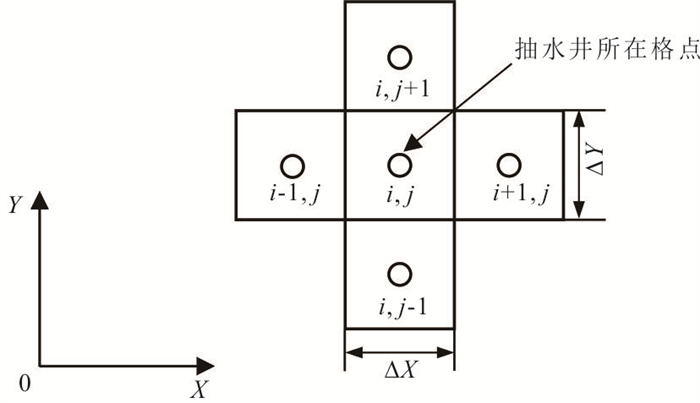
图 1 抽水井所在网格与周边网格格点编号示意
Fig. 1. Node numbers for the pumping well cell and surround grid cells
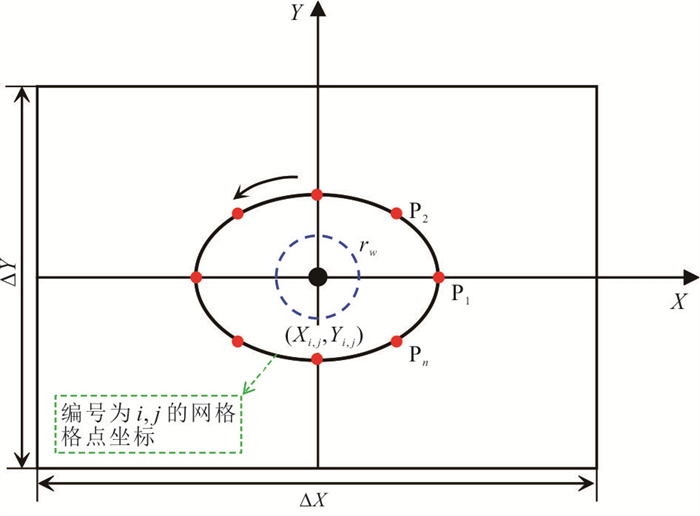
图 2 MODPATH井上粒子追踪起点分布示意
Fig. 2. Starting point distribution for particle tracking on the well rim in MODPATH
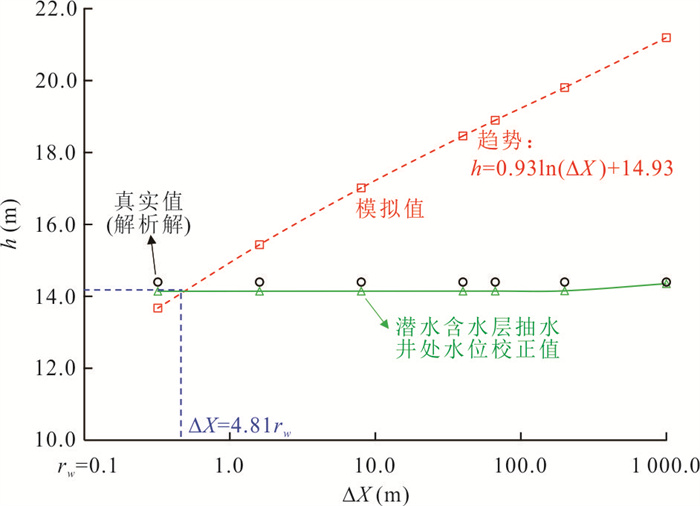
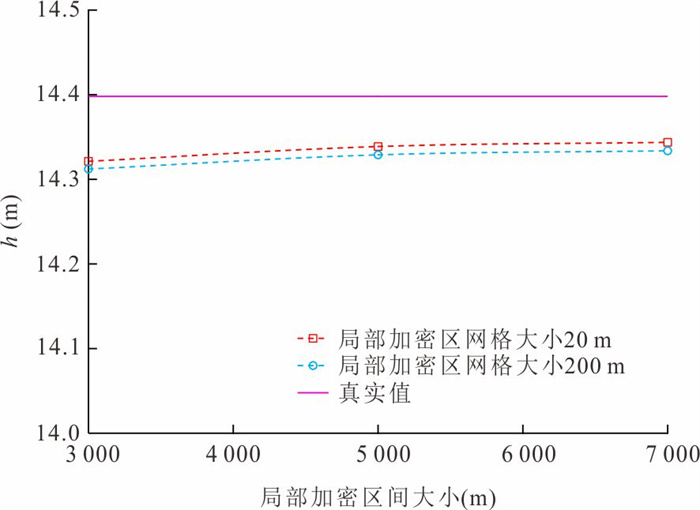
图 5 抽水井处水位模拟值、校正值与真实值对比
Fig. 5. Comparison of simulated, calibrated, and analytical water levels on the pumping well rim
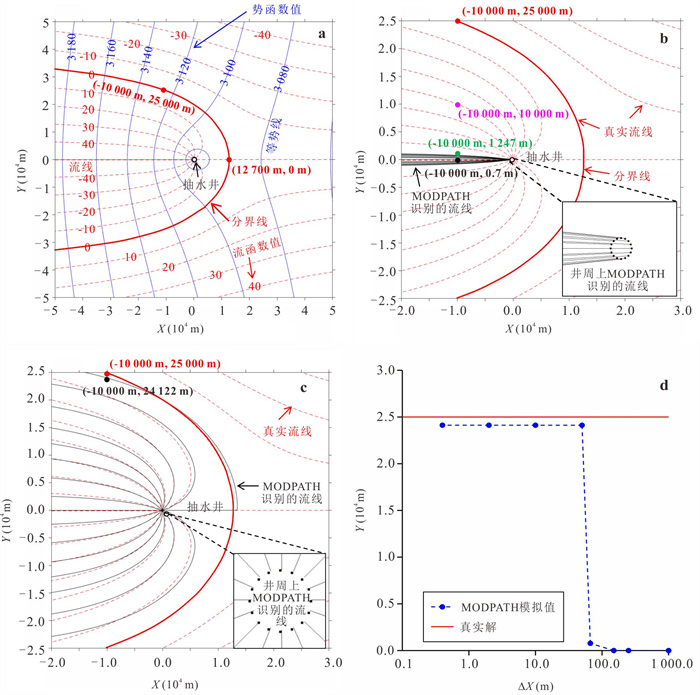
图 6 案例B的流线模拟结果
a.流场真实解;b.ΔX=200 m;c.ΔX=0.32 m;d.X=-10 000 m时,分界线纵坐标Y的模拟值与真实解对比
Fig. 6. Streamline simulation results for case B
-
Bear, J., 1979. Hydraulics of Ground Water. McGraw-Hill Inc., New York. Campos, L. M. B. C., 2010. Complex Analysis with Applications to Flows and Fields. CRC Press, Boca Raton. Chen, C. X., Wang, X. S., Hu, L. T., 2007. Emendation of Drawdown in Pumping Wells for Numerical Modeling of Groundwater Flow. Journal of Hydraulic Engineering, 38(4): 481-485 (in Chinese with English abstract). Gang, S. T., Deng, Y. E., 2015. Comprehensive Summary of GMS Application for Groundwater Resource Evaluation and Management. Ground Water, 37(2): 33-36(in Chinese with English abstract). Lerner, D. N., 1989. Predicting Pumping Water Levels in Single and Multiple Wells Using Regional Groundwater Models. Journal of Hydrology, 105(1-2): 39-55. https://doi.org/10.1016/0022-1694(89)90095-4 Li, R. Y., 2022. Study on the Three-Dimensional Shape and Recharge Sources for Catchment Zone of a Pumping Well near Rivers (Dissertation). China University of Geosciences, Beijing (in Chinese with English abstract). Li, X., Su, S. L., Wen, Z., et al., 2022. Numerical Analysis of Estimating Groundwater Velocity through Single-Well Push-Pull Test. Earth Science, 47(2): 633-641(in Chinese with English abstract). MacMillan, G. J., Schumacher, J., 2015. Correction of Discretization Errors Simulated at Supply Wells. Ground Water, 53(4): 651-657. https://doi.org/10.1111/gwat.12254 Mcdonald, M. G., Harbaugh, A. W., 1988. A Modular Three-Dimensional Finite-Difference Ground-Water Flow Model. US Geological Survey, U. S. A., 83-875. Poeter, E., Hsieh, P., 2020. Graphical Construction of Groundwater Flow Nets. The Groundwater Project: Guelph, Ontario, Canada. https://doi.org/10.21083/978-1-7770541-3-7 Pollock, D. W., 1988. Semianalytical Computation of Path Lines for Finite-Difference Models. Groundwater, 26(6): 743-750. https://doi.org/10.1111/j.1745-6584.1988.tb00425.x Pollock, D. W., 2016. User Guide for MODPATH Version 7—A Particle Tracking Model for MODFLOW. Open-File Report 2016-1086. U. S. Geological Survey, Reston, VA. https://doi.org/10.3133/ofr20161086 Prickett, T. A., 1967. Designing Pumped Well Characteristics into Electric Analog Models. Groundwater, 5(4): 38-46. https://doi.org/10.1111/j.1745-6584.1967.tb01625.x Ramadhan, M., 2015. A Semi-Analytical Particle Tracking Algorithm for Arbitrary Unstructured Grids. University of Waterloo, Waterloo. Strack, O. D., 1989. Groundwater Mechanics. Prentice-Hall, Englewood Cliffs. Su, S. L., Li, X., Guo, Q., et al., 2024. Effect Mechanistic of Partially Penetrating Well on Single-Well Push-Pull Tests for Groundwater Velocity Estimation. Earth Science, 49(1): 288-298(in Chinese with English abstract). Wang, Y., Li, J., Xi, B. D., et al., 2018. Research on the Division Technology of Karst Groundwater Source Protection Areas Based on Numerical Simulation. Carsologica Sinica, 37(6): 799-809(in Chinese with English abstract). Wang, X. G., 2023. Experimental Study on Hydraulic Control and Remediation of Trichloroethylene Pollution in Single Well Pumping and Infiltration Groundwater (Dissertation). Hebei University of Engineering, Handan (in Chinese with English abstract). Wang, X. S., 2008. Revised Model for Finite-Difference Modeling of Flowing Artesian Wells. Earth Science, 33(1): 112-116(in Chinese with English abstract). Xia, Q., Wang, X. S., Lu, L. B., 2007. Characteristics of Error in Numerical Modeling of Well Flow with MODFLOW. Geotechnical Investigation Surveying, 35(10): 29-32, 37(in Chinese with English abstract). Yang, J. H., 2008. Comparative Analysis of Three Fundamental Numerical Computation Methods. Science Technology Information, 35: 19 (in Chinese). Zhang, S., Wang, X. S., Han, P. F., et al., 2024. New Particle Tracking Method for 2D Steady-State Groundwater Flow around Wells: A Modified Algorithm Using the Stream Function. Journal of Hydrology, 632: 130928. https://doi.org/10.1016/j.jhydrol.2024.130928 陈崇希, 王旭升, 胡立堂, 2007. 地下水流数值模拟中抽水井水位的校正. 水利学报, 38(4): 481-485. 刚什婷, 邓英尔, 2015. 基于GMS在地下水资源评价与管理中的应用综述. 地下水, 37(2): 33-36. 李若怡, 2022. 傍河地下水开采井截获区的三维形态与补给来源研究(博士学位论文). 北京: 中国地质大学. 李旭, 苏世林, 文章, 等, 2022. 单井注抽试验测算地下水流速的数值分析. 地球科学, 47(2): 633-641. doi: 10.3799/dqkx.2021.102 苏世林, 李旭, 郭强, 等, 2024. 非完整井对单井注抽试验测算地下水流速影响机理. 地球科学, 49(1): 288-298. doi: 10.3799/dqkx.2022.148 汪洋, 李娟, 席北斗, 等, 2018. 基于数值模拟的岩溶地下水源保护区划分技术研究. 中国岩溶, 37(6): 799-809. 王新港, 2023. 单井抽出-回渗地下水水力控制及对三氯乙烯污染修复实验研究(硕士学位论文). 邯郸: 河北工程大学. 王旭升, 2008. 自流井有限差分模拟的校正模型. 地球科学, 33(1): 112-116. doi: 10.3799/dqkx.2022.148 夏强, 王旭升, 鲁林波, 2007. 利用MODFLOW模拟井流的误差特征. 工程勘察, 35(10): 29-32, 37. 杨建宏, 2008. 三种基本数值计算方法的对比分析研究. 科技信息, 35: 19. -

 下载:
下载:
 点击查看大图
计量
- 文章访问数: 215
- HTML全文浏览量: 12
- PDF下载量: 42
- 被引次数: 0
