




Influence of Surface Water-Groundwater Interaction in Hyporheic Zone on Sulfamethoxazole Migration and Transformation Process
-
摘要:
磺胺甲恶唑(sulfamethoxazole,SMX)作为一种广泛使用的抗生素,其在环境中的残留与检出频率持续增加,研究SMX在河流潜流带中的迁移转化行为对保障河流生态健康与水安全至关重要.本研究基于室内模拟实验,探讨了不同水力梯度下,地表水-地下水交互作用对潜流带沉积物中SMX迁移转化规律的影响.结果表明:地表水-地下水交互作用驱动着潜流带环境因子的动态变化,进而引起微生物多样性及群落结构的演替,最终影响SMX的迁移与转化行为.SMX在潜流带中的转化主要经由水解、脱硫化和生物降解途径实现,其主导衰减机制随交互作用时间的延长而转变.其中,变形菌门与厚壁菌门是参与SMX生物降解的优势菌群.此外,水力梯度对SMX的去除效率具有明显影响,在低水力梯度下,较小的水流流速更有利于SMX在沉积物中的滞留与降解,因而表现出更显著的去除效果.
-
关键词:
- 河流潜流带 /
- 地表水-地下水交互作用 /
- 磺胺甲恶唑迁移转化 /
- 微生物群落 /
- 水文地质
Abstract:As a widely used antibiotic, sulfamethoxazole (SMX) is being increasingly detected in aquatic and soil environments, where its residual concentrations continue to rise. It is imperative to investigate the fate of SMX in the hyporheic zone, as it is critical for safeguarding river ecosystem health and ensuring water security. This study collected hyporheic sediments and conducted simulation experiments to investigate the migration and transformation processes of SMX within the hyporheic zone under various hydraulic gradients. The results demonstrate that dynamics of sedimentary environmental factors in the hyporheic zone, driven by surface water-groundwater interactions, were initiated by successive shifts in microbial diversity and community structure, which in turn modulated the migration and transformation processes of SMX. Hydrolysis, desulfonation, and biodegradation served as the primary pathways for SMX transformation in the hyporheic zone, with the dominant attenuation mechanism transitioning over the course of water interactions. Proteobacteria and Firmicutes were the primary microbial groups in the hyporheic zone and the key drivers of SMX biodegradation. The removal efficiency of SMX varied with hydraulic gradients in the hyporheic zone, with a more significant removal observed under the lower hydraulic gradient condition.
-
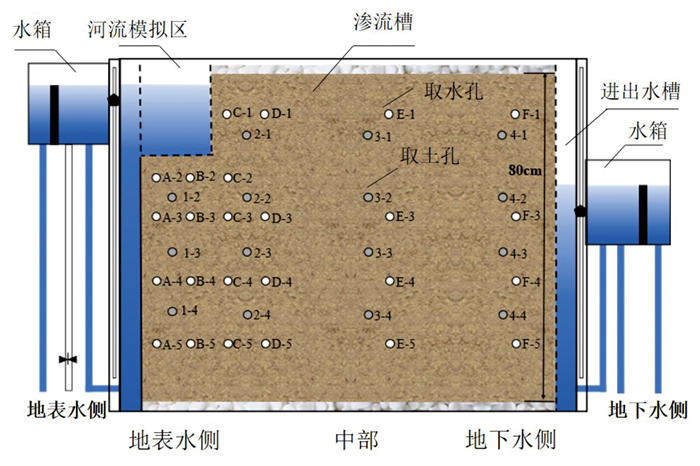
图 1 潜流带地表水-地下水交互过程模拟实验装置
Fig. 1. Simulation experimental device for the process of water exchange in hyporheic zone
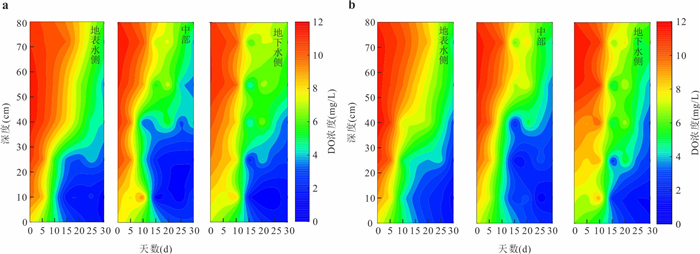
图 2 不同水力梯度下沉积物孔隙水DO变化特征
a. H1组DO; b. H2组DO
Fig. 2. Concentration changes of DO in sediment interstitial water at different depths under different hydraulic gradients
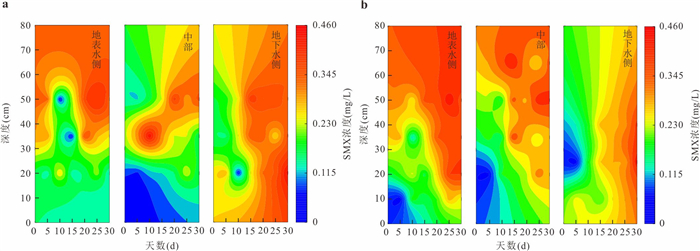
图 3 不同水力梯度下沉积物孔隙水SMX变化特征
a. H1组SMX; b. H2组SMX
Fig. 3. Concentration changes of SMX in sediment interstitial water at different depths under different hydraulic gradients
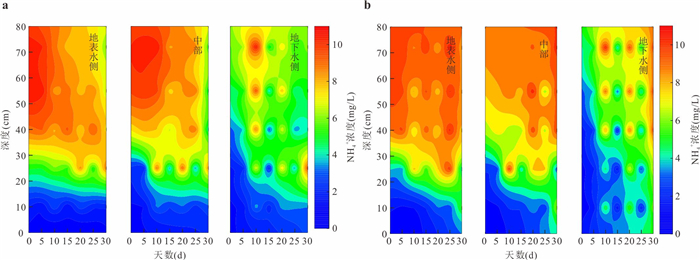
图 4 不同水力梯度下沉积物孔隙水NH4+变化特征
a. H1组NH4+; b. H2组NH4+
Fig. 4. Concentration changes of NH4+ in sediment interstitial water at different depths under different hydraulic gradients
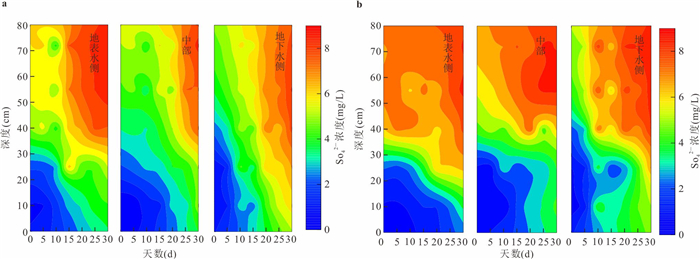
图 5 不同水力梯度下沉积物孔隙水SO42-变化特征
a. H1组SO42-; b. H2组SO42-
Fig. 5. Concentration changes of SO42- in sediment interstitial water at different depths under different hydraulic gradients
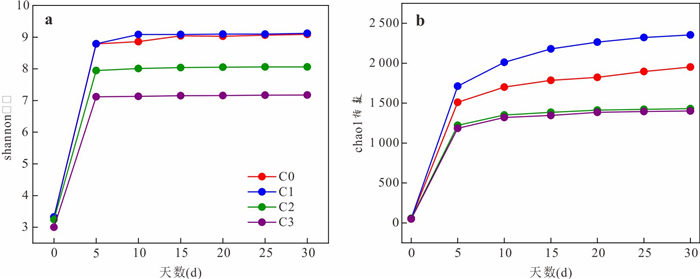
图 6 潜流带沉积物样品Shannon指数稀释曲线(a)和Chao1指数(b)
Fig. 6. Shannon indices (a) and Chao1 index (b) in river sediment samples
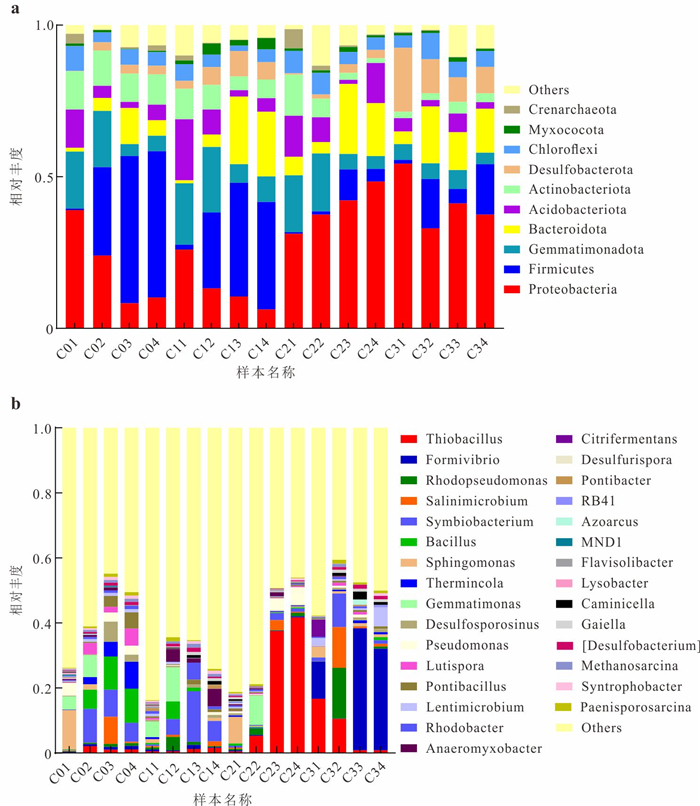
图 7 潜流带沉积物样品在门水平与属水平的微生物种群结构
Fig. 7. Microbial community members at the phylum level and the genus level in river sediment samples
表 1 实验水力梯度设计
Table 1. Design of experimental hydraulic gradients
实验分组 地表水补给地下水 地下水补给地表水 地表水水位(cm) 地下水水位(cm) 水力梯度 地表水水位(cm) 地下水水位(cm) 水力梯度 H1 75 52.5 0.225 62.5 75 0.125 H2 80 48.5 0.315 57.5 80 0.225  下载: 导出CSV
表 2 地表水模拟液的配置组分及浓度
Table 2. Composition and concentration of constituents in simulated surface water
物质 C6H12O6 NH4Cl KNO3 KCl 浓度(mg/L) 3.64 1.34 11.59 18.39 物质 Ca(HCO3)2 NaCl CaCl2 SMX 浓度(mg/L) 330 3.33 18.34 0.5
下载: 导出CSV
表 3 地下水模拟液的配置组分及浓度
Table 3. Composition and concentration of constituents in simulated groundwater
物质 C6H12O6 NH4Cl KNO3 Ca(HCO3)2 NaCl SMX 浓度(mg/L) 13.44 0.475 30.3 630.87 8.95 0.5
下载: 导出CSV
-
Bai, G. M., Sun, Y. J., Sun, Y. J., et al., 2025. Research Progress on Biodegradation of Sulfonamides. Environmental Engineering, 43(7): 112-124(in Chinese with English abstract). Bai, Y., Ruan, X. H., Wang, F. F., et al., 2019. Sulfonamides Removal under Different Redox Conditions and Microbial Response to Sulfonamides Stress during Riverbank Filtration: A Laboratory Column Study. Chemosphere, 220: 668-677. https://doi.org/10.1016/j.chemosphere.2018.12.167 Borsetto, C., Raguideau, S., Travis, E., et al., 2021. Impact of Sulfamethoxazole on a Riverine Microbiome. Water Research, 201: 117382. https://doi.org/10.1016/j.watres.2021.117382 Chabilan, A., Ledesma, D. G. B., Horn, H., et al., 2023. Mesocosm Experiment to Determine the Contribution of Adsorption, Biodegradation, Hydrolysis and Photodegradation in the Attenuation of Antibiotics at the Water Sediment Interface. Science of the Total Environment, 866: 161385. https://doi.org/10.1016/j.scitotenv.2022.161385 Cheng, Y., Li, W. X., Zhang, D., et al., 2024. Hydrolysis of Sulfamethoxazole in the Hyporheic Zone: Kinetics, Factors and Pathways. Environmental Technology, 45(23): 4834-4847. https://doi.org/10.1080/09593330.2023.2283402 Chen, X., Lin, H., Dong, Y. B., et al., 2022. Mechanisms Underlying Enhanced Bioremediation of Sulfamethoxazole and Zinc(Ⅱ) by Bacillus sp. SDB4 Immobilized on Biochar. Journal of Cleaner Production, 370: 133483. https://doi.org/10.1016/j.jclepro.2022.133483 Ding, W. J., Lu, F. Y., Zhao, B., et al., 2024. Kinetics of Nitrification and Denitrification in Hyporheic Zone Sediment with Periodical Supply of Nitrogen. Earth Science, 49(10): 3712-3722(in Chinese with English abstract). Dong, P. Y., Qiu, W. H., He, X., et al., 2021. Analysis of Physicochemical Factors Regulating Transport Behaviors of Sulfonamide Antibiotics in Saturated Porous Media. Journal of Hydrology, 599: 126381. https://doi.org/10.1016/j.jhydrol.2021.126381 Du, Y., Ma, T., Deng, Y. M., et al., 2017. Hydro-Biogeochemistry of Hyporheic Zone: Principles, Methods and Ecological Significance. Earth Science, 42(5): 661-673(in Chinese with English abstract). Gartner, J. D., Renshaw, C. E., Dade, W. B., et al., 2012. Time and Depth Scales of Fine Sediment Delivery into Gravel Stream Beds: Constraints from Fallout Radionuclides on Fine Sediment Residence Time and Delivery. Geomorphology, 151-152: 39-49. https://doi.org/10.1016/j.geomorph.2012.01.008 Harvey, J., Gooseff, M., 2015. River Corridor Science: Hydrologic Exchange and Ecological Consequences from Bedforms to Basins. Water Resources Research, 51(9): 6893-6922. https://doi.org/10.1002/2015WR017617 Jia, Y. Y., Khanal, S. K., Zhang, H. Q., et al., 2017. Sulfamethoxazole Degradation in Anaerobic Sulfate-Reducing Bacteria Sludge System. Water Research, 119: 12-20. https://doi.org/10.1016/j.watres.2017.04.040 Jiang, B. C., Li, A., Cui, D., et al., 2014. Biodegradation and Metabolic Pathway of Sulfamethoxazole by Pseudomonas Psychrophila HA-4, a Newly Isolated Cold-Adapted Sulfamethoxazole-Degrading Bacterium. Applied Microbiology and Biotechnology, 98(10): 4671-4681. https://doi.org/10.1007/s00253-013-5488-3 Kaandorp, V. P., Molina-Navarro, E., Andersen, H. E., et al., 2018. A Conceptual Model for the Analysis of Multi-Stressors in Linked Groundwater-Surface Water Systems. Science of the Total Environment, 627: 880-895. https://doi.org/10.1016/j.scitotenv.2018.01.259 Kassotaki, E., Buttiglieri, G., Ferrando-Climent, L., et al., 2016. Enhanced Sulfamethoxazole Degradation through Ammonia Oxidizing Bacteria Co-Metabolism and Fate of Transformation Products. Water Research, 94: 111-119. https://doi.org/10.1016/j.watres.2016.02.022 Li, H. B., Ma, J. F., Wang, X., et al., 2016. Effect of Hydraulic Loading Rate on Sewage Treatment Efficiency of Subsurface Wastewater Infiltration System. Chinese Journal of Environmental Engineering, 10(2): 544-550(in Chinese with English abstract). Li, P. Y., An, Q. R., Wang, X. H., et al., 2022. Analysis on Diversity and Structure of Microbial Community in River Sediment of Siping Section of Liaohe River. Environmental Science, 43(5): 2586-2594(in Chinese with English abstract). Lin, X. J., McKinley, J., Resch, C. T., et al., 2012. Spatial and Temporal Dynamics of the Microbial Community in the Hanford Unconfined Aquifer. The ISME Journal, 6(9): 1665-1676. https://doi.org/10.1038/ismej.2012.26 Liu, L. M., Chen, H. Y., Zhu, G. H., et al., 2024. Constructed Wetlands for the Removal of Antibiotic Resistance Genes. Earth Science, 49(9): 3440-3444(in Chinese with English abstract). Liu, Q. Q., Li, M., Zhang, F. W., et al., 2017. The Removal of Trimethoprim and Sulfamethoxazole by a High Infiltration Rate Artificial Composite Soil Treatment System. Frontiers of Environmental Science Engineering, 11(2): 12. https://doi.org/10.1007/s11783-017-0920-z Ma, Y. P., Li, M., Wu, M. M., et al., 2015. Occurrences and Regional Distributions of 20 Antibiotics in Water Bodies during Groundwater Recharge. Science of the Total Environment, 518: 498-506. https://doi.org/10.1016/j.scitotenv.2015.02.100 Peng, C., Gan, M. F., Che, J. L., et al., 2024. Study on the Influence of Water Exchange in River Hyporheic Zone on Nitrogen Migration and Transformation Process. Acta Ecologica Sinica, 44(23): 10794-10806(in Chinese with English abstract). Ping, X., Xian, Y., Jin, M. G., 2018. Influence of Bioclogging on Nitrogen Cycling in a Hyporheic Zone with an Undulate River-Bed. Earth Science, 43(S1): 171-180(in Chinese with English abstract). Qu, Y., Song, J. X., Long, Y. Q., et al., 2025. Phosphorus Speciation in the Hyporheic Zone and Its Response to Sediment-Water Quality-Biological Activity Coupling Effect. Journal of Environmental Management, 374: 124145. https://doi.org/10.1016/j.jenvman.2025.124145 Schübl, M., Kiecak, A., Hug, K., et al., 2021. Sorption and Biodegradation Parameters of Selected Pharmaceuticals in Laboratory Column Experiments. Journal of Contaminant Hydrology, 236: 103738. https://doi.org/10.1016/j.jconhyd.2020.103738 Sarker, P., Lei, X. B., Taylor, K., et al., 2023. Evaluation of the Adsorption of Sulfamethoxazole (SMX) within Aqueous Influents onto Customized Ordered Mesoporous Carbon (OMC) Adsorbents: Performance and Elucidation of Key Adsorption Mechanisms. Chemical Engineering Journal, 454: 140082. https://doi.org/10.1016/j.cej.2022.140082 Wang, J. L., Wang, S. Z., 2018. Microbial Degradation of Sulfamethoxazole in the Environment. Applied Microbiology and Biotechnology, 102(8): 3573-3582. https://doi.org/10.1007/s00253-018-8845-4 Xue, W. D., Li, F. X., Zhou, Q. X., 2019. Degradation Mechanisms of Sulfamethoxazole and Its Induction of Bacterial Community Changes and Antibiotic Resistance Genes in a Microbial Fuel Cell. Bioresource Technology, 289: 121632. https://doi.org/10.1016/j.biortech.2019.121632 Xia, X. L., Yue, W. F., Zhai, Y. Z., et al., 2023. DOM Accumulation in the Hyporheic Zone Promotes Geogenic Fe Mobility: A Laboratory Column Study. Science of the Total Environment, 896: 165140. https://doi.org/10.1016/j.scitotenv.2023.165140 Wen, Z., Liu, H., Rezanezhad, F., et al., 2024. Advancement and Perspectives of Hyporheic Zone Hydrology: Technology, Theory and Environmental Implication. Journal of Hydrology, 630: 130721. https://doi.org/10.1016/j.jhydrol.2024.130721 Wu, D. L., Bai, H., He, L. Y., et al., 2025. From River to Groundwater: Antibiotics Pollution, Resistance Prevalence, and Source Tracking. Environment International, 196: 109305. https://doi.org/10.1016/j.envint.2025.109305 Wu, Y., Feng, P. Y., Li, R., et al., 2019. Progress in Microbial Remediation of Antibiotic-Residue Contaminated Environment. Chinese Journal of Biotechnology, 35(11): 2133-2150(in Chinese with English abstract). Zhang, L. L., Zhang, C., Lian, K. T., et al., 2021. Effects of Chronic Exposure of Antibiotics on Microbial Community Structure and Functions in Hyporheic Zone Sediments. Journal of Hazardous Materials, 416: 126141. https://doi.org/10.1016/j.jhazmat.2021.126141 Zhang, L. Y., Ye, Y. B., Wang, L. J., et al., 2015. Nitrogen Removal Processes in Deep Subsurface Wastewater Infiltration Systems. Ecological Engineering, 77: 275-283. https://doi.org/10.1016/j.ecoleng.2015.01.008 Zhou, A. X., 2015. Research on the Migration and Transformation Mechanism and Remediation Technique of Sulfa Antibiotics in Phreatic Water (Dissertation). Jilin University, Changchun (in Chinese with English abstract). Zhu, Z. C., Liu, H., Mao, S. J., et al., 2023. Distribution Characteristics of Microbial Communities in River-Groundwater Interaction Zone and Main Environmental Factors. Earth Science, 48(10): 3832-3843 (in Chinese with English abstract). 白国敏, 孙寓姣, 孙钰洁, 等, 2025. 磺胺类抗生素的生物降解研究进展. 环境工程, 43(7): 112-124. 丁吾举, 陆菲雨, 赵博, 等, 2024. 氮周期供给时潜流带沉积物硝化、反硝化动力学. 地球科学, 49(10): 3712-3722. doi: 10.3799/dqkx.2023.121 杜尧, 马腾, 邓娅敏, 等, 2017. 潜流带水文-生物地球化学: 原理、方法及其生态意义. 地球科学, 42(5): 661-673. 李鹏洋, 安启睿, 王新皓, 等, 2022. 辽河四平段流域河流沉积物微生物群落多样性和结构分析. 环境科学, 43(5): 2586-2594. 李海波, 马吉福, 王鑫, 等, 2016. 水力负荷对污水地下渗滤系统处理效果的影响. 环境工程学报, 10(2): 544-550. 柳林妹, 陈海洋, 朱冠华, 等, 2024. 人工湿地去除抗生素抗性基因. 地球科学, 49(9): 3440-3444. doi: 10.3799/dqkx.2024.082 彭闯, 干牧凡, 车景璐, 等, 2024. 河流潜流带水交换作用对氮迁移转化过程的影响. 生态学报, 44(23): 10794-10806. 平雪, 鲜阳, 靳孟贵, 2018. 河床起伏条件下生物堵塞对潜流带氮素迁移转化的影响. 地球科学, 43(增刊1): 171-180. 吴迎, 冯朋雅, 李荣, 等, 2019. 环境抗生素污染的微生物修复进展. 生物工程学报, 35(11): 2133-2150. 周爱霞. 2015. 潜水中磺胺抗生素迁移转化机理及修复技术研究(博士学位论文). 长春: 吉林大学. 朱子超, 刘慧, 毛胜军, 等, 2021. 河水-地下水侧向交互带微生物群落分布特征及其主控因子. 地球科学, 48(10): 3832-3843. doi: 10.3799/dqkx.2021.217 -

 点击查看大图
计量
- 文章访问数: 239
- HTML全文浏览量: 12
- PDF下载量: 45
- 被引次数: 0
