




Cretaceous Tectonic Evolution and Cu-Au Metallogenesis in Northern Tibet
-
摘要: 藏北白垩纪构造演化存在较大争议,严重制约了高原隆升和藏北世界级规模铜金资源成矿背景的准确认识. 为重建藏北白垩纪演化,对藏北西部吉普三队、松西和日土岩浆岩开展了综合研究. 结果显示,吉普三队和松西岩浆岩分别形成于~120和~110 Ma,均为Ⅰ型高钾钙碱性花岗岩,经历了复杂的熔融、同化、储存、均一化过程,是中特提斯洋俯冲作用的产物. 日土岩浆岩形成于~90 Ma,为富Nb型辉长岩和A型花岗岩组成的双峰式岩浆作用,是造山后伸展事件的产物. 从120~110 Ma至~90 Ma,藏北西部经历了由俯冲向碰撞转变的洋陆转换过程. 利用壳源岩浆岩反演其形成时的地壳厚度和壳源物质贡献度的结果表明,藏北西部在160~100 Ma具有正常的陆壳厚度(~30 km),但~100 Ma之后,地壳明显增厚,~90 Ma时,地壳厚度(~60 km)已超现今伊朗高原. ~110 Ma时,地壳物质贡献度达到峰值,预示着初始碰撞. 综合上述研究,结合区域晚白垩世磨拉石和混杂岩资料,提出中特提斯洋在白垩纪经历了从东向西的穿时洋陆转换,其中藏北西部洋陆转换发生在110~96 Ma. 中特提斯洋闭合后,拉萨-羌塘碰撞导致了藏北显著的地壳加厚和地表隆升,其隆升规模至少堪比现今的伊朗高原. 穿时洋陆转换及造山过程促使岩浆熔体氧逸度的升高,为藏北巨量铜金资源富集成矿创造了有利条件. 本研究从岩浆岩角度重建了藏北白垩纪洋陆转换与造山过程,为造山带形成演化和成矿作用研究提供了经典实例.Abstract: The Cretaceous tectonic evolution of northern Tibet remains highly controversial, significantly constraining our understanding of plateau uplift and the metallogenic background of world-class Cu-Au resources in this region. To reconstruct the Cretaceous evolution of northern Tibet, we conducted an integrated study on magmatic rocks from Jipusandui, Songxi, and Rutog in western Northern Tibet. Results indicate that the Jipusandui(~120 Ma) and Songxi(~110 Ma) intrusions are Ⅰ-type high-K calc-alkaline granites that underwent complex processes of melting, assimilation, storage, and homogenization, representing products of Meso-Tethys Ocean subduction. The Rutog magmatic rocks(~90 Ma) is characterized by a bimodal volcanic association composed of Nb-enriched gabbro and A-type granite, reflecting post-orogenic extensional tectonics. From 120~110 Ma to ~90 Ma, western Northern Tibet experienced an ocean-continent transition from subduction to collision. Inversion of crustal thickness and crustal contributions based on crust-derived magmas reveals that the crust of western Northern Tibet maintained a normal thickness (~30 km) during 160~100 Ma, but significantly thickened after ~100 Ma, reaching ~60 km by ~90 Ma-exceeding the present-day Iranian Plateau. The peak contribution of crustal materials at ~110 Ma suggests the onset of initial collision. Synthesizing results with regional Late Cretaceous molasse and mélange records, we propose that the Meso-Tethys Ocean underwent a diachronous ocean-continent transition from east to west during the Cretaceous, with the transition in western Northern Tibet occurring between 110 and 96 Ma. Following the closure of the Meso-Tethys Ocean, the Lhasa-Qiangtang collision resulted in pronounced crustal thickening and surface uplift, with an uplift magnitude at least comparable to that of the modern Iranian Plateau. This diachronous ocean–continent transition and subsequent orogenesis elevated the oxygen fugacityof magmatic systems, thereby creating favorable conditions for the enrichment and metallogenesis of giant Cu-Au resources in northern Tibet. From the perspective of magmatic records, this study reconstructs the Cretaceousocean-continent transition and orogenic processes in northern Tibet, providing a representative case study for understanding the orogenesis and metallogenesis in collisional orogens.
-
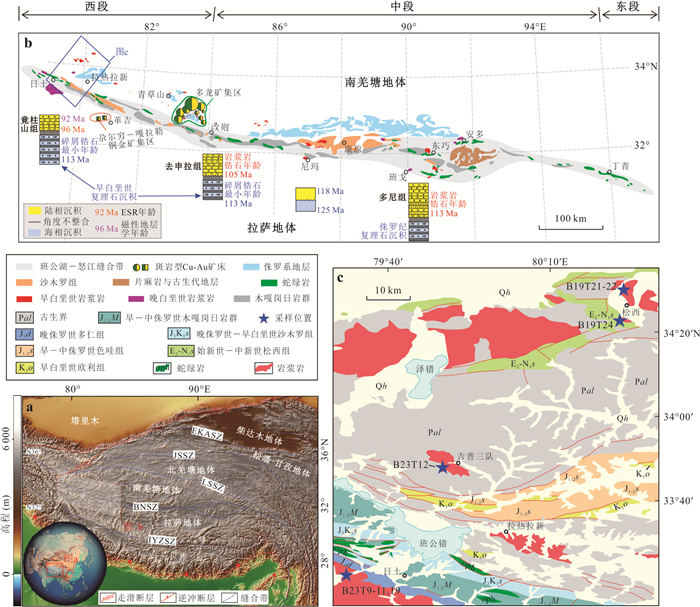
图 1 (a)西藏及邻区构造格架简图(修改自Fan et al.2024a); (b)藏北西部地质简图(修改自Hu et al., 2022 and Zhang et al., 2023)和(c)研究区松西、吉普三队和日土地区地质图
Fig. 1. (a) Tectonic framework of the Tibet, modified after Fanet al.(2024a); (b)Simplified geological map of the western segment of the Bangong-Nujiang Suture Zone in northern Tibet(revised from Hu et al., 2022 and Zhang et al., 2023); (c) Simplified geological map of the studied area, Songxi, Jipusandui and Rutogarea.
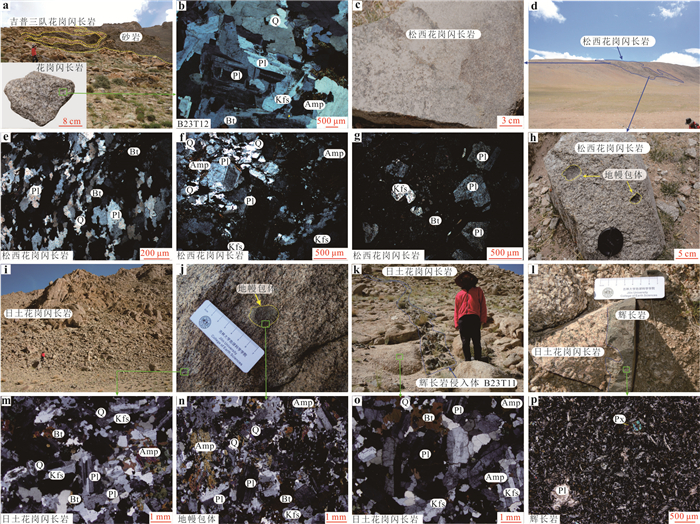
图 2 松西、吉普三队和日土地区岩浆岩野外照片和显微照片(正交偏光)
Pl. 斜长石;Kfs. 钾长石;Q. 石英;Px. 辉石;Amp. 角闪石;Bt. 黑云母
Fig. 2. Representative field photographs and photomicrographs of various magmatic samples from the Songxi, Jipusandui and Rutog area
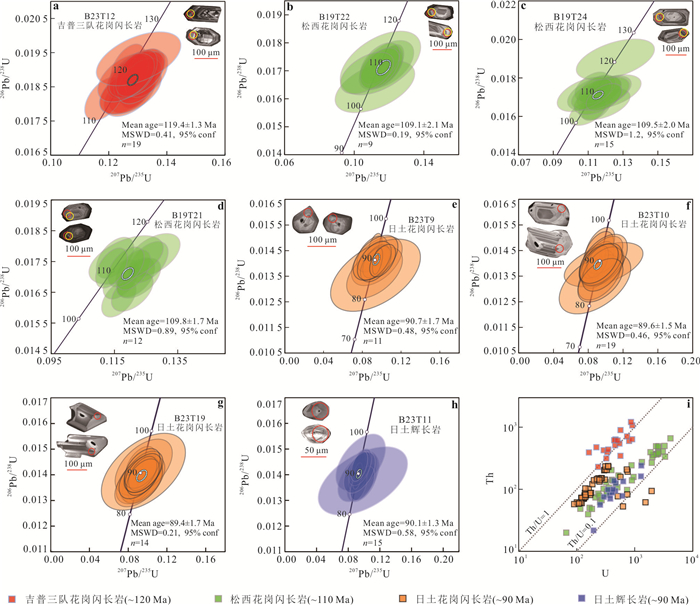
图 3 藏北日土-松西地区岩浆岩锆石阴极发光照片、U-Pb年龄谐和图和锆石微量Th-U图解
红色圆圈与黄色圆圈分别代表锆石U-Pb定年分析点和Lu-Hf同位素分析点
Fig. 3. Cathodoluminescence images, zircon U-Pb concordia and Th-U plots of zircon grains for magmatic rocks from the Rutog-Songxi area, northern Tibet
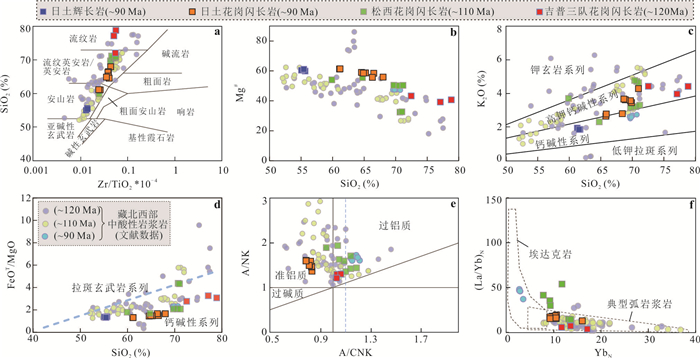
图 4 (a)SiO2 vs. Zr/TiO2×0.000 1图解;(b)Mg# vs. SiO2图解;(c)K2O vs. SiO2图解; (d)FeOT/MgO vs. SiO2图解;(e)A/NK vs. A/CNK图解;(f)(La/Yb)N vs. YbN图解
A/NK=(Al2O3/101.94)/[(Na2O/61.982)+(K2O/94.2)];A/CNK=(Al2O3/101.94)/[(CaO/56.08)+(Na2O/61.982)+(K2O/94.2)]. 藏北西部(120,110和90 Ma)中酸性岩浆岩数据(Li et al.,2018;Lei et al.,2020;Hu et al.,2022;Bai et al.,2024b;Gong et al.,2024及其中的参考文献)
Fig. 4. Diagram of (a)SiO2 vs. Zr/TiO2×0.0001;(b)Mg#vs. SiO2; (c)K2O vs. SiO2; (d)FeOT/MgO vs. SiO2; (e)A/NK vs. A/CNK; (f)(La/Yb)N vs. YbN
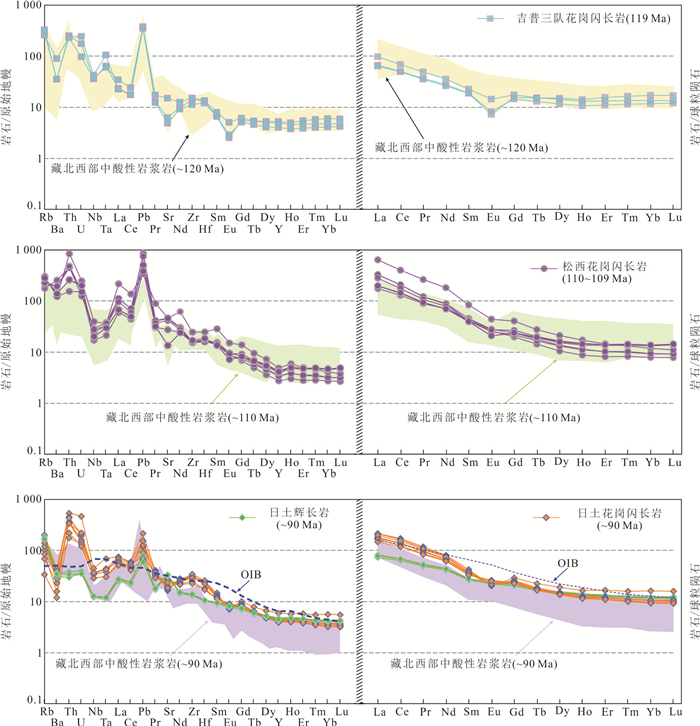
图 5 藏北日土-松西地区岩浆岩原始地幔标准化多元素蛛网图与球粒陨石标准化稀土元素配分图
藏北西部(120,110和90 Ma)中酸性岩浆岩数据来源同图 4
Fig. 5. Primitive-normalized muti-element spider diagram and chondrite-normalized REE diagram for magmatic rocks from the Rutog-Songxi area, northern Tibet
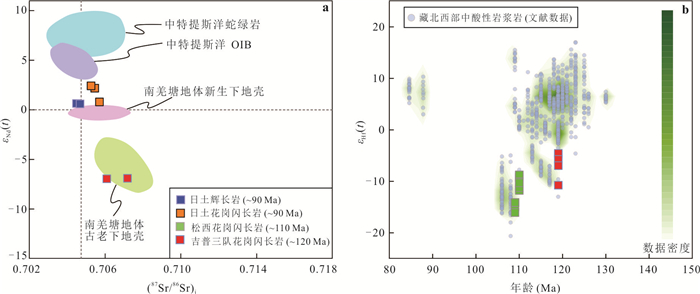
图 6 藏北日土-松西地区岩浆岩全岩Sr-Nd同位素和锆石Lu-Hf同位素图解
数据来源:中特提斯洋蛇绿岩数据(Wang et al.,2016;Tang et al.,2020);中特提斯洋OIB数据(Wang et al.,2016;Fan et al.,2021);南羌塘新生和古老下地壳数据(Hao et al.,2016);藏北西部(120,110和90 Ma)中酸性岩浆岩数据来源同图 4
Fig. 6. (a) εNd(t) versus (87Sr/86Sr)i and (b) εHf(t) versus Age diagram for magmatic rocks from the Rutog-Songxi area, northern Tibet
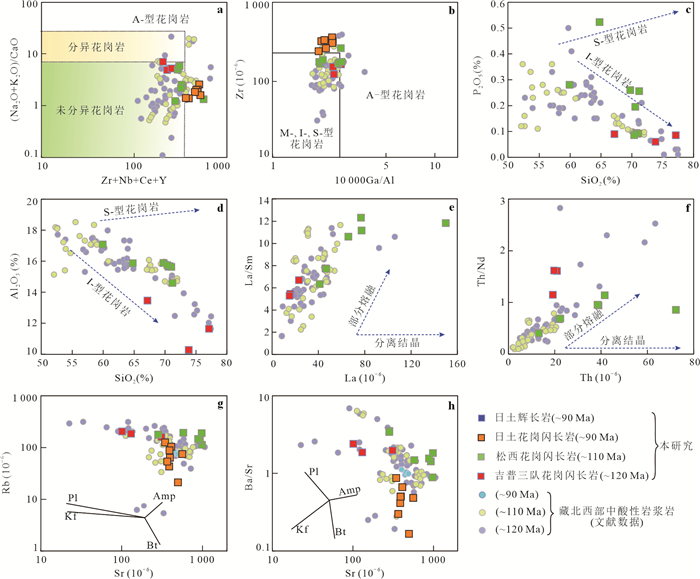
图 7 (a) (Na2O+K2O)/CaO vs. (Zr+Nb+Ce+Y)图解; (b) TiO2/MgOvs. SiO2图解; (c) P2O2 vs. SiO2图解; (d) Al2O3 vs. SiO2图解; (e) La/Smvs. La图解; (f) Th/Nd vs. Th图解; (g) Rb vs. Sr图解; (h) Ba/Sr vs. Sr图解
藏北西部(120,110和90 Ma)中酸性岩浆岩数据来源见图 4;矿物缩写:Amp. 角闪石;Bt. 黑云母,Kf. 钾长石;Pl. 斜长石
Fig. 7. Diagram of (a) (Na2O+K2O)/CaO vs. (Zr+Nb+Ce+Y); (b) TiO2/MgOvs. SiO2; (c) P2O2 vs. SiO2; (d) Al2O3 vs. SiO2; (e) La/Smvs. La; (f) Th/Nd vs. Th; (g) Rb vs. Sr; (h) Ba/Sr vs. Sr
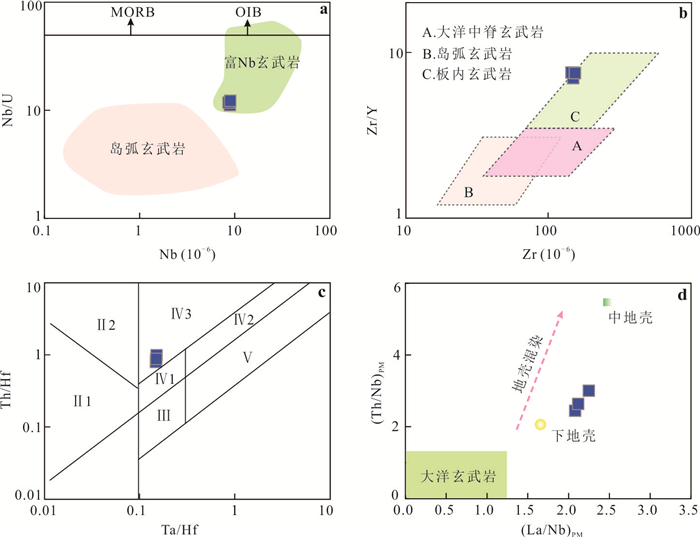
图 8 (a) Nb/U vs. Nb图解;(b) Zr/Y vs.Zr图解;(c) Th/Hf vs. Ta/Hf图解;(d) (La/Nb)PM vs. (Th/Nb)PM图解
Ⅱ2. 大陆边缘岛弧+大陆边缘火山弧;Ⅳ1. 陆内裂谷+大陆边缘裂谷拉斑玄武岩;Ⅳ2. 陆内裂谷碱性玄武岩;Ⅳ3. 大陆伸展带/初始裂谷玄武岩;原始地幔的标准化数据来源于Sun and McDonough(1989);中地壳与下地壳的数据来源于Rudnick and Gao(2014)
Fig. 8. (a) Nb/U vs. Nb; (b) Zr/Y vs. Zr diagram, (c) (La/Nb)PM vs. (Th/Nb)PM, (d) Th/Hf vs. Ta/Hfdiagram
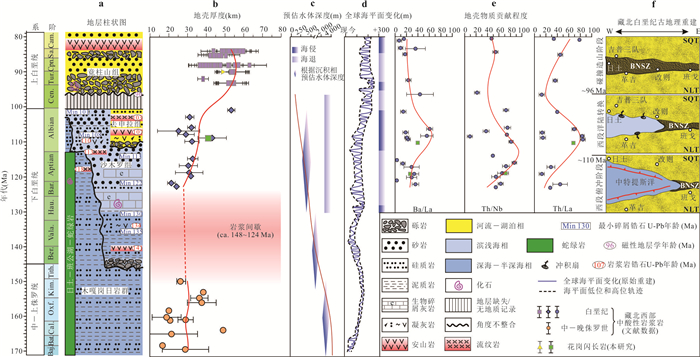
图 9 藏北西部洋陆过度多元素综合表征示意图
a. 班公湖-怒江缝合带(BNSZ)中晚侏罗世-白垩纪地层柱状图;b. 藏北西部中晚侏罗世-白垩纪中酸性岩浆岩的地壳厚度-年龄关系图,地壳厚度计算方法参考(Hu et al.,2017a,2020);c. 基于沉积相环境预估水体深度图;d. 中晚侏罗世-白垩纪全球海平面演化图(参考Ruban,2015);e. 利用藏北西部白垩纪岩浆岩中Ba/La、Th/Nb及Th/La元素,通过壳幔端元二元混合模拟估算的地壳贡献比例变化趋势图,选取的地壳端元(Ba=628×10-6,La=31.0×10-6,Th=10.5×10-6,Nb=12×10-6)及地幔端元数据(Ba=29.2×10-6,La=5.21×10-6,Th=0.404×10-6,Nb=5.24×10-6)分别参考Rudnick and Gao(2014)和Gale et al(2013);f. 中特提斯洋西段白垩纪古地理重建示意图;数据来源于同图 4;缩写:BNSZ. 班公湖-怒江缝合带,SQT. 南羌塘地体,NLT. 北拉萨地体
Fig. 9. Schematic diagram showing the multi-element comprehensive characterization of ocean-continent transition processes in the northern Tibet
-
Allègre, C. J., Courtillot, V., Tapponnier, P., et al., 1984. Structure and Evolution of the Himalaya-Tibet Orogenic Belt. Nature, 307(5946): 17-22. https://doi.org/10.1038/307017a0 Allen, C. M., 2010. Evolution of a Post-Batholith Dike Swarm in Central Coastal Queensland, Australia: Arc-Front to Backarc? Lithos, 51(4): 331-349. https://doi.org/10.1016/s0024-4937(99)00068-7 Bai, J. W., Fan, J. J., Hao, Y. J., et al., 2024a. Late Jurassic-Early Cretaceous Rebangco Ophiolite, Tibet: Constraints on the Meso-Tethys Ocean Tectonic Evolution. Journal of Asian Earth Sciences, 268: 106173. https://doi.org/10.1016/j.jseaes.2024.106173 Bai, J. W., Fan, J. J., Zhan, Y., et al., 2024b. Hotspot-Subduction Zone Interactions and Their Resource Effects at ∼120 Ma on the Central Tibetan Plateau. Lithos, 482/483: 107721. https://doi.org/10.1016/j.lithos.2024.107721 Boztug, D., Harlavan, Y., Arehart, G., et al., 2007. K-Ar Age, Whole-Rock and Isotope Geochemistry of A-Type Granitoids in the Divriği-Sivas Region, Eastern-Central Anatolia, Turkey. Lithos, 97(1/2): 193-218. https://doi.org/10.1016/j.lithos.2006.12.014 Brounce, M. N., Kelley, K. A., Cottrell, E., 2014. Variations in Fe3+/∑Fe of Mariana Arc Basalts and Mantle Wedge fO2. Journal of Petrology, 55(12): 2513-2536. https://doi.org/10.1093/petrology/egu065 Cao, Y., Sun, Z. M., Li, H. B., et al., 2020. Paleomagnetism and U-Pb Geochronology of Early Cretaceous Volcanic Rocks from the Qiangtang Block, Tibetan Plateau: Implications for the Qiangtang-Lhasa Collision. Tectonophysics, 789: 228500. https://doi.org/10.1016/j.tecto.2020.228500 Castillo, P. R., Rigby, S. J., Solidum, R. U., 2007. Origin of High Field Strength Element Enrichment in Volcanic Arcs: Geochemical Evidence from the Sulu Arc, Southern Philippines. Lithos, 97(3/4): 271-288. https://doi.org/10.1016/j.lithos.2006.12.012 Chapman, J. B., Ducea, M. N., DeCelles, P. G., et al., 2015. Tracking Changes in Crustal Thickness during Orogenic Evolution with Sr/Y: an Example from the North American Cordillera. Geology, 43(10): 919-922. https://doi.org/10.1130/g36996.1 Chappell, B. W., Bryant, C. J., Wyborn, D., 2012. Peraluminous Ⅰ-Type Granites. Lithos, 153: 142-153. https://doi.org/10.1016/j.lithos.2012.07.008 Chen, G. R., Liu, H. F., Jiang, G. W., et al., 2004. Discovery of the Shamuluo Formation in the Central Segment of the Bangong Co-Nujiang River Suture Zone, Tibet. Regional Geology of China, 23(2): 193-194(in Chinese with English abstract). Chung, S. L., Liu, D. Y., Ji, J. Q., et al., 2003. Adakites from Continental Collision Zones: Melting of Thickened Lower Crust beneath Southern Tibet. Geology, 31(11): 1021. https://doi.org/10.1130/g19796.1 Condie, K. C., 1989. Geochemical Changes in Baslts and Andesites across the Archean-Proterozoic Boundary: Identification and Significance. Lithos, 23(1/2): 0024493789900200. https://doi.org/10.1016/0024-4937(89)90020-0 Cui, Y. L., Wang, G. H., Lang, X. X., et al., 2016. Structural Deformation Features of Jurassic Sewa Formation in the Southern Qiangtang Terrane of Tibet and Its Tectonic Significance. Chinese Journal of Geology (Scientia Geologica Sinica), 51(3): 748-762(in Chinese with English abstract). Dini, A., Innocenti, F., Rocchi, S., et al., 2002. The Magmatic Evolution of the Late Miocene Laccolith-Pluton-Dyke Granitic Complex of Elba Island, Italy. Geological Magazine, 139(3): 257-279. https://doi.org/10.1017/s0016756802006556 Fan, J. J., Li, C., Liu, Y. M., et al., 2015. Age and Nature of the Late Early Cretaceous Zhaga Formation, Northern Tibet: Constraints on when the Bangong-Nujiang Neo-Tethys Ocean Closed. International Geology Review, 57(3): 342-353. https://doi.org/10.1080/00206814. 2015. 1006695 doi: 10.1080/00206814.2015.1006695 Fan, J. J., Li, C., Wang, M., et al., 2018. Reconstructing in Space and Time the Closure of the Middle and Western Segments of the Bangong-Nujiang Tethyan Ocean in the Tibetan Plateau. International Journal of Earth Sciences, 107(1): 231-249. https://doi.org/10.1007/s00531-017-1487-4 Fan, J. J., Niu, Y. L., Liu, Y. M., et al., 2021. Timing of Closure of the Meso-Tethys Ocean: Constraints from Remnants of a 141-135 Ma Ocean Island within the Bangong-Nujiang Suture Zone, Tibetan Plateau. GSA Bulletin, 133(9/10): 1875-1889. https://doi.org/10.1130/b35896.1 Fan, J. J., Zhang, B. C., Niu, Y. L., et al., 2023. Tracing the Sedimentary Response to the Rifting and Opening of the Meso-Tethys Ocean. Sedimentology, 71(1): 5-26. https://doi.org/10.1111/sed.13126 Fan, J. J., Zhang, B. C., Niu, Y. L., et al., 2024b. Resolving the Nature and Evolution of the Bangong-Nujiang Tethyan Ocean: New Perspectives from the Intraplate Oceanic-Island Fragments Preserved in Northern Tibet. Geological Society of America Bulletin, 136 (3-4): 1379-1394 https://doi.org/10.1130/b37044.1 Fan, J. J., Zhang, B. C., Zhou, J. B., et al., 2024a. The Meso-Tethys Ocean: The Nature, Extension and Spatial-Temporal Evolution. Earth-Science Reviews, 255: 104839. https://doi.org/10.1016/j.earscirev.2024.104839 Fan, J. J., Zhang, L. Q., Zhang, B. C., 2025. Revealing Evolution of Ancient Ocean Basin from Ocean Islands (Seamounts) in Orogenic Belts: a Case Study from Meso-Tethys in Northern Tibet. Journal of Jilin University (Earth Science Edition), 55(6): 1885-1903(in Chinese with English abstract). Farner, M. J., Lee, C. A., 2017. Effects of Crustal Thickness on Magmatic Differentiation in Subduction Zone Volcanism: a Global Study. Earth and Planetary Science Letters, 470: 96-107. https://doi.org/10.1016/j.epsl.2017.04.025 Frost, C. D., Frost, B. R., 2011. On Ferroan (a-Type) Granitoids: Their Compositional Variability and Modes of Origin. Journal of Petrology, 52(1): 39-53. https://doi.org/10.1093/petrology/egq070 Gale, A., Dalton, C. A., Langmuir, C. H., et al., 2013. The Mean Composition of Ocean Ridge Basalts. Geochemistry, Geophysics, Geosystems, 14(3): 489-518. https://doi.org/10.1029/2012gc004334 Geng, Q. R., Peng, Z. M., Zhang, Z., et al., 2012. Tethys Evolution and Metallogenic Geological Background in Bangonghu-Nujiang Metallogenic Belt and Its Adjacent Areas. Geological Publishing House, Beijing(in Chinese). Gerdes, A., Zeh, A., 2006. Combined U-Pb and Hf Isotope LA-(MC-)ICP-MS Analyses of Detrital Zircons: Comparison with SHRIMP and New Constraints for the Provenance and Age of an Armorican Metasediment in Central Germany. Earth and Planetary Science Letters, 249(1/2): 47-61. https://doi.org/10.1016/j.epsl.2006.06.039 Gong, N., Zhang, S. Q., Qi, H., et al., 2024. Two-Stage Mesozoic Oceanic Subduction and Related Mantle Metasomatism beneath the South Qiangtang Terrane with Implications for Post-Collisional Magmatism. Gondwana Research, 136: 219-235. https://doi.org/10.1016/j.gr.2024.09.001 Govindaraju, K., 1994.1994 Compilation of Working Values and Sample Description for 383 Geostandards. Geostandards Newsletter, 18(S1): 1-158. https://doi.org/10.1046/j.1365-2494.1998.53202081.x-i1 Griffin, W. L., Begg, G. C., O'Reilly, S. Y., 2013. Continental-Root Control on the Genesis of Magmatic Ore Deposits. Nature Geoscience, 6(11): 905-910. https://doi.org/10.1038/ngeo1954 Hanson, G. N., 1978. The Application of Trace Elements to the Petrogenesis of Igneous Rocks of Granitic Composition. Earth and Planetary Science Letters, 38(1): 26-43. https://doi.org/10.1016/0012-821x(78)90124-3 Hao, L. L., Hu, W. L., Wang, Q., et al., 2025. Bangong-Nujiang Neo-Tethyan Ocean (Central Tibet): Geodynamics, Crustal Evolution, Metallogeny, and Linkages to the "Yanshan Movement". Earth-Science Reviews, 265: 105119. https://doi.org/10.1016/j.earscirev.2025.105119 Hao, L. L., Wang, Q., Wyman, D. A., et al., 2016. Andesitic Crustal Growth via Mélange Partial Melting: Evidence from Early Cretaceous Arc Dioritic/Andesitic Rocks in Southern Qiangtang, Central Tibet: Diorites in Southern Qiangtang, Tibet. Geochemistry, Geophysics, Geosystems, 17(5): 1641-1659. https://doi.org/10.1002/2016gc006248 Hao, L. L., Wang, Q., Zhang, C. F., et al., 2019. Oceanic Plateau Subduction during Closure of the Bangong-Nujiang Tethyan Ocean: Insights from Central Tibetan Volcanic Rocks. GSA Bulletin, 131(5/6): 864-880. https://doi.org/10.1130/b32045.1 Hastie, A. R., Mitchell, S. F., Kerr, A. C., et al., 2011. Geochemistry of Rare High-Nb Basalt Lavas: Are they Derived from a Mantle Wedge Metasomatised by Slab Melts? Geochimica et Cosmochimica Acta, 75(17): 5049-5072. https://doi.org/10.1016/j.gca.2011.06.018 Hoskin, P. W. O., Black, L. P., 2000. Metamorphic Zircon Formation by Solid-State Recrystallization of Protolith Igneous Zircon. Journal of Metamorphic Geology, 18(4): 423-439. https://doi.org/10.1046/j.1525-1314. 2000. 00266.x doi: 10.1046/j.1525-1314.2000.00266.x Hou, Z. Q., Yang, Z. M., Lu, Y. J., et al., 2015. A Genetic Linkage between Subduction- and Collision-Related Porphyry Cu Deposits in Continental Collision Zones. Geology, 43(3): 247-250. https://doi.org/10.1130/g36362.1 Hou, Z. Q., Yang, Z. M., Zhang, H. R., et al., 2025. Metallogenesis in Collisional Orogens: New Insights and Advances. Earth Science Frontiers, 32(6): 179-209(in Chinese with English abstract). Hu, F. Y., Ducea, M. N., Liu, S. W., et al., 2017a. Quantifying Crustal Thickness in Continental Collisional Belts: Global Perspective and a Geologic Application. Scientific Reports, 7: 7058. https://doi.org/10.1038/s41598-017-07849-7 Hu, F. Y., Wu, F. Y., Chapman, J. B., et al., 2020. Quantitatively Tracking the Elevation of the Tibetan Plateau since the Cretaceous: Insights from Whole-Rock Sr/Y and La/Yb Ratios. Geophysical Research Letters, 47(15): e2020GL089202. https://doi.org/10.1029/2020gl089202 Hu, P. Y., Zhai, Q. G., Jahn, B. M., et al., 2017b. Late Early Cretaceous Magmatic Rocks (118-113 Ma) in the Middle Segment of the Bangong-Nujiang Suture Zone, Tibetan Plateau: Evidence of Lithospheric Delamination. Gondwana Research, 44: 116-138. https://doi.org/10.1016/j.gr.2016.12.005 Hu, X. M., Ma, A. L., Xue, W. W., et al., 2022. Exploring a Lost Ocean in the Tibetan Plateau: Birth, Growth, and Demise of the Bangong-Nujiang Ocean. Earth-Science Reviews, 229: 104031. https://doi.org/10.1016/j.earscirev.2022.104031 Jung, S., Pfänder, J. A., Nebel, O., et al., 2023. High-K Andesites as Witnesses of a Continental Arc System in the Western Alps, Italy: Constraints from HFSE and Hf-Nd-Sr-Pb-O Isotope Systematics. Contributions to Mineralogy and Petrology, 178(2): 12. https://doi.org/10.1007/s00410-022-01983-w Kaislaniemi, L., van Hunen, J., Allen, M. B., et al., 2014. Sublithospheric Small-Scale Convection: A Mechanism for Collision Zone Magmatism. Geology, 42(4): 291-294. https://doi.org/10.1130/g35193.1 Kapp, P., DeCelles, P. G., Gehrels, G. E., et al., 2007. Geological Records of the Lhasa-Qiangtang and Indo-Asian Collisions in the Nima Area of Central Tibet. Geological Society of America Bulletin, 119(7/8): 917-933. https://doi.org/10.1130/b26033.1 Kelley, K. A., Cottrell, E., 2009. Water and the Oxidation State of Subduction Zone Magmas. Science, 325(5940): 605-607. https://doi.org/10.1126/science.1174156 Landenberger, B., Collins, W. J., 1996. Derivation of A-Type Granites from a Dehydrated Charnockitic Lower Crust: Evidence from the Chaelundi Complex, Eastern Australia. Journal of Petrology, 37(1): 145-170. https://doi.org/10.1093/petrology/37.1.145 Lei, M., Chen, J. L., Xu, J. F., et al., 2020. Late Cretaceous Magmatism in the NW Lhasa Terrane, Southern Tibet: Implications for Crustal Thickening and Initial Surface Uplift. GSA Bulletin, 132(1/2): 334-352. https://doi.org/10.1130/b31915.1 Li, H. L., Gao, C., Li, Z. H., et al., 2016. Age and Tectonic Significance of Jingzhushan Formation in Bangong Lake Area, Tibet. Geotectonica et Metallogenia, 40(4): 663-673(in Chinese with English abstract). Li, S. M., 2018. Subduction Polarity and Process of the Bangong Nujiang Tethys Ocean, Xizang: Magmatic and Detrital Zircon Records(Dissertation). China University of Geosciences, Beijing(in Chinese with English abstract). Li, X. K., Chen, J., Wang, R. C., et al., 2018. Temporal and Spatial Variations of Late Mesozoic Granitoids in the SW Qiangtang, Tibet: Implications for Crustal Architecture, Meso-Tethyan Evolution and Regional Mineralization. Earth-Science Reviews, 185: 374-396. https://doi.org/10.1016/j.earscirev.2018.04.005 Li, X. K., Chen, J., Wang, R. C., et al., 2019. Early Cretaceous Tectonomagmatic Evolution and Basin Development of Western Bangong-Nujiang Suture: a Complete History of Soft Collision. Lithos, 344/345: 360-373. https://doi.org/10.1016/j.lithos.2019.06.030 Lin, B., Tang, J. X., Chen, Y. C., et al., 2019. Geology and Geochronology of Naruo Large Porphyry-Breccia Cu Deposit in the Duolong District, Tibet. Gondwana Research, 66: 168-182. https://doi.org/10.1016/j.gr.2018.07.009 Liu, D. L., Shi, R. D., Ding, L., et al., 2018. Late Cretaceous Transition from Subduction to Collision along the Bangong-Nujiang Tethys: New Volcanic Constraints from Central Tibet. Lithos, 296/297/298/299: 452-470. https://doi.org/10.1016/j.lithos.2017.11.012 Liu, J., Li, W. C., Zhou, Q., et al., 2024. Major Types, Spatio-Temporal Distribution, and Metallogenesis of Magmatism-Related Polymetallic Deposits in the Bangonghu-Nujiang Metallogenic Belt, Tibet. Ore Geology Reviews, 167: 105983. https://doi.org/10.1016/j.oregeorev.2024.105983 Liu, Q. H., Xiao, Z. J., Cao, S. H., et al., 2004. A Preliminary Study of the Spatio-Temporal Framework of the Archipelagic Arc-Basin Systems in the Western Part of the Bangong-(Nujiang) Suture Zone, Xizang. Sedimentary Geology and Tethyan Geology, 24(3): 15-21(in Chinese with English abstract). Liu, W. G., Wei, S., Zhang, J., et al., 2020. An Improved Separation Scheme for Sr through Fluoride Coprecipitation Combined with a Cation-Exchange Resin from Geological Samples with High Rb/Sr Ratios for High-Precision Determination of Sr Isotope Ratios. Journal of Analytical Atomic Spectrometry, 35(5): 953-960. https://doi.org/10.1039/d0ja00035c Liu, W. L., Xia, B., Zhong, Y., et al., 2014. Age and Composition of the Rebang Co and Julu Ophiolites, Central Tibet: Implications for the Evolution of the Bangong Meso-Tethys. International Geology Review, 56(4): 430-447. https://doi.org/10.1080/00206814.2013.873356 Liu, W., Wu, J. L., Lei, C. Y., et al., 2019. Detrital Zircon Geochronology of the Shamuluo Formation in Geji Region of Central Tibet: Provenance and Evidence for the Closure Time of the Bangong Co-Nujiang Tethys Ocean. Acta Petrologica Sinica, 35(6): 1738-1756(in Chinese with English abstract). doi: 10.18654/1000-0569/2019.06.07 Ludwig, K. R., 2003. ISOPLOT 3.0: A Geochronological Toolkit for Microsoft Excel. Special Publication No. 4, Berkeley Geochronology Center. Luo, A. B., 2022. Timing and Process of the Extinction of the Bangong-Nujiang Ocean(Dissertation). Jilin University, Changchun(in Chinese with English abstract). Luo, A. B., Fan, J. J., Hao, Y. J., et al., 2020. Aptian Flysch in Central Tibet: Constraints on the Timing of Closure of the Bangong-Nujiang Tethyan Ocean. Tectonics, 39(12): e2020TC006198. https://doi.org/10.1029/2020tc006198 Luo, A. B., Fan, J. J., Zhang, B. C., et al., 2021. From Arc-Continent Collision to Ocean Closure: Lower Cretaceous Shamuluo Formation in the Western Segment of the Bangong-Nujiang Suture Zone, Central Tibet. Geoscience Frontiers, 12(5): 101207. https://doi.org/10.1016/j.gsf.2021.101207 Luo, A. B., Fan, J. J., Zhang, B. C., et al., 2022. Cretaceous Uplift History of the Tibetan Plateau: Insights from the Transition of Marine to Terrestrial Facies in Central Tibet. Palaeogeography, Palaeoclimatology, Palaeoecology, 601: 111103. https://doi.org/10.1016/j.palaeo.2022.111103 Ma, A. L., Hu, X. M., Garzanti, E., et al., 2017. Sedimentary and Tectonic Evolution of the Southern Qiangtang Basin: Implications for the Lhasa-Qiangtang Collision Timing. Journal of Geophysical Research: Solid Earth, 122(7): 4790-4813. https://doi.org/10.1002/2017jb014211 Ma, A. L., Hu, X. M., Garzanti, E., et al., 2024. Diachronous Cretaceous Closure of the Bangong-Nujiang-Shyok Ocean (Westernmost Central Tibet). Tectonics, 43(12): e2024TC008280. https://doi.org/10.1029/2024tc008280 Mo, X. X., Hou, Z. Q., Niu, Y. L., et al., 2007. Mantle Contributions to Crustal Thickening during Continental Collision: Evidence from Cenozoic Igneous Rocks in Southern Tibet. Lithos, 96(1/2): 225-242. https://doi.org/10.1016/j.lithos.2006.10.005 Murodov, D., Mi, W., Murodov, A., et al., 2022. Deep Crustal Structure beneath the Pamir-Tibetan Plateau: Insights from the Moho Depth and Vp/vs Ratio Variation. Frontiers in Earth Science, 10: 821497. https://doi.org/10.3389/feart.2022.821497 Ouyang, K. G., Xie, G. G., Xiao, Z. J., et al., 2005. Establishment of the Duoren and Risum Formations in the Risum Area, Western Tibet, China and Its Geological Significance. Regional Geology of China, 24(7): 642-647(in Chinese with English abstract). Patino Douce, A. E. P., 1997. Generation of Metaluminous A-Type Granites by Low-Pressure Melting of Calc-Alkaline Granitoids. Geology, 25(8): 743. https://doi.org/10.1130/0091-7613(1997)0250743:gomatg>2.3.co;2 doi: 10.1130/0091-7613(1997)0250743:gomatg>2.3.co;2 Pietruszka, A. J., Hauri, E. H., Blichert-Toft, J., 2009. Crustal Contamination of Mantle-Derived Magmas within Piton de la Fournaise Volcano, Reunion Island. Journal of Petrology, 50(4): 661-684. https://doi.org/10.1093/petrology/egp016 Polat, A., Hofmann, A. W., 2003. Alteration and Geochemical Patterns in the 3.7-3.8 Ga Isua Greenstone Belt, West Greenland. Precambrian Research, 126(3/4): 197-218. https://doi.org/10.1016/s0301-9268(03)00095-0 Polat, A., Hofmann, A. W., Rosing, M. T., 2002. Boninite-Like Volcanic Rocks in the 3.7-3.8 Ga Isua Greenstone Belt, West Greenland: Geochemical Evidence for Intra-Oceanic Subduction Zone Processes in the Early Earth. Chemical Geology, 184(3/4): 231-254. https://doi.org/10.1016/s0009-2541(01)00363-1 Qu, X. M., Xin, H. B., Du, D. D., et al., 2012. Ages of Post-Collisional A-Type Granite and Constraints on the Closure of the Oceanic Basin in the Middle Segment of the Bangonghu-Nujiang Suture, the Tibetan Plateau. Geochimica, 41(1): 1-14(in Chinese with English abstract). Rapp, R. P., Shimizu, N., Norman, M. D., et al., 1999. Reaction between Slab-Derived Melts and Peridotite in the Mantle Wedge: Experimental Constraints at 3.8 GPa. Chemical Geology, 160(4): 335-356. https://doi.org/10.1016/s0009-2541(99)00106-0 Richards, J. P., 2011. Magmatic to Hydrothermal Metal Fluxes in Convergent and Collided Margins. Ore Geology Reviews, 40(1): 1-26. https://doi.org/10.1016/j.oregeorev.2011.05.006 Richards, J. P., 2015. The Oxidation State, and Sulfur and Cu Contents of Arc Magmas: Implications for Metallogeny. Lithos, 233: 27-45. https://doi.org/10.1016/j.lithos.2014.12.011 Ruban, D. A., 2015. Mesozoic Long-Term Eustatic Cycles and Their Uncertain Hierarchy. Geoscience Frontiers, 6(4): 503-511. https://doi.org/10.1016/j.gsf.2014.06.001 Rudnick, R. L., Gao, S., 2014. Composition of the Continental Crust. Treatise on Geochemistry. Elsevier, Amsterdam, 1-51. https://doi.org/10.1016/b978-0-08-095975-7.00301-6 Shen, X. M., Zhang, H. X., Wang, Q., et al., 2011. Late Devonian-Early Permian A-Type Granites in the Southern Altay Range, Northwest China: Petrogenesis and Implications for Tectonic Setting of "A-Type" Granites. Journal of Asian Earth Sciences, 42(5): 986-1007. https://doi.org/10.1016/j.jseaes.2010.10.004 Skjerlie, K. P., Johnston, A. D., 1993. Vapor-Absent Melting at 10 Kbar of a Biotite- and Amphibole-Bearing Tonalitic Gneiss: Implications for the Generation of A-Type Granites. Geology, 20(3): 263. https://doi.org/10.1130/0091-7613(1992)0200263:vamako>2.3.co;2 doi: 10.1130/0091-7613(1992)0200263:vamako>2.3.co;2 Song, B. W., Ke, X., He, W. H., et al., 2025. The Late Paleozoic-Mesozoic Ocean Plate Stratigraphy Tectonic-Stratigraphic Realms and Framework of the Tethyan Orogenic System in the Qinghai-Xizang Plateau. Earth Science, 50(9): 3651-3678(in Chinese with English abstract). Spencer, C. J., Kirkland, C. L., Taylor, R. J. M., 2016. Strategies towards Statistically Robust Interpretations of in Situ U-Pb Zircon Geochronology. Geoscience Frontiers, 7(4): 581-589. https://doi.org/10.1016/j.gsf.2015.11.006 Sun, G. Y., Hu, X. M., Xu, Y. W., et al., 2019. Discovery of Middle Jurassic Trench Deposits in the Bangong-Nujiang Suture Zone: Implications for the Timing of Lhasa-Qiangtang Initial Collision. Tectonophysics, 750: 344-358. https://doi.org/10.1016/j.tecto.2018.12.001 Sun, H., Song, Y., Wilkinson, J. J., et al., 2025. Petrogenesis of Early Cretaceous Duorenlieqian Igneous Rocks (113 ∼ 117 Ma) in the Western Bangong-Nujiang Metallogenic Belt, Tibet, China: Implications for Tectono-Magmatic Evolution and Porphyry Cu-Au Mineralization. Ore Geology Reviews, 182: 106650. https://doi.org/10.1016/j.oregeorev.2025.106650 Sun, S. S., McDonough, W. F., 1989. Chemical and Isotopic Systematics of Oceanic Basalts: Implications for Mantle Composition and Processes. Geological Society, London, Special Publications, 42(1): 313-345. https://doi.org/10.1144/gsl.sp.1989.042.01.19 Tang, J. X., Lin, B., Yang, H. H., et al., 2024. Geological Characteristics and Prospecting Direction of Porphyry-Skarn-Epithermal Deposits in Xizang. Mineral Deposits, 43(6): 1223-1265, 1-16(in Chinese with English abstract). Tang, J. X., Wang, Q., Yang, H. H., et al., 2017. Mineralization, Exploration and Resource Potential of Porphyry-Skarn-Epithermal Copper Polymetallic Deposits in Tibet. Acta Geoscientica Sinica, 38(5): 571-613(in Chinese with English abstract). Tang, Y., Zhai, Q. G., Chung, S. L., et al., 2020. First Mid-Ocean Ridge-Type Ophiolite from the Meso-Tethys Suture Zone in the North-Central Tibetan Plateau. GSA Bulletin, 132(9/10): 2202-2220. https://doi.org/10.1130 /b35500.1 doi: 10.1130/b35500.1 Trail, D., Watson, E. B., Tailby, N. D., 2011. The Oxidation State of Hadean Magmas and Implications for Early Earth's Atmosphere. Nature, 480(7375): 79-82. https://doi.org/10.1038/nature10655 Tunini, L., Jiménez-Munt, I., Fernandez, M., et al., 2014. Lithospheric Mantle Heterogeneities beneath the Zagros Mountains and the Iranian Plateau: a Petrological-Geophysical Study. Geophysical Journal International, 200(1): 596-614. https://doi.org/10.1093/gji/ggu418 Wang, B. D., Wang, L. Q., Chung, S. L., et al., 2016. Evolution of the Bangong-Nujiang Tethyan Ocean: Insights from the Geochronology and Geochemistry of Mafic Rocks within Ophiolites. Lithos, 245: 18-33. https://doi.org/10.1016/j.lithos.2015.07.016 Wang, J. P., 2003. Tethys Geology in Eastern Xizang. Science Press. Beijing(in Chinese). Wang, W., Wang, M., Zhai, Q. G., et al., 2020. Transition from Oceanic Subduction to Continental Collision Recorded in the Bangong-Nujiang Suture Zone: Insights from Early Cretaceous Magmatic Rocks in the North-Central Tibet. Gondwana Research, 78: 77-91. https://doi.org/10.1016/j.gr.2019.09.008 Wang, Y., Tang, J. X., Wang, L. Q., et al., 2019. Magmatism and Metallogenic Mechanism of the Ga'erqiong and Galale Cu-Au Deposits in the West Central Lhasa Subterrane, Tibet: Constraints from Geochronology, Geochemistry, and Sr-Nd-Pb-Hf Isotopes. Ore Geology Reviews, 105: 616-635. https://doi.org/10.1016/j.oregeorev.2019.01.015 Weis, D., Kieffer, B., Maerschalk, C., et al., 2005. High-Precision Pb-Sr-Nd-Hf Isotopic Characterization of USGS BHVO-1 and BHVO-2 Reference Materials. Geochemistry, Geophysics, Geosystems, 6(2): 2004GC000852. https://doi.org/10.1029/2004gc000852 Whalen, J. B., Currie, K. L., Chappell, B. W., 1987. A-Type Granites: Geochemical Characteristics, Discrimination and Petrogenesis. Contributions to Mineralogy and Petrology, 95(4): 407-419. https://doi.org/10.1007/BF00402202 Wiedenbeck, M., Allé, P., Corfu, F., et al., 1995. Three Natural Zircon Standards for U-Th-Pb, Lu-Hf, Trace Element and Ree Analyses. Geostandards Newsletter, 19(1): 1-23. https://doi.org/10.1111/j.1751-908x.1995.tb00147.x Wu, F. Y., Sun, D. Y., Li, H. M., et al., 2002. A-Type Granites in Northeastern China: Age and Geochemical Constraints on Their Petrogenesis. Chemical Geology, 187(1/2): 143-173. https://doi.org/10.1016/s0009-2541(02)00018-9 Wu, H., Chen, J. W., Wang, Q., et al., 2019. Spatial and Temporal Variations in the Geochemistry of Cretaceous High-Sr/Y Rocks in Central Tibet. American Journal of Science, 319(2): 105-121. https://doi.org/10.2475/02.2019.02 Wu, H., Li, C., Hu, P. Y., et al., 2014. The Discovery of Early Cretaceous Bimodal Volcanic Rocks in the Dachagou Area of Tibet and Its Significance. Geological Bulletin of China, 33(11): 1804-1814(in Chinese with English abstract). Wu, H., Yang, C., Wu, Y. W., et al., 2024. Petrogenesis of Late Cretaceous Magmatic Rocks in the Zhongcang Area of Northern Tibet and Their Implications for Early Uplift of the Plateau. Earth Science Frontiers, 31(6): 261-281(in Chinese with English abstract). Wu, J. L., Liu, W., Yin, X. K., et al., 2021. Geochronology, Zircon Hf Isotope and Geochemistry of Volcanic Rocks from Shamuluo Formation in Western Banggongco-Nujiang Suture Zone, North Tibet. Earth Science, 46(2): 444-459(in Chinese with English abstract). Xiao, Y., Liu, X. J., Wu, H., et al., 2025. Late Cretaceous Extensional Collapse Driven by Delamination in Central Tibet Prior to India-Asia Collision. Geochemistry, Geophysics, Geosystems, 26(7): e2025GC012305. https://doi.org/10.1029/2025gc012305 Xie, G. G., Xiao, Z. J., Ouyang, K. G., et al., 2010. Regional Geological Survey Report of 1: 250 000 Kana Sheet and Ritu County Sheet in Xizang. Geology Press, Beijing(in Chinese). Yang, J. H., Wu, F. Y., Chung, S. L., et al., 2006. A Hybrid Origin for the Qianshan A-Type Granite, Northeast China: Geochemical and Sr-Nd-Hf Isotopic Evidence. Lithos, 89(1/2): 89-106. https://doi.org/10.1016/j.lithos. 2005. 10.002 doi: 10.1016/j.lithos.2005.10.002 Yin, A., Harrison, T. M., 2000. Geologic Evolution of the Himalayan-Tibetan Orogen. Annual Review of Earth and Planetary Sciences, 28: 211-280. https://doi.org/10.1146/annurev.earth.28.1.211 Zeng, Y. R., Huang, J. G., Ma, D. S., et al., 2016. The New Evidence for the Upper Limit of Mugakangri Group-Complex from Bangong-Nujing Junction Zone, Tibet: Reports from Early Early Cretaceous Palynoflora in Kongnongla Area, Bangor County, Tibet. Geological Bulletin of China, 35(12): 2027-2032. (in Chinese with English abstract). Zhang, B. C., Fan, J. J., Luo, A. B., 2023. Genetic Pattern of the Albian Volcanic Rocks in the Ziruco Area, Northern Tibet: Implications for A-Type Granites. Lithos, 436/437: 106970. https://doi.org/10.1016/j.lithos.2022.106970 Zhang, K. X., Song, B. W., He, W. H., et al., 2025. Distribution and Evolution of the Tethyan OPS in the Central-Southern Qinghai-Xizang Region. Earth Science, 50(3): 1162-1200(in Chinese with English abstract). Zhang, S., Shi, H. F., Hao, H. J., et al., 2014. Geochronology, Geochemistry and Tectonic Significance of Late Cretaceous Adakites in Bangong Lake, Tibet. Earth Science, 39(5): 509-524. (in Chinese with English abstract). Zhang, Z., Song, J. L., Tang, J. X., et al., 2017. Petrogenesis, Diagenesis and Mineralization Ages of Galale Cu-Au Deposit, Tibet: Zircon U-Pb Age, Hf Isotopic Composition and Molybdenite Re-Os Dating. Earth Science, 42(6): 862-880. (in Chinese with English abstract). Zhang, Z., Yao, X. F., Tang, J. X., et al., 2015. Lithogeochemical, Re-Os and U-Pb Geochronological, Hf-Lu and S-Pb Isotope Data of the Ga'erqiong-Galale Cu-Au Ore-Concentrated Area: Evidence for the Late Cretaceous Magmatism and Metallogenic Event in the Bangong-Nujiang Suture Zone, Northwestern Tibet, China. Resource Geology, 65(2): 76-102. https://doi.org/10.1111/rge. 12064 doi: 10.1111/rge.12064 Zhong, Y., Liu, W. L., Xia, B., et al., 2017. Geochemistry and Geochronology of the Mesozoic Lanong Ophiolitic Mélange, Northern Tibet: Implications for Petrogenesis and Tectonic Evolution. Lithos, 292/293: 111-131. https://doi.org/10.1016/j.lithos.2017.09.003 Zhou, G. Y., Qi, C. X., Wan, M. Q., et al., 2024. Late Cretaceous Gabbros in the Yanhu Area, Northern Xizang: Implications for the Post-Collisional Delamination Process of the Bangong-Nujiang Suture Zone. Geotectonica et Metallogenia, 48(4): 866-878. (in Chinese with English abstract). Zhu, D. C., Li, S. M., Cawood, P. A., et al., 2016. Assembly of the Lhasa and Qiangtang Terranes in Central Tibet by Divergent Double Subduction. Lithos, 245: 7-17. https://doi.org/10.1016/j.lithos.2015.06.023 Zhu, D. C., Pan, G. T., Mo, X. X., et al., 2006. Identification for the Mesozoic OIB-Type Basalts in Central Qinghai-Tibetan Plateau: Geochronology, Geochemistry and Their Tectonic Setting. Acta Geologica Sinica, 80(9): 1312-1328(in Chinese with English abstract). Zhu, D. C., Zhao, Z. D., Niu, Y. L., et al., 2011. The Lhasa Terrane: Record of a Microcontinent and Its Histories of Drift and Growth. Earth and Planetary Science Letters, 301(1/2): 241-255. https://doi.org/10.1016/j.epsl. 2010. 11.005 doi: 10.1016/j.epsl.2010.11.005 Zhu, Z. C., Zhai, Q. G., Hu, P. Y., et al., 2019. Closure of the Bangong-Nujiang Tethyan Ocean in the Central Tibet: Results from the Provenance of the Duoni Formation. Journal of Sedimentary Research, 89(10): 1039-1054. https://doi.org/10.2110/jsr.2019.55 陈国荣, 刘鸿飞, 蒋光武, 等, 2004. 西藏班公湖-怒江结合带中段沙木罗组的发现. 地质通报, 23(2): 193-194. 崔玉良, 王根厚, 郎欣欣, 等, 2016. 西藏南羌塘侏罗系色哇组构造变形特征及其构造意义. 地质科学, 51(3): 748-762. 范建军, 张丽强, 张博川, 2025. 从造山带洋岛(海山)揭示古洋盆演化: 以藏北中特提斯为例. 吉林大学学报(地球科学版), 55(6): 1885-1903 耿全如, 彭智敏, 张璋, 等, 2012. 班公湖-怒江成矿带及邻区特提斯演化与成矿地质背景. 北京: 地质出版社. 侯增谦, 杨志明, 张洪瑞, 等, 2025. 大陆碰撞成矿作用: 新认识与新进展. 地学前缘, 32(6): 179-209. 李华亮, 高成, 李正汉, 等, 2016. 西藏班公湖地区竟柱山组时代及其构造意义. 大地构造与成矿学, 40(4): 663-673. 李世民, 2018. 西藏班公湖-怒江特提斯洋的俯冲极性和过程: 岩浆岩和碎屑锆石记录(博士学位论文). 北京: 中国地质大学. 刘庆宏, 肖志坚, 曹圣华, 等, 2004. 班公湖-怒江结合带西段多岛弧盆系时空结构初步分析. 沉积与特提斯地质, 24(3): 15-21. 刘文, 吴建亮, 雷传扬, 等, 2019. 西藏革吉地区沙木罗组碎屑锆石年代学研究: 物源及其对班公湖-怒江特提斯洋西段闭合时限的制约. 岩石学报, 35(6): 1738-1756. 罗安波, 2022. 班公湖-怒江洋消亡时限和过程(博士学位论文). 长春: 吉林大学. 欧阳克贵, 谢国刚, 肖志坚, 等, 2005. 西藏西部日松地区多仁组、日松组的建立及其地质意义. 地质通报, 24(7): 642-647. 曲晓明, 辛洪波, 杜德道, 等, 2012. 西藏班公湖-怒江缝合带中段碰撞后A型花岗岩的时代及其对洋盆闭合时间的约束. 地球化学, 41(1): 1-14. 宋博文, 柯学, 何卫红, 等, 2025. 青藏特提斯造山系晚古生代-中生代洋板块构造-地层分区及地层格架. 地球科学, 50(9): 3651-3678. doi: 10.3799/dqkx.2024.053 唐菊兴, 林彬, 杨欢欢, 等, 2024. 西藏斑岩-矽卡岩-浅成低温热液型矿床地质特征及找矿方向. 矿床地质, 43(6): 1223-1265, 1-16. 唐菊兴, 王勤, 杨欢欢, 等, 2017. 西藏斑岩-矽卡岩-浅成低温热液铜多金属矿成矿作用、勘查方向与资源潜力. 地球学报, 38(5): 571-613. 王建平, 2003. 西藏东部特提斯地质. 北京: 科学出版社. 吴浩, 李才, 胡培远, 等, 2014. 藏北班公湖-怒江缝合带早白垩世双峰式火山岩的确定及其地质意义. 地质通报, 33(11): 1804-1814. 吴浩, 杨晨, 吴彦旺, 等, 2024. 藏北中仓地区晚白垩世岩浆岩成因及其对高原早期隆升的指示. 地学前缘, 31(6): 261-281. 吴建亮, 刘文, 尹显科, 等, 2021. 藏北班公湖-怒江缝合带西段沙木罗组火山岩年代学、Hf同位素及地球化学特征. 地球科学, 46(2): 444-459. 谢国刚, 肖志坚, 欧阳克贵, 等, 2010. 西藏1∶25万喀纳幅、日土县幅区域地质调查报告. 北京: 地质出版社. 曾禹人, 黄建国, 马德胜, 等, 2016. 西藏班公湖-怒江结合带木嘎岗日岩群时代上限的新证据: 来自恐弄拉地区早白垩世早期孢粉化石的报道. 地质通报, 35(12): 2027-2032. 张克信, 宋博文, 何卫红, 等, 2025. 青藏中-南部特提斯洋板块地层分布与演化. 地球科学, 50(3): 1162-1200. doi: 10.3799/dqkx.2024.147 张硕, 史洪峰, 郝海健, 等, 2014. 青藏高原班公湖地区晚白垩世埃达克岩年代学、地球化学及构造意义. 地球科学, 39(5): 509-524. doi: 10.3799/dqkx.2014.049 张志, 宋俊龙, 唐菊兴, 等, 2017. 西藏嘎拉勒铜金矿床的成岩成矿时代与岩石成因: 锆石U-Pb年龄、Hf同位素组成及辉钼矿Re-Os定年. 地球科学, 42(6): 862-880. 周高宇, 祁诚雪, 万牧钦, 等, 2024. 藏北盐湖地区晚白垩世辉长岩: 对班公湖-怒江缝合带碰撞后拆沉作用的指示. 大地构造与成矿学, 48(4): 866-878. 朱弟成, 潘桂棠, 莫宣学, 等, 2006. 青藏高原中部中生代OIB型玄武岩的识别: 年代学、地球化学及其构造环境. 地质学报, 80(9): 1312-1328. -
 柏佳伟附表.docx

-

 下载:
下载:
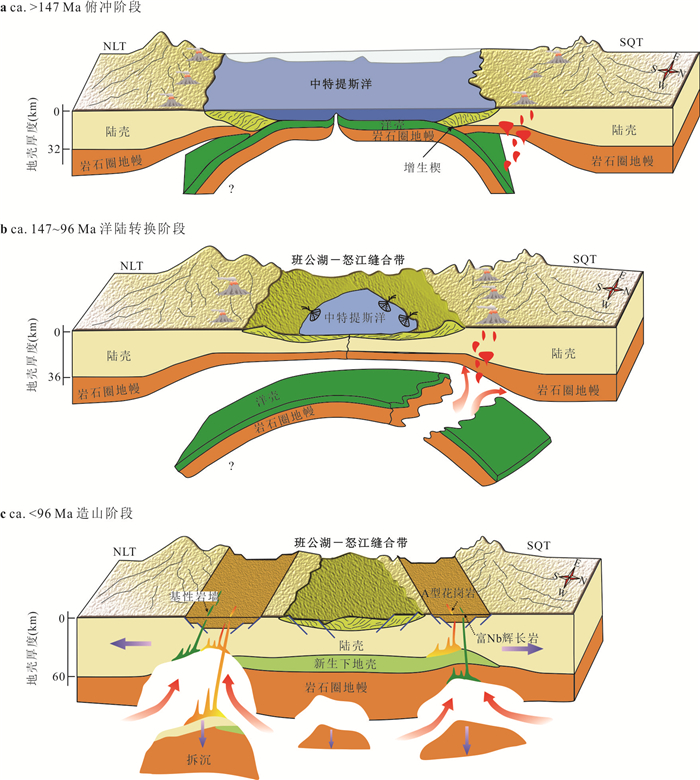
 点击查看大图
计量
- 文章访问数: 152
- HTML全文浏览量: 27
- PDF下载量: 13
- 被引次数: 0
