




Mineralization Process of No.3 Orebody of Jinchuan Deposit and New Implication for Metallogenic Model
-
摘要: 为查明金川矿床3号矿体成矿过程、深化成矿模式,利用电子探针、全岩主微量,Ni、Cu及PGE元素分析等方法,获取3号矿体中细粒及伟晶状二辉橄榄岩中橄榄石Fo值及Ni含量为82.4%~85%和1 069×10-6~2 420×10-6;Fo值及Ni含量具有由北西向南东逐渐变高趋势.主量元素变化表明3号矿体主要发生了橄榄石和辉石的分离结晶;赋矿岩体略富集轻稀土元素,明显富集LILE而亏损HFSE.3号矿体铂族元素含量与24号矿体相似,明显高于1号和2号矿体.3号矿体南东方向深部仍存在基性程度更高且含矿性更好的矿体,金川矿床是“幔源岩浆深部硫化物熔离-含矿岩浆多中心”侵位的产物,3号和24号矿体共用同一岩浆通道,1号和2号矿体是含矿岩浆沿不同通道分别侵位的产物.Abstract: To elucidate the mineralization process of the No.3 orebody of the Jinchuan deposit and to refine the Jinchuan metallogenic model, it conducted EPMA of ore minerals together with whole-rock major-trace element and Ni-Cu-PGE analyses. Olivine from the fine-grained and pegmatitic lherzolite hosting the No.3 orebody shows Fo values of 82.4%-85.0% and Ni contents of 1 069×10-6-2 420×10-6. Both Fo and olivine Ni content increase progressively from the northwest to the southeast. Major-element variations suggest that the No.3 orebody experienced dominantly olivine- and pyroxene-controlled fractional crystallization. The ore-bearing rocks are slightly enriched in light rare earth elements (LREE), markedly enriched in large-ion lithophile elements (LILE), and depleted in high-field-strength elements (HFSE). The total PGE abundances of the No.3 orebody are comparable to those of the No.24 orebody, but are significantly higher than those of the No.1 and No.2 orebodies. Importantly, the southeastern segment of the No.3 orebody remains relatively more mafic and therefore retains greater mineralization potential. These observations support a metallogenic model in which the Jinchuan deposit formed through "mantle-derived magma, sulfide segregation, and multi-center emplacement of mineralized magma". The No.3 and No.24 orebodies were supplied by the same magma conduit, whereas the No. 1 and No. 2 orebodies were fed by separate conduits.
-
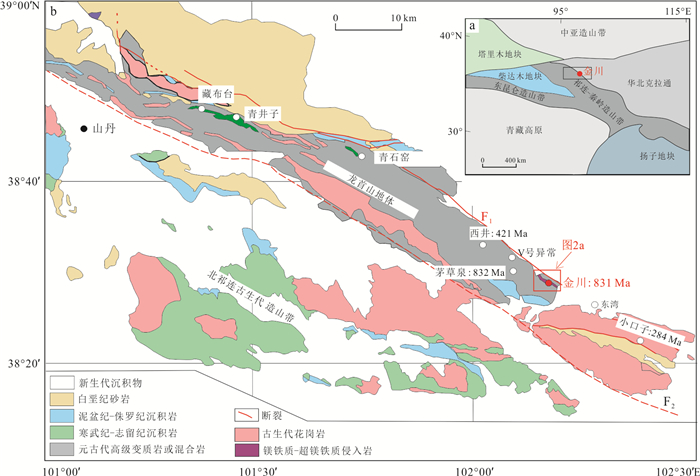
图 1 龙首山隆起带区域地质及镁铁‒超镁铁岩分布
金川年龄数据据Li et al., 2005;茅草泉和小口子数据焦建刚等, 2012, 2017;西井数据段俊等,2015
Fig. 1. The distribution of the mafic-ultramafic intrusion of the Longshoushan Terrane
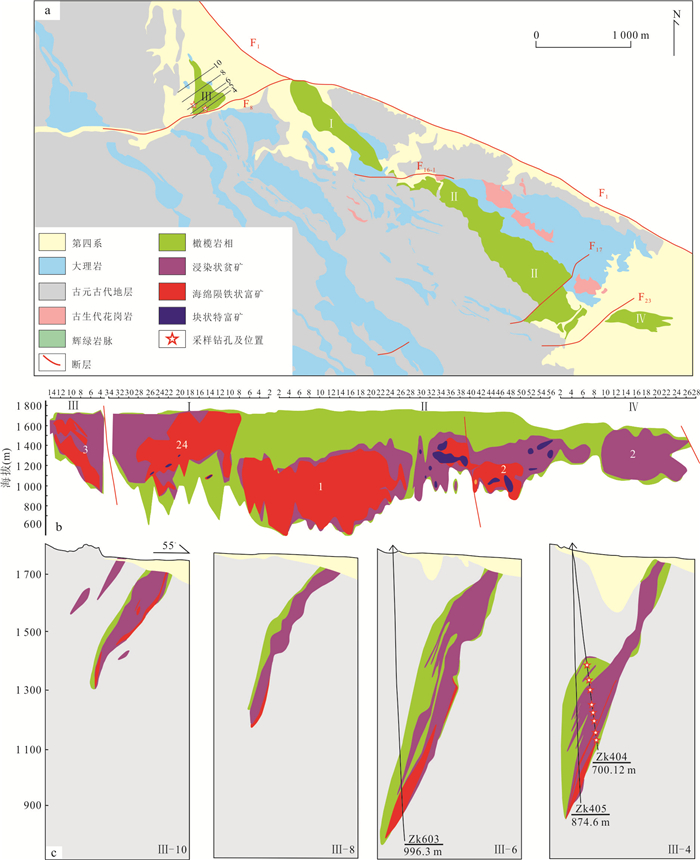
图 2 金川矿区地质简图(a)、勘探线纵投影图(b)及3号矿体典型勘探线剖面图(c)
图b、c图例同图a
Fig. 2. Geologic map of the Jinchuan intrusion (a), a projected long section (b) and the typical cross section of No.3 orebody
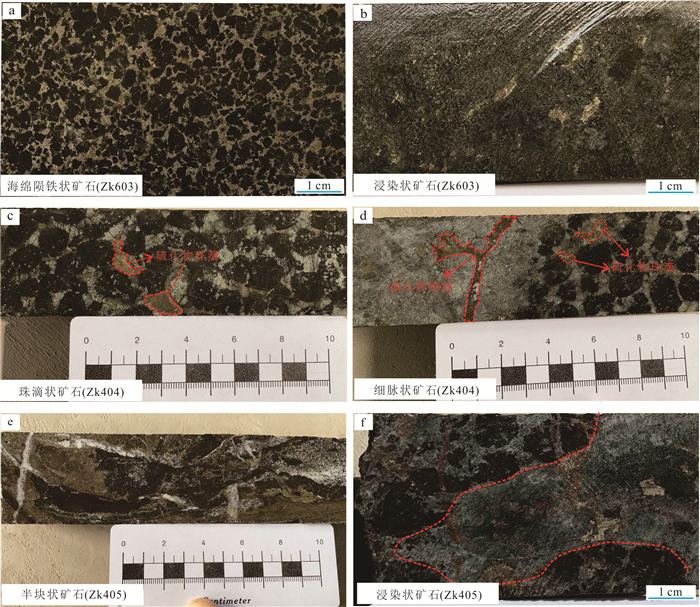
图 3 金川矿床3号矿体中不同矿石类型及相互接触关系
a. 海绵陨铁状矿石;b.浸染状矿石;c. 伟晶状二辉橄榄岩中橄榄石与硫化物珠滴关系;d. 伟晶状二辉橄榄岩与细粒辉石岩相接触关系及矿石类型;e. 半块状矿石;f. 细粒浸染状矿石与伟晶状二辉橄榄岩接触关系
Fig. 3. The contact relationships of different ore types in No.3 orebody
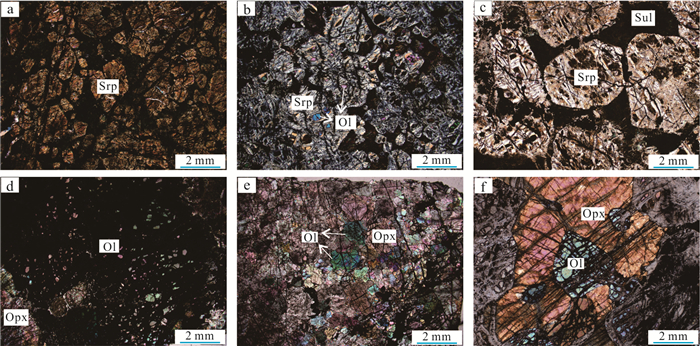
图 4 3号矿体中不同岩相显微照片
a、b. 橄榄石全部蚀变为蛇纹石;c. 中粗粒纯橄岩中橄榄石特征;d. 伟晶状二辉橄榄岩中残留的新鲜橄榄石;e、f.中细粒二辉橄榄岩中橄榄石堆晶及包橄结构. Ol. 橄榄石;Srp. 蛇纹石;Opx. 斜方辉石;Sul. 硫化物
Fig. 4. The micrographs of different lithofacies in No.3 orebody
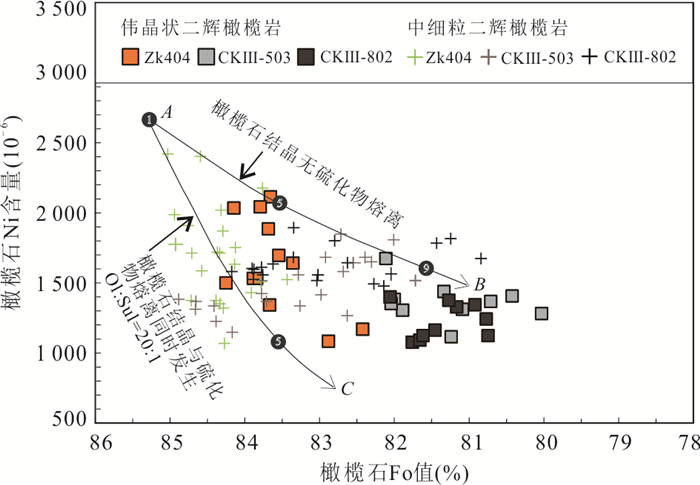
图 5 Ⅲ号岩体不同岩相橄榄石Fo-Ni含量相关性图解
CKIII-802及CKIII-503橄榄石数据引自Kang et al.(2022)
Fig. 5. The correlation of Fo-Ni of the different lithofacies in the No.Ⅲ intrusion
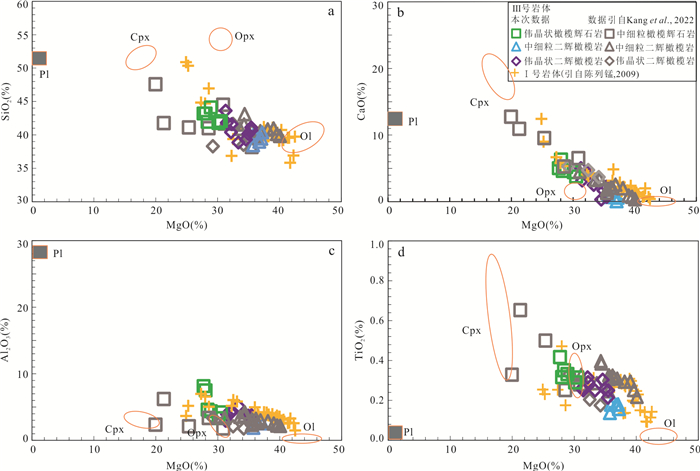
图 6 金川矿床Ⅲ号岩体主量元素相关性及与Ⅰ号岩体主量元素对比
Ⅰ号岩体数据陈列锰,2009;Ⅲ号岩体部分数据引自Kang et al., 2022. Ol. 橄榄石;Opx. 斜方辉石;Cpx. 单斜辉石;Pl. 斜长石
Fig. 6. Comparison of major oxide contents in whole rocks between No.Ⅲ and No.Ⅰ intrusions
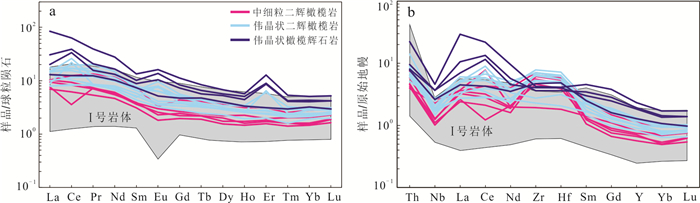
图 7 Ⅲ号岩体稀土元素球粒陨石标准化配分曲线图(a)和微量元素原始地幔标准化蛛网图(b)及其与Ⅰ号岩体对比
Ⅰ号岩体数据据陈列锰(2009);球粒陨石标准化值据Anders and Grevesse(1989),原始地幔标准化值据Palme and O’Neill(2007)
Fig. 7. Chondrite-normalized REE patterns (a) and primitive mantle-normalized incompatible element patterns (b) for No.Ⅲ and comparison with No.Ⅰ intrusion
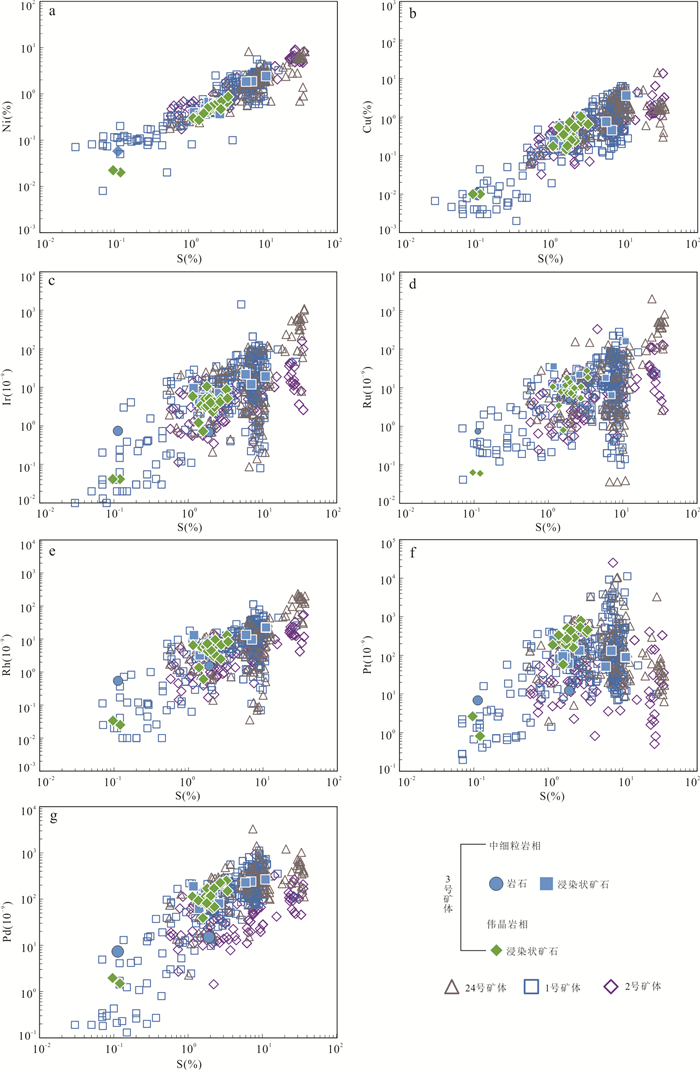
图 8 3号及其他主要矿体S与铂族元素相关性图解
1号、2号和24号矿体数据来自于Chai and Naldrett(1992b)、Song et al.(2009)、Chen et al.(2013)和Duan et al.(2016)
Fig. 8. The correlation between S and Ni, Cu and PGE for the No.3 orebody and other major orebodies
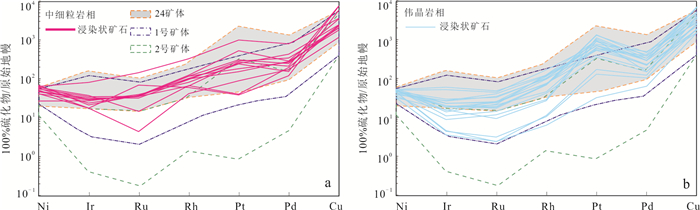
图 9 3号矿体矿石样品PGE原始地幔标准化图解及与各典型矿体对比
1、2和24号数据来源同图 8,原始地幔中Ni、Cu和PGE的含量数据引自Palme and O’Neill(2007)
Fig. 9. Primitive mantle-normalized PGE patterns for sulfide bearing rocks from No.3 orebody
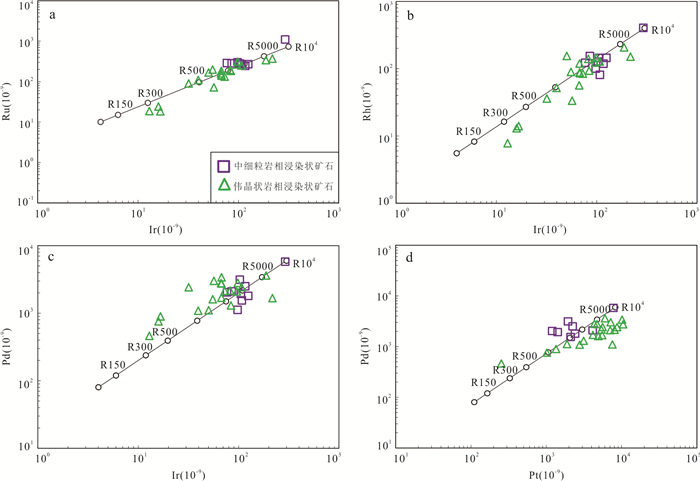
图 10 金川3号矿体不同岩相中浸染状矿石中硫化物的“R因子”模拟计算
铂族元素模拟所采用的D硫化物/硅酸盐熔体分别为:DIr=30 000,DRu=27 000,DRh=27 000,DPd=30 000,DPt=30 000;模拟结果表明母岩浆中PGE含量分别为:Ir=0.042×10‒9,Ru=0.1×10‒9,Rh=0.055×10‒9,Pd=0.8×10‒9,Pt=1.1×10‒9
Fig. 10. Modeling of the R factor for sulfides in disseminated ores from different lithofacies of the No.3 orebody
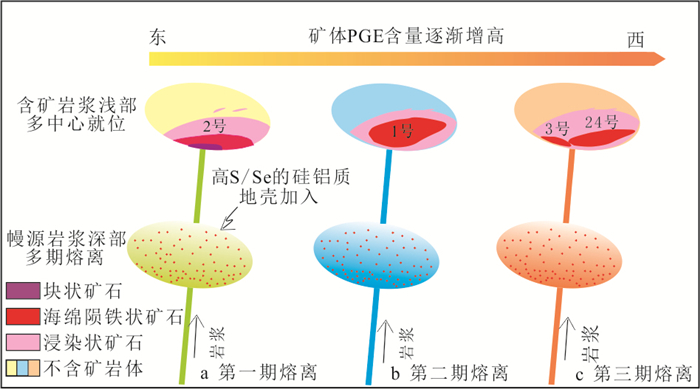
图 11 金川矿床“幔源岩浆深部多期熔离‒含矿岩浆多中心侵位”成矿模型示意图
Fig. 11. The model of "multi-stage sulfide segregation in deep magma chamber-multi-center emplacement" of Jinchuan deposit
表 1 Ⅲ号岩体Zk404的橄榄石成分(%)
Table 1. The olivine composition (%) from Zk404 of No.Ⅲ intrusion
赋矿岩性 分析点号 MgO SiO2 FeO MnO NiO Total Fo Ni 中细粒伊丁石化二辉橄榄岩 b7-01 45.51 39.89 15.09 0.19 0.26 101.54 84.3 2 019 b7-01 43.75 39.29 14.71 0.19 0.22 99.34 84.1 1 752 b7-02 45.91 39.76 14.52 0.19 0.23 100.67 84.9 1 776 b7-03 45.30 39.68 15.05 0.28 0.24 100.73 84.3 1 870 中细粒二辉橄榄岩 b13-2-02 44.27 39.74 15.72 0.09 0.31 100.32 83.4 2 420 b19-2-01 44.32 39.75 14.62 0.22 0.18 99.09 84.4 1 375 b19-2-02 44.95 40.30 15.11 0.20 0.21 101.10 84.1 1 634 b19-2-05 44.69 39.95 15.44 0.16 0.28 100.65 83.8 2 177 b19-2-07 44.48 39.70 14.31 0.25 0.22 99.00 84.7 1 713 b19-2-08 43.96 39.80 15.56 0.25 0.19 99.87 83.4 1 524 b19-2-09 45.27 39.94 14.95 0.25 0.22 100.71 84.4 1 721 b19-2-10 44.15 39.86 15.09 0.12 0.18 99.51 83.9 1 430 b19-2-11 44.76 39.59 14.35 0.14 0.24 99.14 84.8 1 909 b19-2-12 44.40 40.40 14.70 0.32 0.22 100.26 84.3 1 713 b19-2-13 43.86 39.91 14.25 0.13 0.20 99.01 84.6 1 587 b19-01 44.49 39.71 15.35 0.29 0.19 100.12 83.8 1 509 b19-02 44.35 39.58 14.74 0.20 0.17 99.10 84.3 1 320 b19-04 45.45 39.51 14.26 0.13 0.31 99.75 85.0 2 420 b19-07 45.25 39.66 15.05 0.19 0.14 100.35 84.3 1 069 b19-09 44.49 39.80 14.44 0.20 0.31 99.45 84.6 2 404 b19-10 45.19 39.85 14.96 0.20 0.17 100.41 84.3 1 352 b19-11 44.36 39.90 14.48 0.18 0.13 99.30 84.5 982 b19-12 45.21 40.00 14.29 0.25 0.25 100.04 84.9 1 988 b19-13 44.48 40.18 14.30 0.24 0.18 99.56 84.7 1 375 伟晶状二辉橄榄岩 b21-01 44.44 39.53 15.82 0.19 0.21 100.27 83.4 1 642 b21-03 43.78 39.48 16.12 0.23 0.14 99.79 82.9 1 084 b22-01 44.45 39.56 15.44 0.26 0.24 99.98 83.7 1 886 b22-02 44.70 40.03 14.89 0.20 0.19 100.12 84.3 1 501 b22-06 44.42 40.12 15.47 0.19 0.27 100.96 83.7 2 114 b22-07 44.31 39.32 14.88 0.25 0.26 99.12 84.1 2 035 b22-08 43.67 39.67 15.05 0.22 0.26 99.06 83.8 2 043 b22-09 43.14 39.55 16.78 0.23 0.26 100.26 82.1 2 059 b22-11 44.60 39.84 15.66 0.23 0.22 100.65 83.5 1 697 b22-12 43.18 39.68 16.41 0.16 0.15 99.84 82.4 1 171 b22-13 44.08 39.74 15.12 0.19 0.20 99.53 83.9 1 532 b22-14 44.00 39.23 15.31 0.17 0.17 98.97 83.7 1 344 注:电子探针分析在自然资源部岩浆作用成矿与找矿重点实验室测定;测试者:王亚磊;测试手段:利用KEOL JXA-8230型电子探针测试;测试条件:电压为20 kV,电流为10 nA,束斑直径为1 μm,元素峰值检测时间为10 s,上下背景检测时间为5 s;测试精度:小于1%;测试误差:小于2%.  下载: 导出CSV
表 2 Ⅲ号岩体岩石及矿石中的PGE(10‒9)及Ni、Cu、S(%)元素含量
Table 2. Concentrations of PGE (10‒9) and Ni、Cu、S (%) in the No. Ⅲ intrusion
样品编号 采样深度(m) 矿石类型 粒度 Ru Pd Ir Pt Rh Cu Ni S (10‒9) (%) zk404-b7 404 无矿化 中细粒 0.7 7.3 0.7 6.9 0.5 - 0.1 0.1 zk404-b9 452 浸染状 中细粒 35.9 190.6 9.5 254.5 13.3 0.2 0.4 1.2 zk404-b12 484 浸染状 中细粒 10.6 61.4 4.3 83.1 3.2 0.6 0.4 1.4 zk404-b13 496 浸染状 中细粒 14.7 104.7 3.9 61.3 6.3 0.2 0.7 1.9 zk404-b14 505 浸染状 中细粒 16.7 123.9 5.0 244.0 9.1 0.4 0.6 2.1 zk404-b15 511 浸染状 中细粒 12.7 143.5 4.7 88.9 5.8 0.2 0.4 1.7 zk404-b16 520 浸染状 中细粒 10.4 106.9 5.0 95.3 5.0 0.2 0.4 1.6 zk404-b18 525 浸染状 中细粒 21.6 80.7 7.0 135.7 7.2 1.1 0.4 2.6 zk404-b22 533 浸染状 伟晶状 10.6 113.4 5.9 188.2 6.5 0.2 0.3 1.2 zk404-b25 548 浸染状 伟晶状 11.6 112.9 5.0 258.4 5.9 0.3 0.4 1.7 zk404-b26 552 浸染状 伟晶状 7.2 170.1 3.4 506.5 4.3 0.5 0.4 1.8 zk404-b28 566 浸染状 中粗粒 19.2 131.8 9.2 385.9 7.5 0.7 0.7 1.9 zk404-b29 573 浸染状 伟晶状 14.2 113.1 5.2 379.2 6.6 0.7 0.4 1.9 zk404-b32 588 细脉状 伟晶状 18.4 149.7 5.1 456.3 8.3 0.6 0.9 3.4 zk404-b33 598 浸染状 伟晶状 10.6 209.1 5.1 795.2 6.7 0.7 0.7 2.8 zk404-b35 607 浸染状 伟晶状 9.8 171.8 4.1 291.1 3.5 0.5 0.6 2.2 zk404-b36 620 浸染状 伟晶状 7.2 116.8 4.0 439.8 4.6 0.2 0.5 2.0 zk404-b38 634 浸染状 伟晶状 3.4 92.9 1.2 334.1 1.4 0.5 0.3 1.4 zk404-b39 640 浸染状 伟晶状 5.4 226.2 4.2 536.0 2.5 1.0 0.5 2.7 zk404-b40 646 浸染状 伟晶状 18.0 81.3 10.6 268.6 7.3 0.2 0.5 1.8 zk404-b41 651 浸染状 伟晶状 0.8 39.1 0.7 58.6 0.6 0.4 0.4 1.6 zk404-b42 664 浸染状 伟晶状 0.1 1.5 - 0.8 - - - 0.1 zk404-b43 671 浸染状 伟晶状 0.1 2.0 - 2.6 - - - 0.1 注:铂族元素在中国科学院地球化学研究所关键矿产成矿与预测全国重点实验室完成;测试者:王大鹏;测试手段:卡洛斯管法;测试条件:测试仪器为PlasmaQuant MS Elite型ICP-MS,测试电压为50 kV,电流为60 mA;稀土和微量元素测试仪器为Agilent 7700e ICP-MS;测试精度:小于10%;测试误差:Pd分析误差小于1%,Ir、Ru、Rh、Pt分析误差小于10%.
下载: 导出CSV
-
Anders, E., Grevesse, N., 1989. Abundances of the Elements: Meteoritic and Solar. Geochimica et Cosmochimica Acta, 53(1): 197-214. https://doi.org/10.1016/0016-7037(89)90286-X Ballhaus, C., Tredoux, M., Späth, A., 2001. Phase Relations in the Fe-Ni-Cu-PGE-S System at Magmatic Temperature and Application to Massive Sulphide Ores of the Sudbury Igneous Complex. Journal of Petrology, 42(10): 1911-1926. https://doi.org/10.1093/petrology/42.10.1911 Barnes, S. J., Cruden, A. R., Arndt, N., et al., 2016. The Mineral System Approach Applied to Magmatic Ni-Cu-PGE Sulphide Deposits. Ore Geology Reviews, 76: 296-316. https://doi.org/10.1016/j.oregeorev.2015.06.012 Barnes, S. J., Lightfoot, P. C., 2005. Formation of Magmatic Nickel Sulfide Deposits and Processes Affecting Their Copper and Platinum Group Element Contents. Economic Geology 100th Anniversary Volume, 34: 179-213. https://doi.org/10.5382/AV100.08. Barnes, S. J., Mungall, J. E., Le Vaillant, M., et al., 2017. Sulfide-Silicate Textures in Magmatic Ni-Cu-PGE Sulfide Ore Deposits: Disseminated and Net-Textured Ores. American Mineralogist, 102(3): 473-506. https://doi.org/10.2138/am-2017-5754 Barnes, S. J., Zientek, M. L., Severson, M. J., 1997. Ni, Cu, Au, and Platinum-Group Element Contents of Sulphides Associated with Intraplate Magmatism: A Synthesis. Canadian Journal of Earth Sciences, 34(4): 337-351. https://doi.org/10.1139/e17-030 Campbell, I. H., Naldrett, A. J., 1979. The Influence of Silicate: Sulfide Ratios on the Geochemistry of Magmatic Sulfides. Economic Geology, 74(6): 1503-1506. https://doi.org/10.2113/gsecongeo.74.6.1503 Chai, G., Naldrett, A. J., 1992a. The Jinchuan Ultramafic Intrusion: Cumulate of a High-Mg Basaltic Magma. Journal of Petrology, 33(2): 277-303. https://doi.org/10.1093/petrology/33.2.277 Chai, G., Naldrett., A. J., 1992b. Characteristics of Ni-Cu-PGE Mineralization and Genesis of the Jinchuan Deposit, Northwest China. Economic Geology, 87(6): 1475-1495. https://doi.org/10.2113/gsecongeo.87.6.1475 Chen, L. M., 2009. Features and Genesis of Segment I and Its Hosted Ni-Cu Sulfide Deposit of the Jinchuan Intrusion, Gansu, Province (Dissertation). Institute of Geochemistry, Chinese Academy of Sciences, Guiyang (in Chinese with English abstract). Chen, L. M., Song, X. Y., Keays, R. R., et al., 2013. Segregation and Fractionation of Magmatic Ni-Cu-PGE Sulfides in the Western Jinchuan Intrusion, Northwestern China: Insights from Platinum Group Element Geochemistry. Economic Geology, 108(8): 1793-1811. https://doi.org/10.2113/econgeo.108.8.1793 Duan, J., Li, C. S., Qian, Z. Z., et al., 2016. Multiple S Isotopes, Zircon Hf Isotopes, Whole-Rock Sr-Nd Isotopes, and Spatial Variations of PGE Tenors in the Jinchuan Ni-Cu-PGE Deposit, NW China. Mineralium Deposita, 51(4): 557-574. https://doi.org/10.1007/s00126-015-0626-8 Duan, J., Qian, Z. Z., Jiao, J. G., et al., 2015. Genesis of Xijing Intrusion from Longshoushan Terrane and the Tectonic Significance. Journal of Jilin University (Earth Science Edition), 45(3): 832-846 (in Chinese with English abstract). Fleet, M. E., Crocket, J. H., Stone, W. E., 1996. Partitioning of Platinum-Group Elements (Os, Ir, Ru, Pt, Pd) and Gold between Sulfide Liquid and Basalt Melt. Geochimica et Cosmochimica Acta, 60(13): 2397-2412. https://doi.org/10.1016/0016-7037(96)00100-7 Gong, J. H., Zhang, J. X., Wang, Z. Q., et al., 2016. Origin of the Alxa Block, Western China: New Evidence from Zircon U-Pb Geochronology and Hf Isotopes of the Longshoushan Complex. Gondwana Research, 36: 359-375. https://doi.org/10.1016/j.gr.2015.06.014 Gong, J. H., Zhang, J. X., Yu, S. Y., 2011. The Origin of Longshoushan Group and Associated Rocks in the Southern Part of the Alxa Block: Constraint from LA-ICP-MS U-Pb Zircon Dating. Acta Petrologica et Mineralogica, 30(5): 795-818 (in Chinese with English abstract). Jiao, J. G., Jin, S. F., Rui, H. C., et al., 2017. Petrology, Geochemistry and Chronology Study of the Xiaokouzi Mafic-Ultramafic Intrusion in the Eastern Section of Longshou Mountains, Gansu. Acta Geologica Sinica, 91(4): 736-747 (in Chinese with English abstract). Jiao, J. G., Tang, Z. L., Yan, H. Q., et al., 2012. Magmatic Mass Balance and Metallogenic Process of Jinchuan Cu-Ni Sulfide Deposit. Mineral Deposits, 31(6): 1135-1148 (in Chinese with English abstract). Kang, J., Song, X. Y., Long, T. M., et al., 2022. Lithologic and Geochemical Constraints on the Genesis of a Newly Discovered Orebody in the Jinchuan Intrusion, NW China. Economic Geology, 117(8): 1809-1825. https://doi.org/10.5382/econgeo.4911 Li, C. S., Naldrett, A. J., 1999. Geology and Petrology of the Voisey's Bay Intrusion: Reaction of Olivine with Sulfide and Silicate Liquids. Lithos, 47(1-2): 1-31. https://doi.org/10.1016/S0024-4937(99)00005-5 Li, C. S., Ripley, E. M., 2011. The Giant Jinchuan Ni-Cu-(PGE) Deposit: Tectonic Setting, Magma Evolution, Ore Genesis and Exploration Implications. Review Economic Geology, 17: 163-180. Li, C. S., Xu, Z. H., de Waal, S. A., et al., 2004. Compositional Variations of Olivine from the Jinchuan Ni-Cu Sulfide Deposit, Western China: Implications for Ore Genesis. Mineralium Deposita, 39(2): 159-172. https://doi.org/10.1007/s00126-003-0389-5 Li, L. J., Mao, X. C., Liu, Z. K., et al., 2025. Multi-Stage Magma Emplacement in the Western End of the Jinchuan Ni-Cu Sulfide Deposit, NW China, and Mineral Exploration Strategy Based on Exploration Data. Journal of Geochemical Exploration, 268: 107615. https://doi.org/10.1016/j.gexplo.2024.107615 Li, X. H., Su, L., Chung, S. L., et al., 2005. Formation of the Jinchuan Ultramafic Intrusion and the World's Third Largest Ni-Cu Sulfide Deposit: Associated with the ∼825 Ma South China Mantle Plume? Geochemistry, Geophysics, Geosystems, 6(11): 1-16. https://doi.org/10.1007/s00126-023-01184-w Long, T. M., Song, X. Y., Kang, J., et al., 2023. Genesis of No. 2 Orebody of the Jinchuan Magmatic Ni-Cu-(PGE) Sulfide Deposit, NW China: New Constraints from the Newly Discovered Deep Extension. Mineralium Deposita, 58(7): 1317-1332. https://doi.org/10.1016/b0-08-043751-6/02177-0 Mao, X. C., Su, Z., Deng, H., et al., 2024. Three- Dimensional Mineral Prospectivity Modeling with Geometric Restoration: Application to the Jinchuan Ni-Cu-(PGE) Sulfide Deposit, Northwestern China. Natural Resources Research, 33(1): 75-105. https://doi.org/10.1007/s11053-023-10269-2 Mao, Y. J., Barnes, S. J., Duan, J., et al., 2018. Morphology and Particle Size Distribution of Olivines and Sulphides in the Jinchuan Ni-Cu Sulphide Deposit: Evidence for Sulphide Percolation in a Crystal Mush. Journal of Petrology, 59(9): 1701-1730. https://doi.org/10.1093/petrology/egy077 Palme, H., O'Neill, H. St. C., 2007. Cosmochemical Estimates of Mantle Composition. In: Holland, H. D., Turekian, K. K., eds., Treatise on Geochemistry. Elsevier, Amsterdam. https://doi.org/10.1007/s00126-009-0259-x Peach, C. L., Mathez, E. A., Keays, R. R., 1990. Sulfide Melt-Silicate Melt Distribution Coefficients for Noble Metals and Other Chalcophile Elements as Deduced from MORB: Implications for Partial Melting. Geochimica et Cosmochimica Acta, 54(12): 3379-3389. https://doi.org/10.1016/0016-7037(90)90292-S SGU (The Sixth Geological Unit of the Geological Survey of Gansu Province), 1984. Geology of the Baijiazuizi Cu-Ni Sulfide Deposit. Geological Publishing House, Beijing (in Chinese). Song, X. Y., Danyushevsky, L. V., Keays, R. R., et al., 2012. Structural, Lithological, and Geochemical Constraints on the Dynamic Magma Plumbing System of the Jinchuan Ni-Cu Sulfide Deposit, NW China. Mineralium Deposita, 47(3): 277-297. https://doi.org/10.1007/s00126-011-0370-7 Song, X. Y., Kang, J., Long, T. M., et al., 2023. Bifurcate Magma Conduit of Jinchuan Super-Large Ni-Cu-PGE Sulfide Deposit in Gansu, China and Its Implications for Deep Ore Prospecting. Journal of Earth Sciences and Environment, 45(5): 1049-1062 (in Chinese with English abstract). Song, X. Y., Keays, R. R., Zhou, M. F., et al., 2009. Siderophile and Chalcophile Elemental Constraints on the Origin of the Jinchuan Ni-Cu-(PGE) Sulfide Deposit, NW China. Geochimica et Cosmochimica Acta, 73(2): 404-424. https://doi.org/10.1016/j.gca.2008.10.029 Sun, X., Liu, C. H., Duan, R. H., 2024. The Age and Geological Significance of Early Neoproterozoic Mafic Sills on the Eastern Margin of the North China Craton: Evidence from Zirconology. Earth Science, 49(9): 3122-3139 (in Chinese with English abstract). Tang, Z. L., Li, W. Y., 1995. The Metallogenetic Model and Geological Characteristics of the Jinchuan Pt-Bearing Ni-Cu Sulfide Deposit. Geological Publishing House, Beijing (in Chinese) Wan, Y. S., Dong, C. Y., Xie, H. Q., et al., 2024. Formation and Evolution of Archean Continental Crust in the Anshan-Benxi Area, North China Craton: A Review. Earth Science, 49(11): 3855-3878 (in Chinese with English abstract). Xue, S. C., Wang, Q. F., Wang, Y. L., et al., 2023. The Roles of Various Types of Crustal Contamination in the Genesis of the Jinchuan Magmatic Ni-Cu-PGE Deposit: New Mineralogical and C-S-Sr-Nd Isotope Constraints. Economic Geology, 118(8): 1795-1812. https://doi.org/10.5382/econgeo.5017 Yang, X. Z., Ishihara, S., Zhao, D. H., 2006. Genesis of the Jinchuan PGE Deposit, China: Evidence from Fluid Inclusions, Mineralogy and Geochemistry of Precious Elements. Mineralogy and Petrology, 86(1): 109-128. https://doi.org/10.1007/s00710-005-0094-4 Zhang, M. J., Kamo, S. L., Li, C. et al. 2010. Precise U-Pb Zircon-Baddeleyite Age of the Jinchuan Sulfide Ore-Bearing Ultramafic Intrusion, Western China. Mineralium Deposita, 45: 3-9. _ext_link_paichu__ 陈列锰, 2009. 甘肃金川Ⅰ号岩体及其铜镍硫化物矿床特征和成因(博士学位论文). 贵阳: 中国科学院地球化学研究所. 段俊, 钱壮志, 焦建刚, 等, 2015. 甘肃龙首山岩带西井镁铁质岩体成因及其构造意义. 吉林大学学报(地球科学版), 45(3): 832-846. 甘肃省地质矿产局第六地质队, 1984. 白家咀子硫化铜镍矿床地质. 北京: 地质出版社. 宫江华, 张建新, 于胜尧, 2011. 阿拉善地块南缘龙首山岩群及相关岩石的起源和归属——来自LA-ICP-MS锆石U-Pb年龄的制约. 岩石矿物学杂志, 30(5): 795-818. 焦建刚, 靳树芳, 芮会超, 等, 2017. 甘肃龙首山东段小口子镁铁-超镁铁质岩体岩石学、地球化学及年代学研究. 地质学报, 91(4): 736-747. 焦建刚, 汤中立, 闫海卿, 等, 2012. 金川铜镍硫化物矿床的岩浆质量平衡与成矿过程. 矿床地质, 31(6): 1135-1148. 宋谢炎, 康健, 隆廷茂, 等, 2023. 甘肃金川超大型Ni-Cu-PGE硫化物矿床岩浆通道分枝构造及其深部找矿意义. 地球科学与环境学报, 45(5): 1049-1062. 孙逊, 刘超辉, 段瑞涵, 2024. 华北克拉通东缘新元古代早期基性岩床的时代及其地质意义: 来自锆石学的证据. 地球科学, 49(9): 3122-3139. doi: 10.3799/dqkx.2023.095 汤中立, 李文渊, 1995. 金川铜镍硫化物(含铂)矿床成矿模式及地质对比. 北京: 地质出版社. 万渝生, 董春艳, 颉颃强, 等, 2024. 华北克拉通鞍山-本溪地区太古宙地壳形成演化: 综述. 地球科学, 49(11): 3855-3878. doi: 10.3799/dqkx.2024.104 -

 点击查看大图
计量
- 文章访问数: 70
- HTML全文浏览量: 10
- PDF下载量: 11
- 被引次数: 0
