




Construction of Multilayered Mineralization Prediction Data Based on Geological Big Data and Artificial Intelligence
-
摘要:
随着大数据和人工智能技术的迅猛发展,矿产预测正在经历一场由数据稀疏型向数据密集型的技术变革,成为矿产勘查和找矿突破的重要“科技引擎”.尽管人们在地质信息化的进程中已经积累了大量的地质矿产、地球物理、地球化学和遥感等多源异构工程探测数据,以及丰富的地质报告和文献资源,但如何高效整合并深度挖掘这些数据,以进一步优化矿产预测指标体系、构建高质量矿产预测数据集、提升预测精度,仍是当前研究亟待解决的关键问题.针对这些挑战,本文提出利用大模型和知识图谱技术,整合地球系统、成矿系统、勘查系统与预测评价系统的多层次、多维度知识信息,打造多系统耦合的矿产预测知识图谱,实现矿产预测指标体系的智能化构建.同时,基于大数据和人工智能技术,形成以地学探测数据智能挖掘、科学数据智能抽取和时空分析,以及数据智能反演和模拟为核心的多层次矿产预测数据体系.这一方法体系通过推动预测数据与预测指标的深度耦合,可有效提升预测结果的准确性和可靠性,为矿产勘查和找矿突破提供强有力的技术支持.
Abstract:With the advancement of big data and artificial intelligence technologies, mineralization prediction is undergoing a series of technological innovations, transitioning from data-sparse to data-intensive approaches. This shift is expected to become a new "technology engine" for breakthroughs in mineral exploration and discovery. Despite the substantial accumulation of heterogeneous multisource geological, geophysical, geochemical, and remote sensing data, as well as rich geological reports and literature, it remains a critical research challenge to effectively integrate and deeply mine these valuable data resources to further optimize mineralization prediction indicator systems and construct high-quality mineralization prediction datasets. To address the challenge, this paper proposes integrating multilayered and multidimensional mineralization prediction knowledge across the Earth system, metallogenic system, exploration system, and prediction-evaluation system through large models and knowledge graph technologies. A multilayered, multi-system-coupled mineralization prediction knowledge graph will be constructed, and intelligent construction of mineralization prediction indicator systems will be achieved through knowledge graph mining. Based on big data and artificial intelligence technologies, a multilayered method system for intelligent construction of mineralization prediction data will be developed. This system will focus on intelligent mining of geological exploration data, automated scientific data extraction and spatiotemporal analysis, and intelligent data inversion and simulation. Such advancements are expected to strengthen the deep coupling between prediction data and indicators, enhancing the accuracy and reliability of prediction results, and providing more robust technical support for mineral exploration and discovery breakthroughs.
-
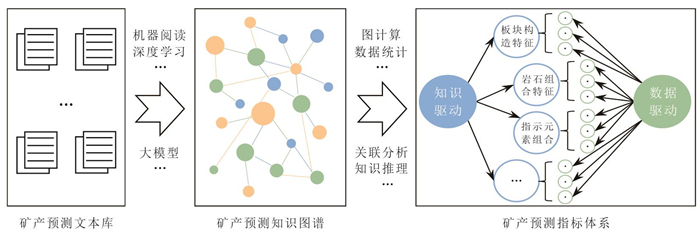
图 1 基于知识图谱的矿产预测模型自动构建流程
Fig. 1. Automated workflow for mineral prospectivity modeling based on knowledge graphs
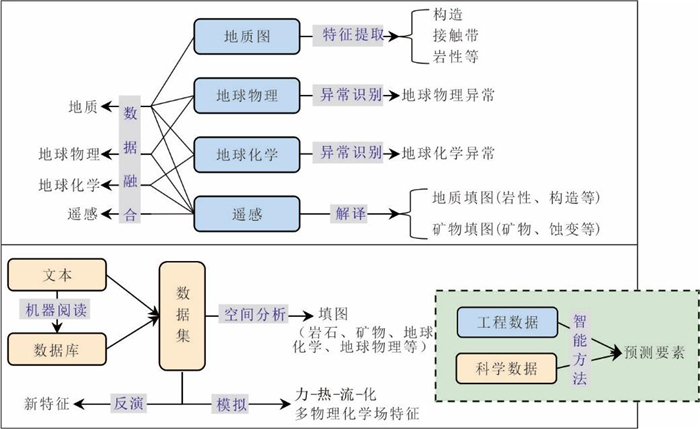
图 2 基于人工智能和大数据的多层次矿产预测数据智能构建方法
Fig. 2. Multi-level intelligent data construction method for mineral prospectivity prediction based on artificial intelligence and big data
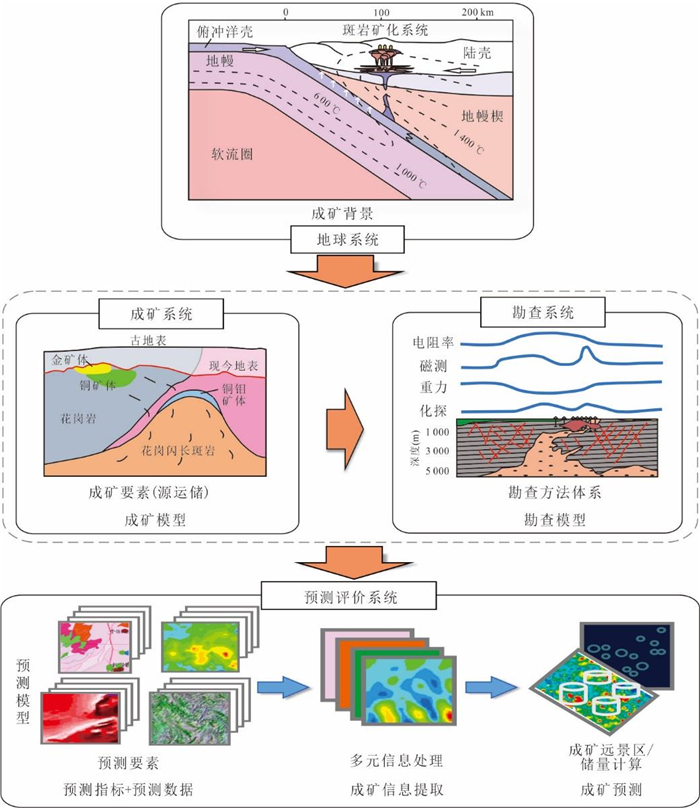
图 3 “地球系统‒成矿系统‒勘查系统‒预测评价系统”耦合的矿产预测流程
Fig. 3. Coupled metallogenic prediction workflow integrating the "Earth system-metallogenic system-exploration system-prediction and evaluation system"
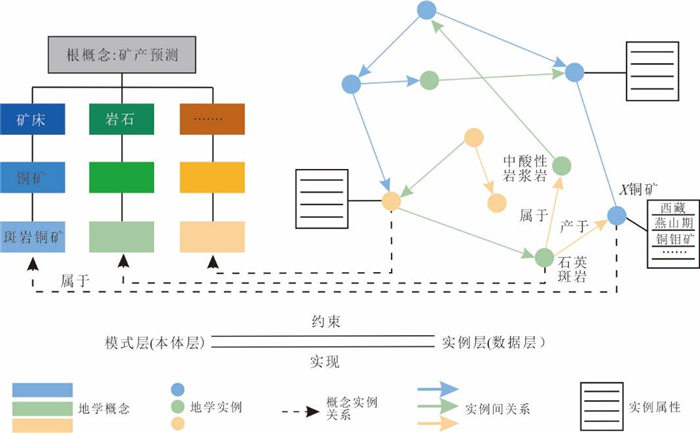
图 4 矿产预测知识图谱示意图
Fig. 4. Schematic diagram of the knowledge graph for mineral prospectivity prediction
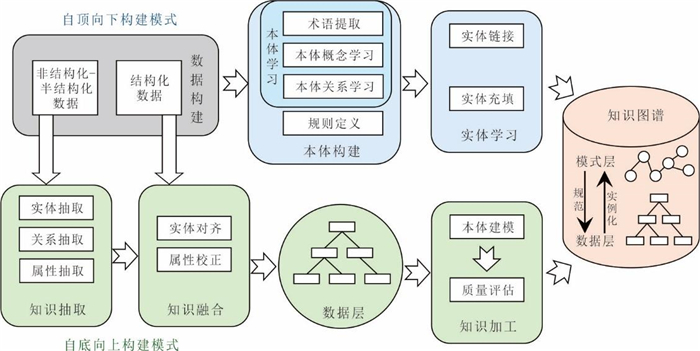
图 5 矿产预测知识图谱构建流程
Fig. 5. Workflow for constructing the knowledge graph of mineral prospectivity prediction.
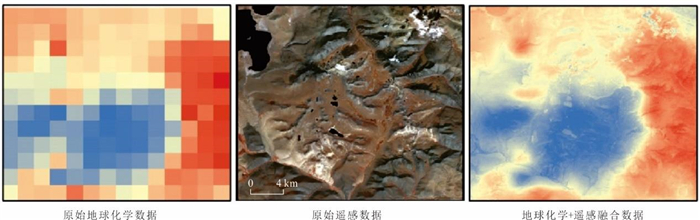
图 6 小比例地球化学数据与高分辨率遥感图像融合(据Wang et al., 2021)
Fig. 6. Integration of low-scale geochemical data and high-resolution remote sensing imagery (modified by Wang et al., 2021)
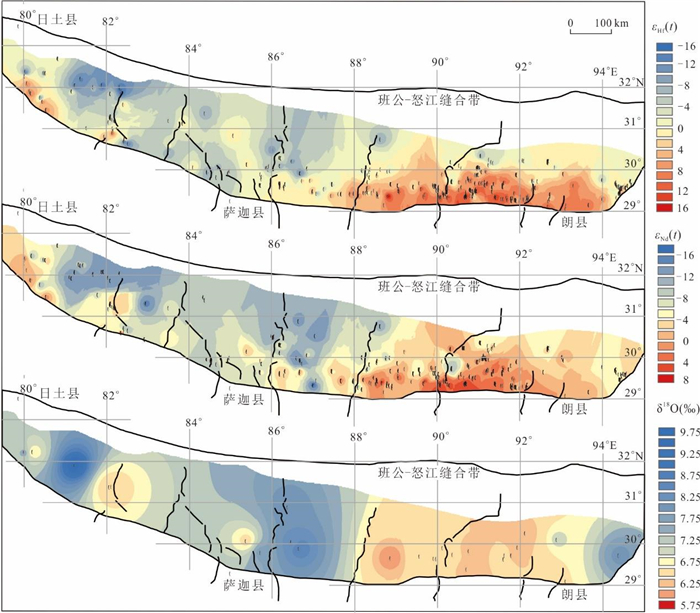
图 7 西藏冈底斯地区新生代以来火成岩Nd-Hf-O同位素填图(据Hou et al., 2023数据重绘)
Fig. 7. Mapping of Nd-Hf-O isotopes in Cenozoic igneous rocks of the Gangdese region, Xizang (modified by Hou et al., 2023)
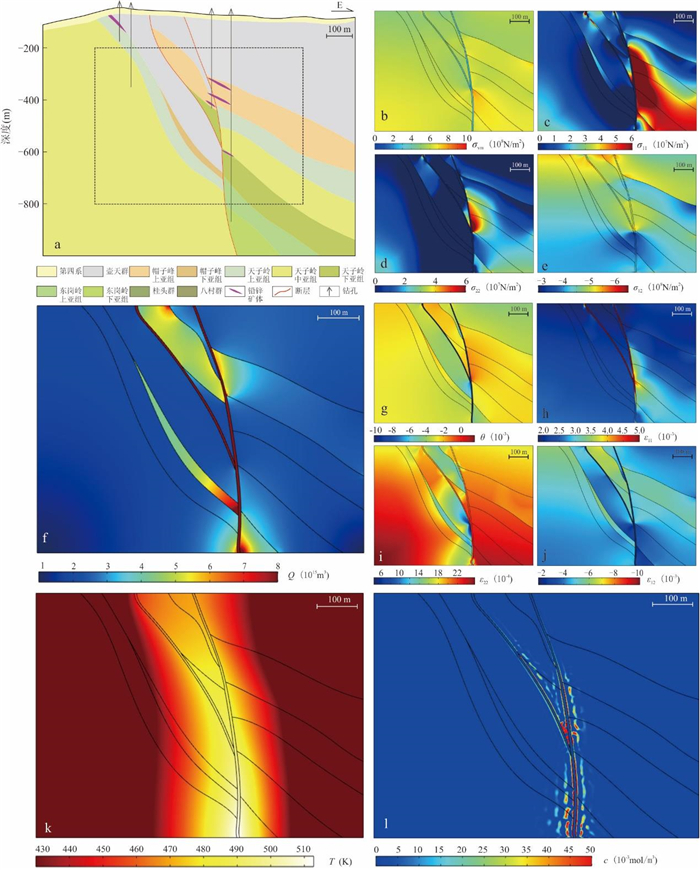
图 8 粤北凡口铅锌矿成矿力‒热‒流场模拟
图据Xiao et al.(2024);a.钒口铅锌矿勘查剖面图;b.冯•米塞斯应力;c.第一主应力;d.第二主应力;e.第三主应力;f.流体通量模拟;g.体积应变;h.第一主应变;i.第二主应变;j.第三主应变;k.热力场模拟;l.铅锌矿随机森林预测结果
Fig. 8. Simulation of structural stress, strain, thermal, and fluid fields for the Fankou Pb-Zn deposit, northern Guangdong
-
An, W. T., Chen, J. P., Zhu, P. F., 2021. A Two-Way Forecasting Method Based on Numerical Simulation of Mineralization Process for the Prediction of Concealed Ore Deposits. Earth Science Frontiers, 28(3): 97-111 (in Chinese with English abstract). Chapman, J. B., Ducea, M. N., DeCelles, P. G., et al., 2015. Tracking Changes in Crustal Thickness during Orogenic Evolution with Sr/Y: An Example from the North American Cordillera. Geology, 43(10): 919-922. https://doi.org/10.1130/g36996.1 Chen, J. P., Chen, Y., Wang, Q. M., 2008. Study on Synthetic Informational Mineral Resource Prediction Using GIS: A Case Study in Chifeng Region, Inner Mongolia, China. Earth Science Frontiers, 15(4): 18-26 (in Chinese with English abstract). doi: 10.1016/S1872-5791(08)60035-4 Cheng, Q. M., 2006. Singularity-Generalized Self-Similarity-Fractal Spectrum (3S) Models. Earth Science, 31(3): 337-348 (in Chinese with English abstract). Cheng, Q. M., 2025. A New Paradigm for Mineral Resource Prediction Based on Human Intelligence-Artificial Intelligence Integration. Earth Science Frontiers, 32(4): 1-19 (in Chinese with English abstract). Dai, J. J., Qu, X. M., Song, Y., 2018. Porphyry Copper Deposit Prognosis in the Middle Region of the Bangonghu-Nujiang Metallogenic Belt, Tibet, Using ASTER Remote Sensing Data. Resource Geology, 68(1): 65-82. https://doi.org/10.1111/rge.12154 Diaz-Rodriguez, J., Müller, R. D., Chandra, R., 2021. Predicting the Emplacement of Cordilleran Porphyry Copper Systems Using a Spatio-Temporal Machine Learning Model. Ore Geology Reviews, 137: 104300. https://doi.org/10.1016/j.oregeorev.2021.104300 Ding, H. F., Jing, L. H., Xi, M. J., et al., 2023. Research on Scale Improvement of Geochemical Exploration Based on Remote Sensing Image Fusion. Remote Sensing, 15(8): 1993. https://doi.org/10.3390/rs15081993 Dong, X. F., Gan, F. P., Li, N., et al., 2020. Fine Mineral Identification of GF-5 Hyperspectral Image. Journal of Remote Sensing, 24(4): 454-464 (in Chinese with English abstract). Feng, T. T., Cai, S. R., Zhang, Z. J., 2025. Mining Elements of Carbonatite-Type Rare Earth Deposits Based on Knowledge Map. Earth Science Frontiers, 32(4): 262-279 (in Chinese with English abstract). Gan, Y., Peng, S. P., Mao, J. W., et al., 2022. High-Quality Development Strategy for the Supply Chain of Critical Minerals and Its Material Industry in China. Strategic Study of CAE, 24(3): 1-9 (in Chinese with English abstract). Ge, Y. Z., Zhang, Z. J., Cheng, Q. M., et al., 2022. Geological Mapping of Basalt Using Stream Sediment Geochemical Data: A Case Study of Covered Areas in Jining, Inner Mongolia, China. Journal of Geochemical Exploration, 232: 106888. https://doi.org/10.1016/j.gexplo.2021.106888 Hoggard, M. J., Czarnota, K., Richards, F. D., et al., 2020. Global Distribution of Sediment-Hosted Metals Controlled by Craton Edge Stability. Nature Geoscience, 13(7): 504-510. https://doi.org/10.1038/s41561-020-0593-2 Hou, Z. Q., Wang, R., Zhang, H. J., et al., 2023. Formation of Giant Copper Deposits in Tibet Driven by Tearing of the Subducted Indian Plate. Earth-Science Reviews, 243: 104482. https://doi.org/10.1016/j.earscirev.2023.104482 Hu, X. Y., Li, X. H., Yuan, F., et al., 2020. Numerical Modeling of Ore-Forming Processes within the Chating Cu-Au Porphyry-Type Deposit, China: Implications for the Longevity of Hydrothermal Systems and Potential Uses in Mineral Exploration. Ore Geology Reviews, 116: 103230. https://doi.org/10.1016/j.oregeorev.2019.103230 Ma, X. G., 2022. Knowledge Graph Construction and Application in Geosciences: A Review. Computers & Geosciences, 161: 105082. https://doi.org/10.1016/j.cageo.2022.105082 Martin, E. L., Barrote, V. R., Cawood, P. A., 2022. A Resource for Automated Search and Collation of Geochemical Datasets from Journal Supplements. Scientific Data, 9: 724. https://doi.org/10.1038/s41597-022-01730-7 Niu, Y. L., 2021. Lithosphere Thickness Controls the Extent of Mantle Melting, Depth of Melt Extraction and Basalt Compositions in all Tectonic Settings on Earth: A Review and New Perspectives. Earth-Science Reviews, 217: 103614. https://doi.org/10.1016/j.earscirev.2021.103614 Richards, J. P., 2003. Tectono-Magmatic Precursors for Porphyry Cu-(Mo-Au) Deposit Formation. Economic Geology, 98(8): 1515-1533. https://doi.org/10.2113/gsecongeo.98.8.1515 Shi, L. Y., Zuo, R. G., 2026. Mineral Prospecting Large Model. Earth Science. 51(3): 832-848 (in Chinese with English abstract). Wang, C. B., Wang, M. G., Wang, B., et al., 2024. Knowledge Graph-Infused Quantitative Mineral Resource Forecasting. Earth Science Frontiers, 31(4): 26-36 (in Chinese with English abstract). Wang, X. Q., 2013. Landmark Events of Exploration Geochemistry in the Past 80 Years. Geology in China, 40(1): 322-330 (in Chinese with English abstract). Wang, Z. Y., Zuo, R. G., Jing, L. H., 2021. Fusion of Geochemical and Remote-Sensing Data for Lithological Mapping Using Random Forest Metric Learning. Mathematical Geosciences, 53(6): 1125-1145. https://doi.org/10.1007/s11004-020-09897-8 Xiao, F., Chen, X. Y., Cheng, Q. M., 2024. Combining Numerical Modeling and Machine Learning to Predict Mineral Prospectivity: A Case Study from the Fankou Pb-Zn Deposit, Southern China. Applied Geochemistry, 160: 105857. https://doi.org/10.1016/j.apgeochem.2023.105857 Xiao, K. Y., Fan, M. J., Sun, L., et al., 2023. Theoretical Method of Integrated Geological Information Prediction of Metallogenic Series for Mineral Resource Potential Assessment. Acta Geoscientica Sinica, 44(5): 769-780 (in Chinese with English abstract). Yuan, F., Li, X. H., Hu, X. Y., et al., 2019. A New Approach for Researching Hydrothermal Deposit: Numerical Simulation. Chinese Journal of Geology, 54(3): 678-690 (in Chinese with English abstract). Zhang, N. N., Zhou, K. F., 2017. Identification of Hydrothermal Alteration Zones of the Baogutu Porphyry Copper Deposits in Northwest China Using ASTER Data. Journal of Applied Remote Sensing, 11(1): 015016. https://doi.org/10.1117/1.jrs.11.015016 Zhang, Y. H., Wang, T., Jiao, S. T., et al., 2020. Review of Igneous Rock Databases and Their Application Prospect. Geological Journal of China Universities, 26(1): 11-26 (in Chinese with English abstract). Zhang, Z. J., Chen, G. X., Kusky, T., et al., 2023a. Lithospheric Thickness Records Tectonic Evolution by Controlling Metamorphic Conditions. Science Advances, 9(50): eadi2134. https://doi.org/10.1126/sciadv.adi2134 Zhang, Z. J., Cheng, Q. M., Yang, J., et al., 2021. Machine Learning for Mineral Prospectivity: A Case Study of Iron-Polymetallic Mineral Prospectivity in Southwestern Fujian. Earth Science Frontiers, 28(3): 221-235 (in Chinese with English abstract). Zhang, Z. J., Kusky, T., Yang, X. K., et al., 2023b. A Paradigm Shift in Precambrian Research Driven by Big Data. Precambrian Research, 399: 107235. https://doi.org/10.1016/j.precamres.2023.107235 Zhang, Z. J., Yang, Z. X., Jian, F. Y., et al., 2025. Interpretability-Enhanced Mineral Prospectivity Models: A Synergistic Approach Using Large Language Models, Knowledge Graphs, and Machine Learning. Mathematical Geosciences, Online. https://doi.org/10.1007/s11004-025-10231-3 Zhao, M. L., Zhang, Z. J., Yang, J., et al., 2025. Knowledge Graph Construction and Knowledge Discovery for Porphyry Copper Deposits. Ore Geology Reviews, 186: 106875. https://doi.org/10.1016/j.oregeorev.2025.106875 Zhao, P. D., 2019. Characteristics and Rational Utilization of Geological Big Data. Earth Science Frontiers, 26(4): 1-5 (in Chinese with English abstract). Zhou, C. H., Wang, H., Wang, C. S., et al., 2021. Geoscience Knowledge Graph in the Big Data Era. Scientia Sinica (Terrae), 51(7): 1070-1079 (in Chinese with English abstract). doi: 10.1360/SSTe-2020-0337 Zhou, Y. Z., Zhang, Q. L., Huang, Y. J., et al., 2021a. Constructing Knowledge Graph for the Porphyry Copper Deposit in the Qingzhou-Hangzhou Bay Area: Insight into Knowledge Graph Based Mineral Resource Prediction and Evaluation. Earth Science Frontiers, 28(3): 67-75 (in Chinese with English abstract). Zhou, Y. Z., Zuo, R. G., Liu, G., et al., 2021b. The Great-Leap-Forward Development of Mathematical Geoscience during 2010-2019: Big Data and Artificial Intelligence Algorithm Are Changing Mathematical Geoscience. Bulletin of Mineralogy, Petrology and Geochemistry, 40(3): 556-573, 777 (in Chinese with English abstract). Zhu, Y. Q., Sun, K., Li, W. R., et al., 2023. Comparative Analysis and Enlightenment of Geoscience Knowledge Graphs: A Perspective of Construction Methods and Contents. Geological Journal of China Universities, 29(3): 382-394 (in Chinese with English abstract). Zou, Y. H., Liu, Y., Dai, T. G., et al., 2017. Finite Difference Modeling of Metallogenic Processes in the Hutouya Pb-Zn Deposit, Qinghai, China: Implications for Hydrothermal Mineralization. Ore Geology Reviews, 91: 463-476. https://doi.org/10.1016/j.oregeorev.2017.09.008 Zuo, R. G., Cheng, Q. M., Xu, Y., et al., 2024. Explainable Artificial Intelligence Models for Mineral Prospectivity Mapping. Scientia Sinica (Terrae), 54(9): 2917-2928 (in Chinese with English abstract). doi: 10.1360/N072024-0018 安文通, 陈建平, 朱鹏飞, 2021. 基于成矿过程数值模拟的隐伏矿双向预测研究. 地学前缘, 28(3): 97-111. 陈建平, 陈勇, 王全明, 2008. 基于GIS的多元信息成矿预测研究: 以赤峰地区为例. 地学前缘, 15(4): 18-26. 成秋明, 2006. 非线性成矿预测理论: 多重分形奇异性-广义自相似性-分形谱系模型与方法. 地球科学, 31(3): 337-348. http://www.earth-science.net/article/id/1555 成秋明, 2025. 面向人类智能与人工智能融合的矿产资源预测新范式. 地学前缘, 32(4): 1-19. 董新丰, 甘甫平, 李娜, 等, 2020. 高分五号高光谱影像矿物精细识别. 遥感学报, 24(4): 454-464. 冯婷婷, 蔡诗柔, 张振杰, 2025. 基于知识图谱的碳酸岩型稀土矿成矿要素挖掘. 地学前缘, 32(4): 262-279. 干勇, 彭苏萍, 毛景文, 等, 2022. 我国关键矿产及其材料产业供应链高质量发展战略研究. 中国工程科学, 24(3): 1-9. 师路易, 左仁广, 2026. 矿产预测大模型. 地球科学, 51(3): 832-848. 王成彬, 王明果, 王博, 等, 2024. 融合知识图谱的矿产资源定量预测. 地学前缘, 31(4): 26-36. 王学求, 2013. 勘查地球化学80年来重大事件回顾. 中国地质, 40(1): 322-330. 肖克炎, 樊铭静, 孙莉, 等, 2023. 矿床成矿系列综合信息预测理论方法及其应用. 地球学报, 44(5): 769-780. 袁峰, 李晓晖, 胡训宇, 等, 2019. 热液矿床成矿作用研究新途径: 数值模拟. 地质科学, 54(3): 678-690. 张颖慧, 王涛, 焦守涛, 等, 2020. 国内外岩浆岩数据库现状与应用前景. 高校地质学报, 26(1): 11-26. 张振杰, 成秋明, 杨玠, 等, 2021. 机器学习与成矿预测: 以闽西南铁多金属矿预测为例. 地学前缘, 28(3): 221-235. 赵鹏大, 2019. 地质大数据特点及其合理开发利用. 地学前缘, 26(4): 1-5. 周成虎, 王华, 王成善, 等, 2021. 大数据时代的地学知识图谱研究. 中国科学: 地球科学, 51(7): 1070-1079. 周永章, 张前龙, 黄永健, 等, 2021a. 钦杭成矿带斑岩铜矿知识图谱构建及应用展望. 地学前缘, 28(3): 67-75. 周永章, 左仁广, 刘刚, 等, 2021b. 数学地球科学跨越发展的十年: 大数据、人工智能算法正在改变地质学. 矿物岩石地球化学通报, 40(3): 556-573, 777. 诸云强, 孙凯, 李威蓉, 等, 2023. 地球科学知识图谱比较分析与启示: 构建方法与内容视角. 高校地质学报, 29(3): 382-394. -

 下载:
下载:
 点击查看大图
计量
- 文章访问数: 307
- HTML全文浏览量: 41
- PDF下载量: 78
- 被引次数: 0
