




Numerical Modeling of Ore-Forming Processes and Mineral Prospectivity Modeling for Magmatic-Hydrothermal Deposits
-
摘要:
数值模拟方法为定量解析岩浆热液矿床的成矿过程提供了关键技术手段,对揭示控矿机理与指导成矿预测研究具有重要意义.近年来,伴随计算地球科学的迅速发展,成矿过程数值模拟研究取得了显著进展,在多个层面为成矿预测提供了有力支撑.本文系统梳理了成矿过程数值模拟的基本理论与方法,综合评述了当前数值模拟在刻画成矿过程、解析控矿机理以及支撑成矿预测等方面的研究现状,并对数值模拟方法在未来成矿预测中的发展方向作出展望.未来研究将在力‒热‒化‒流全耦合模拟、高性能数值算法开发以及多元信息智能融合等方面持续深化,共同推动成矿预测向物理机制与数据协同驱动的新范式发展.
Abstract:Numerical modeling provides a key approach for quantitatively analyzing the ore-forming processes, revealing ore location mechanisms, and facilitating mineral prospectivity studies for magmatic-hydrothermal deposits. In recent years, with the rapid advancement of computational geosciences, significant progress has been made in numerical modeling of ore-forming processes, which provides critical support for metallogenic prediction in multiple aspects. We summarize the fundamental theories and methods of numerical modeling, provide a comprehensive review of current research regarding advances in simulating ore-forming processes, analyzing ore location mechanisms, and facilitating metallogenic prediction. Finally, we conclude with an outlook on the future development of numerical modeling in advancing metallogenic prediction. We propose that future research should focus on advancing coupled mechanical-thermal-chemical-fluid processes modeling, developing efficient numerical methods, and promoting the intelligent integration of multi-source data. These efforts will collectively drive the evolution of mineral prospectivity modeling toward a new paradigm characterized by mechanism-data synergistic modeling.
-
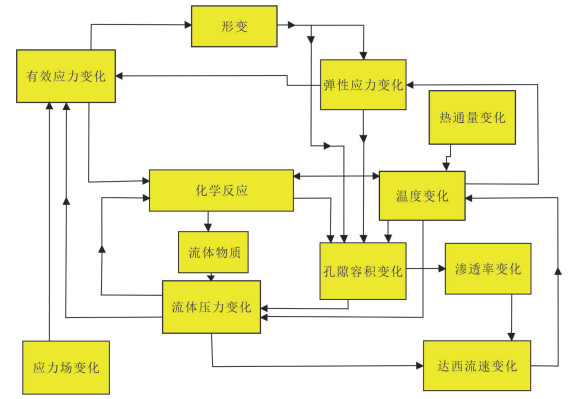
图 1 形变‒流体流动‒热传递‒化学反应耦合反馈关系(据Ord et al.,2012)
Fig. 1. Feedback relations in the fully coupled deformation-fluid flow-thermal transfer-chemical reaction (after Ord et al., 2012)
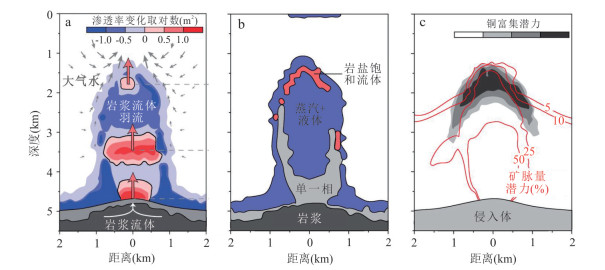
图 2 斑岩铜矿成矿过程
a、b.岩浆流体羽流及其相态;c.斑岩铜矿体富集潜力;据Weis et al.(2012)
Fig. 2. Ore-forming process of porphyry copper deposit
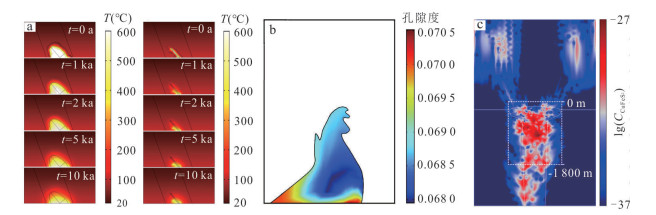
图 3 控矿机理的揭示和成矿预测
a.侵入体形态对温度场影响;b.矿石沉淀引起的渗透率变化;c.矿化潜力的预测;据肖凡和王恺其(2021)、Gao et al.(2024)、Hu et al.(2020)
Fig. 3. Analyze ore location mechanisms and facilitate metallogenic prediction
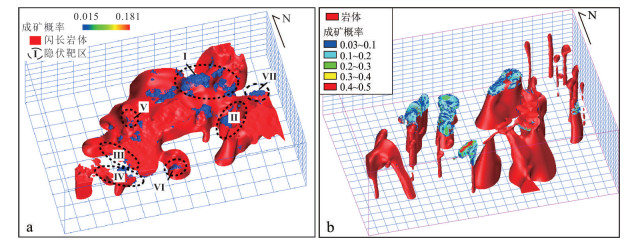
图 4 融合数值模拟信息的综合信息三维成矿预测
a.安庆月山地区;b.宣城狸桥地区;据Li et al.(2019)、谢先岗等(2024)
Fig. 4. 3D mineral prospectivity modeling integrating numerical modeling data
-
An, W. T., Chen, J. P., Zhu, P. F., 2021. A Two-Way Forecasting Method Based on Numerical Simulation of Mineralization Process for the Prediction of Concealed Ore Deposits. Earth Science Frontiers, 28(3): 97-111 (in Chinese with English abstract). Bi, C. X., Liu, L. M., Zhou, F. H., 2025.3D Ore Prediction by Integrating Dynamic Simulation with Machine Learning: A Case Study of the Tongshan Copper Deposit, Anhui Province, China. Geotectonica et Metallogenia, 49(1): 103-116 (in Chinese with English abstract). Brenner, S. C., Scott, L. R., 2008. The Mathematical Theory of Finite Element Methods. Springer, New York. https://doi.org/10.1007/978-0-387-75934-0 Chang, C., Luo, G., 2021. The Coupled THMC Finite- Element Modeling of Hydrothermal Systems: Insights into the Jiama Porphyry Metallogenic System. Ore Geology Reviews, 138: 104404. https://doi.org/10.1016/j.oregeorev.2021.104404 Chang, C., Xiao, K. Y., Feng, G. H., et al., 2025. Reaction Transport Numerical Modeling on the Zonation of Skarn Deposits: A Case Study of the Jiama Porphyry-Skarn Cu-Polymetallic Deposit in Qinghai-Xizang. Geological Bulletin of China, 44(10): 2019-2039 (in Chinese with English abstract). Chelle-Michou, C., Rottier, B., Caricchi, L., et al., 2017. Tempo of Magma Degassing and the Genesis of Porphyry Copper Deposits. Scientific Reports, 7: 40566. https://doi.org/10.1038/srep40566 Chen, H. Y., Cheng, J. M., Zhang, J. L., 2022. Multidimensional Study of Ore Deposits: Current Status and Future Prospects. Bulletin of Geological Science and Technology, 41(5): 1-4 (in Chinese with English abstract). Chen, J. P., Lü, P., Wu, W., et al., 2007. A 3D Method for Predicting Blind Orebodies, Based on a 3D Visualization Model and Its Application. Earth Science Frontiers, 14(5): 54-62 (in Chinese with English abstract). doi: 10.1016/S1872-5791(07)60035-9 Chen, J. P., Yu, P. P., Shi, R., et al., 2014. Research on Three-Dimensional Quantitative Prediction and Evaluation Methods of Regional Concealed Ore Bodies. Earth Science Frontiers, 21(5): 211-220 (in Chinese with English abstract). Chen, J., Zuo, X., Liu, Z. K., et al., 2024.3D Mineral Prospectivity Modeling Using Deep Adaptation Network Transfer Learning: A Case Study of the Xiadian Gold Deposit, Eastern China. Geochemistry, 84(4): 126189. https://doi.org/10.1016/j.chemer.2024.126189 Chen, W. L., Xiao, F., 2023. Advances in Numerical Modeling of Metallogenic Dynamics: A Review of Theories, Methods and Technologies. Bulletin of Geological Science and Technology, 42(3): 234-249 (in Chinese with English abstract). Chen, Y. Q., Wang, S. C., 1995. The Basic Principles and Methods Ore-Forming Series Prognosis of Comprehensive Information. Shandong Land and Resources, 11(1): 55-62 (in Chinese with English abstract). Cheng, Q. M., 2006. Singularity-Generalized Self-Similarity-Fractal Spectrum (3S) Models. Earth Science, 31(3): 337-348 (in Chinese with English abstract). Cheng, Y. Q., Chen, Y. C., Zhao, Y. M., 1979. Preliminary Discussion on the Problems of Minerogenetic Series of Mineral Deposits. Bulletin of the Chinese Academy of Geological Sciences, 1(1): 32-58 (in Chinese with English abstract). Chi, G. X., Xue, C. J., 2011. An Overview of Hydrodynamic Studies of Mineralization. Geoscience Frontiers, 2(3): 423-438. https://doi.org/10.1016/j.gsf.2011.05.001 Ciarlet, P. G., 2002. The Finite Element Method for Elliptic Problems. Society for Industrial and Applied Mathematics, Philadelphia. https://doi.org/10.1137/1.9780898719208 Cox, S. F., 2005. Coupling between Deformation, Fluid Pressures, and Fluid Flow in Ore-Producing Hydrothermal Systems at Depth in the Crust. In: Hedenquist, J. W., Thompson, J. F. H., Goldfarb, R. J., et al., eds., One Hundredth Anniversary Volume. Society of Economic Geologists, McLean. https://doi.org/10.5382/av100.04 Cui, X. N., Chen, L., 2024. Factors Controlling the Stratified Emplacement of Mantle-Derived Magma within the Crust: 2-D Thermomechanical Modelling. Acta Petrologica Sinica, 40(4): 1087-1101 (in Chinese with English abstract). doi: 10.18654/1000-0569/2024.04.04 Dai, W. Q., Li, X. H., Yuan, F., et al., 2019. Numerical Simulation of Formation Process of Typical Skarn Minerals in Anqing Copper Deposit. Journal of Hefei University of Technology (Natural Science), 42(3): 346-354 (in Chinese with English abstract). Gao, L. X., Li, X. H., Yuan, F., et al., 2024. Numerical Modeling of the Mineralizing Processes within the Shaxi Porphyry-Type Cu-Au Deposit, Eastern China: Influence and Restriction from Physical and Chemical Characteristics of Host Rocks. Ore Geology Reviews, 168: 106041. https://doi.org/10.1016/j.oregeorev.2024.106041 Gao, X. Q., Zhang, D., Absai, V., et al., 2016. Computational Simulation of Coupled Geodynamics for Forming the Makeng Deposit in Fujian Province, China: Constraints of Mechanics, Thermotics and Hydrology. Journal of Geochemical Exploration, 160: 31-43. https://doi.org/10.1016/j.gexplo.2015.10.010 Gruzdeva, Y., Weis, P., Andersen, C., 2024. Timing of Volatile Degassing from Hydrous Upper-Crustal Magma Reservoirs with Implications for Porphyry Copper Deposits. Journal of Geophysical Research: Solid Earth, 129(7): e2023JB028433. https://doi.org/10.1029/2023JB028433 Heinrich, C. A., 2024. The Chain of Processes Forming Porphyry Copper Deposits—An Invited Paper. Economic Geology, 119(4): 741-769. https://doi.org/10.5382/econgeo.5069 Hill, R., 1998. The Mathematical Theory of Plasticity. Oxford University Press, Oxford. https://doi.org/10.1093/oso/9780198503675.001.0001 Hobbs, B. E., Zhang, Y., Ord, A., et al., 2000. Application of Coupled Deformation, Fluid Flow, Thermal and Chemical Modelling to Predictive Mineral Exploration. Journal of Geochemical Exploration, 69: 505-509. https://doi.org/10.1016/S0375-6742(00)00099-6 Hou, Q. L., Cheng, N. N., Shi, M. Y., et al., 2018. The Union of Various Rock Deformation Criteria at Different Structural Levels and Its Further Development. Acta Petrologica Sinica, 34(6): 1792-1800 (in Chinese with English abstract). Hu, X. Y., Chen, Y. H., Liu, G. X., et al., 2022. Numerical Modeling of Formation of the Maoping Pb-Zn Deposit within the Sichuan-Yunnan-Guizhou Metallogenic Province, Southwestern China: Implications for the Spatial Distribution of Concealed Pb Mineralization and Its Controlling Factors. Ore Geology Reviews, 140: 104573. https://doi.org/10.1016/j.oregeorev.2021.104573 Hu, X. Y., Li, X. H., Yuan, F., et al., 2020. Numerical Modeling of Ore-Forming Processes within the Chating Cu-Au Porphyry-Type Deposit, China: Implications for the Longevity of Hydrothermal Systems and Potential Uses in Mineral Exploration. Ore Geology Reviews, 116: 103230. https://doi.org/10.1016/j.oregeorev.2019.103230 Hu, X. Y., Liu, G. X., Chen, Y. H., et al., 2023a. Numerical Simulation of Ore Formation within Skarn-Type Pb-Zn Deposits: Implications for Mineral Exploration and the Duration of Ore-Forming Processes. Ore Geology Reviews, 163: 105768. https://doi.org/10.1016/j.oregeorev.2023.105768 Hu, X. Y., Ren, K. Y., Li, Y., et al., 2023b. Correlation between the Surface Morphology of the Intrusions and the Formation of Mineralization within Skarn Deposits: A Numerical Simulation Study of the Qiaomaishan Skarn Cu Deposit, Middle and Lower Yangtze River Metallogenic Belt, China. Journal of Geochemical Exploration, 254: 107307. https://doi.org/10.1016/j.gexplo.2023.107307 Huang, J. X., Liu, Z. K., Deng, H., 2024. Identifying Fluid Pathways in Hydrothermal Deposits Using Hidden Markov Models: Representation of Fluid Flow as Exploration Criteria. Geochemistry, 84(4): 126180. https://doi.org/10.1016/j.chemer.2024.126180 Huang, Q. Y., Li, Z. H., Xu, D. R., et al., 2021. Application and Prospect of Numerical Simulation of Dynamics on Coupled Multi-Processes in Hydrothermal Deposit Research. Geotectonica et Metallogenia, 45(6): 1146-1160 (in Chinese with English abstract). Huber, C., Townsend, M., Degruyter, W., et al., 2019. Optimal Depth of Subvolcanic Magma Chamber Growth Controlled by Volatiles and Crust Rheology. Nature Geoscience, 12(9): 762-768. https://doi.org/10.1038/s41561-019-0415-6 Jia, C., Yuan, F., Zhang, M. M., et al., 2014. Numerical Simulation of the Process of Deposit Formation in Baixiangshan Iron Deposit, Ningwu Basin. Acta Petrologica Sinica, 30(4): 1031-1040 (in Chinese with English abstract). Jiang, M., Xu, Z. G., Zhou, Z. P., 2021. Pore-Scale Investigation on Reactive Flow in Porous Media Considering Dissolution and Precipitation by LBM. Journal of Petroleum Science and Engineering, 204: 108712. https://doi.org/10.1016/j.petrol.2021.108712 Kong, W. H., Xiao, K. Y., Chen, J. P., et al., 2021. A Combined Prediction Method for Reducing Prediction Uncertainty in the Quantitative Mineral Resources Prediction. Earth Science Frontiers, 28(3): 128-138 (in Chinese with English abstract). Korges, M., Weis, P., Andersen, C., 2020. The Role of Incremental Magma Chamber Growth on Ore Formation in Porphyry Copper Systems. Earth and Planetary Science Letters, 552: 116584. https://doi.org/10.1016/j.epsl.2020.116584 Leal, A. M. M., Kulik, D. A., Smith, W. R., et al., 2017. An Overview of Computational Methods for Chemical Equilibrium and Kinetic Calculations for Geochemical and Reactive Transport Modeling. Pure and Applied Chemistry, 89(5): 597-643. https://doi.org/10.1515/pac-2016-1107 Leal, A. M. M., Kyas, S., Kulik, D. A., et al., 2020. Accelerating Reactive Transport Modeling: On-Demand Machine Learning Algorithm for Chemical Equilibrium Calculations. Transport in Porous Media, 133(2): 161-204. https://doi.org/10.1007/s11242-020-01412-1 Li, J. W., Zhao, X. F., Deng, X. D., et al., 2019. An Overview of the Advance on the Study of China's Ore Deposits during the Last Seventy Years. Scientia Sinica (Terrae), 49(11): 1720-1771 (in Chinese with English abstract). Li, X. H., Yuan, F., Zhang, M. M., et al., 2019. 3D Computational Simulation-Based Mineral Prospectivity Modeling for Exploration for Concealed Fe-Cu Skarn-Type Mineralization within the Yueshan Orefield, Anqing District, Anhui Province, China. Ore Geology Reviews, 105: 1-17. https://doi.org/10.1016/j.oregeorev.2018.12.003 Li, Y., Pan, J. Y., Wu, L. G., et al., 2023. Transient Tin Mineralization from Cooling of Magmatic Fluids in a Long-Lived System. Geology, 51(3): 305-309. https://doi.org/10.1130/g50781.1 Li, Y., Selby, D., Feely, M., et al., 2017. Fluid Inclusion Characteristics and Molybdenite Re-Os Geochronology of the Qulong Porphyry Copper-Molybdenum Deposit, Tibet. Mineralium Deposita, 52(2): 137-158. https://doi.org/10.1007/s00126-016-0654-z Li, Z. Y., Xiong, X. H., Wu, J. M., 2004. Brief Introduction to Common Numerical Methods in Computational Fluid Dynamics. Guangdong Shipbuilding, 23(3): 5-8 (in Chinese). Liang, X. J., 1992. The Study on Some Thermodynamic Properties in Metasomatic Systems. Bulletin of the Chinese Academy of Geological Sciences, 13: 85-95 (in Chinese with English abstract). Lin, B., Tang, J. X., Tang, P., et al., 2024. Multipulsed Magmatism and Duration of the Hydrothermal System of the Giant Jiama Porphyry Cu System, Tibet, China. Economic Geology, 119(1): 201-217. https://doi.org/10.5382/econgeo.5054 Liu, L. M., Cao, W., Liu, H. S., et al., 2022. Applying Benefits and Avoiding Pitfalls of 3D Computational Modeling-Based Machine Learning Prediction for Exploration Targeting: Lessons from Two Mines in the Tongling-Anqing District, Eastern China. Ore Geology Reviews, 142: 104712. https://doi.org/10.1016/j.oregeorev.2022.104712 Liu, L. M., Shu, Z. M., Zhao, C. B., et al., 2008. The Controlling Mechanism of Ore Formation Due to Flow-Focusing Dilation Spaces in Skarn Ore Deposits and Its Significance for Deep-Ore Exploration: Examples from the Tongling-Anqing District. Acta Petrologica Sinica, 24(8): 1848-1856 (in Chinese with English abstract). Liu, L. M., Zhou, F. F., Cao, W., 2024. Integrate Physics-Driven Dynamics Simulation with Data-Driven Machine Learning to Predict Potential Targets in Maturely Explored Orefields: A Case Study in Tongguangshan Orefield, Tongling, China. Journal of Geochemical Exploration, 262: 107478. https://doi.org/10.1016/j.gexplo.2024.107478 Liu, L. M., Zhou, R. C., Zhao, C. B., 2010. Constraints of Tectonic Stress Regime on Mineralization System Related to the Hypabyssal Intrusion: Implication from the Computational Modeling Experiments on the Geodynamics during Cooling Process of the Yuenshan Intrusion in Anqing District, China. Acta Petrologica Sinica, 26(9): 2869-2878 (in Chinese with English abstract). Liu, X. C., Xiao, C. H., Zhang, S. H., et al., 2020. Whether Sanguliu Granite Provided Energy Required for Forming Wulong Gold Deposit, Liaoning Province, China? Earth Science, 45(11): 3998-4013 (in Chinese with English abstract). Ma, W., Liu, Y. C., Hou, Z. Q., et al., 2025. Evolution of Ore Fluids in the Magmatic-Hydrothermal Pb-Zn Metallogenic System: A Case Study from Narusongduo Deposit in the Himalayan-Tibetan Orogen. Geological Society of America Bulletin, 137(5/6): 2427-2454. https://doi.org/10.1130/b37866.1 Manning, C. E., Ingebritsen, S. E., 1999. Permeability of the Continental Crust: Implications of Geothermal Data and Metamorphic Systems. Reviews of Geophysics, 37(1): 127-150. https://doi.org/10.1029/1998RG900002 Mao, X. C., Duan, X. M., Deng, H., et al., 2026. Intelligent 3D Prediction of Deep Mineral Resources: Theory, Methods, and Challenges. Earth Science, 51(3): 793-815 (in Chinese with English abstract). Mao, X. C., Tang, Y. H., Lai, J. Q., et al., 2011. Three Dimensional Structure of Metallogenic Geologic Bodies in the Fenghuangshan Ore Field and Ore-Controlling Geological Factors. Acta Geologica Sinica, 85(9): 1507-1518 (in Chinese with English abstract). Mao, X. C., Zhang, M. M., Deng, H., et al., 2016. Three-Dimensional Visualization Prediction Method for Concealed Ore Bodies in Deep Mining Areas. Journal of Geology, 40(3): 363-371 (in Chinese with English abstract). Mao, X. C., Zhong, H. T., Liu, Z. K., et al., 2024. 3D Numerical Modeling for Investigating Structural Controls on Orogenic Gold Mineralization, Sanshandao Gold Belt, Eastern China. Natural Resources Research, 33(4): 1413-1437. https://doi.org/10.1007/s11053-024-10353-1 Norton, D., Knapp, R., 1977. Transport Phenomena in Hydrothermal Systems: The Nature of Porosity. American Journal of Science, 277(8): 913-936. https://doi.org/10.2475/ajs.277.8.913 Ord, A., Hobbs, B. E., Lester, D. R., 2012. The Mechanics of Hydrothermal Systems: I. Ore Systems as Chemical Reactors. Ore Geology Reviews, 49: 1-44. https://doi.org/10.1016/j.oregeorev.2012.08.003 Ord, A., Hobbs, B. E., Zhao, C. B., 2009. Fundamentals of Computational Geoscience. Springer, Berlin. https://doi.org/10.1007/978-3-540-89743-9 Ord, A., Oliver, N. H. S., 1997. Mechanical Controls on Fluid Flow during Regional Metamorphism: Some Numerical Models. Journal of Metamorphic Geology, 15(3): 345-359. https://doi.org/10.1111/j.1525-1314.1997.00030.x Phillips, O. M., 1991. Flow and Reactions in Permeable Rocks. Cambridge University Press, Cambridge. Pokrovski, G. S., 2025. Thermodynamic Modeling of Hydrothermal Ore Deposit Formation. Ore Geology Reviews, 178: 106436. https://doi.org/10.1016/j.oregeorev.2024.106436 Raissi, M., Perdikaris, P., Karniadakis, G. E., 2019. Physics-Informed Neural Networks: A Deep Learning Framework for Solving Forward and Inverse Problems Involving Nonlinear Partial Differential Equations. Journal of Computational Physics, 378: 686-707. https://doi.org/10.1016/j.jcp.2018.10.045 Scott, S., Driesner, T., Weis, P., 2017. Boiling and Condensation of Saline Geothermal Fluids above Magmatic Intrusions. Geophysical Research Letters, 44(4): 1696-1705. https://doi.org/10.1002/2016GL071891 Shan, W. F., Mao, X. C., Liu, Z. K., et al., 2023. Computational Simulation of the Ore-Forming Processes Associated with the Sanshandao-Haiyu Gold Belt, Jiaodong Peninsula, Eastern China: Implications for the Duration of Ore Formation. Frontiers in Earth Science, 11: 1154945. https://doi.org/10.3389/feart.2023.1154945 Shi, L. Y., Zuo, R. G., 2026. Foundation Model for Mineral Prospectivity Mapping. Earth Science, 51(3): 832-848 (in Chinese with English abstract). Stoltnow, M., Weis, P., Korges, M., 2023. Hydrological Controls on Base Metal Precipitation and Zoning at the Porphyry-Epithermal Transition Constrained by Numerical Modeling. Scientific Reports, 13: 3786. https://doi.org/10.1038/s41598-023-30572-5 Thomée, V., 2001. From Finite Differences to Finite Elements: A Short History of Numerical Analysis of Partial Differential Equations. Journal of Computational and Applied Mathematics, 128(1-2): 1-54. https://doi.org/10.1016/S0377-0427(00)00507-0 Wang, F., Dang, H. N., Shang, Y., et al., 2025. From Traditional Numerical Methods to Neural Networks: Evolution and Prospect of Numerical Solution of Partial Differential Equations. Modern Applied Physics, 16(1): 41-66 (in Chinese with English abstract). Wang, G. W., Zhang, Z. Q., Li, R. X., et al., 2021. Resource Prediction and Assessment Based on 3D/4D Big Data Modeling and Deep Integration in Key Ore Districts of North China. Science China Earth Sciences, 64(9): 1590-1606. https://doi.org/10.1007/s11430-020-9791-4 Wang, S. C., 2010. The New Development of Theory and Method of Synthetic Information Mineral Resources Prognosis. Geological Bulletin of China, 29(10): 1399-1403 (in Chinese with English abstract). Wang, S. C., Ye, S. S., Yang, Y. Q., et al., 1999. The Prediction Expert System of the Synthetic Information and Metallogenic Series for Mineral Resources. Changchun Publishing House, Changchun: (in Chinese). Wang, Y., Zhou, Y. Z., Xiao, F., et al., 2020. Numerical Metallogenic Modelling and Support Vector Machine Methods Applied to Predict Deep Mineralization: a Case Study from the Fankou Pb-Zn Ore Deposit in Northern Guangdong. Geotectonica et Metallogenia, 44(2): 222-230 (in Chinese with English abstract). Wang, Z. C., Zong, Z., Qiao, L. P., et al., 2018. Creep Behaviors and Constitutive Model of Transversely Isotropic Rocks. Chinese Journal of Geotechnical Engineering, 40(7): 1221-1229 (in Chinese with English abstract). Weis, P., 2015. The Dynamic Interplay between Saline Fluid Flow and Rock Permeability in Magmatic-Hydrothermal Systems. Geofluids, 15(1-2): 350-371. https://doi.org/10.1111/gfl.12100 Weis, P., Driesner, T., Heinrich, C. A., 2012. Porphyry-Copper Ore Shells Form at Stable Pressure-Temperature Fronts within Dynamic Fluid Plumes. Science, 338(6114): 1613-1616. https://doi.org/10.1126/science.1225009 White, W. S., 1971. A Paleohydrologic Model for Mineralization of the White Pine Copper Deposit, Northern Michigan. Economic Geology, 66(1): 1-13. https://doi.org/10.2113/gsecongeo.66.1.1 Xiao, F., Chen, X. Y., 2025. Numerical Modeling and Exploration Data Coupled-Driven Mineral Prospectivity Mapping: A Case Study of Fankou Pb-Zn Deposit. Geotectonica et Metallogenia, 49(2): 298-316 (in Chinese with English abstract). Xiao, F., Chen, X. Y., Cheng, Q. M., 2024a. Combining Numerical Modeling and Machine Learning to Predict Mineral Prospectivity: A Case Study from the Fankou Pb-Zn Deposit, Southern China. Applied Geochemistry, 160: 105857. https://doi.org/10.1016/j.apgeochem.2023.105857 Xiao, F., He, Z. C., Zheng, Y., et al., 2025. A DFT Study on Mechanisms of Indium Adsorption on Sphalerite (100), (110), and (111) Surfaces: Implications for Critical Metal Mineralization. Ore Geology Reviews, 181: 106572. https://doi.org/10.1016/j.oregeorev.2025.106572 Xiao, F., Wang, K. Q., 2021. Fault and Intrusion Control on Copper Mineralization in the Dexing Porphyry Copper Deposit in Jiangxi, China: A Perspective from Stress Deformation-Heat Transfer-Fluid Flow Coupled Numerical Modeling. Earth Science Frontiers, 28(3): 190-207 (in Chinese with English abstract). Xiao, F., Wang, K. Q., Cheng, Q. M., 2024b. Porphyry Magma Cooling and Crystallization Control of Mineralization: Insights from the Dynamic Numerical Modeling. Ore Geology Reviews, 166: 105956. https://doi.org/10.1016/j.oregeorev.2024.105956 Xiao, K. Y., Fan, M. J., Sun, L., et al., 2023. Theoretical Method of Integrated Geological Information Prediction of Metallogenic Series for Mineral Resource Potential Assessment. Acta Geoscientica Sinica, 44(5): 769-780 (in Chinese with English abstract). Xiao, K. Y., Li, N., Sun, L., et al., 2012. Large Scale 3D Mineral Prediction Methods and Channels Based on 3D Information Technology. Journal of Geology, 36(3): 229-236 (in Chinese with English abstract). Xie, S. F., Liu, Z. K., Mao, X. C., et al., 2025. Ore- Forming Simulation of the Axi Low-Sulfidation Epithermal Gold Deposit, Western China: Genetic Implications on Mineralization Pattern. Journal of Geochemical Exploration, 273: 107740. https://doi.org/10.1016/j.gexplo.2025.107740 Xie, X. G., Li, X. H., Yuan, F., et al., 2024. Research on Three-Dimensional Mineral Prospectivity Modeling by Integrating Numerical Simulation of the Ore-Forming Process: A Case Study in the Chating Area of Xuancheng, Anhui Province, China. Bulletin of Mineralogy, Petrology and Geochemistry, 43(2): 446-458 (in Chinese with English abstract). doi: 10.3724/j.issn.1007-2802.20240022 Xiong, Y. H., Zuo, R. G., Miller, S. A., 2023. The Behavior of Hydrothermal Mineralization with Spatial Variations of Fluid Pressure. Journal of Geophysical Research: Solid Earth, 128(2): e2022JB025255. https://doi.org/10.1029/2022JB025255 Xu, J., Ciobanu, C. L., Cook, N. J., et al., 2020. Numerical Modelling of Rare Earth Element Fractionation Trends in Garnet: A Tool to Monitor Skarn Evolution. Contributions to Mineralogy and Petrology, 175(4): 30. https://doi.org/10.1007/s00410-020-1670-7 Yang, Y., Wang, J. X., Zhang, X. N., et al., 2024. Application of Hydrothermal System Solubility Experiment and Thermodynamic Calculation Method in Metallogenic Process Simulation. Mineral Deposits, 43(1): 71-85 (in Chinese with English abstract). Ye, T. Z., Xiao, K. Y., Yan, G. S., 2007. Methodology of Deposit Modeling and Mineral Resource Potential Assessment Using Integrated Geological Information. Earth Science Frontiers, 14(5): 11-19 (in Chinese with English abstract). Yu, C. W., 1994. Dynamics of Ore-Forming Processes: Systematics and Methodology. Earth Science Frontiers, 1(3): 54-82 (in Chinese). Yu, C. W., 1996. Generalized Geochemical Dynamics. Discovery of Nature, (4): 14-17 (in Chinese with English abstract). Yuan, F., Li, X. H., Hu, X. Y., et al., 2019a. A New Approach for Researching Hydrothermal Deposit: Numerical Simulation. Chinese Journal of Geology (Scientia Geologica Sinica), 54(3): 678-690 (in Chinese with English abstract). Yuan, F., Li, X. H., Tian, W. D., et al., 2024. Key Issues in Three-Dimensional Predictive Modeling of Mineral Prospectivity. Earth Science Frontiers, 31(4): 119-128 (in Chinese with English abstract). Yuan, F., Li, X. H., Zhang, M. M., et al., 2014. Three Dimension Prospectivity Modelling Based on Integrated Geoinformation for Prediction of Buried Orebodies. Acta Geologica Sinica, 88(4): 630-643 (in Chinese with English abstract). Yuan, F., Li, X. H., Zhang, M. M., et al., 2018. Research Progress of 3D Prospectivity Modeling. Gansu Geology, 27(1): 32-36 (in Chinese with English abstract). Yuan, F., Zhang, M. M., Li, X. H., et al., 2019b. Prospectivity Modeling: From Twodimension to Three-Dimension. Acta Petrologica Sinica, 35(12): 3863-3874 (in Chinese with English abstract). doi: 10.18654/1000-0569/2019.12.18 Yuan, S. D., Williams-Jones, A. E., Bodnar, R. J., et al., 2025. The Role of Magma Differentiation in Optimizing the Fluid-Assisted Extraction of Copper to Generate Large Porphyry-Type Deposits. Science Advances, 11(26): eadr8464. https://doi.org/10.1126/sciadv.adr8464 Zhai, Y. S., 1999. On the Metallogenic System. Earth Science Frontiers, 6(1): 14-28 (in Chinese with English abstract). Zhai, Y. S., 2001. Hundred Years' Retrospect and Developing Trend of Mineral Deposit Geology. Advance in Earth Sciences, 16(5): 719-725 (in Chinese with English abstract). Zhai, Y. S., 2007. Earth System, Metallogenic System to Exploration System. Earth Science Frontiers, 14(1): 172-181 (in Chinese with English abstract). Zhang, M. M., Chen, C., Huang, Y. Q., et al., 2026. Three-Dimensional Mineral Prospectivity Modeling of Skarn-Type Copper Deposits in the Anqing Area Based on Causal Inference and Graph Attention Networks. Earth Science, 51(3): 909-920 (in Chinese with English abstract). Zhang, S. Y., He, W. Y., Gao, X., et al., 2024. Alteration Zonation and Metallogenic Mechanism of Porphyry Copper Deposits: A Case Study of Thermodynamic Equilibrium Simulation of Fluid-Rock Interactions in Yulong Deposit. Acta Petrologica Sinica, 40(6): 1837-1852 (in Chinese with English abstract). doi: 10.18654/1000-0569/2024.06.09 Zhang, Y. X., 2010. Geochemical Kinetics. Higher Education Press, Beijing (in Chinese). Zhao, C. B., Hobbs, B. E., Ord, A., 2008. Investigating Dynamic Mechanisms of Geological Phenomena Using Methodology of Computational Geosciences: An Example of Equal-distant Mineralization in a Fault. Scientia Sinica Terrae, 38(5): 646-652 (in Chinese). Zhao, C. B., Hobbs, B. E., Ord, A., 2018. Modeling of Mountain Topography Effects on Hydrothermal Pb-Zn Mineralization Patterns: Generic Model Approach. Journal of Geochemical Exploration, 190: 400-410. https://doi.org/10.1016/j.gexplo.2018.04.004 Zhao, P., 1992. chemical-Thermodynamic Equilibrium and Simulation of Gas-Water-Rock in Geothermal System. Acta Petrologica Sinica, 8(4): 311-323 (in Chinese with English abstract). Zhao, P. D., 2002. "Three-Component" Quantitative Resource Prediction and Assessments: Theory and Practice of Digital Mineral Prospecting. Earth Science, 27(5): 482-489 (in Chinese with English abstract). Zhao, P. D., 2007. Quantitative Mineral Prediction and Deep Mineral Exploration. Earth Science Frontiers, 14(5): 1-10 (in Chinese with English abstract). Zhao, Y. D., Zhang, W. G., Liu, H., et al., 2024. The Spatial and Temporal Evolution of Thermal Stress after Granite Emplacement and Its Influencing Factors. Journal of Geomechanics, 30(1): 38-56 (in Chinese with English abstract). Zhao, Y. L., Liu, L. M., 2011. 3D-Numerical Modeling of Coupled Geodynamic Processes and Mineralization at the Contact Zones of Complex Plutons: Example from the Anqing Deposit, Anhui Province, China. Geotectonica et Metallogenia, 35(1): 128-136 (in Chinese with English abstract). Zheng, Y., Deng, H., Wu, J. J., et al., 2024. Deep Multimodal Fusion for 3D Mineral Prospectivity Modeling: Integration of Geological Models and Simulation Data via Canonical-Correlated Joint Fusion Networks. Computers & Geosciences, 188: 105618. https://doi.org/10.1016/j.cageo.2024.105618 Zhong, R. C., Brugger, J., Chen, Y. J., et al., 2015. Contrasting Regimes of Cu, Zn and Pb Transport in Ore-Forming Hydrothermal Fluids. Chemical Geology, 395: 154-164. https://doi.org/10.1016/j.chemgeo.2014.12.008 Zhou, F. H., Liu, L. M., 2025. Machine Learning Prediction of Deep Potential Ores and Its Explanation Based on Integration of 3D Geological Model and Numerical Dynamics Simulation: An Example from Dongguashan Orefield, Tongling Copper District, China. Natural Resources Research, 34(1): 121-147. https://doi.org/10.1007/s11053-024-10430-5 Zhou, Y. Z., Zuo, R. G., Liu, G., et al., 2021. The Great-Leap-Forward Development of Mathematical Geoscience during 2010-2019: Big Data and Artificial Intelligence Algorithm Are Changing Mathematical Geoscience. Bulletin of Mineralogy, Petrology and Geochemistry, 40(3): 556-573, 777 (in Chinese with English abstract). Zhu, J., Chen, J. P., 2019. Research Status of FLAC3D-Based Mineralization Process Simulation. Journal of Geology, 43(3): 506-513 (in Chinese with English abstract). Zou, Y. H., Liu, Y., Dai, T. G., et al., 2017. Finite Difference Modeling of Metallogenic Processes in the Hutouya Pb-Zn Deposit, Qinghai, China: Implications for Hydrothermal Mineralization. Ore Geology Reviews, 91: 463-476. https://doi.org/10.1016/j.oregeorev.2017.09.008 Zou, Y. H., Liu, Y., Pan, Y., et al., 2019. Numerical Simulation of Hydrothermal Mineralization Associated with Simplified Chemical Reactions in Kaerqueka Polymetallic Deposit, Qinghai, China. Transactions of Nonferrous Metals Society of China, 29(1): 165-177. https://doi.org/10.1016/S1003-6326(18)64925-8 Zuo, R. G., 2021. Data Science-Based Theory and Method of Quantitative Prediction of Mineral Resources. Earth Science Frontiers, 28(3): 49-55 (in Chinese with English abstract). 安文通, 陈建平, 朱鹏飞, 2021. 基于成矿过程数值模拟的隐伏矿双向预测研究. 地学前缘, 28(3): 97-111. 毕晨曦, 刘亮明, 周飞虎, 2025. 融合动力学模拟的机器学习三维成矿预测: 以安徽铜山铜矿为例. 大地构造与成矿学, 49(1): 103-116. 常成, 肖克炎, 封官宏, 等, 2025. 矽卡岩矿床分带性的反应输运数值建模: 以青藏甲玛斑岩‒矽卡岩型铜多金属矿床为例. 地质通报, 44(10): 2019-2039. 陈华勇, 程佳敏, 张俊岭, 2022. 多维度矿床学研究: 现状与未来展望. 地质科技通报, 41(5): 1-4. 陈建平, 吕鹏, 吴文, 等, 2007. 基于三维可视化技术的隐伏矿体预测. 地学前缘, 14(5): 54-62. 陈建平, 于萍萍, 史蕊, 等, 2014. 区域隐伏矿体三维定量预测评价方法研究. 地学前缘, 21(5): 211-220. 陈伟林, 肖凡, 2023. 成矿动力学数值计算模拟研究进展: 理论、方法与技术. 地质科技通报, 42(3): 234-249. 陈永清, 王世称, 1995. 综合信息成矿系列预测的基本原理和方法. 山东地质, 11(1): 55-62. 成秋明, 2006. 非线性成矿预测理论: 多重分形奇异性‒广义自相似性‒分形谱系模型与方法. 地球科学, 31(3): 337-348. http://www.earth-science.net/article/id/1555 程裕淇, 陈毓川, 赵一鸣, 1979. 初论矿床的成矿系列问题. 中国地质科学院院报, 1(1): 32-58. 崔晓娜, 陈林, 2024. 幔源岩浆在地壳中分层侵位的控制因素: 二维热‒力学模拟. 岩石学报, 40(4): 1087-1101. 戴文强, 李晓晖, 袁峰, 等, 2019. 安庆铜矿床典型矽卡岩矿物形成过程数值模拟. 合肥工业大学学报(自然科学版), 42(3): 346-354. 侯泉林, 程南南, 石梦岩, 等, 2018. 不同构造层次岩石变形准则的融合与发展. 岩石学报, 34(6): 1792-1800. 黄沁怡, 李增华, 许德如, 等, 2021. 多过程耦合动力学数值模拟在热液矿床研究中的应用及发展前景. 大地构造与成矿学, 45(6): 1146-1160. 贾蔡, 袁峰, 张明明, 等, 2014. 宁芜盆地白象山铁矿床成矿作用过程数值模拟. 岩石学报, 30(4): 1031-1040. 孔维豪, 肖克炎, 陈建平, 等, 2021. 降低矿产资源定量预测不确定性的双向预测方法. 地学前缘, 28(3): 128-138. 李建威, 赵新福, 邓晓东, 等, 2019. 新中国成立以来中国矿床学研究若干重要进展. 中国科学: 地球科学, 49(11): 1720-1771. 李志印, 熊小辉, 吴家鸣, 2004. 计算流体力学常用数值方法简介. 广东造船, 23(3): 5-8. 梁祥济, 1992. 交代作用体系的一些热力学性质研究. 中国地质科学院院报, 13: 85-95. 刘亮明, 疏志明, 赵崇斌, 等, 2008. 矽卡岩矿床的汇流扩容空间控矿机制及其对深部找矿的意义: 以铜陵‒安庆地区为例. 岩石学报, 24(8): 1848-1856. 刘亮明, 周瑞超, 赵崇斌, 2010. 构造应力环境对浅成岩体成矿系统的制约: 从安庆月山岩体冷却过程动力学计算模拟结果分析. 岩石学报, 26(9): 2869-2878. 刘向冲, 肖昌浩, 张拴宏, 等, 2020. 辽东三股流岩体是否为五龙金矿成矿提供必要的能量? 地球科学, 45(11): 3998-4013. doi: 10.3799/dqkx.2020.292 毛先成, 段新明, 邓浩, 等, 2026. 深部矿产三维智能预测理论、方法与挑战. 地球科学, 51(3): 793-815. doi: 10.3799/dqkx.2025.227 毛先成, 唐艳华, 赖健清, 等, 2011. 凤凰山矿田成矿地质体三维结构与控矿地质因素分析. 地质学报, 85(9): 1507-1518. 毛先成, 张苗苗, 邓浩, 等, 2016. 矿区深部隐伏矿体三维可视化预测方法. 地质学刊, 40(3): 363-371. 师路易, 左仁广, 2026. 矿产预测大模型. 地球科学, 51(3): 832-848. doi: 10.3799/dqkx.2025.190 王飞, 党浩宁, 尚勇, 等, 2025. 从传统数值方法到神经网络: 偏微分方程数值解的演进与展望. 现代应用物理, 16(1): 41-66. 王世称, 2010. 综合信息矿产预测理论与方法体系新进展. 地质通报, 29(10): 1399-1403. 王世称, 叶水盛, 杨永强, 等, 1999. 综合信息成矿系列预测专家系统. 长春: 长春出版社. 王语, 周永章, 肖凡, 等, 2020. 基于成矿条件数值模拟和支持向量机算法的深部成矿预测: 以粤北凡口铅锌矿为例. 大地构造与成矿学, 44(2): 222-230. 王者超, 宗智, 乔丽苹, 等, 2018. 横观各向同性岩石蠕变性质与本构模型研究. 岩土工程学报, 40(7): 1221-1229. 肖凡, 陈信宇, 2025. 基于数值模拟与勘查数据协同驱动的矿产定量预测: 以凡口铅锌矿为例. 大地构造与成矿学, 49(2): 298-316. 肖凡, 王恺其, 2021. 德兴斑岩铜矿床断裂与侵入体产状对成矿的控制作用: 从力‒热‒流三场耦合数值模拟结果分析. 地学前缘, 28(3): 190-207. 肖克炎, 樊铭静, 孙莉, 等, 2023. 矿床成矿系列综合信息预测理论方法及其应用. 地球学报, 44(5): 769-780. 肖克炎, 李楠, 孙莉, 等, 2012. 基于三维信息技术大比例尺三维立体矿产预测方法及途径. 地质学刊, 36(3): 229-236. 谢先岗, 李晓晖, 袁峰, 等, 2024. 融合成矿过程数值模拟信息的三维成矿预测方法研究: 以安徽宣城茶亭地区为例. 矿物岩石地球化学通报, 43(2): 446-458. 杨颖, 王佳新, 张雪旎, 等, 2024. 热液体系溶解度实验和热力学计算方法在成矿过程模拟中的应用. 矿床地质, 43(1): 71-85. 叶天竺, 肖克炎, 严光生, 2007. 矿床模型综合地质信息预测技术研究. 地学前缘, 14(5): 11-19. 於崇文, 1994. 成矿作用动力学: 理论体系和方法论. 地学前缘, 1(3): 54-82. 於崇文, 1996. 广义地球化学动力学. 大自然探索(4): 14-17. 袁峰, 李晓晖, 胡训宇, 等, 2019a. 热液矿床成矿作用研究新途径: 数值模拟. 地质科学, 54(3): 678-690. 袁峰, 李晓晖, 田卫东, 等, 2024. 三维成矿预测关键问题. 地学前缘, 31(4): 119-128. 袁峰, 李晓晖, 张明明, 等, 2014. 隐伏矿体三维综合信息成矿预测方法. 地质学报, 88(4): 630-643. 袁峰, 李晓晖, 张明明, 等, 2018. 三维成矿预测研究进展. 甘肃地质, 27(1): 32-36. 袁峰, 张明明, 李晓晖, 等, 2019b. 成矿预测: 从二维到三维. 岩石学报, 35(12): 3863-3874. 翟裕生, 1999. 论成矿系统. 地学前缘, 6(1): 14-28. 翟裕生, 2001. 矿床学的百年回顾与发展趋势. 地球科学进展, 16(5): 719-725. 翟裕生, 2007. 地球系统、成矿系统到勘查系统. 地学前缘, 14(1): 172-181. 张明明, 陈聪, 黄宇勤, 等, 2026. 基于因果推理模型和图注意力网络的安庆地区矽卡岩型铜矿床三维成矿预测方法. 地球科学, 51(3): 909-920. doi: 10.3799/dqkx.2025.198 张少颖, 和文言, 高雪, 等, 2024. 斑岩铜矿蚀变分带与成矿机制: 玉龙矿床水‒岩反应热力学平衡模拟例析. 岩石学报, 40(6): 1837-1852. 张有学, 2010. 地球化学动力学. 北京: 高等教育出版社. 赵崇斌, Hobbs, B. E., Ord, A., 2008. 用计算地球科学研究方法探讨地质现象的动力学机制: 以断层中等距成矿分布为例. 中国科学: 地球科学, 38(5): 646-652. 赵平, 1992. 地热系统气‒水‒岩石体系化学热力学平衡及其模拟计算. 岩石学报, 8(4): 311-323. 赵鹏大, 2002. "三联式"资源定量预测与评价: 数字找矿理论与实践探讨. 地球科学, 27(5): 482-489. http://www.earth-science.net/article/id/1153 赵鹏大, 2007. 成矿定量预测与深部找矿. 地学前缘, 14(5): 1-10. 赵裕达, 张文高, 刘昊, 等, 2024. 花岗岩侵位后的热应力时空演化及其影响因素. 地质力学学报, 30(1): 38-56. 赵义来, 刘亮明, 2011. 复杂形态岩体接触带成矿耦合动力学三维数值模拟: 以安庆铜矿为例. 大地构造与成矿学, 35(1): 128-136. 周永章, 左仁广, 刘刚, 等, 2021. 数学地球科学跨越发展的十年: 大数据、人工智能算法正在改变地质学. 矿物岩石地球化学通报, 40(3): 556-573, 777. 朱静, 陈建平, 2019. 基于FLAC3D的成矿过程模拟研究现状. 地质学刊, 43(3): 506-513. 左仁广, 2021. 基于数据科学的矿产资源定量预测的理论与方法探索. 地学前缘, 28(3): 49-55. -

 下载:
下载:
 点击查看大图
计量
- 文章访问数: 229
- HTML全文浏览量: 46
- PDF下载量: 63
- 被引次数: 0
