




Deep Geothermal Energy Storage: Opportunities, Challenges, and Development Prospects
-
摘要: 在能源低碳转型的宏观背景下,风电、光伏等新能源固有的随机性与波动性,导致其并网难度大、利用效率低,已成为制约能源结构优化升级的关键瓶颈.储能技术作为实现跨时段能量调节的核心手段,为破解这一难题提供了重要技术支撑.深部地热储能作为一种新兴的长时大规模储能技术,凭借规模化潜力大、经济性优、应用场景广及系统韧性强等显著优势,逐渐成为新能源领域的研究热点和前沿方向.系统阐述了深部地热储能的技术背景与核心优势,深入分析了深部地热系统的分类特征、储能地质结构、储能能力及储能效率的关键影响因素;详细综述了含水层储能、岩土储能、压缩空气储能及二氧化碳羽流储能等主流技术路径的原理、工程应用现状与关键技术进展;全面剖析了当前深部地热储能在储址勘测、储能效率调控及环境安全风险防控等方面面临的核心问题;最后从多能互补能源体系构建、技术创新与产业化体系完善两个维度提出了未来发展建议,旨在为深部地热储能技术的规模化应用与可持续发展提供理论参考与技术支撑,助力我国“双碳”目标与能源安全战略的实现.Abstract: Against the background of low-carbon energy transition, the inherent intermittency and volatility of wind and photovoltaic power pose significant challenges to grid integration and utilization efficiency, which has become a key bottleneck constraining the optimization and upgrading of the energy structure. Energy storage technology, as a core means of achieving inter-temporal energy regulation, provides crucial technical support to address this challenge. As an emerging long-duration, large-scale energy storage technology, deep geothermal energy storage has gradually become a research focus and a frontier direction in the field of renewable energy, owing to its prominent advantages such as substantial scalability, high economical efficiency, wide application scenarios, and strong system resilience. In this paper it systematically elaborates on the technological background and core strengths of deep geothermal energy storage, and conducts an in-depth analysis of the classification characteristics of deep geothermal systems, the geological structures for energy storage, as well as the key factors influencing storage capacity and efficiency. It presents a detailed review of mainstream technical pathways, including hydrothermal reservoir heat storage, geotechnical energy storage, compressed air energy storage, and CO2 plume geothermal systems, covering their working principles, current status of engineering applications, and key technological advances. The paper comprehensively examines the critical issues currently faced by deep geothermal energy storage in areas such as site exploration, efficiency regulation, and environmental safety risk prevention. Finally, future development recommendations are proposed from two dimensions: the construction of a multi-energy complementary energy system, and the enhancement of technological innovation and industrial development systems. The aim is to provide theoretical reference and technical support for the large‑scale application and sustainable development of deep geothermal energy storage technology, thereby contributing to the achievement of China's "dual-carbon" goals and energy security strategy.
-
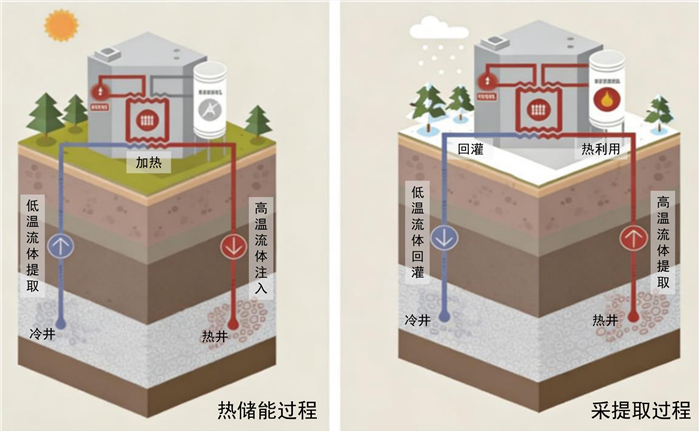
图 1 深部地热储能示意(黄永辉等,2020)
Fig. 1. Schematic diagrams of deep geothermal heat storage (Huang et al., 2020)
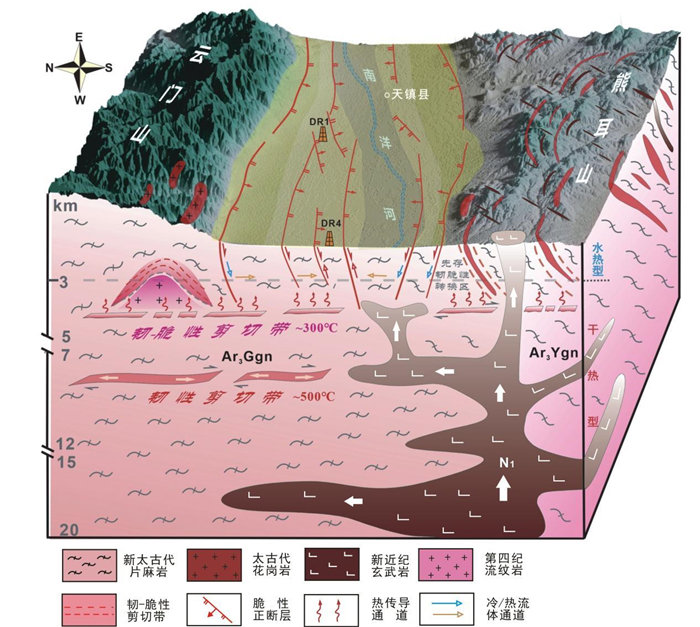
图 2 山西大同天镇“双热型”高温地热系统概念模型
Fig. 2. Conceptual model of the "dual-heat-source" high-temperature geothermal system in Tianzhen, Datong City, Shanxi Province
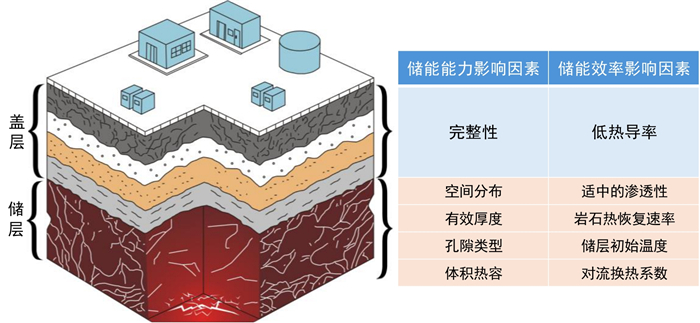
图 3 地热储能地质结构简图及储能能力、效率影响因素
Fig. 3. Simplified geological structure diagram for geothermal heat storage and factors affecting its storage capacity and efficiency
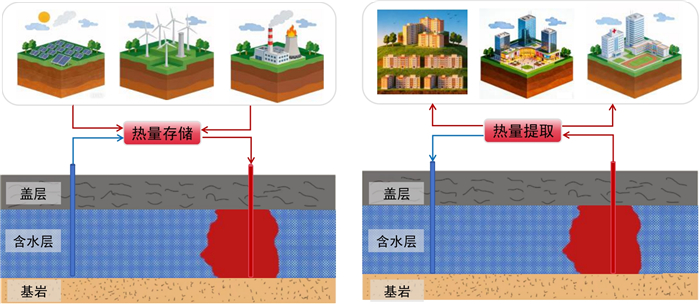
图 4 含水层储能系统示意(黄永辉等,2023;Geerts et al., 2025)
Fig. 4. Schematic diagrams of an aquifer thermal energy storage (ATES) system (from Huang et al., 2023; Geerts et al., 2025)
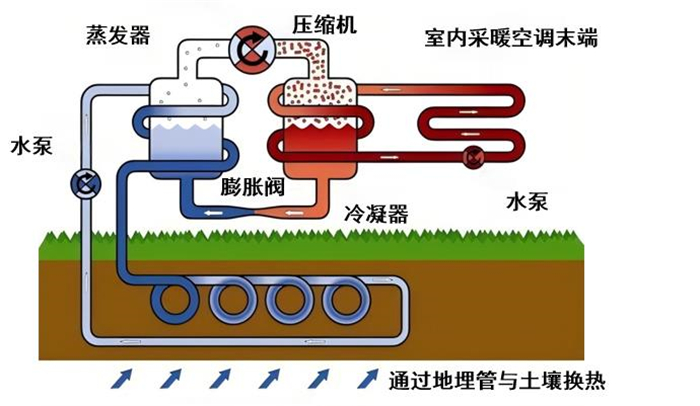
图 5 岩土储能系统示意(
https://wenku.baidu.com )Fig. 5. Schematic diagram of a borehole thermal energy storage (BTES) system(
https://wenku.baidu.com )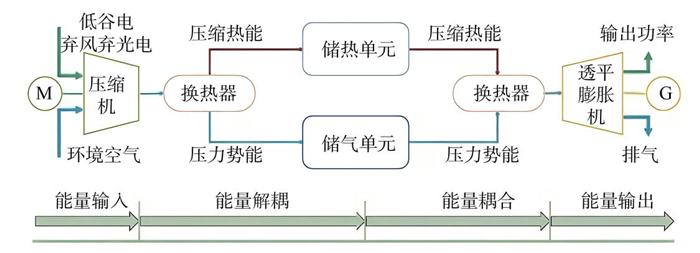
图 6 压缩空气储能系统示意(袁照威和杨易凡,2024)
Fig. 6. Schematic diagram of a compressed air energy storage (CAES) system (from Yuan and Yang, 2024)
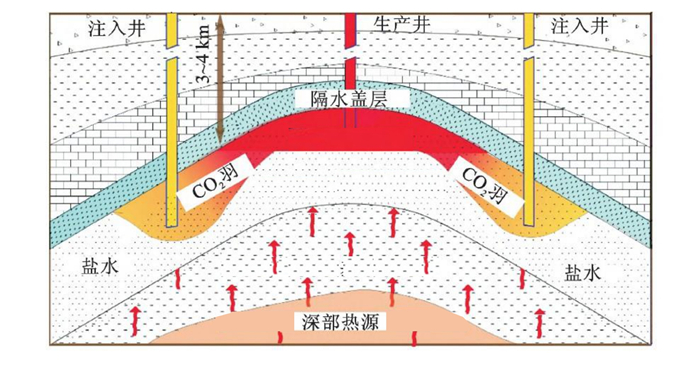
图 7 二氧化碳羽流储能示意(周倩等,2023)
Fig. 7. Schematic diagram of CO2 plume energy storage (from Zhou et al., 2023)
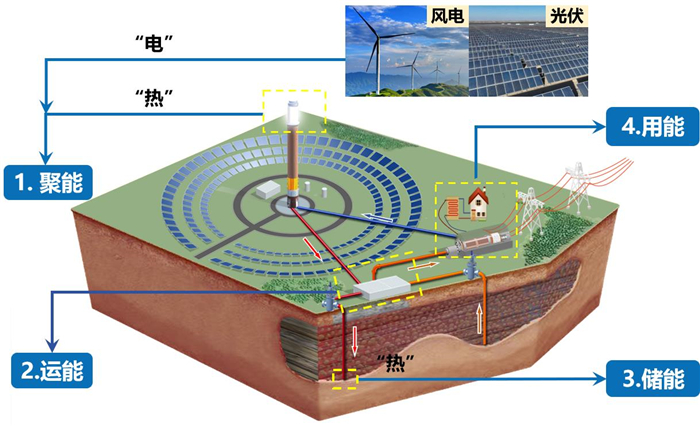
图 8 “地大方案”——地下超长时高温储能系统概念
Fig. 8. Conceptual diagram of the "CUG Solution": An underground ultra-long-duration high-temperature energy storage system
表 1 已有实际应用的各类储能技术原理、现状及优缺点对比
Table 1. Comparison of working principles, current status, and advantages and disadvantages of various energy storage technologies with practical applications
储能类型 原理 现状 优点 缺点 抽水蓄能 利用电力低谷时段将水抽至高位水库,高峰时段释放水流发电,实现能量存储与释放. 全球抽水蓄能电站装机容量约1.85亿kW,截至2025年底,我国抽水蓄能装机规模超过6 600万kW,连续10年位居世界首位. 技术最成熟、寿命长(50~100年)、效率稳定(75%~85%)、适合大规模调峰. 严格依赖地形(高差)、生态环境影响大、建设周期长达6~10年、投资门槛高. 压缩空气储能 压缩空气储存于地下洞穴,释能时加热膨胀驱动发电机发电. 截至2025年底,我国压缩空气储能累计装机规模约为163万kW.2025年1月,世界首座300 MW级压缩空气储能电站在湖北应城全容量并网,创单机功率、储能规模和转换效率三项世界纪录. 适合大规模(单机100~300 MW)、寿命长(30~50年)、安全性高、清洁. 依赖地质条件、效率虽提升但仍低于抽蓄(约50%)、建设周期长. 飞轮储能 电能驱动飞轮高速旋转,以动能形式储存能量,需能时通过发电机释放. 2025年山西浮山推进120 MW飞轮储能项目(含20 MW飞轮+100 MW锂电池),主要参与电网频率调节. 响应速度极快(毫秒级)、功率密度高、效率高(85%~95%)、无衰减循环. 能量密度低(储能时长通常仅数秒至15分钟)、自放电率高(每小时约1%~3%)、造价高. 锂离子电池 锂离子在正负极间迁移实现充放电,以磷酸铁锂(LFP)为主流路线. 截至2025年9月底,我国锂离子电池储能装机超过9 800万kW,占新型储能的96.1%. 能量密度高、响应快、产业链成熟、成本持续快速下降. 安全性(热失控)问题仍存在;日历寿命(10~15年)短于抽蓄/压缩空气;锂资源地缘风险. 液流电池 电解液在电堆中循环发生氧化还原反应,以全钒液流电池(VRB)为主. 截止2025年上半年,全球液流电池累计装机约6 GWh,仅占电化学储能总量的约2%.截至2025年9月底,我国液流电池储能装机达到115万kW,较“十三五”末增长约30倍. 安全性高、循环寿命极长(> 20年/20 000次)、容量与功率解耦(易扩展)、无衰减. 能量密度低(20~50 Wh/L)、初始投资仍较高(约锂电4倍)、钒电解液成本波动大. 钠离子电池 钠离子在电极间迁移,结构与锂离子电池类似. 2025年11月全球首个吉瓦时级钠电项目在中国达州投运,中国的钠电储能累计装机已突破1.8 GW,全球占比超过95%. 钠资源丰富且分布广泛、低温性能好(‒20 ℃容量保持率 > 80%)、与锂电产线兼容. 能量密度(100~160 Wh/kg)低于锂电、循环寿命(1 000~2 000次)仍需提升. 氢储能 电解水制氢储存,通过燃料电池或燃烧发电. 截止2025年底,全球氢储能装机容量已突破15 GW.而我国2025年可再生能源制氢产能超25万吨/年,实现翻番式增长. 可实现跨季节长时储能、能量密度极高(33.3 kWh/kg H2)、可与工业/交通耦合. 全流程效率低(30%~40%)、储运成本高(高压/液化)、基础设施尚不成熟. 超级电容器 利用双电层储存电荷,充放电速度快. 截至2025年7月,全球超级电容储能累计装机已突破1 GW,但在我国新型储能总装机中的占比极小(推算 < 0.5%). 循环寿命极长(> 50万次)、功率密度极高(10~15 kW/kg)、响应纳秒级. 能量密度低(5~10 Wh/kg)、成本远高于电池.  下载: 导出CSV
表 2 美国和德国含水层储能系统工程案例
Table 2. Engineering cases of aquifer thermal energy storage (ATES) systems in the United States and Germany
年份 地点/工程名称 当前状态 热源 注入温度(℃) 深度(m) 1976 Auburn University, Mobile/AL, USA 实验/已关闭 电厂余热 55 40~61 1982 University of Minnesota, St. Paul, USA 实验/已关闭 未知 115 180~240 1999 Reichstag Berlin, Germany 示范工程/正在运行 热电联供 70 300 2004 Neubrandenburg. Germany 正在运行 热电联供 75~80 1 250 2016 BMW. TUMunich. Germany 未知 垃圾处理余热 130 500~700 2017 Hamburg. Germany 正在运行 垃圾处理余热 80~90 400~500
下载: 导出CSV
-
Adams, B. M., Kuehn, T. H., Bielicki, J. M., et al., 2015. A Comparison of Electric Power Output of CO2 Plume Geothermal (CPG) and Brine Geothermal Systems for Varying Reservoir Conditions. Applied Energy, 140: 365-377. https://doi.org/10.1016/j.apenergy.2014.11.043 Allen, R. D., Doherty, T. J., Erikson, R. L., et al., 1983. Factors Affecting Storage of Compressed Air in Porous-Rock Reservoirs. Department of Energy Office of Scientific and Technical Information, United States. https://doi.org/10.2172/6270908 Bai, T., 2010. Research on Operation Characteristic of Ground Heat Exchanger for Ground Coupled Heat Pump System in Cold Climate (Dissertation). Harbin Institute of Technology, Harbin (in Chinese with English abstract). Brown, C. S., Doran, H., Kolo, I., et al., 2023. Investigating the Influence of Groundwater Flow and Charge Cycle Duration on Deep Borehole Heat Exchangers for Heat Extraction and Borehole Thermal Energy Storage. Energies, 16(6): 2677. https://doi.org/10.3390/en16062677 Bu, X. B., 2025. Medium-Deep Geothermal Energy Storage Synergistic CO2 Sequestration. Proceedings of the 7th Geothermal Youth Forum, Shanghai (in Chinese). Bu, X. B., Zhang, D. D., 2020. Performance Analysis, Countermeasures and Suggestions of Integrated Heating System Combined Medium-Deep Borehole Heat Exchanger with Heat Pump. Science & Technology for Development, 16(S1): 338-345 (in Chinese with English abstract). Chen, H., Cui, Y. H., Wang, H. M., et al., 2024. Advances in Mines Ecological Restoration and Carbon Sequestration Potential. Earth Science, 49(12): 4594-4607 (in Chinese with English abstract). https://doi.org/10.3799/dqkx.2024.081 Clauser, C., Huenges, E., 1995. Thermal Conductivity of Rocks and Minerals. Rock Physics & Phase Relations. American Geophysical Union, Washington, D. C., 105-126. https://doi.org/10.1029/rf003p0105 Deng, J. W., Peng, C. W., Su, Y. Y., et al., 2023. Research on the Heat Storage Characteristic of Deep Borehole Heat Exchangers under Intermittent Operation Mode: Simulation Analysis and Comparative Study. Energy, 282: 128938. https://doi.org/10.1016/j.energy.2023.128938 Dong, J. W., Li, Y., 2021. Study of the Site Evaluation of Compressed Air Energy Storage in Aquifers. Safety and Environmental Engineering, 28(3): 228-239 (in Chinese with English abstract). Doughty, C., 2007. Modeling Geologic Storage of Carbon Dioxide: Comparison of Non-Hysteretic and Hysteretic Characteristic Curves. Energy Conversion and Management, 48(6): 1768-1781. https://doi.org/10.1016/j.enconman.2007.01.022 Drijver, B., Van Aarssen, M., Zwart, B. D., 2012. High-Temperature Aquifer Thermal Energy Storage (HT-ATES): Sustainable and Multi-Usable. The 12th International Conference on Energy Storage, Lleida, Spain. Fu, L., Ma, X., Diao, Y. J., et al., 2022. Economic Analysis of Carbon Storage in CO2 Plume Geothermal System. Geology in China, 49(5): 1374-1384. (in Chinese with English abstract). Geerts, D., Daniilidis, A., Kramer, G. J., et al., 2025. Analytically Estimating the Efficiency of High Temperature Aquifer Thermal Energy Storage. Geothermal Energy, 13: 17. https://doi.org/10.1186/s40517-025-00343-8 Guo, C. B., Wang, Z. H., Liu, K., et al., 2019. The Application and Research Progress of Special Underground Space. Geology in China, 46(3): 482-492 (in Chinese with English abstract). Guo, F., Yang, X. D., Xu, L. Y., et al., 2017. A Central Solar-Industrial Waste Heat Heating System with Large Scale Borehole Thermal Storage. Procedia Engineering, 205: 1584-1591. https://doi.org/10.1016/j.proeng.2017.10.274 Guo, F., Zhu, X. Y., Zhang, J. Y., et al., 2020. Large-Scale Living Laboratory of Seasonal Borehole Thermal Energy Storage System for Urban District Heating. Applied Energy, 264: 114763. https://doi.org/10.1016/j.apenergy.2020.114763 Guo, Q. H., 2022. Definition of Magma-Impacted Geothermal System. Acta Geologica Sinica, 96(1): 208-214 (in Chinese with English abstract). doi: 10.1111/1755-6724.14801 Hou, Z. M., Wu, X. N., Luo, J. S., et al., 2024. Major Challenges of Deep Geothermal Systems and an Innovative Development Mode of REGS Integrated with Energy Storage. Coal Geology & Exploration, 52(1): 1-13 (in Chinese with English abstract). Huang, G. S., Liu, L., Mu, M. G., et al., 2023. Prediction of Dynamic Temperature and Thermal Front in a Multi-Aquifer Thermal Energy Storage System with Reinjection. Energies, 16(21): 7358. https://doi.org/10.3390/en16217358 Huang, L. C., Hou, Z. M., Fang, Y. L., et al., 2024. The Development, Frontier and Prospect of Large-Scale Underground Energy Storage: A Bibliometric Review. Journal of Energy Storage, 103: 114293. https://doi.org/10.1016/j.est.2024.114293 Huang, Y. H., Pang, Z. H., Cheng, Y. Z., et al., 2020. The Development and Outlook of the Deep Aquifer Thermal Energy Storage (Deep-ATES). Earth Science Frontiers, 27(1): 17-24 (in Chinese with English abstract). Huang, Y. H., Yang, J. S., Zhu, C. Q., et al., 2023. Numerical Modeling of the High-Temperature Thermal Energy Storage System in Deep Aquifers. Acta Geoscientica Sinica, 44(1): 239-247 (in Chinese with English abstract). Ingebritsen, S. E., Appold, M. S., 2012. The Physical Hydrogeology of Ore Deposits. Economic Geology, 107(4): 559-584. https://doi.org/10.2113/econgeo.107.4.559 Jeon, J. S., Lee, S. R., Pasquinelli, L., et al., 2015. Sensitivity Analysis of Recovery Efficiency in High-Temperature Aquifer Thermal Energy Storage with Single Well. Energy, 90: 1349-1359. https://doi.org/10.1016/j.energy.2015.06.079 Li, D. W., Wang, Y. X., 2015. Major Issues of Research and Development of Hot Dry Rock Geothermal Energy. Earth Science, 40(11): 1858-1869 (in Chinese with English abstract). Li, S., Wang, G. S., Zhou, M. M., et al., 2024a. Thermal Performance of an Aquifer Thermal Energy Storage System: Insights from Novel Multilateral Wells. Energy, 294: 130915. https://doi.org/10.1016/j.energy.2024.130915 Li, Y., Cui, J., Yu, H., et al., 2024b. The Impacts of Geothermal Gradients on Compressed Carbon Dioxide Energy Storage in Aquifers. Renewable Energy, 231: 120954. https://doi.org/10.1016/j.renene.2024.120954 Li, W., Li, X. G., Zhao, J., et al., 2009. Study on Heat Storage Characteristics of Soil and Simulation. Acta Energiae Solaris Sinica, 30(11): 1491-1495 (in Chinese with English abstract). Li, Y., Liu, Y. N., Hu, B., et al., 2020. Numerical Investigation of a Novel Approach to Coupling Compressed Air Energy Storage in Aquifers with Geothermal Energy. Applied Energy, 279: 115781. https://doi.org/10.1016/j.apenergy.2020.115781 Liu, X. L., Zhong, L. S., Wang, J. S., 2023. The Investigation on a Hot Dry Rock Compressed Air Energy Storage System. Energy Conversion and Management, 291: 117274. https://doi.org/10.1016/j.enconman.2023.117274 Lu, S. M., 2018. A Global Review of Enhanced Geothermal System (EGS). Renewable and Sustainable Energy Reviews, 81: 2902-2921. https://doi.org/10.1016/j.rser.2017.06.097 Lundh, M., Dalenbäck, J. O., 2008. Swedish Solar Heated Residential Area with Seasonal Storage in Rock: Initial Evaluation. Renewable Energy, 33(4): 703-711. https://doi.org/10.1016/j.renene.2007.03.024 Ma, X., Yang, G. D., Li, X. F., et al., 2019. Geochemical Modeling of Changes in Caprock Permeability Caused by CO2-Brine-Rock Interactions under the Diffusion Mechanism. Oil & Gas Science and Technology-Revue D'IFP Energies Nouvelles, 74: 83. https://doi.org/10.2516/ogst/2019055 Moeck, I. S., 2014. Catalog of Geothermal Play Types Based on Geologic Controls. Renewable and Sustainable Energy Reviews, 37: 867-882. https://doi.org/10.1016/j.rser.2014.05.032 Nilsson, E., Rohdin, P., 2019. Performance Evaluation of an Industrial Borehole Thermal Energy Storage (BTES) Project-Experiences from the First Seven Years of Operation. Renewable Energy, 143: 1022-1034. https://doi.org/10.1016/j.renene.2019.05.020 Qin, X. X., Zhao, Y. Z., Dai, C. J., et al., 2022. Thermal Performance Analysis on the Seasonal Heat Storage by Deep Borehole Heat Exchanger with the Extended Finite Line Source Model. Energies, 15(22): 8366. https://doi.org/10.3390/en15228366 Rad, F. M., Fung, A. S., 2016. Solar Community Heating and Cooling System with Borehole Thermal Energy Storage-Review of Systems. Renewable and Sustainable Energy Reviews, 60: 1550-1561. https://doi.org/10.1016/j.rser.2016.03.025 Rui, Z. H., Liu, Y. L., Zhang, Z., et al., 2024. Research Progress and Prospect of Geothermal Energy Storage Technology. Petroleum Science Bulletin, 9(2): 260-281 (in Chinese with English abstract). Rutqvist, J., 2012. The Geomechanics of CO2 Storage in Deep Sedimentary Formations. Geotechnical and Geological Engineering, 30(3): 525-551. https://doi.org/10.1007/s10706-011-9491-0 Sibbitt, B., McClenahan, D., Djebbar, R., et al., 2012. The Performance of a High Solar Fraction Seasonal Storage District Heating System-Five Years of Operation. Energy Procedia, 30: 856-865. https://doi.org/10.1016/j.egypro.2012.11.097 Stottlemyre, J. A., 1978. Preliminary Stability Criteria for Compressed Air Energy Storage in Porous Media Reservoirs. Pacific Northwest Laboratory, Department of Energy, United States. https://doi.org/10.2172/6648903 Succar, S., Williams, R. H., 2008. Compressed Air Energy Storage: Theory, Resources, and Applications for Wind Power. Princeton Environmental Institute, Carbon Mitigation Initiative, Princeton University, Princeton. Tang, D., Li, Y., Liu, Y. J., et al., 2024. Factors Affecting Compressed Carbon Dioxide Energy Storage System in Deep Aquifers. Bulletin of Engineering Geology and the Environment, 83(10): 407. https://doi.org/10.1007/s10064-024-03887-4 Tas, L., Hartog, N., Bloemendal, M., et al., 2025. Efficiency and Heat Transport Processes of Low-Temperature Aquifer Thermal Energy Storage Systems: New Insights from Global Sensitivity Analyses. Geothermal Energy, 13: 2. https://doi.org/10.1186/s40517-024-00326-1 Tzoufka, K., Blöcher, G., Cacace, M., et al., 2024. Physics-Based Numerical Evaluation of High-Temperature Aquifer Thermal Energy Storage (HT-ATES) in the Upper Jurassic Reservoir of the German Molasse Basin. Advances in Geosciences, 65: 103-111. https://doi.org/10.5194/adgeo-65-103-2024 van Lopik, J. H., Hartog, N., Zaadnoordijk, W. J., 2016. The Use of Salinity Contrast for Density Difference Compensation to Improve the Thermal Recovery Efficiency in High-Temperature Aquifer Thermal Energy Storage Systems. Hydrogeology Journal, 24(5): 1255-1271. https://doi.org/10.1007/s10040-016-1366-2 Wang, G. L., Yue, G. F., Lin, W. J., et al., 2024. Deep Carbonate Geohermal Reservoir Production Enhancement Technology in North China Plain. Earth Science, 49(4): 1470-1486 (in Chinese with English abstract). https://doi.org/10.3799/dqkx.2022.449 Wang, Y., Zhang, F. S., 2025. Operation Optimization for Aquifer Thermal Energy Storage (ATES) Systems Based on a Surrogate Model-Assisted Method. Applied Thermal Engineering, 268: 125907. https://doi.org/10.1016/j.applthermaleng.2025.125907 Wang, Y. X., Jiang, S., Hu, F., et al., 2026. Orthogonal Experimental Optimization and Economic Evaluation of a Coupled Multi-Parameter Simulation for a Concentrating Solar-Geothermal Energy Storage System. Bulletin of Geological Science and Technology, 45(3): 1-15 (in Chinese with English abstract). Wang, Y. M., Chen, W., Bu, X. B., 2025. Quantitative Analysis of Influential Factors of Formation Heat Losses in High-Temperature Aquifer Thermal Energy Storage System. Chemical Industry and Engineering Progress, 44(10): 5717-5729 (in Chinese with English abstract). Wei, M. C., Yang, B., Xu, T. F., et al., 2015. Effects of Well Spacing and Reservior Permeability on Heat Extraction in CO2 Plume Geothermal System: A Case Study of Songliao Basin. Geological Science and Technology Information, 34(2): 188-193 (in Chinese with English abstract). Winterleitner, G., Schütz, F., Wenzlaff, C., et al., 2018. The Impact of Reservoir Heterogeneities on High-Temperature Aquifer Thermal Energy Storage Systems. a Case Study from Northern Oman. Geothermics, 74: 150-162. https://doi.org/10.1016/j.geothermics.2018.02.005 Wołoszyn, J., 2018. Global Sensitivity Analysis of Borehole Thermal Energy Storage Efficiency on the Heat Exchanger Arrangement. Energy Conversion and Management, 166: 106-119. https://doi.org/10.1016/j.enconman.2018.04.009 Wołoszyn, J., 2020. Global Sensitivity Analysis of Borehole Thermal Energy Storage Efficiency for Seventeen Material, Design and Operating Parameters. Renewable Energy, 157: 545-559. https://doi.org/10.1016/j.renene.2020.05.047 Wołoszyn, J., Gołaś, A., 2014. Sensitivity Analysis of Efficiency Thermal Energy Storage on Selected Rock Mass and Grout Parameters Using Design of Experiment Method. Energy Conversion and Management, 87: 1297-1304. https://doi.org/10.1016/j.enconman.2014.03.059 Xu, L. Y., Torrens, J. I., Guo, F., et al., 2018. Application of Large Underground Seasonal Thermal Energy Storage in District Heating System: A Model-Based Energy Performance Assessment of a Pilot System in Chifeng, China. Applied Thermal Engineering, 137: 319-328. https://doi.org/10.1016/j.applthermaleng.2018.03.047 Yan, L. J., Zhang, X., 2015. Research on Heat Storage Characteristics of Ground Heat Exchanger Based on Thermal Influencing Radius. Chinese Journal of Refrigeration Technology, 35(1): 1-5, 10 (in Chinese with English abstract). Yang, C. H., Wang, T. T., 2022. Advance in Deep Underground Energy Storage. Chinese Journal of Rock Mechanics and Engineering, 41(9): 1729-1759 (in Chinese with English abstract). Yang, Z. J., Shi, Y., Peng, J. L., et al., 2024. Advances in Theory and Technology of Heat Extraction and Energy Storage Utilization in CO2 Geological Storage Processes. Journal of Chengdu University of Technology (Science & Technology Edition), 51(6): 913-926 (in Chinese with English abstract). Yuan, Z. W., Yang, Y. F., 2024. Research Status and Development Trend of Compressed Air Energy Storage Technology. Southern Energy Construction, 11(2): 146-153 (in Chinese with English abstract). Zhang, Y. Y., Ye, C. T., Kong, Y. L., et al., 2023. Thermal Attenuation and Heat Supplementary Analysis of Medium-Deep Coaxial Borehole System-Based on a Practical Project. Energy, 270: 126805. https://doi.org/10.1016/j.energy.2023.126805 Zhao, Y. Z., Pang, Z. H., Huang, Y. H., et al., 2021. Correction to: An Efficient Hybrid Model for Thermal Analysis of Deep Borehole Heat Exchangers. Geothermal Energy, 9: 7. https://doi.org/10.1186/s40517-021-00191-2 Zhou, D. J., Li, K., Gao, H. H., et al., 2024. CO2 High-Temperature Aquifer Thermal Energy Storage (CO2 HT-ATES) Feasible Study: Combing the Heating Storage and CCUS. Gas Science and Engineering, 122: 205224. https://doi.org/10.1016/j.jgsce.2024.205224 Zhou, D. J., Li, K., Gao, H. H., et al., 2026. Injection Strategy Analysis of High-Temperature Aquifer Thermal Energy Storage System, an Insight from the Study Case in Burgwedel, Germany. Renewable Energy, 256: 124722. https://doi.org/10.1016/j.renene.2025.124722 Zhou, Q., Wang, F. Q., Zou, L. F., et al., 2023. Research Progress on Geothermal Exploitation of CO2 Plume Geothermal Systems. Resources Environment & Engineering, 37(5): 530-536 (in Chinese with English abstract). 白天, 2010. 严寒地区土壤源热泵系统地埋管运行特性研究. 哈尔滨: 哈尔滨工业大学. 卜宪标, 2025. 中深层水热型地热储能协同CO2封存. 上海: 第七届地热青年论坛. 卜宪标, 张冬冬, 2020. 中深层井下换热器联合热泵供暖系统性能提高技术途径分析. 科技促进发展, 16(S1): 338-345. 陈珲, 崔一涵, 汪海明, 等, 2024. 矿山生态修复及其固碳潜力研究进展. 地球科学, 49(12): 4594-4607. doi: 10.3799/dqkx.2024.081 董家伟, 李毅, 2021. 含水层压缩空气储能选址评价方法研究. 安全与环境工程, 28(3): 228-239. 付雷, 马鑫, 刁玉杰, 等, 2022. 二氧化碳羽流地热系统的碳封存经济分析. 中国地质, 49(5): 1374-1384. 郭朝斌, 王志辉, 刘凯, 等, 2019. 特殊地下空间应用与研究现状. 中国地质, 46(3): 482-492. 郭清海, 2022. 岩浆热源型地热系统释义. 地质学报, 96(1): 208-214. 侯正猛, 吴旭宁, 罗佳顺, 等, 2024. 深部地热能系统主要挑战与耦合储能的增强型创新开发模式. 煤田地质与勘探, 52(1): 1-13. 黄永辉, 庞忠和, 程远志, 等, 2020. 深层含水层地下储热技术的发展现状与展望. 地学前缘, 27(1): 17-24. 黄永辉, 杨俊生, 朱传庆, 等, 2023. 深部含水层储热系统的数值模拟研究. 地球学报, 44(1): 239-247. 李德威, 王焰新, 2015. 干热岩地热能研究与开发的若干重大问题. 地球科学, 40(11): 1858-1869. doi: 10.3799/dqkx.2015.166 李伟, 李新国, 赵军, 等, 2009. 土壤蓄热特性与模拟研究. 太阳能学报, 30(11): 1491-1495. 芮振华, 刘月亮, 张政, 等, 2024. 地热储能技术研究进展及未来展望. 石油科学通报, 9(2): 260-281. 王贵玲, 岳高凡, 蔺文静, 等, 2024. 华北平原典型深部碳酸盐岩热储增产改造技术. 地球科学, 49(4): 1470-1486. doi: 10.3799/dqkx.2022.449 王焰新, 蒋恕, 胡帆, 等, 2026. 聚光太阳能-地热储能系统多参数耦合仿真的正交试验优化与经济性评估. 地质科技通报, 45(3): 1-15. 王一鸣, 陈伟, 卜宪标, 2025. 高温含水层储热系统地层热损失影响因素量化分析. 化工进展, 44(10): 5717-5729. 魏铭聪, 杨冰, 许天福, 等, 2015. 二氧化碳羽流地热系统中井间距和储层渗透率对热提取率的影响: 以松辽盆地为例. 地质科技情报, 34(2): 188-193. 闫俐君, 张旭, 2015. 基于热作用半径的地埋管换热器储热特性研究. 制冷技术, 35(1): 1-5, 10. 杨春和, 王同涛, 2022. 深地储能研究进展. 岩石力学与工程学报, 41(9): 1729-1759. 杨子江, 石宇, 彭俊岚, 等, 2024. CO2地质封存过程的取热‒储能利用理论与技术进展. 成都理工大学学报(自然科学版), 51(6): 913-926. 袁照威, 杨易凡, 2024. 压缩空气储能技术研究现状及发展趋势. 南方能源建设, 11(2): 146-153. 周倩, 王富强, 邹立帆, 等, 2023. CO2羽流地热系统开采特性研究进展及展望. 资源环境与工程, 37(5): 530-536. -

 点击查看大图
计量
- 文章访问数: 600
- HTML全文浏览量: 22
- PDF下载量: 58
- 被引次数: 0
